
These go beyond Exercise 3.1 into genuine HOTS (Higher Order Thinking Skills) territory — boat/stream speed problems, age problems solved via two equations, and a parameter-based consistency question. See the standard-level Exercise 3.1 Solutions first if you haven’t already. These Class 10 Mathematics Chapter 3 important questions are handy for last-minute exam practice.
Last Updated: October 24, 2026
How to Approach the HOTS Questions in This Chapter
HOTS questions on this chapter often embed the pair of equations inside a real-world scenario that includes extra, irrelevant information — practice identifying exactly which two quantities to assign as variables before writing any equation, rather than jumping straight into algebra.
Extra Questions (HOTS Level): Pair of Linear Equations in Two Variables (Class 10 Maths Chapter 3)
Q1. A boat goes 30 km upstream and 44 km downstream in 10 hours. In 13 hours, it can go 40 km upstream and 55 km downstream. Find the speed of the boat in still water and the speed of the stream.
Let boat speed = x km/h, stream speed = y km/h. Upstream speed = (x−y), downstream speed = (x+y).
30/(x−y) + 44/(x+y) = 10 and 40/(x−y) + 55/(x+y) = 13.
Let u = 1/(x−y), v = 1/(x+y): 30u + 44v = 10 and 40u + 55v = 13. Multiplying the first by 4 and second by 3: 120u + 176v = 40 and 120u + 165v = 39. Subtracting: 11v = 1, so v = 1/11. Substituting back: 30u + 4 = 10, so u = 1/5.
So x−y = 5 and x+y = 11. Adding: 2x = 16, x = 8; then y = 3.
Boat speed = 8 km/h, Stream speed = 3 km/h.
Q2. Five years hence, a father’s age will be three times his son’s age. Five years ago, the father was seven times as old as his son. Find their present ages.
Let father’s present age = x, son’s present age = y.
(x+5) = 3(y+5) → x = 3y + 10
(x−5) = 7(y−5) → x = 7y − 30
Equating: 3y + 10 = 7y − 30 → 40 = 4y → y = 10, so x = 40.
Check: 5 years hence, 45 = 3×15 ✓. 5 years ago, 35 = 7×5 ✓.
Father = 40 years, Son = 10 years.
Q3. For what value of k will the pair of equations kx + 3y = k − 3 and 12x + ky = k have infinitely many solutions?
Writing both as ax + by − c = 0: kx + 3y − (k−3) = 0 and 12x + ky − k = 0.
For infinitely many solutions: k/12 = 3/k = (k−3)/k.
From k/12 = 3/k: k² = 36, so k = 6 or k = −6.
Testing k = 6: 6/12 = 1/2 and (6−3)/6 = 1/2 — matches.
Testing k = −6: −6/12 = −1/2 but (−6−3)/−6 = 3/2 — does not match.
k = 6.
Q4. Assertion (A): The pair of equations x + 2y − 4 = 0 and 2x + 4y − 12 = 0 has no solution. Reason (R): Two lines are parallel if a₁/a₂ = b₁/b₂ ≠ c₁/c₂. Which is correct?
a₁/a₂ = 1/2, b₁/b₂ = 2/4 = 1/2, c₁/c₂ (writing as x+2y−4=0 and 2x+4y−12=0) = 4/12 = 1/3. Since a₁/a₂ = b₁/b₂ ≠ c₁/c₂, the lines are parallel, so the system has no solution — Assertion is true.
The Reason correctly states the parallel-lines condition and correctly explains the Assertion.
Both A and R are true, and R is the correct explanation of A.
Q5. The sum of a two-digit number and the number obtained by reversing its digits is 66. If the digits differ by 2, find the number(s). How many such numbers are there?
Let the ten’s digit = x, unit’s digit = y. Number = 10x+y, reversed number = 10y+x.
(10x+y) + (10y+x) = 66 → 11x + 11y = 66 → x + y = 6.
Digits differ by 2, so x−y = 2 or y−x = 2.
Case 1: x+y=6, x−y=2 → x=4, y=2 → number = 42.
Case 2: x+y=6, y−x=2 → x=2, y=4 → number = 24.
Two such numbers exist: 42 and 24.
Q6. A fraction becomes 1/3 when 1 is subtracted from the numerator, and becomes 1/4 when 8 is added to the denominator. Find the fraction.
Let the fraction = x/y.
(x−1)/y = 1/3 → 3(x−1) = y → y = 3x − 3
x/(y+8) = 1/4 → 4x = y+8 → y = 4x − 8
Equating: 3x−3 = 4x−8 → x = 5, then y = 3(5)−3 = 12.
Check: (5−1)/12 = 4/12 = 1/3 ✓. 5/(12+8) = 5/20 = 1/4 ✓.
Fraction = 5/12.
How These Differ From Exercise 3.1
Exercise 3.1 focuses on forming and graphing simple linear pairs and checking consistency using the ratio test. These HOTS questions require you to first recognise which variables to define (often a reciprocal substitution for speed/time problems, as in Q1), and combine that with the same elimination technique — exactly the kind of two-step reasoning the CBSE board favours for 4-5 mark questions.
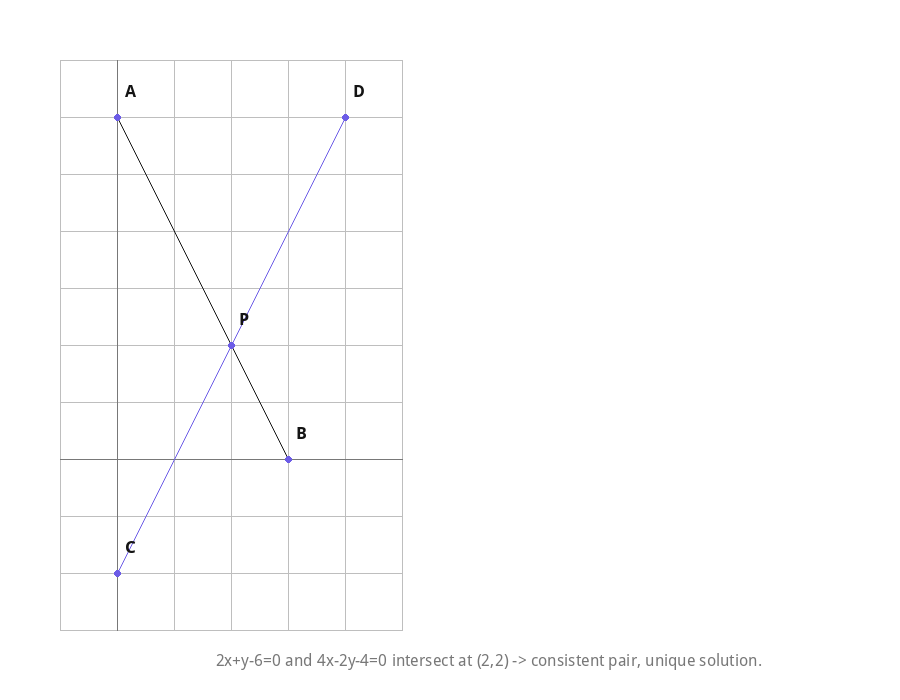
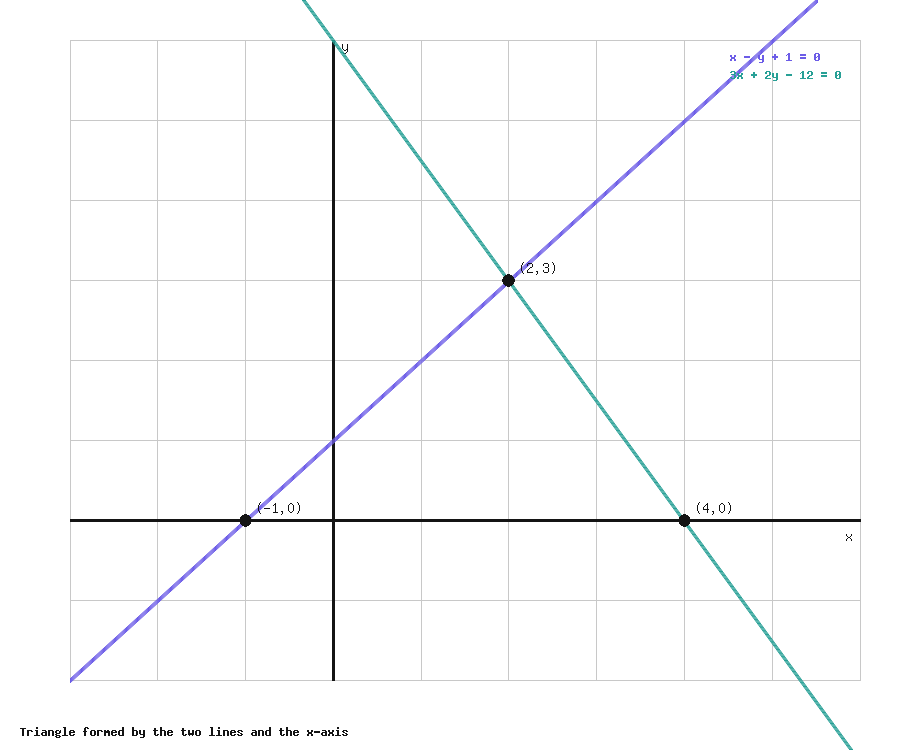
Quick visual: a worked diagram from the full Solutions page, for reference.
- Chapter 1: Real Numbers
- Chapter 2: Extra Questions - Polynomials (HOTS)
- Chapter 4: Quadratic Equations
- Chapter 5: Arithmetic Progressions
- Chapter 6: Triangles
- Chapter 7: Coordinate Geometry
- Chapter 8: – Introduction to Trigonometry
- Chapter 9: Extra Questions - Some Applications of Trigonometry (HOTS)
- Chapter 10: Extra Questions - Circles (HOTS)
- Chapter 11: Areas Related to Circles Extra Questions (HOTS)
- Chapter 12: Surface Areas and Volumes Extra Questions (HOTS)
- Chapter 13: Statistics Extra Questions (HOTS)
- Chapter 14: Probability Extra Questions (HOTS)
Frequently Asked Questions
What does it mean if a pair of linear equations has no solution?
A pair of linear equations has no solution when the lines they represent are parallel and never intersect, which happens when the ratio of the coefficients of x and y is the same for both equations but the ratio of constants is different.
How can you quickly determine whether a pair of linear equations has a unique solution, no solution, or infinitely many solutions?
By comparing the ratios of the coefficients of x, y, and the constants: unequal x/y ratios give a unique solution, equal ratios of all three give infinitely many solutions, and equal x/y ratios with an unequal constant ratio give no solution.
Chapter Quiz — Test Your Understanding
Class 10 Mathematics Chapter 3 – Solutions and Notes
For complete step-by-step answers and a quick summary, check the Class 10 Mathematics Chapter 3 Solutions and Class 10 Mathematics Chapter 3 Revision Notes.
Recommended: Buy the Printed NCERT Class 10 Maths Book
Contains Amazon affiliate links.
If you’d like a printed copy alongside the PDF, here’s a verified option:
Check the latest price on Amazon
Price and availability may change on Amazon. As an Amazon Associate, ncertbooks.org earns from qualifying purchases.



Pingback: NCERT Solutions Class 10 Maths Chapter 3 Pair of Linear Equations