
Chapter 3 — Pair of Linear Equations in Two Variables is one of the highest-yield chapters in the current 2026-27 CBSE Class 10 Maths syllabus. Below are complete, step-by-step solutions for Exercise 3.1, covering forming equations from word problems, solving graphically, and checking consistency using the ratio test.
Last Updated: October 24, 2026
How to Approach This Chapter
For word problems, write out in words what each variable represents before forming the equations — most errors here come from translating the problem incorrectly, not from solving the resulting equations. Once you have two equations, elimination is usually faster than substitution unless one equation already isolates a variable.
NCERT Solutions for Class 10 Maths Chapter 3: Pair of Linear Equations in Two Variables (Exercise 3.1)
Q1(i). Form the pair of linear equations: 10 students of Class X took part in a Mathematics quiz. If the number of girls is 4 more than the number of boys, find the number of boys and girls.
Let the number of boys = x and girls = y.
x + y = 10
y = x + 4
Solving graphically (or by substitution): substituting y = x + 4 into the first equation gives x + (x+4) = 10, so 2x = 6, x = 3, y = 7. The two lines intersect at (3, 7).
Boys = 3, Girls = 7.
Q1(ii). 5 pencils and 7 pens together cost ₹50, whereas 7 pencils and 5 pens together cost ₹46. Find the cost of one pencil and one pen.
Let cost of a pencil = ₹x, cost of a pen = ₹y.
5x + 7y = 50
7x + 5y = 46
Multiply the first equation by 7 and the second by 5: 35x + 49y = 350 and 35x + 25y = 230. Subtracting: 24y = 120, so y = 5. Substituting back: 5x + 35 = 50, so x = 3.
Pencil = ₹3, Pen = ₹5.
Q2. On comparing the ratios a₁/a₂, b₁/b₂ and c₁/c₂, find out whether the following pairs of lines are intersecting, parallel or coincident:
(i) 5x − 4y + 8 = 0 and 7x + 6y − 9 = 0
a₁/a₂ = 5/7, b₁/b₂ = −4/6 = −2/3. Since a₁/a₂ ≠ b₁/b₂, the lines are intersecting (unique solution).
(ii) 9x + 3y + 12 = 0 and 18x + 6y + 24 = 0
a₁/a₂ = 9/18 = 1/2, b₁/b₂ = 3/6 = 1/2, c₁/c₂ = 12/24 = 1/2. All three ratios are equal, so the lines are coincident (infinitely many solutions).
(iii) 6x − 3y + 10 = 0 and 2x − y + 9 = 0
a₁/a₂ = 6/2 = 3, b₁/b₂ = −3/−1 = 3, c₁/c₂ = 10/9. Since a₁/a₂ = b₁/b₂ ≠ c₁/c₂, the lines are parallel (no solution).
Q3. Check whether the following pairs of linear equations are consistent or inconsistent:
(i) 3x + 2y = 5; 2x − 3y = 7 — a₁/a₂ = 3/2, b₁/b₂ = 2/−3. Not equal → consistent, unique solution.
(ii) 2x − 3y = 8; 4x − 6y = 9 — a₁/a₂ = 1/2, b₁/b₂ = 1/2, c₁/c₂ = 8/9. a₁/a₂ = b₁/b₂ ≠ c₁/c₂ → inconsistent, no solution.
(iii) 3/2 x + 5/3 y = 7; 9x − 10y = 14 — a₁/a₂ = 1/6, b₁/b₂ = −1/6. Not equal → consistent, unique solution.
(iv) 5x − 3y = 11; −10x + 6y = −22 — all three ratios equal −1/2 → consistent, infinitely many solutions (coincident lines).
(v) 4/3 x + 2y = 8; 2x + 3y = 12 — all three ratios equal 2/3 → consistent, infinitely many solutions (coincident lines).
Q4. Which of the following pairs of linear equations are consistent/inconsistent? If consistent, obtain the solution graphically:
(i) x + y = 5; 2x + 2y = 10 — coincident lines, consistent, infinitely many solutions.
(ii) x − y = 8; 3x − 3y = 16 — parallel lines, inconsistent, no solution.
(iii) 2x + y − 6 = 0; 4x − 2y − 4 = 0 — ratios unequal, consistent. From equation 1, y = 6 − 2x. Substituting into equation 2: 4x − 2(6−2x) − 4 = 0 → 8x − 16 = 0 → x = 2, y = 2. Solution: (2, 2).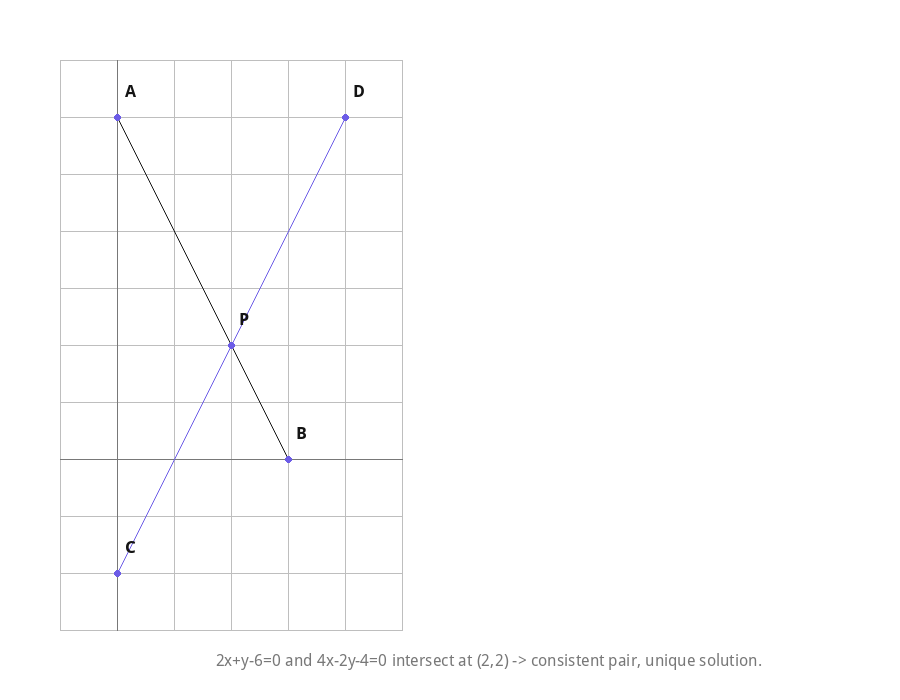
(iv) 2x − 2y − 2 = 0; 4x − 4y − 5 = 0 — a₁/a₂ = b₁/b₂ = 1/2 but c₁/c₂ = 2/5. Inconsistent, no solution.
Q5. Half the perimeter of a rectangular garden, whose length is 4 m more than its width, is 36 m. Find the dimensions.
Let width = x, length = y = x + 4. Half the perimeter = x + y = 36. Substituting: x + (x+4) = 36 → 2x = 32 → x = 16, y = 20.
Width = 16 m, Length = 20 m.
Q6. Given the linear equation 2x + 3y − 8 = 0, write another linear equation such that the pair formed is (i) intersecting (ii) parallel (iii) coincident.
(i) Any equation with a different a/b ratio, e.g. 3x + 2y − 7 = 0 (intersecting lines).
(ii) Same a/b ratio, different c ratio, e.g. 6x + 9y + 7 = 0 (a₁/a₂ = b₁/b₂ = 1/3, c ratio different — parallel).
(iii) All ratios equal, e.g. 4x + 6y − 16 = 0 (exactly double the original — coincident).
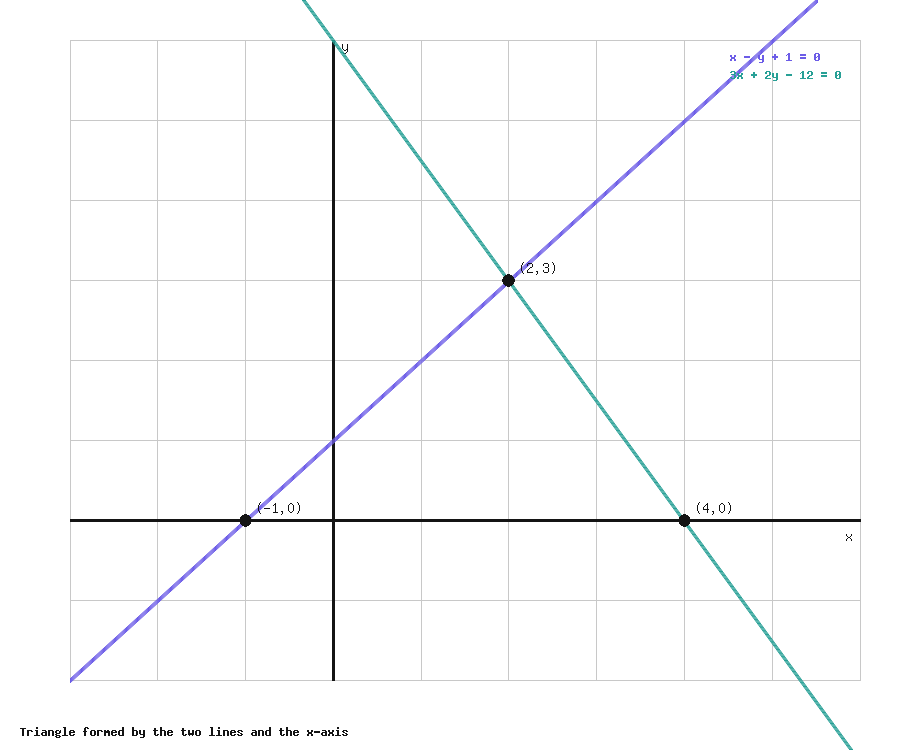
Graphing both lines shows they intersect at (2,3), and meet the x-axis at (-1,0) and (4,0) respectively.
Q7. Draw the graphs of x − y + 1 = 0 and 3x + 2y − 12 = 0. Find the vertices of the triangle formed by these lines and the x-axis.
Line 1 (x − y + 1 = 0) meets the x-axis at (−1, 0). Line 2 (3x + 2y − 12 = 0) meets the x-axis at (4, 0). Solving the two lines together: from line 1, y = x + 1; substituting into line 2: 3x + 2(x+1) − 12 = 0 → 5x − 10 = 0 → x = 2, y = 3.
Triangle vertices: (−1, 0), (4, 0) and (2, 3).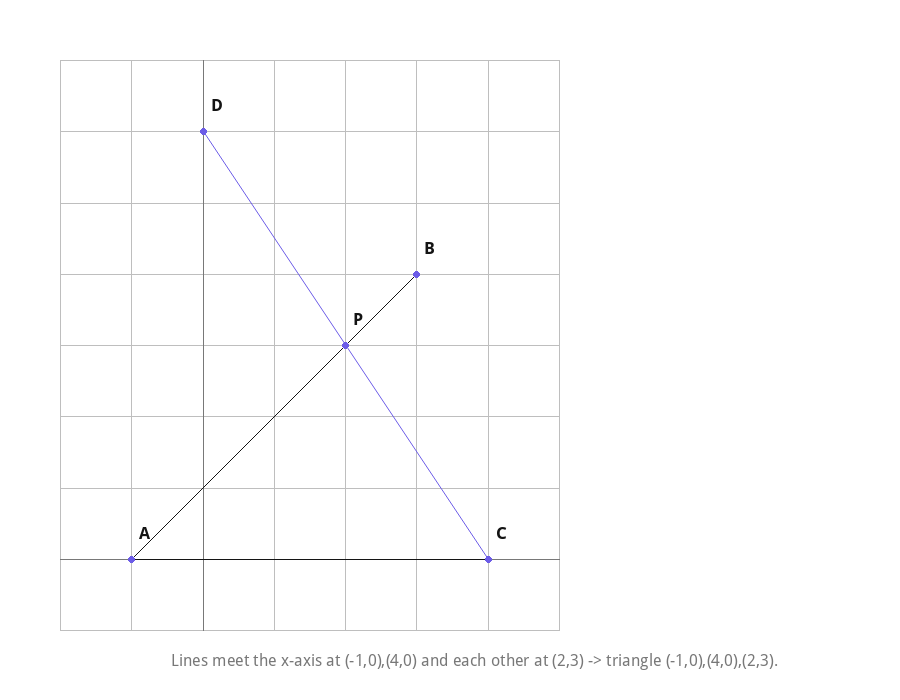
Why This Chapter Matters
Pair of Linear Equations in Two Variables is one of the most exam-heavy chapters in Class 10 Maths — it routinely contributes 6–8 marks across the CBSE board paper through a mix of short-answer consistency questions and long-answer word problems (ages, fractions, speed/distance), and the substitution/elimination techniques from the later exercises of this chapter are used constantly in Class 11 and 12 algebra and coordinate geometry.
CBSE Exam Weightage
This chapter falls under Unit II: Algebra in the CBSE Class 10 Maths board exam syllabus. This unit typically carries around 20 marks (25%) of the 80-mark theory paper, based on CBSE’s published unit-wise weightage (Question Paper Design). CBSE sets weightage at the unit level rather than chapter-by-chapter, so the exact share from this specific chapter can vary a little between years and sample papers.
How to Use These Solutions
Attempt each part yourself on paper before checking — the ratio test (a₁/a₂ vs b₁/b₂ vs c₁/c₂) in Q2–Q4 is worth memorising cold, since it appears as a standalone 1-2 mark question almost every year. You can download the full chapter directly from our Class 10 Maths NCERT book page, or browse every Class 10 subject on our Class 10 hub.
Want harder practice or a fast recap? See Extra Questions for Pair of Linear Equations, our Revision Notes summary, or the Class 10 Maths Formulas Handbook.
Class 10 Mathematics Chapter 3 – Notes and Extra Questions
Along with these NCERT Solutions, students can also use the Class 10 Mathematics Chapter 3 Extra Questions and Class 10 Mathematics Chapter 3 Revision Notes for quick revision and extra practice.

Pingback: Extra Questions: Class 10 Maths Ch 3 Pair of Linear Equations (HOTS)
Pingback: Revision Notes: Class 10 Maths Ch 3 Pair of Linear Equations
Pingback: Class 10 Maths Chapter 3 Extra Questions HOTS - Pair of Linear Equations