
Chapter 12, Surface Areas and Volumes, is one of the highest-weightage chapters in the Class 10 Maths board exam. It combines mensuration formulas from earlier classes (cubes, cuboids, cylinders, cones, spheres, hemispheres) into problems on combinations of solids — a favourite source of 3-5 mark board questions. Getting comfortable with visualising which surfaces are “hidden” when two solids are joined is the single most important skill this chapter teaches, and it carries directly into similar problems in competitive exams like NTSE and Olympiads.
Last Updated: October 24, 2026
How to Approach This Chapter
For combined-solid problems, sketch the solid first and mark exactly which faces are shared (and therefore excluded) before writing the surface-area expression — most errors come from including a face that’s actually hidden inside the combined shape. For melting-and-recasting problems, always equate volumes, not surface areas, since volume is what’s conserved.
As per the current 2026-27 rationalised NCERT syllabus, this chapter has two exercises — 12.1 (Surface Area of a Combination of Solids) and 12.2 (Volume of a Combination of Solids) — 17 questions in total. Some older solution sites online still show a third exercise, 12.3, on converting one solid into another; that exercise was removed in the 2023 rationalisation, so ignore any “12.3” content you find elsewhere — it does not exist in the current book.
Exercise 12.1 — Surface Areas of Combination of Solids (use π = 22/7 unless stated)
Q1. Two cubes, each of volume 64 cm³, are joined end to end. Find the surface area of the resulting cuboid.
Solution: Side of each cube, a³ = 64 ⟹ a = 4 cm. Joining two cubes end to end gives a cuboid of dimensions 8 cm × 4 cm × 4 cm.
Surface area = 2(lb + bh + hl) = 2(8×4 + 4×4 + 4×8) = 2(32+16+32) = 2×80 = 160 cm².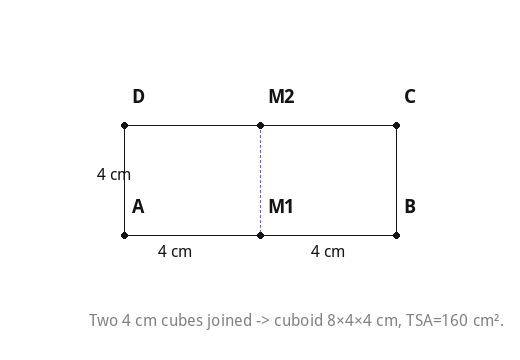
Q2. A vessel is a hollow hemisphere mounted by a hollow cylinder. The diameter of the hemisphere is 14 cm and the total height of the vessel is 13 cm. Find the inner surface area of the vessel.
Solution: r = 7 cm. Height of cylindrical part = 13 − 7 = 6 cm.
Inner surface area = 2πrh + 2πr² = 2πr(h + r) = 2×(22/7)×7×(6+7) = 2×22×13 = 572 cm².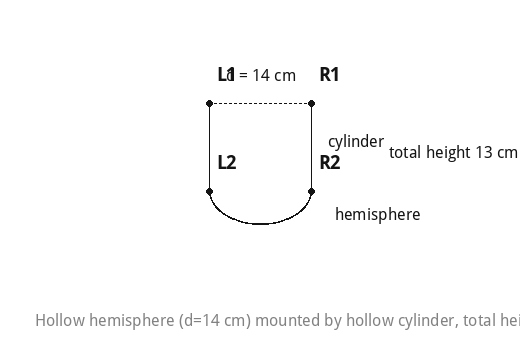
Q3. A toy is a cone of radius 3.5 cm mounted on a hemisphere of the same radius. Total height of the toy is 15.5 cm. Find its total surface area.
Solution: r = 3.5 cm, height of cone h = 15.5 − 3.5 = 12 cm. Slant height l = √(r²+h²) = √(12.25+144) = √156.25 = 12.5 cm.
TSA = πrl + 2πr² = πr(l + 2r) = (22/7)×3.5×(12.5+7) = 11×19.5 = 214.5 cm².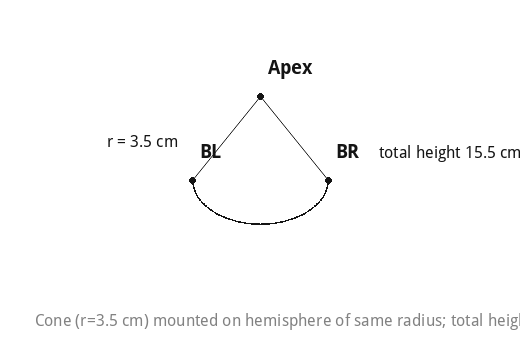
Q4. A cubical block of side 7 cm is surmounted by a hemisphere. What is the greatest diameter the hemisphere can have, and what is the surface area of the solid?
Solution: Greatest possible diameter = side of cube = 7 cm ⟹ r = 3.5 cm.
Surface area = (surface area of cube) − (base circle of hemisphere) + (curved surface of hemisphere) = 6×7² + πr² (since −πr²+2πr² = πr²) = 294 + (22/7×3.5×3.5) = 294 + 38.5 = 332.5 cm².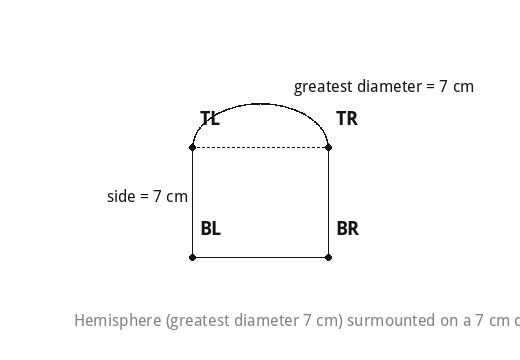
Q5. A hemispherical depression is cut from one face of a cubical wooden block of edge l, such that the diameter of the hemisphere equals l. Find the surface area of the remaining solid.
Solution: r = l/2. Surface area = 6l² − πr² + 2πr² = 6l² + πr² = 6l² + π(l/2)² = (6 + π/4)l², i.e. [(24+π)/4]l².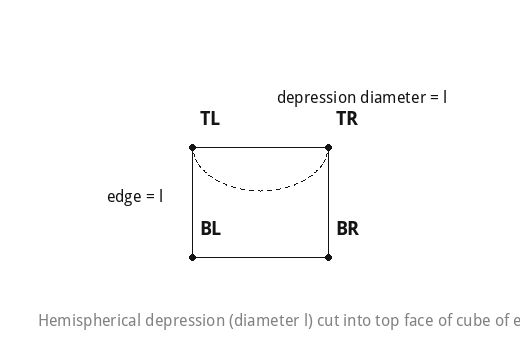
Q6. A medicine capsule is a cylinder with two hemispheres stuck to its ends. Total length 14 mm, diameter 5 mm. Find its surface area.
Solution: r = 2.5 mm. Cylinder length = 14 − 2×2.5 = 9 mm.
Surface area = 2πrh + 2(2πr²) = 2πr(h+2r) = 2×(22/7)×2.5×(9+5) = 2×(22/7)×2.5×14 = 220 mm².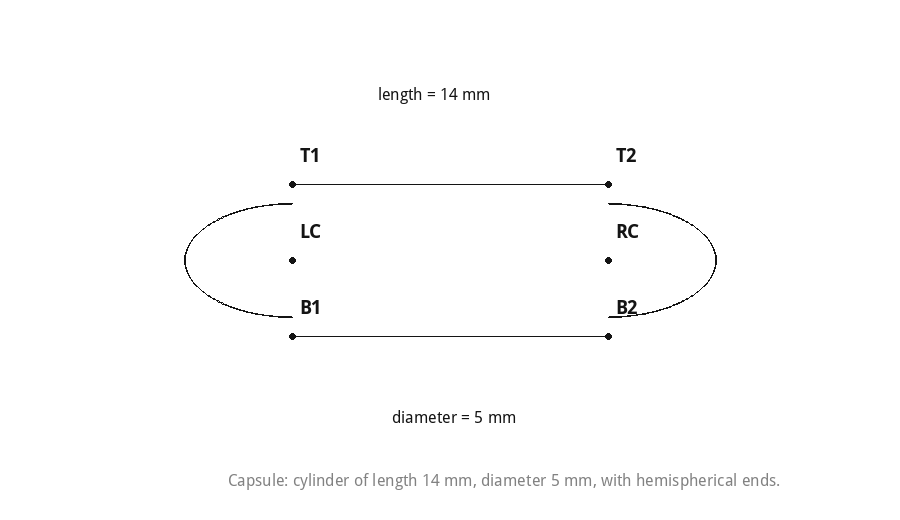
Q7. A tent is a cylinder surmounted by a cone. Cylinder height 2.1 m, diameter 4 m, slant height of the cone 2.8 m. Find the area of canvas used and its cost at ₹500/m².
Solution: r = 2 m. Canvas area = 2πrh + πrl = πr(2h+l) = (22/7)×2×(4.2+2.8) = (22/7)×2×7 = 44 m². Cost = 44 × 500 = ₹22,000.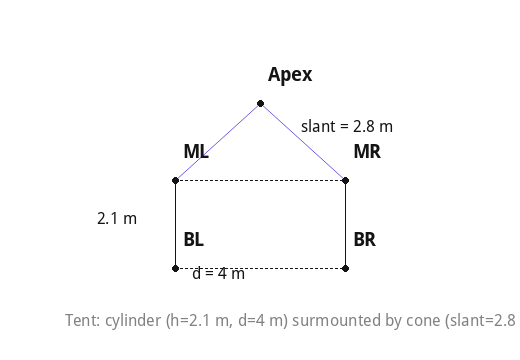
Q8. From a solid cylinder of height 2.4 cm and diameter 1.4 cm, a conical cavity of the same height and diameter is hollowed out. Find the total surface area of the remaining solid (nearest cm²).
Solution: r = 0.7 cm. Slant height of cavity l = √(r²+h²) = √(0.49+5.76) = √6.25 = 2.5 cm.
TSA = CSA of cylinder + base circle + CSA of cone cavity = 2πrh + πr² + πrl = 10.56 + 1.54 + 5.5 = 17.6 ≈ 18 cm².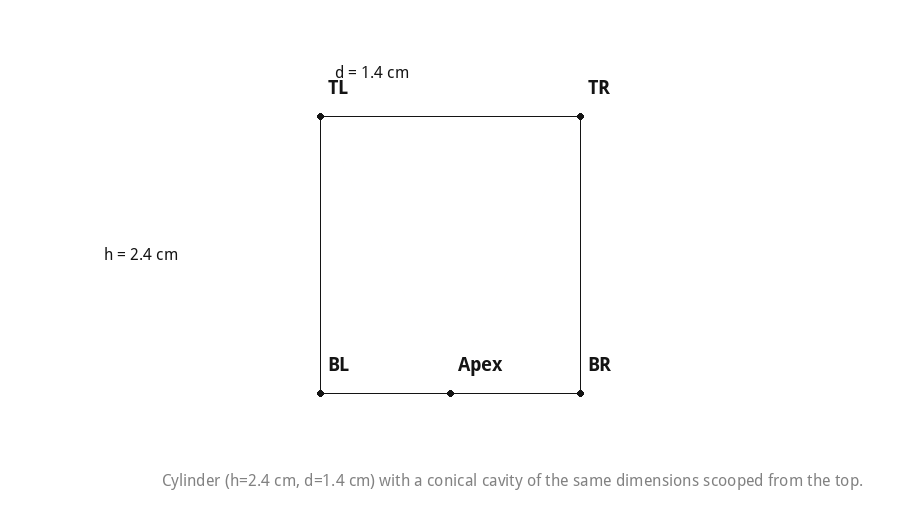
Q9. A wooden article is made by scooping out a hemisphere from each end of a solid cylinder of height 10 cm and base radius 3.5 cm. Find its total surface area.
Solution: TSA = CSA of cylinder + 2×(CSA of hemisphere) = 2πrh + 2(2πr²) = 2πr(h+2r) = 2×(22/7)×3.5×(10+7) = 22×17 = 374 cm².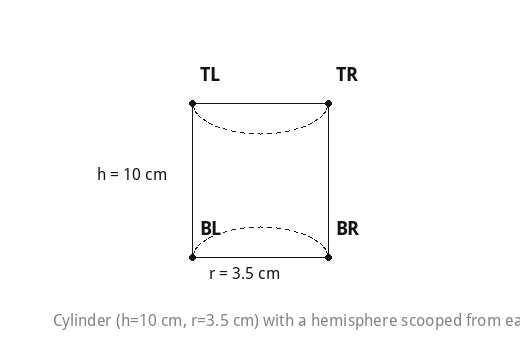
Exercise 12.2 — Volumes of Combination of Solids
Q1. A solid cone stands on a hemisphere, both of radius 1 cm, and the cone’s height equals its radius. Find the volume in terms of π.
Solution: Volume = (1/3)πr²h + (2/3)πr³ = (1/3)π(1)(1) + (2/3)π(1) = π/3 + 2π/3 = π cm³.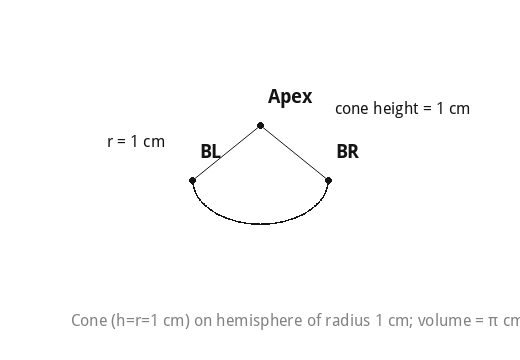
Q2. Rachel’s model: a cylinder with two cones attached at its ends, diameter 3 cm, total length 12 cm, each cone of height 2 cm. Find the volume of air inside.
Solution: r = 1.5 cm. Cylinder height = 12 − 2×2 = 8 cm. Volume = πr²[h + (2/3)(2)] = π(2.25)(8 + 4/3) = π×2.25×(28/3) = 21π = 21×22/7 = 66 cm³.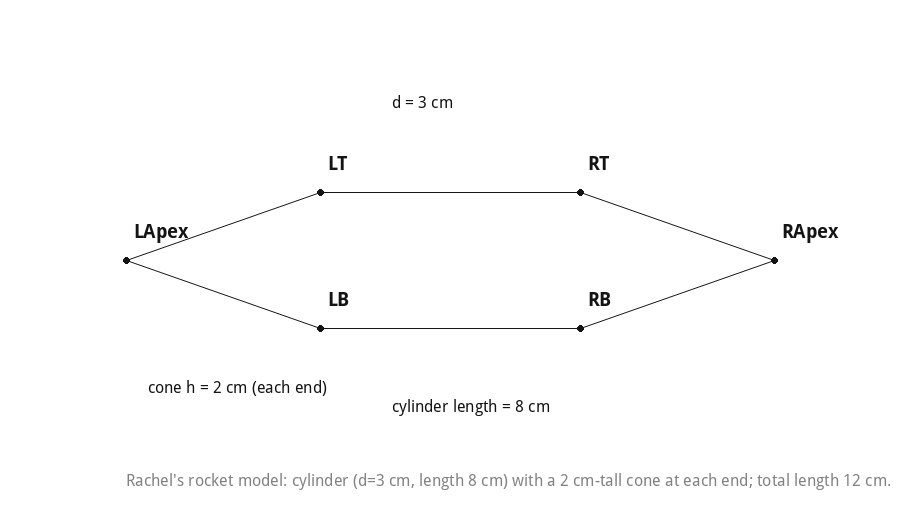
Q3. A gulab jamun (cylinder with two hemispherical ends), length 5 cm, diameter 2.8 cm, holds sugar syrup up to 30% of its volume. Find the approximate syrup in 45 gulab jamuns.
Solution: r = 1.4 cm, cylinder height = 5 − 2.8 = 2.2 cm. Volume of one = πr²h + (4/3)πr³ ≈ 25.05 cm³. For 45 pieces: 45×25.05 ≈ 1127.25 cm³. Syrup (30%) ≈ 0.3×1127.25 ≈ 338 cm³.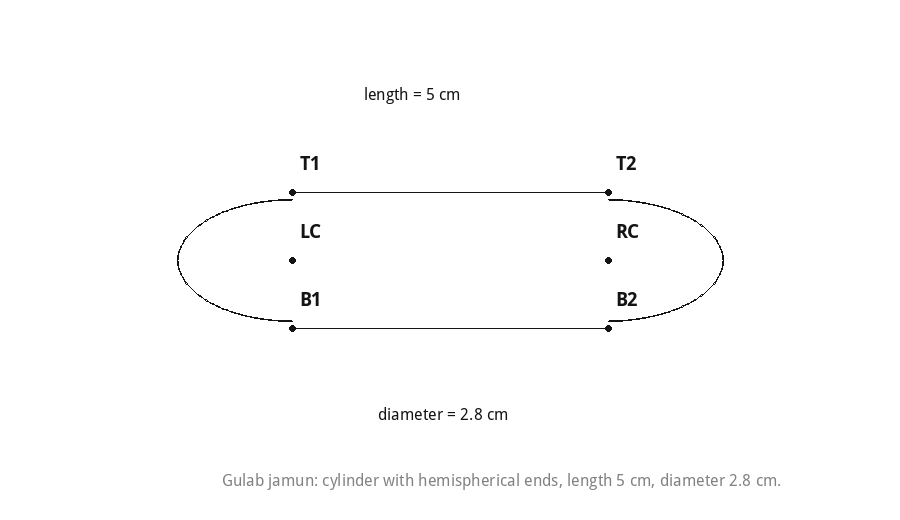
Q4. A wooden pen stand, a cuboid 15 cm × 10 cm × 3.5 cm, has four conical depressions of radius 0.5 cm and depth 1.4 cm each. Find the volume of wood.
Solution: Cuboid volume = 15×10×3.5 = 525 cm³. One cone = (1/3)π(0.25)(1.4) ≈ 0.367 cm³; four cones ≈ 1.47 cm³. Wood volume = 525 − 1.47 ≈ 523.53 cm³.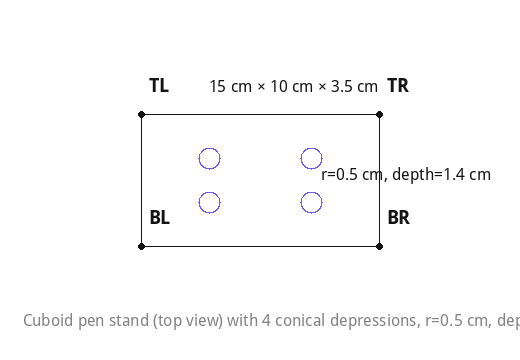
Q5. An inverted conical vessel, height 8 cm, top radius 5 cm, is filled to the brim. Lead shots of radius 0.5 cm are dropped in, and one-fourth of the water flows out. Find the number of lead shots.
Solution: Cone volume = (1/3)π(25)(8) = 200π/3. Water displaced = (1/4)×200π/3 = 50π/3. One shot’s volume = (4/3)π(0.5)³ = π/6. Number of shots = (50π/3)/(π/6) = 100.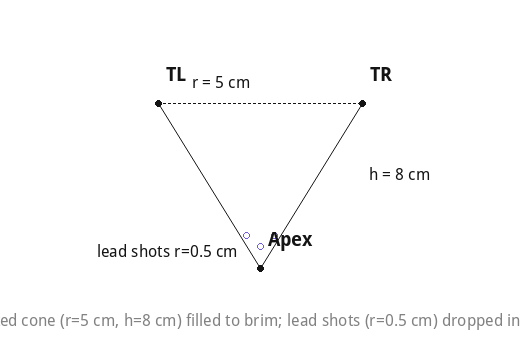
Q6. An iron pole is a cylinder of height 220 cm, base diameter 24 cm, surmounted by another cylinder of height 60 cm, radius 8 cm. Find its mass (1 cm³ iron ≈ 8 g, use π = 3.14).
Solution: Volume = π(144×220 + 64×60) = π×35520 ≈ 3.14×35520 = 111,532.8 cm³. Mass = 111,532.8×8 g = 892,262.4 g ≈ 892.26 kg.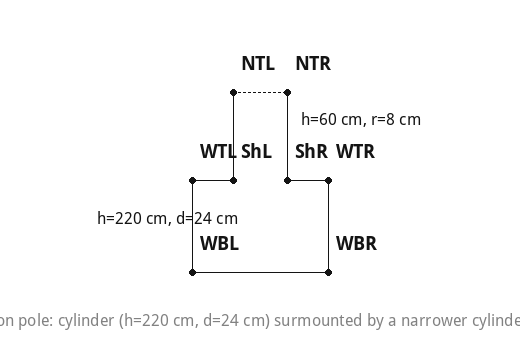
Q7. A cone (h=120 cm, r=60 cm) on a hemisphere (r=60 cm) stands upright, touching the bottom, inside a cylinder full of water (r=60 cm, h=180 cm). Find the water left in the cylinder.
Solution: Cylinder volume = π(3600)(180) = 648000π. Cone + hemisphere = 144000π + 144000π = 288000π. Water left = 648000π − 288000π = 360000π = 360000×22/7 ≈ 1,131,428.57 cm³ (≈1.131 m³).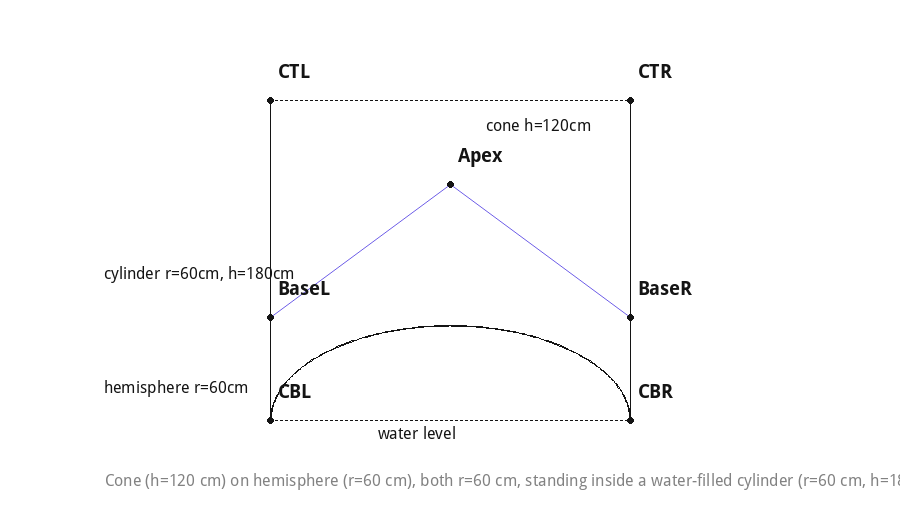
Q8. A spherical vessel with a cylindrical neck (8 cm long, 2 cm diameter) and spherical part diameter 8.5 cm is measured by a child to hold 345 cm³. Using π = 3.14, check her answer.
Solution: Sphere volume = (4/3)(3.14)(4.25)³ ≈ 321.39 cm³. Neck volume = 3.14×(1)²×8 = 25.12 cm³. Total ≈ 346.51 cm³ — very close to the child’s measured 345 cm³, so her measurement is essentially correct within experimental/rounding error.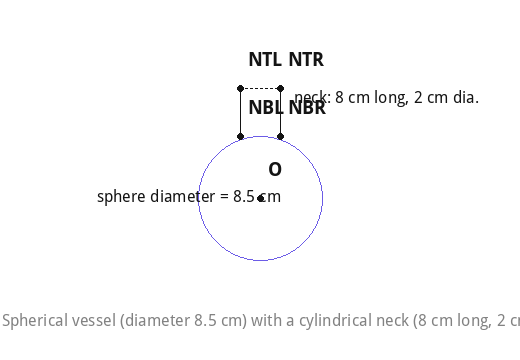
Why This Chapter Matters for Boards
Surface Areas and Volumes typically contributes 6-8 marks to the Class 10 Maths board paper, almost always as one long-answer combination-of-solids question. Examiners particularly like the “convert one shape into another, keeping volume constant” style of reasoning, so make sure the Extra Questions/HOTS companion post below is not skipped — several of its questions are built exactly around that reasoning pattern.
CBSE Exam Weightage
This chapter falls under Unit VI: Mensuration in the CBSE Class 10 Maths board exam syllabus. This unit typically carries around 10 marks (12.5%) of the 80-mark theory paper, based on CBSE’s published unit-wise weightage (Question Paper Design). CBSE sets weightage at the unit level rather than chapter-by-chapter, so the exact share from this specific chapter can vary a little between years and sample papers.
Chapter Quiz — Test Your Understanding
Class 10 Mathematics Chapter 12 – Notes and Extra Questions
Along with these NCERT Solutions, students can also use the Class 10 Mathematics Chapter 12 Extra Questions and Class 10 Mathematics Chapter 12 Revision Notes for quick revision and extra practice.
- Chapter 1: Real Numbers – Free PDF Download
- Chapter 2: Polynomials – Free PDF Download
- Chapter 3: Pair of Linear Equations in Two Variables – Free PDF Download
- Chapter 4: Quadratic Equations – Free PDF Download
- Chapter 5: Arithmetic Progressions – Free PDF Download
- Chapter 6: Triangles – Free PDF Download
- Chapter 7: Coordinate Geometry – Free PDF Download
- Chapter 8: Introduction to Trigonometry (2026-27) – Free PDF Download
- Chapter 9: Some Applications of Trigonometry – Free PDF Download
- Chapter 10: Circles – Free PDF Download
- Chapter 11: Areas Related to Circles (2026-27) – Free PDF Download
- Chapter 13: Statistics (2026-27)
- Chapter 14: Probability (2026-27)
FAQs
Q: Does the 2026-27 NCERT book still have Exercise 12.3?
A: No. The 2023 rationalisation removed the old “converting one solid into another” exercise (previously 13.3 in the pre-rationalised book); only 12.1 and 12.2 remain.
Q: Is π = 22/7 or 3.14 used in this chapter?
A: Both appear — use whichever value the specific question specifies; when unspecified, 22/7 is the NCERT default.
Recommended: Buy the Printed NCERT Class 10 Maths Book
Contains Amazon affiliate links.
If you’d like a printed copy alongside the PDF, here’s a verified option:
Check the latest price on Amazon
Price and availability may change on Amazon. As an Amazon Associate, ncertbooks.org earns from qualifying purchases.



Pingback: Class 10 Maths Ch 12 Surface Areas and Volumes Extra Questions (HOTS)
Pingback: Class 10 Maths Ch 12 Surface Areas and Volumes Revision Notes