
Class 10 Maths Chapter 13, Statistics, has three exercises in the current 2023-rationalised, 2026-27 session syllabus — Exercise 13.1 (9 questions, mean of grouped data), Exercise 13.2 (6 questions, mode of grouped data), and Exercise 13.3 (7 questions, median of grouped data) — 22 questions in all. Below are original, independently-derived, step-by-step solutions to all 22.
Last Updated: September 23, 2026
How to Approach This Chapter
Before calculating mean, median, or mode for grouped data, build the frequency table carefully with correct class marks and cumulative frequencies — most errors trace back to this setup table, not the final formula. For the modal class, double-check it’s the class with the highest frequency.
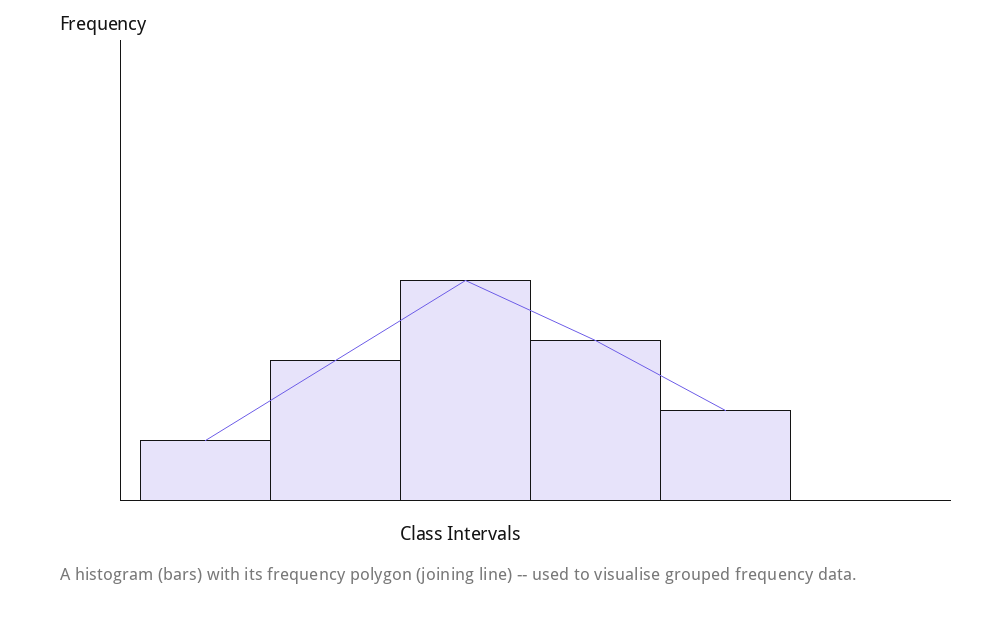 Reference figure: a histogram of grouped data, illustrating how frequency-distribution data used throughout this chapter is visualised.
Why This Chapter Matters for Boards
Statistics is a high-weightage, high-scoring chapter in the CBSE Class 10 Maths board exam, since the mean/median/mode formulas are mechanical once the correct method (direct, assumed-mean, or step-deviation) is chosen. Questions frequently test converting inclusive/discontinuous class intervals to continuous form, finding a missing frequency from a given mean or median, and comparing all three measures for the same data.
Exercise 13.1 Solutions — Mean of Grouped Data
- Q1. A survey of 20 houses recorded the number of plants: 0-2(1), 2-4(2), 4-6(1), 6-8(5), 8-10(6), 10-12(2), 12-14(3) houses. Find the mean number of plants per house.
Solution: Direct Method (small values): class marks 1,3,5,7,9,11,13; fᵢxᵢ = 1,6,5,35,54,22,39; Σfᵢ = 20, Σfᵢxᵢ = 162. Mean = 162/20 = 8.1 plants. - Q2. Daily wages of 50 workers: 100-120(12), 120-140(14), 140-160(8), 160-180(6), 180-200(10). Find the mean using a suitable method.
Solution: Step-Deviation, a=150, h=20; uᵢ = -2,-1,0,1,2; fᵢuᵢ = -24,-14,0,6,20; Σfᵢuᵢ = -12. Mean = 150 + (-12/50)×20 = 150 – 4.8 = Rs 145.20. - Q3. Pocket allowance data: 11-13(7), 13-15(6), 15-17(9), 17-19(13), 19-21(f), 21-23(5), 23-25(4). Mean is Rs 18. Find f.
Solution: Assumed mean a=18 (matches given mean). fᵢdᵢ sums to 2f-40. Since mean=a, Σfᵢdᵢ=0 ⇒ 2f-40=0 ⇒ f = 20. - Q4. Heart beats/min of 30 women: 65-68(2), 68-71(4), 71-74(3), 74-77(8), 77-80(7), 80-83(4), 83-86(2). Find the mean.
Solution: Step-Deviation, a=75.5, h=3; Σfᵢuᵢ = 4. Mean = 75.5 + (4/30)×3 = 75.9 beats/min. - Q5. Mangoes per box (inclusive classes): 50-52(15), 53-55(110), 56-58(135), 59-61(115), 62-64(25). Find the mean.
Solution: Convert to continuous classes (49.5-52.5, etc., h=3). Step-Deviation, a=57: Σfᵢuᵢ = 25, Σfᵢ = 400. Mean = 57 + (25/400)×3 = 57.1875 mangoes. - Q6. Daily food expenditure of 25 households: 100-150(4), 150-200(5), 200-250(12), 250-300(2), 300-350(2). Find the mean.
Solution: Step-Deviation, a=225, h=50: Σfᵢuᵢ = -7. Mean = 225 + (-7/25)×50 = 225-14 = Rs 211. - Q7. SO₂ concentration (ppm) in 30 localities: 0.00-0.04(4), 0.04-0.08(9), 0.08-0.12(9), 0.12-0.16(2), 0.16-0.20(4), 0.20-0.24(2). Find the mean.
Solution: Step-Deviation, a=0.14, h=0.04: Σfᵢuᵢ = -31. Mean = 0.14 + (-31/30)×0.04 = 0.099 ppm (approx.). - Q8. Days absent for 40 students (unequal class widths): 0-6(11), 6-10(10), 10-14(7), 14-20(4), 20-28(4), 28-38(3), 38-40(1). Find the mean.
Solution: Assumed-Mean Method (unequal widths, cannot use step-deviation shortcut), a=17: Σfᵢdᵢ = -181. Mean = 17 + (-181/40) = 12.48 days (approx.). - Q9. Literacy rate (%) of 35 cities: 45-55(3), 55-65(10), 65-75(11), 75-85(8), 85-95(3). Find the mean.
Solution: Step-Deviation, a=70, h=10: Σfᵢuᵢ = -2. Mean = 70 + (-2/35)×10 = 69.43% (approx.).
Exercise 13.2 Solutions — Mode of Grouped Data
- Q1. Ages of patients: 5-15(6), 15-25(11), 25-35(21), 35-45(23), 45-55(14), 55-65(5). Find the mode and mean, and compare.
Solution: Modal class 35-45 (highest f=23): l=35,f₁=23,f₀=21,f₂=14,h=10. Mode = 35+[2/11]×10 = 36.8 years. Mean (assumed mean a=30): Σfᵢdᵢ=430, Mean=30+430/80=35.38 years. Most patients cluster near 36.8 (mode), average is slightly higher at 35.38. - Q2. Lifetimes (h) of 225 components: 0-20(10),20-40(35),40-60(52),60-80(61),80-100(38),100-120(29). Find the modal lifetime.
Solution: Modal class 60-80 (f=61): l=60,f₁=61,f₀=52,f₂=38,h=20. Mode=60+[9/32]×20=65.625 hours. - Q3. Monthly expenditure of 200 families across 8 classes (1000-5000, step 500): 24,40,33,28,30,22,16,7. Find modal and mean expenditure.
Solution: Modal class 1500-2000 (f=40): l=1500,f₁=40,f₀=24,f₂=33,h=500. Mode=1500+[16/23]×500=Rs 1847.83 (approx.). Mean (step-deviation a=2750): Σfᵢuᵢ=-35, Mean=2750+(-35/200)×500=Rs 2662.50. - Q4. Students-per-teacher ratio across states: 15-20(3),20-25(8),25-30(9),30-35(10),35-40(3),40-45(0),45-50(0),50-55(2). Find mode and mean; interpret.
Solution: Modal class 30-35 (f=10): Mode=30+[1/8]×5=30.6 (approx.). Mean (step-deviation a=32.5): Σfᵢuᵢ=-23, Mean=32.5+(-23/35)×5=29.2 (approx.). Most states cluster near 30.6; nationwide average is slightly lower. - Q5. ODI runs of top batsmen (8 classes, 3000-11000, step 1000): 4,18,9,7,6,3,1,1. Find the mode.
Solution: Modal class 4000-5000 (f=18): l=4000,f₁=18,f₀=4,f₂=9,h=1000. Mode=4000+[14/23]×1000=4608.7 runs (approx.). - Q6. Cars passing in 100 periods of 3 min (8 classes, 0-80, step 10): 7,14,13,12,20,11,15,8. Find the mode.
Solution: Modal class 40-50 (f=20): l=40,f₁=20,f₀=12,f₂=11,h=10. Mode=40+[8/17]×10=44.7 cars (approx.).
Exercise 13.3 Solutions — Median of Grouped Data
- Q1. Monthly electricity units for 68 consumers: 65-85(4),85-105(5),105-125(13),125-145(20),145-165(14),165-185(8),185-205(4). Find median, mean, mode; compare.
Solution: n=68,n/2=34; cf: 4,9,22,42,56,64,68 ⇒ median class 125-145. Median=125+[(34-22)/20]×20=137. Mode (modal class 125-145,f=20): Mode=125+[7/13]×20=135.77 (approx.). Mean (step-dev a=135): Mean=135+(7/68)×20=137.06 (approx.). All three are close, showing a fairly symmetric distribution. - Q2. Median of the distribution 0-10(5),10-20(x),20-30(20),30-40(15),40-50(y),50-60(5), total 60, is 28.5. Find x and y.
Solution: 5+x+20+15+y+5=60 ⇒ x+y=15. Median class 20-30 (l=20,cf=5+x,f=20,h=10): 28.5=20+[(30-5-x)/20]×10 ⇒ x=8. So x=8, y=7. - Q3. Ages of 100 policy holders given as “below” cumulative data (below 20 to below 60, step 5): 2,6,24,45,78,89,92,98,100. Find the median age.
Solution: Convert to class frequencies: 2,4,18,21,33,11,3,6,2 (cf same as given). n=100,n/2=50; median class 35-40 (cf just >50 is 78). l=35,cf=45,f=33,h=5. Median=35+[(50-45)/33]×5=35.76 years (approx.). - Q4. Leaf lengths (mm) of 40 leaves, inclusive classes 118-126 to 172-180: 3,5,9,12,5,4,2. Find the median length.
Solution: Convert to continuous classes (117.5-126.5, h=9). n=40,n/2=20; cf:3,8,17,29,34,38,40 ⇒ median class 144.5-153.5. l=144.5,cf=17,f=12,h=9. Median=144.5+[(20-17)/12]×9=146.75 mm. - Q5. Lifetime (h) of 400 neon lamps: 1500-2000(14),2000-2500(56),2500-3000(60),3000-3500(86),3500-4000(74),4000-4500(62),4500-5000(48). Find the median lifetime.
Solution: cf: 14,70,130,216,290,352,400. n=400,n/2=200; median class 3000-3500 (first cf>200 is 216). l=3000,cf=130,f=86,h=500. Median=3000+[(200-130)/86]×500=3406.98 hours (approx.). - Q6. Letters in 100 surnames: 1-4(6),4-7(30),7-10(40),10-13(16),13-16(4),16-19(4). Find median, mean, modal number of letters.
Solution: n=100,n/2=50; cf:6,36,76,92,96,100 ⇒ median class 7-10. Median=7+[(50-36)/40]×3=8.05. Mean (step-dev a=11.5): Σfᵢuᵢ=-106, Mean=11.5+(-106/100)×3=8.32. Mode (modal class 7-10,f=40): Mode=7+[10/34]×3=7.88. - Q7. Weights (kg) of 30 students: 40-45(2),45-50(3),50-55(8),55-60(6),60-65(6),65-70(3),70-75(2). Find the median weight.
Solution: cf:2,5,13,19,25,28,30. n=30,n/2=15; median class 55-60 (cf just>15 is 19). l=55,cf=13,f=6,h=5. Median=55+[(15-13)/6]×5=56.67 kg (approx.).
- NCERT Solutions – Chapter 13
- Extra Questions (HOTS) – Chapter 13
- Revision Notes – Chapter 13
- Class 10 Maths Book (Catalog Page)
CBSE Exam Weightage
This chapter falls under Unit VII: Statistics and Probability in the CBSE Class 10 Maths board exam syllabus. This unit typically carries around 11 marks (13.75%) of the 80-mark theory paper, based on CBSE’s published unit-wise weightage (Question Paper Design). CBSE sets weightage at the unit level rather than chapter-by-chapter, so the exact share from this specific chapter can vary a little between years and sample papers.
Chapter Quiz — Test Your Understanding
Class 10 Mathematics Chapter 13 – Notes and Extra Questions
Along with these NCERT Solutions, students can also use the Class 10 Mathematics Chapter 13 Extra Questions and Class 10 Mathematics Chapter 13 Revision Notes for quick revision and extra practice.
- Chapter 1: Real Numbers – Free PDF Download
- Chapter 2: Polynomials – Free PDF Download
- Chapter 3: Pair of Linear Equations in Two Variables – Free PDF Download
- Chapter 4: Quadratic Equations – Free PDF Download
- Chapter 5: Arithmetic Progressions – Free PDF Download
- Chapter 6: Triangles – Free PDF Download
- Chapter 7: Coordinate Geometry – Free PDF Download
- Chapter 8: Introduction to Trigonometry (2026-27) – Free PDF Download
- Chapter 9: Some Applications of Trigonometry – Free PDF Download
- Chapter 10: Circles – Free PDF Download
- Chapter 11: Areas Related to Circles (2026-27) – Free PDF Download
- Chapter 12: Surface Areas and Volumes (2026-27) – Free PDF Download
- Chapter 14: Probability (2026-27)
FAQ
Q: Is this content updated for the 2026-27 NCERT edition?
A: Yes. The current rationalised syllabus has exactly 3 exercises (13.1, 13.2, 13.3) totalling 22 questions, cross-verified against two independent current sources before writing.
Q: Which formula should I remember for board exams?
A: Mode = l + [(f₁-f₀)/(2f₁-f₀-f₂)] × h, and Median = l + [(n/2-cf)/f] × h — both need the modal/median class identified correctly first.
Recommended: Buy the Printed NCERT Class 10 Maths Book
Contains Amazon affiliate links.
If you’d like a printed copy alongside the PDF, here’s a verified option:
4.4 out of 5 stars (836 ratings) · Rs. 125
Price and availability may change on Amazon. As an Amazon Associate, ncertbooks.org earns from qualifying purchases.


