
These HOTS-level questions go beyond Exercise 12.1/12.2 — general/abstract reasoning, reverse-engineering, and fresh numbers not used in the Solutions post, designed for students aiming for full marks on combination-of-solids problems. These Class 10 Mathematics Chapter 12 important questions are handy for last-minute exam practice.
Last Updated: October 24, 2026
How to Approach the HOTS Questions in This Chapter
HOTS questions on this chapter often combine two different solids in one problem (a cone melted and recast into several spheres, or a combined solid involving three different shapes) — practice identifying which quantity, volume or surface area, is actually conserved or relevant before setting up the equation.
Q1 (General derivation). A solid consists of a right circular cylinder of radius r and height h, with a hemisphere of the same radius attached to one end and a cone of the same radius and height h₁ attached to the other end. Derive a general formula for the total surface area of the solid in terms of r, h and h₁.
Solution: Slant height of cone, l = √(r²+h₁²). The two curved ends are the hemisphere’s curved surface and the cone’s curved surface; the cylinder contributes only its curved surface (both circular ends are covered by the attached solids).
TSA = (curved surface of cylinder) + (curved surface of hemisphere) + (curved surface of cone) = 2πrh + 2πr² + πrl = πr(2h + 2r + √(r²+h₁²)).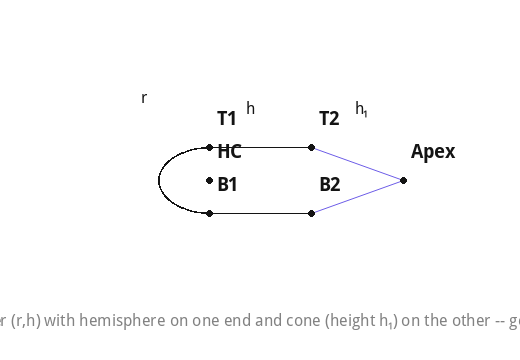
Q2 (Reverse-engineering). A solid toy is in the shape of a hemisphere surmounted by a cone of the same radius. If the total surface area of the toy is 235.5 cm² and the radius is 3.5 cm, find the height of the cone.
Solution: TSA = πr(l+2r) ⟹ 235.5 = (22/7)(3.5)(l+7) ⟹ 235.5 = 11(l+7) ⟹ l+7 = 21.409 ⟹ l ≈ 14.409 cm.
h = √(l²−r²) = √(207.6 − 12.25) = √195.35 ≈ 13.98 cm ≈ 14 cm.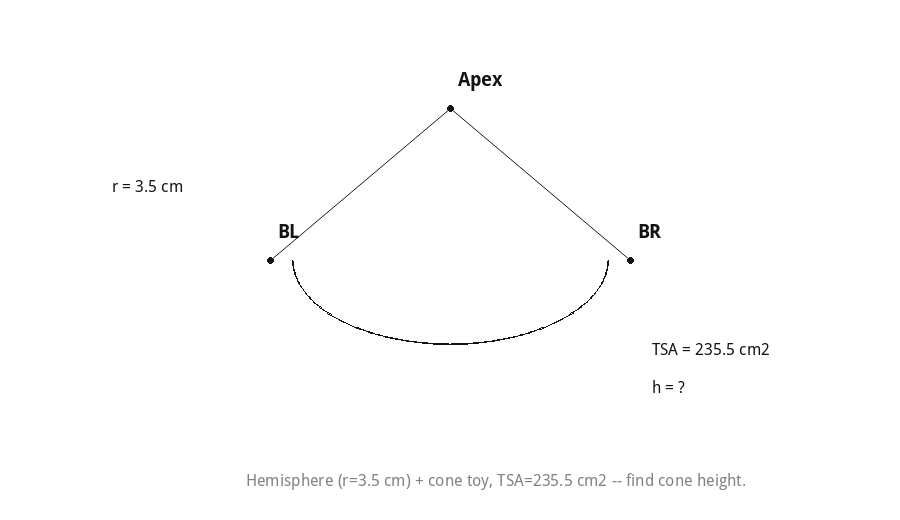
Q3 (Assertion-Reason). Assertion (A): When a solid cone is carved out of a solid hemisphere of the same base radius, the surface area of the remaining solid equals its original curved surface area plus the cone’s curved surface area.
Reason (R): Removing the cone exposes a new conical cavity whose curved surface becomes part of the outer boundary, while the flat circular base remains unaffected.
Solution: Both A and R are true, and R correctly explains A — the flat base stays as-is, only the top curved surface changes from a flat circle to the cone cavity’s slant surface. Answer: (a) Both A and R are true, and R is the correct explanation of A.
Q4 (Fresh-numbers word problem). A cylindrical tub of radius 6 cm and height 15 cm is full of water. A solid in the shape of a cone mounted on a hemisphere (both of radius 3 cm and the cone’s height 6 cm) is dropped into the tub. Find the volume of water that overflows.
Solution: Volume of solid = (1/3)π(3²)(6) + (2/3)π(3³) = 18π + 18π = 36π cm³ = 36×22/7 ≈ 113.14 cm³.
Since the tub was full, the water that overflows equals the volume of the submerged solid = ≈113.14 cm³.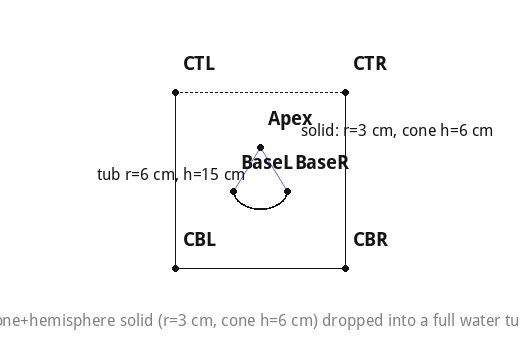
Q5 (Ratio/general proof). A sphere of radius R is melted and recast into a right circular cone of the same radius R. Prove that the height of the cone is 4R, and find the ratio of the cone’s slant height to R.
Solution: Volume conserved: (4/3)πR³ = (1/3)πR²h ⟹ h = 4R (proved).
Slant height l = √(R²+16R²) = √17·R. Ratio l : R = √17 : 1 (≈ 4.123 : 1).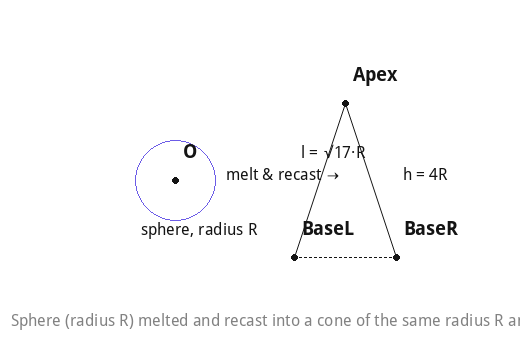
Q6 (Multi-solid word problem, fresh numbers). A juice glass is a frustum-free combination: a cylinder of radius 3.5 cm and height 10 cm topped by a hemisphere of the same radius used as a lid. If the cylinder is filled with juice to 80% of its volume, find the volume of juice.
Solution: Cylinder volume = πr²h = (22/7)(12.25)(10) = 385 cm³. 80% of this = 0.8×385 = 308 cm³. (The hemisphere lid is not filled — it is a cover, not a liquid-holding region, testing careful reading of “which part holds liquid.”)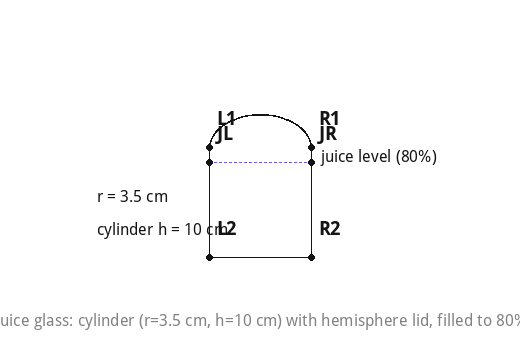
- Chapter 1: Real Numbers
- Chapter 2: Extra Questions - Polynomials (HOTS)
- Chapter 3: Pair of Linear Equations in Two Variables
- Chapter 4: Quadratic Equations
- Chapter 5: Arithmetic Progressions
- Chapter 6: Triangles
- Chapter 7: Coordinate Geometry
- Chapter 8: – Introduction to Trigonometry
- Chapter 9: Extra Questions - Some Applications of Trigonometry (HOTS)
- Chapter 10: Extra Questions - Circles (HOTS)
- Chapter 11: Areas Related to Circles Extra Questions (HOTS)
- Chapter 13: Statistics Extra Questions (HOTS)
- Chapter 14: Probability Extra Questions (HOTS)
Frequently Asked Questions
How is the surface area of a combination of two solid shapes, such as a cone mounted on a cylinder, calculated?
It is found by adding the curved or lateral surface areas of each individual shape that remains exposed, while excluding the areas of any surfaces where the two shapes are joined and no longer visible.
Why does converting one solid shape into another, such as melting a sphere to form a cylinder, keep the volume constant but not the surface area?
The total amount of material, and therefore the volume, remains unchanged, but the surface area can change because the new shape distributes that same volume of material differently.
Chapter Quiz — Test Your Understanding
Class 10 Mathematics Chapter 12 – Solutions and Notes
For complete step-by-step answers and a quick summary, check the Class 10 Mathematics Chapter 12 Solutions and Class 10 Mathematics Chapter 12 Revision Notes.
Recommended: Buy the Printed NCERT Class 10 Maths Book
Contains Amazon affiliate links.
If you’d like a printed copy alongside the PDF, here’s a verified option:
Check the latest price on Amazon
Price and availability may change on Amazon. As an Amazon Associate, ncertbooks.org earns from qualifying purchases.


