Quick revision notes for Class 10th Maths Chapter 11 — Areas Related to Circles — covering every formula for sector, segment and combined-figure area.
Last Updated: October 24, 2026
Common Mistakes Students Make in Areas Related to Circles
- Mixing up area and circumference: using 2πr where πr² was needed, or vice versa.
- Sector vs segment confusion: using the sector-area formula where the segment area (sector minus triangle) was actually needed.
- Combined-figure sign errors: forgetting to add or subtract areas correctly (e.g. a square with circles cut out).
- Forgetting the /360 factor: in the sector-area formula, when the angle isn’t out of a full circle.
Class 10 Maths Chapter 11 – Areas Related to Circles: Quick Revision Notes
- Circumference of a circle = 2πr
- Area of a circle = πr²
- Length of an arc = (θ/360) × 2πr
- Area of a sector = (θ/360) × πr²
- Area of a sector (using arc length l) = (1/2) × l × r
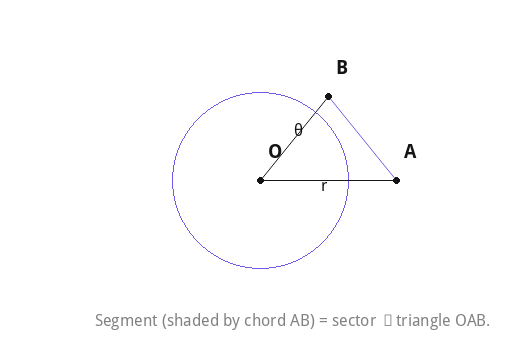
- Area of a segment = Area of sector − Area of triangle = (θ/360)πr² − (1/2)r²sinθ
- Minor segment + Major segment = Area of circle

- Minor sector + Major sector = Area of circle
- Quadrant (θ=90°): Area = (1/4)πr²
- Semicircle (θ=180°): Area = (1/2)πr²
- Area of a ring/annulus (radii R > r) = π(R² − r²)
- Angle swept by minute hand = 6° per minute; by hour hand = 0.5° per minute
- Use π = 22/7 or 3.14 strictly as specified in the question
- NCERT Solutions – Chapter 11
- Extra Questions (HOTS) – Chapter 11
- Revision Notes – Chapter 11
- Class 10 Maths Book (Catalog Page)
- Chapter 1: Real Numbers
- Chapter 2: Polynomials
- Chapter 3: Pair of Linear Equations in Two Variables
- Chapter 4: Quadratic Equations
- Chapter 5: Arithmetic Progressions
- Chapter 6: Triangles
- Chapter 7: Coordinate Geometry
- Chapter 8: – Introduction to Trigonometry
- Chapter 9: Revision Notes - Some Applications of Trigonometry
- Chapter 10: Revision Notes - Circles
- Chapter 12: Surface Areas and Volumes Revision Notes
- Chapter 13: Statistics Revision Notes
- Chapter 14: Probability Revision Notes
Frequently Asked Questions
What is the difference between the area of a sector and the area of a segment?
A sector’s area is bounded by two radii and an arc (like a pizza slice); a segment’s area is bounded by a chord and an arc (the region cut off by a straight line) — segment area is always found by subtracting a triangle’s area from the corresponding sector’s area.
How do you find the area of a shape formed by combining a circle (or parts of it) with other figures like squares or triangles?
Break the combined figure into its individual simple shapes (circle/sector/segment plus square/rectangle/triangle), calculate each area separately using the correct formula, then add or subtract them based on whether the regions overlap or are combined — this decomposition approach is the standard method for the whole chapter.
Chapter Quiz — Test Your Understanding
Class 10 Mathematics Chapter 11 – Solutions and Important Questions
Need full answers or more practice? See the Class 10 Mathematics Chapter 11 Solutions and Class 10 Mathematics Chapter 11 Extra Questions. These Class 10 Mathematics Chapter 11 notes are ideal for quick revision just before exams.
What to Revise First (and Last) in This Chapter
Prioritise the sector and segment area formulas, and exactly when each applies, first, since combined-figure questions build directly on them. Leave detailed combined-figure problems involving three or more shapes for an earlier, slower revision pass.
Recommended: Buy the Printed NCERT Class 10 Maths Book
Contains Amazon affiliate links.
If you’d like a printed copy alongside the PDF, here’s a verified option:
Check the latest price on Amazon
Price and availability may change on Amazon. As an Amazon Associate, ncertbooks.org earns from qualifying purchases.