
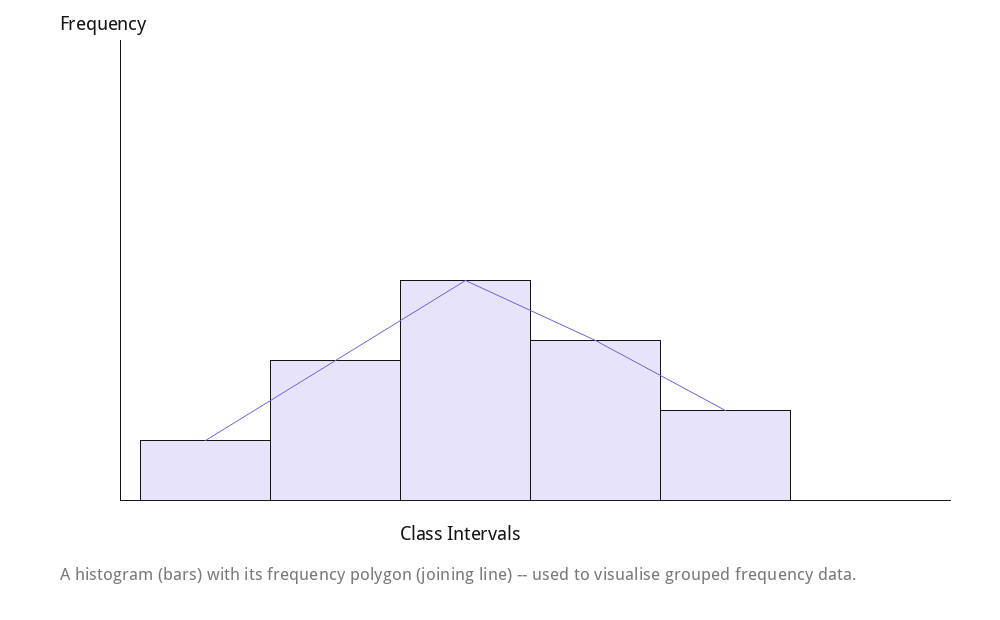
 Reference figure: a histogram of grouped data, illustrating how frequency-distribution data used throughout this chapter is visualised.
Last Updated: September 23, 2026
Common Mistakes Students Make in Statistics
- Mixing up mean methods for grouped data: confusing the direct, assumed-mean, and step-deviation methods, or misidentifying the modal class.
- Cumulative frequency errors: building the “less than” or “more than” ogive incorrectly.
- Wrong class mark: using a class boundary instead of the midpoint.
- Mixing up “less than” and “more than” methods: when constructing an ogive to find the median graphically.
Class 10 Maths Chapter 13 – Statistics: Quick Revision Notes
- Class mark xᵢ = (Upper limit + Lower limit)/2
- Mean (Direct): x̄ = Σfᵢxᵢ/Σfᵢ
- Mean (Assumed Mean): x̄ = a + Σfᵢdᵢ/Σfᵢ, dᵢ=xᵢ-a — use for unequal class widths
- Mean (Step-Deviation): x̄ = a + (Σfᵢuᵢ/Σfᵢ)×h, uᵢ=(xᵢ-a)/h — use for equal widths, large numbers
- All three mean methods always give the same numeric answer
- Inclusive/gapped classes must be converted to continuous classes first (adjust limits by half the gap)
- Mode = l + [(f₁-f₀)/(2f₁-f₀-f₂)] × h — modal class = class with highest frequency
- Median = l + [(n/2-cf)/f] × h — median class = first class whose cf ≥ n/2, found from a cumulative frequency table
- “Less than” cumulative tables must be converted to individual class frequencies before use
- Empirical relationship: Mode = 3 Median − 2 Mean (equivalently 3 Median = Mode + 2 Mean)
- Ogive: less-than ogive rises (upper limits vs cf); more-than ogive falls (lower limits vs cf); their intersection’s x-coordinate gives the median graphically
- Common trap: modal class = highest frequency, NOT highest cumulative frequency
- NCERT Solutions – Chapter 13
- Extra Questions (HOTS) – Chapter 13
- Revision Notes – Chapter 13
- Class 10 Maths Book (Catalog Page)
- Chapter 1: Real Numbers
- Chapter 2: Polynomials
- Chapter 3: Pair of Linear Equations in Two Variables
- Chapter 4: Quadratic Equations
- Chapter 5: Arithmetic Progressions
- Chapter 6: Triangles
- Chapter 7: Coordinate Geometry
- Chapter 8: – Introduction to Trigonometry
- Chapter 9: Revision Notes - Some Applications of Trigonometry
- Chapter 10: Revision Notes - Circles
- Chapter 11: Areas Related to Circles Revision Notes
- Chapter 12: Surface Areas and Volumes Revision Notes
- Chapter 14: Probability Revision Notes
Frequently Asked Questions
Which method is fastest for calculating the mean of grouped data: direct, assumed-mean, or step-deviation?
The step-deviation method is usually fastest when class sizes are equal and class marks are large, since it reduces big numbers to small, easy-to-handle values before scaling back — but all three methods give the same final answer, so choose based on which is quickest for the specific numbers given.
How is the median of grouped data found using an ogive (cumulative frequency curve)?
Plot the cumulative frequency against the upper class limits to draw the ogive, then locate n/2 on the cumulative frequency axis and read across to find the corresponding class — this graphical method is an alternative to the formula-based approach and is sometimes asked directly in exams.
Chapter Quiz — Test Your Understanding
Class 10 Mathematics Chapter 13 – Solutions and Important Questions
Need full answers or more practice? See the Class 10 Mathematics Chapter 13 Solutions and Class 10 Mathematics Chapter 13 Extra Questions. These Class 10 Mathematics Chapter 13 notes are ideal for quick revision just before exams.
What to Revise First (and Last) in This Chapter
Prioritise the mean methods (direct, assumed-mean, step-deviation) and the class-mark calculation first, since they appear in nearly every numerical. Leave detailed ogive construction and graphical median-finding for an earlier, slower revision pass.
Recommended: Buy the Printed NCERT Class 10 Maths Book
Contains Amazon affiliate links.
If you’d like a printed copy alongside the PDF, here’s a verified option:
4.4 out of 5 stars (836 ratings) · Rs. 125
Price and availability may change on Amazon. As an Amazon Associate, ncertbooks.org earns from qualifying purchases.


