Class 10 Maths Chapter 9 – Revision Notes
- Line of sight: the line from the observer’s eye to the object being viewed.
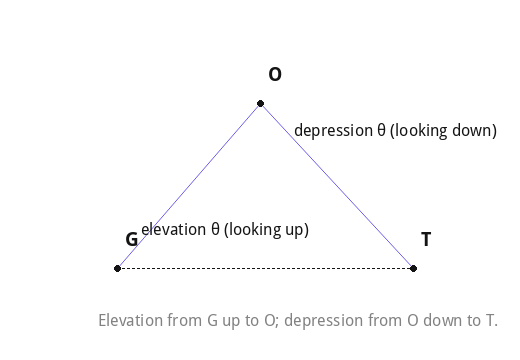
- Angle of elevation: angle between the horizontal and the line of sight when the object is above the horizontal level.
- Angle of depression: angle between the horizontal and the line of sight when the object is below the horizontal level.
- Core formula: height = distance × tanθ; distance = height / tanθ; line-of-sight length = height / sinθ = distance / cosθ.

- Standard values: tan30° = 1/√3, tan45° = 1, tan60° = √3; sin30° = 1/2, sin45° = 1/√2, sin60° = √3/2.
- Complementary-angle result: if elevations from distances p and q are complementary, height = √(pq).
- Two-position (moving observer) formula: if elevation changes from θ to φ after moving distance a towards the object, height = a·tanθ·tanφ / (tanφ-tanθ).
- Exam tip: always draw the right triangle and label the known angle/side before choosing a ratio.
- Syllabus note (2026-27): only Exercise 9.1 (16 questions) is in the current rationalised syllabus; the old Exercise 9.2 was removed.
Related
- Chapter 1: Real Numbers
- Chapter 2: Polynomials
- Chapter 3: Pair of Linear Equations in Two Variables
- Chapter 4: Quadratic Equations
- Chapter 5: Arithmetic Progressions
- Chapter 6: Triangles
- Chapter 7: Coordinate Geometry
- Chapter 8: – Introduction to Trigonometry
- Chapter 10: Revision Notes - Circles
- Chapter 11: Areas Related to Circles Revision Notes
- Chapter 12: Surface Areas and Volumes Revision Notes
- Chapter 13: Statistics Revision Notes
- Chapter 14: Probability Revision Notes
Frequently Asked Questions
Why is drawing a clear diagram the most important first step in this chapter?
Because nearly every problem describes a real-world scenario (a tower, a building, a kite) in words, and correctly labelling the right triangle formed — including which angle is the angle of elevation/depression — determines whether you apply the correct trig ratio at all.
Last Updated: October 24, 2026
Which trigonometric ratio should be used when the height and horizontal distance are both involved?
Tangent (tan = opposite/adjacent = height/horizontal distance) is used when both the height and horizontal distance are relevant; sine and cosine are used when the hypotenuse (the direct line of sight distance) is involved instead.
Chapter Quiz — Test Your Understanding
Class 10 Mathematics Chapter 9 – Solutions and Important Questions
Need full answers or more practice? See the Class 10 Mathematics Chapter 9 Solutions and Class 10 Mathematics Chapter 9 Extra Questions. These Class 10 Mathematics Chapter 9 notes are ideal for quick revision just before exams.
Common Mistakes Students Make in This Chapter
- Confusing angle of elevation and depression: mixing up which is measured looking up versus looking down from the horizontal.
- Setting up the wrong right triangle: misidentifying which side is opposite or adjacent to the given angle.
- Skipping the diagram: attempting the problem algebraically without sketching the situation first, leading to setup errors.
- Wrong trigonometric ratio: using tan where sin or cos was actually needed, based on which two sides are given or asked for.
What to Revise First (and Last) in This Chapter
Prioritise drawing an accurate diagram for every problem and correctly identifying angle of elevation vs depression first, since setup is where most marks are lost in this chapter, not the trigonometry itself. Leave problems involving two observation points or moving objects for an earlier, slower revision pass.
Recommended: Buy the Printed NCERT Class 10 Maths Book
Contains Amazon affiliate links.
If you’d like a printed copy alongside the PDF, here’s a verified option:
Check the latest price on Amazon
Price and availability may change on Amazon. As an Amazon Associate, ncertbooks.org earns from qualifying purchases.