
A fast, one-glance recap of Class 10 Maths Chapter 6 (Triangles) — for the full worked explanations, see the Solutions. These Class 10 Mathematics Chapter 6 notes are ideal for quick revision just before exams.
Last Updated: October 24, 2026
Common Mistakes Students Make in Triangles
- Mixing up similarity criteria: applying the wrong criterion (AA, SAS, SSS), or accidentally using a congruence criterion for a similarity proof.
- Basic Proportionality Theorem errors: not correctly identifying which sides actually correspond as proportional.
- Mislabeling the hypotenuse: especially in triangles drawn in an unusual orientation, before applying Pythagoras theorem.
- Area-ratio mistakes: forgetting the ratio of areas of similar triangles equals the square of the ratio of corresponding sides, not the ratio itself.
Why This Chapter Matters
Triangles is one of the standard chapters in the CBSE/NCERT Class 10 Maths syllabus and questions from it appear regularly in board exams, in formats ranging from 1-mark objective questions to longer 3-5 mark descriptive or numerical questions. Because the concepts here often build on earlier chapters (and feed into later ones), a solid grip on this chapter also makes the rest of the Maths syllabus easier to follow.
Revision Notes: Triangles
- Similar figures: same shape, not necessarily same size; congruent figures are always similar, but similar figures need not be congruent
- Similarity of polygons: corresponding angles equal and corresponding sides proportional — both conditions needed together
- Basic Proportionality Theorem (BPT / Thales’ Theorem): a line parallel to one side of a triangle divides the other two sides in the same ratio
- Converse of BPT: if a line divides two sides of a triangle in the same ratio, it is parallel to the third side
- Similarity criteria: AA (AAA), SSS, SAS
- Midpoint theorem (via BPT): a line through the midpoint of one side, parallel to another side, bisects the third side — and its converse
- Ratio of areas of similar triangles = square of the ratio of corresponding sides (beyond the current 3-exercise syllabus, but a key extension — see Extra Questions)
- Pythagoras theorem via similarity: the altitude to the hypotenuse of a right triangle creates two smaller triangles, each similar to the original and to each other
- Height-shadow / pole problems: use similar triangles formed by the sun’s rays at the same instant — ratio of height to shadow length is constant at a given time
- 2023 rationalisation removed old Exercises 6.4-6.6 (Areas of Similar Triangles, Pythagoras Theorem, Optional) — only 6.1, 6.2, 6.3 remain as numbered exercises now
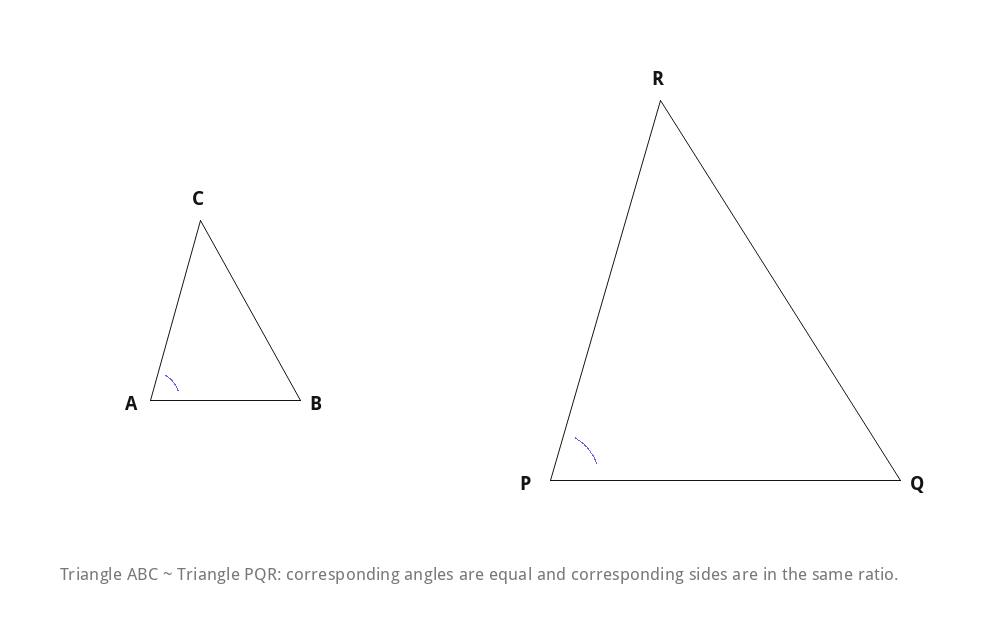 Similar triangles: same shape, corresponding angles equal and sides proportional.
See also: Extra Questions (HOTS) | Formulas Handbook
How to Use These Notes
These revision notes are meant for quick recall in the last few days before an exam or unit test — they are not a substitute for first reading the full chapter and working through examples in the NCERT textbook. A good routine is: read the chapter once, solve the in-text and end-of-chapter questions using the linked Solutions, then come back to this page a day or two before the exam to refresh the key definitions and formulas without re-reading the whole chapter.
- Chapter 1: Real Numbers
- Chapter 2: Polynomials
- Chapter 3: Pair of Linear Equations in Two Variables
- Chapter 4: Quadratic Equations
- Chapter 5: Arithmetic Progressions
- Chapter 7: Coordinate Geometry
- Chapter 8: – Introduction to Trigonometry
- Chapter 9: Revision Notes - Some Applications of Trigonometry
- Chapter 10: Revision Notes - Circles
- Chapter 11: Areas Related to Circles Revision Notes
- Chapter 12: Surface Areas and Volumes Revision Notes
- Chapter 13: Statistics Revision Notes
- Chapter 14: Probability Revision Notes
Frequently Asked Questions
What is the Basic Proportionality Theorem (Thales’ Theorem) used for?
It states that if a line is drawn parallel to one side of a triangle, intersecting the other two sides, it divides those two sides in the same ratio — this single theorem and its converse are the basis for most similarity proofs in this chapter.
What is the difference between congruent and similar triangles?
Congruent triangles are identical in both shape AND size (all corresponding sides and angles are equal); similar triangles have the same shape but not necessarily the same size (corresponding angles are equal, and corresponding sides are in the same proportion).
Chapter Quiz — Test Your Understanding
Class 10 Mathematics Chapter 6 – Solutions and Important Questions
Need full answers or more practice? See the Class 10 Mathematics Chapter 6 Solutions and Class 10 Mathematics Chapter 6 Extra Questions.
What to Revise First (and Last) in This Chapter
Prioritise the similarity criteria and the Basic Proportionality Theorem first, since most proof-based questions build on them. Leave detailed area-ratio proofs for an earlier, slower revision pass.
Recommended: Buy the Printed NCERT Class 10 Maths Book
Contains Amazon affiliate links.
If you’d like a printed copy alongside the PDF, here’s a verified option:
Check the latest price on Amazon
Price and availability may change on Amazon. As an Amazon Associate, ncertbooks.org earns from qualifying purchases.


