
These go beyond Exercises 6.1-6.3 into genuine HOTS (Higher Order Thinking Skills) territory — a general area-ratio proof, a reverse-engineering area problem with fresh numbers, an assertion-reason question, a multi-part height/shadow problem, a two-poles distance problem, and the classical similar-triangles proof of the Pythagoras theorem (removed as its own exercise in the 2023 rationalisation, but essential to understand). See the standard-level Chapter 6 Solutions first if you haven’t already. These Class 10 Mathematics Chapter 6 important questions are handy for last-minute exam practice.
Last Updated: September 10, 2026
Extra Questions (HOTS Level): Triangles (Class 10 Maths Chapter 6)
Q1. (General proof) Prove that the ratio of the areas of two similar triangles is equal to the square of the ratio of their corresponding sides.
Let ΔABC~ΔPQR with AB/PQ=BC/QR=CA/RP=k. Draw altitudes AM⊥BC and PN⊥QR. Since ∠B=∠Q (similar triangles) and ∠AMB=∠PNQ=90°, ΔABM~ΔPQN (AA) ⇒ AM/PN=AB/PQ=k.
Area(ΔABC)/Area(ΔPQR) = (½·BC·AM)/(½·QR·PN) = (BC/QR)×(AM/PN) = k×k = k².
So the ratio of areas equals the square of the ratio of corresponding sides — a general result true for any pair of similar triangles, not tied to specific numbers.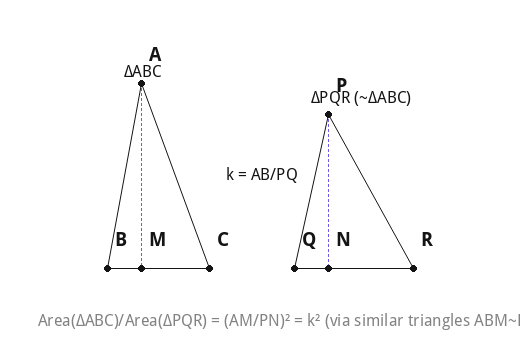
Q2. (Reverse-engineering, fresh numbers) In ΔABC, D is on AB with AD = ¼AB, and DE∥BC meets AC at E. If Area(ΔABC) = 96 cm², find Area(ΔADE).
DE∥BC ⇒ ΔADE~ΔABC (AA), with ratio AD/AB = 1/4. By Q1’s result, Area(ΔADE)/Area(ΔABC) = (1/4)² = 1/16.
Area(ΔADE) = 96/16 = 6 cm².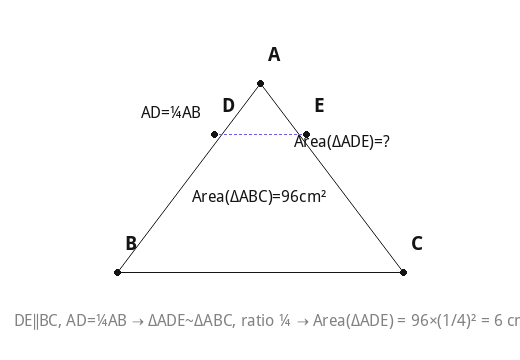
Q3. (Assertion-Reason) Assertion (A): If AB/DE = BC/EF = CA/FD for ΔABC and ΔDEF, then ΔABC~ΔDEF. Reason (R): if the three sides of one triangle are proportional to the three sides of another, the two triangles are similar by the SSS similarity criterion.
The Assertion is precisely a restatement of the SSS similarity criterion, and the Reason states that exact criterion. Both A and R are true, and R is the correct explanation of A.
Q4. (Multi-part word problem, fresh numbers) A vertical stick 12 m long casts a shadow 8 m long at the same time a tower casts a shadow 40 m long. Find the tower’s height. If the tower’s height is later reduced by 25%, find its new shadow length at the same time of day.
Height/shadow ratio is constant at a given time: 12/8 = h/40 ⇒ h = 60 m.
After a 25% reduction: new height = 60 × 0.75 = 45 m. New shadow = 45 × (8/12) = 30 m.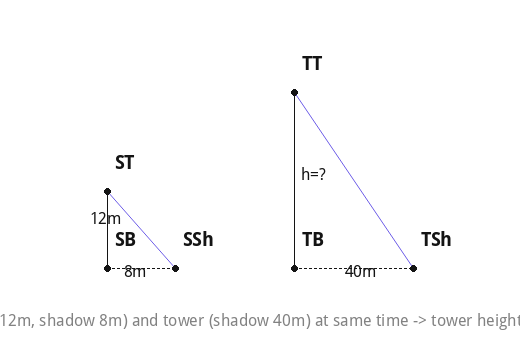
Q5. (Applied Pythagoras-via-similar-triangles problem) Two vertical poles of heights 8 m and 12 m stand 15 m apart on level ground. Find the distance between their tops.
Draw a horizontal line from the top of the shorter pole to the taller pole, forming a right triangle with legs equal to the horizontal distance (15 m) and the height difference (12−8 = 4 m).
Distance between tops = √(15²+4²) = √(225+16) = √241 ≈ 15.5 m.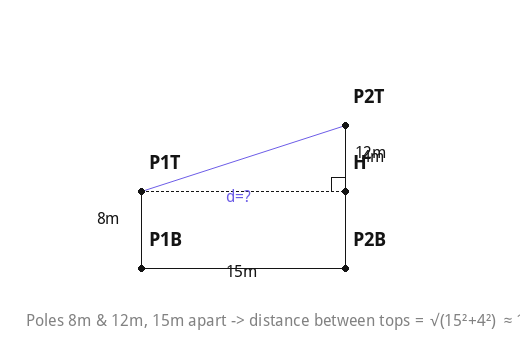
Q6. (Classical proof, beyond the current exercise) Using similar triangles, prove the Pythagoras theorem: in a right triangle, the square of the hypotenuse equals the sum of squares of the other two sides.
Let ΔABC be right-angled at B, with BD⊥AC (D on AC).
In ΔADB and ΔABC: ∠ADB=∠ABC=90°, ∠A common ⇒ ΔADB~ΔABC ⇒ AD/AB=AB/AC ⇒ AB²=AD·AC …(1)
In ΔBDC and ΔABC: ∠BDC=∠ABC=90°, ∠C common ⇒ ΔBDC~ΔABC ⇒ CD/BC=BC/AC ⇒ BC²=CD·AC …(2)
Adding (1) and (2): AB²+BC² = AD·AC+CD·AC = AC(AD+CD) = AC·AC = AC². Proved — this similar-triangles method was Exercise 6.5 before the 2023 rationalisation folded it into the chapter’s explanatory content.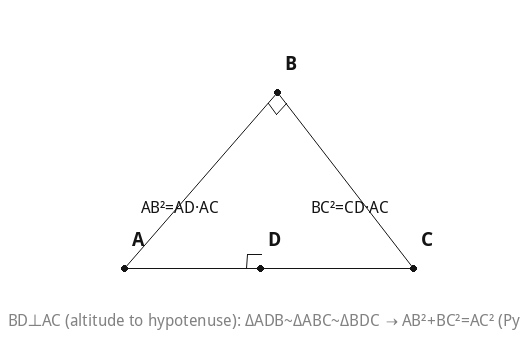
See also: Revision Notes | Formulas Handbook
Class 10 Mathematics Chapter 6 – Solutions and Notes
For complete step-by-step answers and a quick summary, check the Class 10 Mathematics Chapter 6 Solutions and Class 10 Mathematics Chapter 6 Revision Notes.

- Chapter 1: Real Numbers
- Chapter 2: Extra Questions - Polynomials (HOTS)
- Chapter 3: Pair of Linear Equations in Two Variables
- Chapter 4: Quadratic Equations
- Chapter 5: Arithmetic Progressions
- Chapter 7: Coordinate Geometry
- Chapter 8: – Introduction to Trigonometry
- Chapter 9: Extra Questions - Some Applications of Trigonometry (HOTS)
- Chapter 10: Extra Questions - Circles (HOTS)
- Chapter 11: Areas Related to Circles Extra Questions (HOTS)
- Chapter 12: Surface Areas and Volumes Extra Questions (HOTS)
- Chapter 13: Statistics Extra Questions (HOTS)
- Chapter 14: Probability Extra Questions (HOTS)

