
Class 10 Science Chapter 8 – Heredity: NCERT Solutions
Chapter 8 of Class 10 Science covers Heredity — how traits pass from parents to offspring. Under the 2023 curriculum rationalisation, the Evolution portion of the earlier combined “Heredity” chapter was removed from the CBSE syllabus, and the chapter was renumbered and retitled simply Heredity. The solutions below cover the core heredity concepts and the well-established textbook-exercise question types for this topic.
Last Updated: October 24, 2026
How to Approach This Chapter
Before working out a cross, write the parent genotypes clearly and set up a Punnett square rather than reasoning through ratios in your head — most errors come from a setup mistake, not misunderstanding dominance. Keep genotype and phenotype as two separate answers when both are asked for.
Why this chapter matters for boards
Heredity is a high-frequency topic for both objective (MCQ/assertion-reason) and short-answer board questions — monohybrid/dihybrid cross ratios, dominant/recessive traits, and the XX/XY sex-determination mechanism appear almost every year.
Textbook-style Exercise Solutions
- Q1. If a trait A exists in 10% of a population of an asexually reproducing species and trait B exists in 60% of the same population, which trait likely arose earlier?
Answer: Trait B likely arose earlier. In an asexually reproducing population, a trait that has existed for a longer time has had more generations to spread and accumulate; a higher percentage generally indicates an older origin (assuming no unusual selection pressure against it). - Q2. How does the creation of variation in a species promote survival?
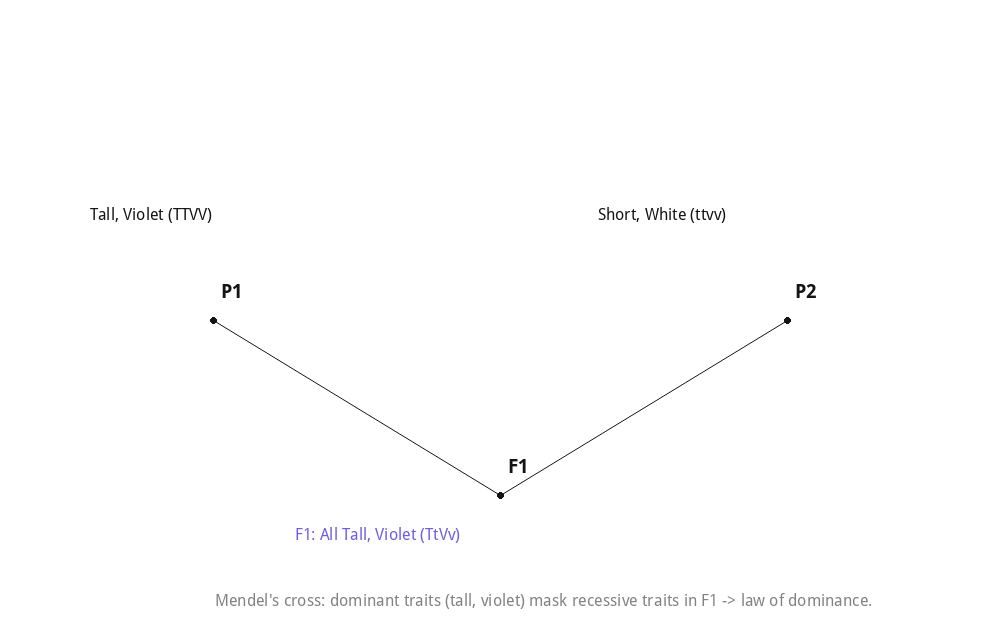
Answer: Variations arise during reproduction due to differences in DNA copying. Most are neutral, but some help individuals survive drastic environmental changes (for example, a variant bacterium that tolerates higher temperature survives a heat wave that kills the rest of the population). This lets the species survive changing conditions even though individuals without the helpful variation may die out. - Q3. In a cross between tall, violet-flowered pea plants and short, white-flowered pea plants, all F1 offspring were tall with violet flowers. What does this tell us about the inheritance of height and flower colour?
Answer: Tallness and violet colour are dominant traits (each fully expressed in F1). Because both dominant traits appeared together and the two traits segregate independently in later generations, the genes controlling height and flower colour are inherited independently of each other — Mendel’s Law of Independent Assortment.
- Q4. How is the sex of a child determined in human beings?
Answer: Humans have 23 pairs of chromosomes; one pair are the sex chromosomes. Every egg carries an X chromosome, but sperm carry either an X or a Y chromosome in equal proportion. If an X-carrying sperm fertilises the egg the child is female (XX); if a Y-carrying sperm fertilises the egg the child is male (XY). The father’s sperm therefore determines the child’s sex, with a natural probability close to 50:50. - Q5. A mother with blood group A and a father with blood group O have a child who could be either group A or group O. What does this depend on?
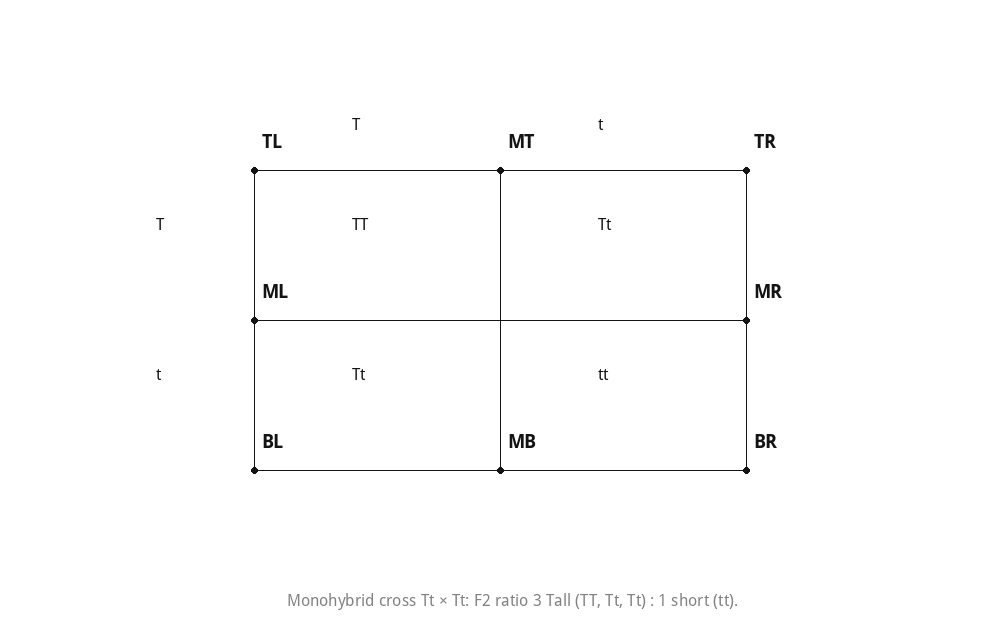
Answer: It depends on the mother’s genotype. The IA allele is dominant over i. If the mother is homozygous (IAIA), all children get an IA allele and are group A. If heterozygous (IAi), she can pass either IA or i; combined with the father’s i allele (group O is ii), the child is A (IAi) or O (ii) with equal probability. - Q6. What is a monohybrid cross, and what phenotypic ratio does it produce in the F2 generation?
Answer: A monohybrid cross studies inheritance of a single trait (e.g. tall x short). Self-pollinating F1 (all tall, Tt) gives an F2 ratio of 3 tall : 1 short (genotypic 1 TT : 2 Tt : 1 tt). - Q7. What phenotypic ratio does a dihybrid cross produce in F2, and why?
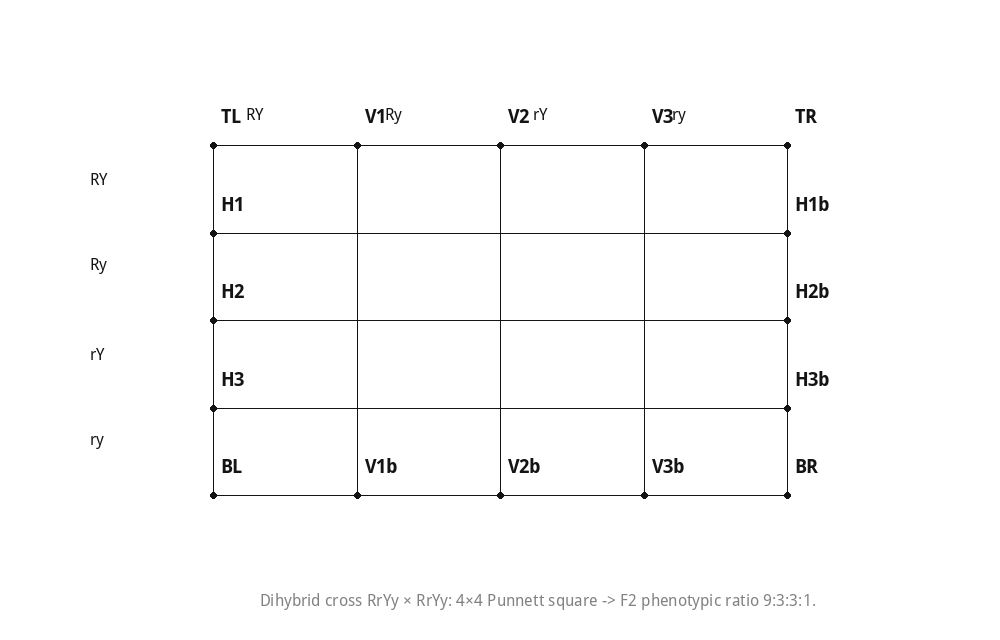
Answer: A dihybrid cross tracks two traits together (e.g. round-yellow x wrinkled-green seeds). The F2 ratio is 9:3:3:1, because the two genes assort independently during gamete formation. - Q8. Why are traits acquired during an individual’s lifetime (like a strong body built by exercise) generally not passed on to offspring?
Answer: Only changes in the DNA of germ cells (egg/sperm) are inherited. Acquired traits affect body cells (somatic cells) but not germ-cell DNA, so they are not transmitted to the next generation. - Q9. Give an example showing how a dominant trait can remain hidden in one generation and reappear in the next.
Answer: If both parents are heterozygous Tt (tall, since T is dominant), all are phenotypically tall, but the recessive short trait (tt) is hidden. Crossing two Tt parents can produce a short (tt) offspring in a 1-in-4 ratio, showing the recessive trait re-emerging after being masked.
Note on scope: some question numbers/wording in third-party solution sets for this chapter show minor inconsistencies after the 2023 rationalisation (which removed the Evolution section); the nine questions above cover the core, stable Heredity concepts confirmed across multiple current sources.
CBSE Exam Weightage
This chapter falls under Unit II: World of Living in the CBSE Class 10 Science board exam syllabus. This unit typically carries around 25 marks (31.25%) of the 80-mark theory paper, based on CBSE’s published unit-wise weightage (Question Paper Design). CBSE sets weightage at the unit level rather than chapter-by-chapter, so the exact share from this specific chapter can vary a little between years and sample papers.
Chapter Quiz — Test Your Understanding
Class 10 Science Chapter 8 – Notes and Extra Questions
Along with these NCERT Solutions, students can also use the Class 10 Science Chapter 8 Extra Questions and Class 10 Science Chapter 8 Revision Notes for quick revision and extra practice.
Related
- Chapter 1: Chemical Reactions and Equations – Free PDF Download
- Chapter 2: Acids, Bases and Salts – Free PDF Download
- Chapter 3: Metals and Non-metals – Free PDF Download
- Chapter 4: Carbon and its Compounds – Free PDF Download
- Chapter 5: Life Processes – Free PDF Download
- Chapter 6: Control and Coordination – Free PDF Download
- Chapter 7: How do Organisms Reproduce? (2026-27) – Free PDF Download
- Chapter 9: Light - Reflection and Refraction – Free PDF Download
- Chapter 10: The Human Eye and the Colourful World (2026-27) – Free PDF Download
- Chapter 11: Electricity (2026-27) – Free PDF Download
- Chapter 12: Magnetic Effects of Electric Current (2026-27)
- Chapter 13: Our Environment – Free PDF Download
FAQs
Q: Is Evolution part of the Class 10 Heredity chapter now?
No. Since the 2023 CBSE/NCERT syllabus rationalisation, the Evolution portion was removed and the chapter (previously “Heredity”) was renamed to simply “Heredity”; it now focuses on Mendelian genetics and sex determination.
Q: What is the F2 ratio for a dihybrid cross?
9:3:3:1.
Recommended: Buy the Printed NCERT Class 10 Science Book
Contains Amazon affiliate links.
If you’d like a printed copy alongside the PDF, here’s a verified option:
Check the latest price on Amazon
Price and availability may change on Amazon. As an Amazon Associate, ncertbooks.org earns from qualifying purchases.



Pingback: Class 10 Science Chapter 8 Extra Questions HOTS - Heredity