
Chapter 6 — Control and Coordination covers how the nervous system and hormones let organisms sense and respond to their environment. Below are complete, original answers to all 12 end-of-chapter exercise questions from the current 2026-27 NCERT textbook.
Last Updated: October 24, 2026
How to Approach This Chapter
n
Start with the neuron and synapse structure since every reflex-arc and nervous-system question builds on it — get the direction of the nerve impulse (dendrite to axon terminal, across the synaptic gap via chemicals) fixed first. Solve the hormone-based questions as a table exercise (gland, hormone, function, effect of deficiency/excess) rather than as separate scattered facts — this chapter rewards structured recall over rote sentences.
n
NCERT Solutions for Class 10 Science Chapter 6: Control and Coordination
Q1. Which of the following is a plant hormone? (a) Insulin (b) Thyroxin (c) Oestrogen (d) Cytokinin
(d) Cytokinin — the other three are animal hormones (insulin from the pancreas, thyroxin from the thyroid, oestrogen from the ovary).
Q2. The gap between two neurons is called a (a) Dendrite (b) Synapse (c) Axon (d) Impulse
(b) Synapse — the junction where a neuron’s axon terminal releases chemical neurotransmitters to signal the next neuron.
Q3. The brain is responsible for (a) thinking (b) regulating heartbeat (c) balancing the body (d) all of the above
(d) All of the above — the cerebrum handles thinking, the medulla regulates heartbeat/breathing, and the cerebellum manages balance.
Q4. What is the function of receptors in our body? Think of situations where receptors do not work properly — what problems are likely to arise?
Receptors are specialised nerve endings/cells (mainly in sense organs) that detect specific stimuli — light (eye), sound (ear), smell (nose), taste (tongue), touch/temperature/pain (skin) — and convert them into nerve impulses sent to the central nervous system. If receptors are damaged (e.g. retinal damage, nerve damage in skin), the body loses the ability to sense that particular stimulus properly — leading to problems like impaired vision or hearing, loss of taste/smell, or a dangerous inability to feel pain/heat, which can lead to unnoticed injuries.
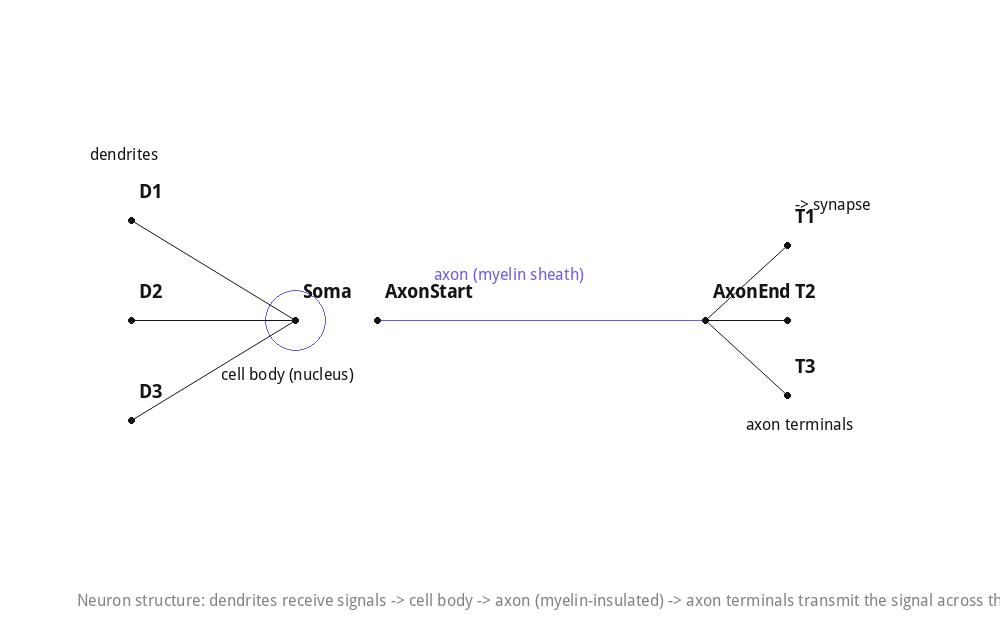
Q5. Draw the structure of a neuron and explain its function.
A neuron has: dendrites (branched fibres that receive signals), a cell body (contains the nucleus), an axon (a long fibre, often insulated, that carries the impulse away from the cell body), and axon terminals/synaptic knobs at the end (release neurotransmitter chemicals across the synapse to the next neuron or effector). Function: a stimulus is detected, converted into an electrical impulse at the dendrite end, the impulse travels along the axon, and a chemical signal crosses the synapse to pass the message on.
Q6. How does phototropism occur in plants?
Phototropism (bending towards light) happens because the plant hormone auxin, produced at the shoot tip, moves to and accumulates more on the shaded side of the shoot. Higher auxin concentration promotes more cell elongation on that shaded side than on the lit side, causing the shoot to bend towards the light source.
Q7. Which signals will get disrupted in the case of a spinal cord injury?
A spinal cord injury disrupts the two-way flow of nerve signals passing through the injury site — sensory signals travelling up from the body to the brain, and motor signals travelling down from the brain to the body, are both blocked below the point of injury. This affects both voluntary movement and sensation in that region, though simple reflexes controlled entirely at a spinal segment below the injury may sometimes still function if that local reflex arc itself is intact.
Q8. How does chemical coordination occur in plants?
Plants lack a nervous system, so they coordinate using chemical messengers called phytohormones, which diffuse through plant tissue to target cells: auxin (growth, phototropism), gibberellin (stem elongation), cytokinin (cell division), abscisic acid (growth inhibitor, stress/wilting response), and ethylene (fruit ripening).
Q9. What is the need for a system of control and coordination in an organism?
Organisms constantly face changes in their environment (light, temperature, danger, food availability). A control-and-coordination system lets different organs/cells sense such changes and respond together in a timely, appropriate way — rather than each part reacting independently or not at all — which is essential for survival, movement, and maintaining a stable internal environment.
Q10. How are involuntary actions and reflex actions different from each other?
Involuntary actions are automatic, often continuous, and not consciously controlled (e.g. heartbeat, breathing, peristalsis) — usually regulated by the medulla in the hindbrain. Reflex actions are sudden, rapid, involuntary responses to a specific, often sudden stimulus (e.g. pulling a hand away from something hot), carried out via a fast reflex arc through the spinal cord without waiting for the brain’s conscious decision. Both are involuntary, but a reflex is a rapid one-off stimulus-response event, while many involuntary actions are ongoing background processes.
Q11. Compare and contrast nervous and hormonal mechanisms for control and coordination in animals.
Nervous: uses electrical impulses through neurons, acts very fast, effect is usually short-lived and localised (e.g. reflexes, movement). Hormonal: uses chemical messengers carried by the bloodstream, acts more slowly, but the effect is longer-lasting and can be widespread across the body (e.g. growth, metabolism, long-term stress response). The two systems work together for complete, well-timed coordination in animals.
Q12. What is the difference between the movement in a sensitive plant (like Mimosa) and the movement in our legs?
In a sensitive plant, touching a leaf causes a rapid change in water content (turgor pressure) in special motor cells (the pulvinus), making the leaf fold — this is a quick, non-directional, non-growth movement with no nervous system involved. Movement in our legs instead uses muscles pulling on bones across joints, actively controlled by nerve impulses from the nervous system — a directional, much faster, and precisely coordinated locomotor movement.
Why This Chapter Matters for Boards
Control and Coordination is a high-yield chapter for both MCQs and long-answer diagram/comparison questions (neuron structure, reflex arc, nervous vs hormonal coordination) and links directly into Heredity and Life Processes in later chapters of this same textbook.
Extra Questions (HOTS) | Revision Notes | Formulas Handbook | Class 10 Science Book
CBSE Exam Weightage
This chapter falls under Unit II: World of Living in the CBSE Class 10 Science board exam syllabus. This unit typically carries around 25 marks (31.25%) of the 80-mark theory paper, based on CBSE’s published unit-wise weightage (Question Paper Design). CBSE sets weightage at the unit level rather than chapter-by-chapter, so the exact share from this specific chapter can vary a little between years and sample papers.
Chapter Quiz — Test Your Understanding
Class 10 Science Chapter 6 – Notes and Extra Questions
Along with these NCERT Solutions, students can also use the Class 10 Science Chapter 6 Extra Questions and Class 10 Science Chapter 6 Revision Notes for quick revision and extra practice.
- Chapter 1: Chemical Reactions and Equations – Free PDF Download
- Chapter 2: Acids, Bases and Salts – Free PDF Download
- Chapter 3: Metals and Non-metals – Free PDF Download
- Chapter 4: Carbon and its Compounds – Free PDF Download
- Chapter 5: Life Processes – Free PDF Download
- Chapter 7: How do Organisms Reproduce? (2026-27) – Free PDF Download
- Chapter 8: Heredity – Free PDF Download
- Chapter 9: Light - Reflection and Refraction – Free PDF Download
- Chapter 10: The Human Eye and the Colourful World (2026-27) – Free PDF Download
- Chapter 11: Electricity (2026-27) – Free PDF Download
- Chapter 12: Magnetic Effects of Electric Current (2026-27)
- Chapter 13: Our Environment – Free PDF Download
Frequently Asked Questions
Do I need to know hormone chemical structures for the board exam?
No — the syllabus focuses on the function and role of each hormone (what it does, where it’s made), not its chemical formula.
Recommended: Buy the Printed NCERT Class 10 Science Book
Contains Amazon affiliate links.
If you’d like a printed copy alongside the PDF, here’s a verified option:
Check the latest price on Amazon
Price and availability may change on Amazon. As an Amazon Associate, ncertbooks.org earns from qualifying purchases.
