
Reproduction is the biological process that lets a species continue across generations even though it isn’t essential for any single organism’s own survival. Chapter 7 covers both asexual and sexual reproduction, human reproductive anatomy, and contraception — a regularly-tested chapter in the board exam.
Last Updated: October 24, 2026
How to Approach This Chapter
When answering about asexual reproduction, name the specific method and a clear example together, not just the method in isolation — many marks are lost by giving a correct method without an example or vice versa. For the human reproductive system, learn each organ’s function alongside its position in the diagram.
Textbook exercise (11 questions, 2026-27 edition)
Q1. Asexual reproduction takes place through budding in: (a) Amoeba (b) Yeast (c) Plasmodium (d) Leishmania.
Answer: (b) Yeast — Amoeba and Leishmania reproduce by binary fission, Plasmodium by multiple fission; only yeast among these buds off a small outgrowth that separates as a new individual.
Q2. Which is not part of the female reproductive system: (a) Ovary (b) Uterus (c) Vas deferens (d) Fallopian tube.
Answer: (c) Vas deferens — it carries sperm in the male reproductive system.
Q3. The anther contains: (a) Sepals (b) Ovules (c) Carpel (d) Pollen grains.
Answer: (d) Pollen grains — the anther is the pollen-producing part of the stamen (male part of the flower).
Q4. What are the advantages of sexual reproduction over asexual reproduction?
Answer: Sexual reproduction combines DNA from two parents, producing offspring with genetic variation. This variation is the raw material for a species to adapt to a changing environment — a population with varied individuals is less likely to be wiped out entirely by a single new stress (disease, temperature change), unlike genetically identical asexually-produced clones.
Q5. What functions does the testis perform?
Answer: (1) Produces sperm, the male gametes. (2) Secretes testosterone, the hormone that regulates the development of male secondary sexual characteristics (facial hair, voice change, etc.).
Q6. Why does menstruation occur?
Answer: Each month the uterus lining thickens and becomes blood-vessel-rich to receive and nourish a fertilised egg. If the released egg is not fertilised, this lining is not needed, breaks down, and is shed as blood and tissue through the vagina roughly every 28 days — this shedding is menstruation.
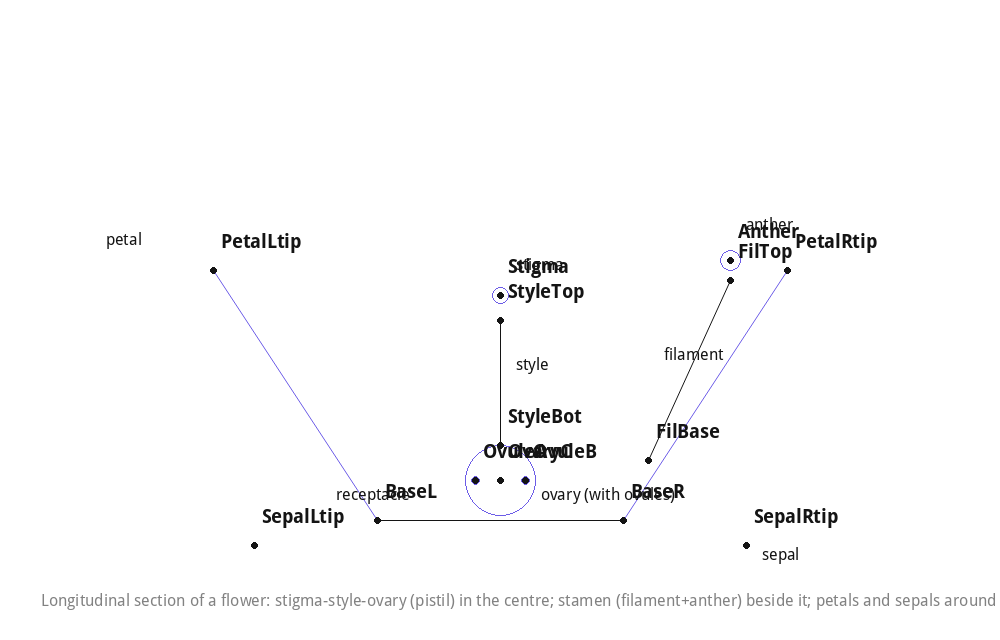
Q7. Draw a labelled diagram of the longitudinal section of a flower.
Answer: Label these parts from outside inward/base to tip: sepal, petal, receptacle (base); stamen — filament and anther (male part); pistil/carpel — stigma, style and ovary containing ovules (female part).
Q8. What are the different methods of contraception?
Answer: Barrier methods (condoms, diaphragms) physically stop sperm reaching the egg; hormonal methods (oral pills) prevent ovulation; intrauterine devices (like the copper-T) prevent implantation; surgical methods (vasectomy in males, tubectomy in females) permanently block the gamete-carrying tubes.
Q9. How are the modes of reproduction different in unicellular and multicellular organisms?
Answer: A unicellular organism is itself a single cell, so ordinary cell division (binary or multiple fission) is enough to produce a complete new organism. A multicellular organism’s body has many specialised, differentiated cell types, so a random body cell dividing cannot recreate the whole organism — reproduction instead relies on specialised reproductive cells/organs (gonads producing gametes, or specific vegetative structures) capable of developing into all the required tissue types.
Q10. How does reproduction help provide stability to populations of species?
Answer: Reproduction continuously replaces individuals lost to death (predation, disease, age), keeping a species’ population size roughly stable across generations. It ensures the continuity of the species over time even though no individual organism needs to reproduce in order to survive itself.
Q11. What could be the reasons for adopting contraceptive methods?
Answer: To avoid unwanted pregnancy, to space births for the health of mother and child, to help manage population growth, and (for barrier methods specifically) to reduce the risk of sexually transmitted infections.
Part of the Class 10 Science Chapter 7 cluster: Solutions | Extra Questions (HOTS) | Revision Notes | Formulas Handbook | Class 10 Science book page.
CBSE Exam Weightage
This chapter falls under Unit II: World of Living in the CBSE Class 10 Science board exam syllabus. This unit typically carries around 25 marks (31.25%) of the 80-mark theory paper, based on CBSE’s published unit-wise weightage (Question Paper Design). CBSE sets weightage at the unit level rather than chapter-by-chapter, so the exact share from this specific chapter can vary a little between years and sample papers.
- Chapter 1: Chemical Reactions and Equations – Free PDF Download
- Chapter 2: Acids, Bases and Salts – Free PDF Download
- Chapter 3: Metals and Non-metals – Free PDF Download
- Chapter 4: Carbon and its Compounds – Free PDF Download
- Chapter 5: Life Processes – Free PDF Download
- Chapter 6: Control and Coordination – Free PDF Download
- Chapter 8: Heredity – Free PDF Download
- Chapter 9: Light - Reflection and Refraction – Free PDF Download
- Chapter 10: The Human Eye and the Colourful World (2026-27) – Free PDF Download
- Chapter 11: Electricity (2026-27) – Free PDF Download
- Chapter 12: Magnetic Effects of Electric Current (2026-27)
- Chapter 13: Our Environment – Free PDF Download
Frequently Asked Questions
What is the difference between asexual and sexual reproduction?
Asexual reproduction involves a single parent and produces genetically identical offspring (e.g. budding in yeast, fragmentation); sexual reproduction involves fusion of male and female gametes from two parents, producing genetically varied offspring.
Why is variation important in a species, and how does reproduction create it?
Variation increases a species’ chance of survival when the environment changes, since some variants are more likely to survive and reproduce; sexual reproduction is the main natural source of variation because offspring inherit a new combination of traits from two different parents.
Chapter Quiz — Test Your Understanding
Class 10 Science Chapter 7 – Notes and Extra Questions
Along with these NCERT Solutions, students can also use the Class 10 Science Chapter 7 Extra Questions and Class 10 Science Chapter 7 Revision Notes for quick revision and extra practice.
Recommended: Buy the Printed NCERT Class 10 Science Book
Contains Amazon affiliate links.
If you’d like a printed copy alongside the PDF, here’s a verified option:
Check the latest price on Amazon
Price and availability may change on Amazon. As an Amazon Associate, ncertbooks.org earns from qualifying purchases.
