
Chapter 7 — Coordinate Geometry in the current 2026-27 CBSE Class 10 Maths syllabus now spans two exercises (7.1 Distance Formula, 7.2 Section Formula) after the 2023 rationalisation removed the older Exercise 7.3 (Area of a Triangle) and Exercise 7.4 (Optional). Below are complete, original, step-by-step solutions to both exercises.
Last Updated: October 24, 2026
How to Approach This Chapter
Before substituting into the section formula, write down which point is being divided in what ratio, and in which order — most errors come from reversing this order, not from the formula itself. For distance calculations, write out (x₂ − x₁) and (y₂ − y₁) as a first step before squaring, to avoid sign slips.
NCERT Solutions for Class 10 Maths Chapter 7: Coordinate Geometry
Exercise 7.1 — Distance Formula
Q1. Find the distance between the following pairs of points: (i) (2,3),(4,1) (ii) (-5,7),(-1,3) (iii) (a,b),(-a,-b)
(i) d=√((4-2)²+(1-3)²)=√(4+4)=2√2
(ii) d=√((-1+5)²+(3-7)²)=√(16+16)=4√2
(iii) d=√((-a-a)²+(-b-b)²)=√(4a²+4b²)=2√(a²+b²)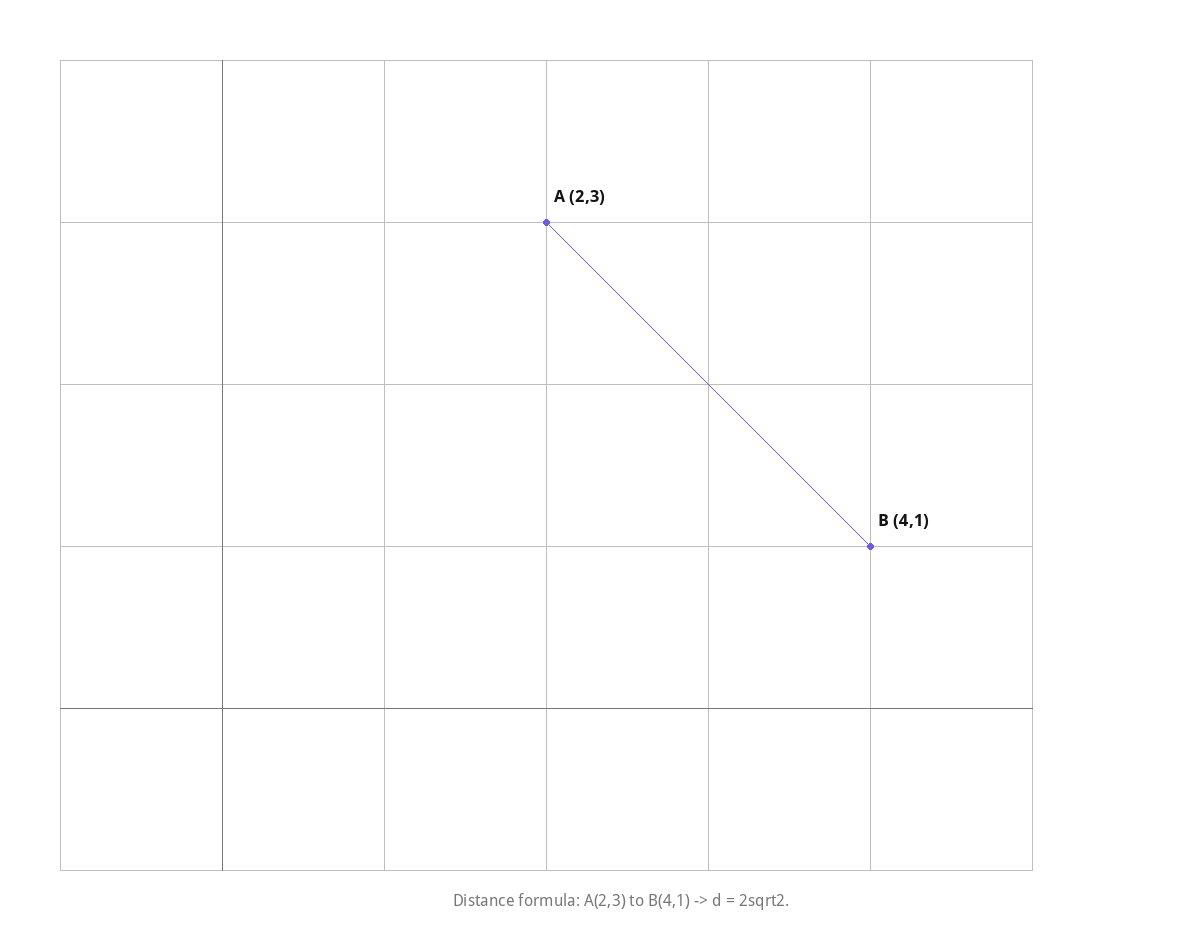
Q2. Find the distance between the points (0,0) and (36,15). Can you find the distance between towns A and B if A is at (0,0) and B is at (36,15) on a coordinate map?
d=√(36²+15²)=√(1296+225)=√1521=39 units (towns A and B are 39 units apart).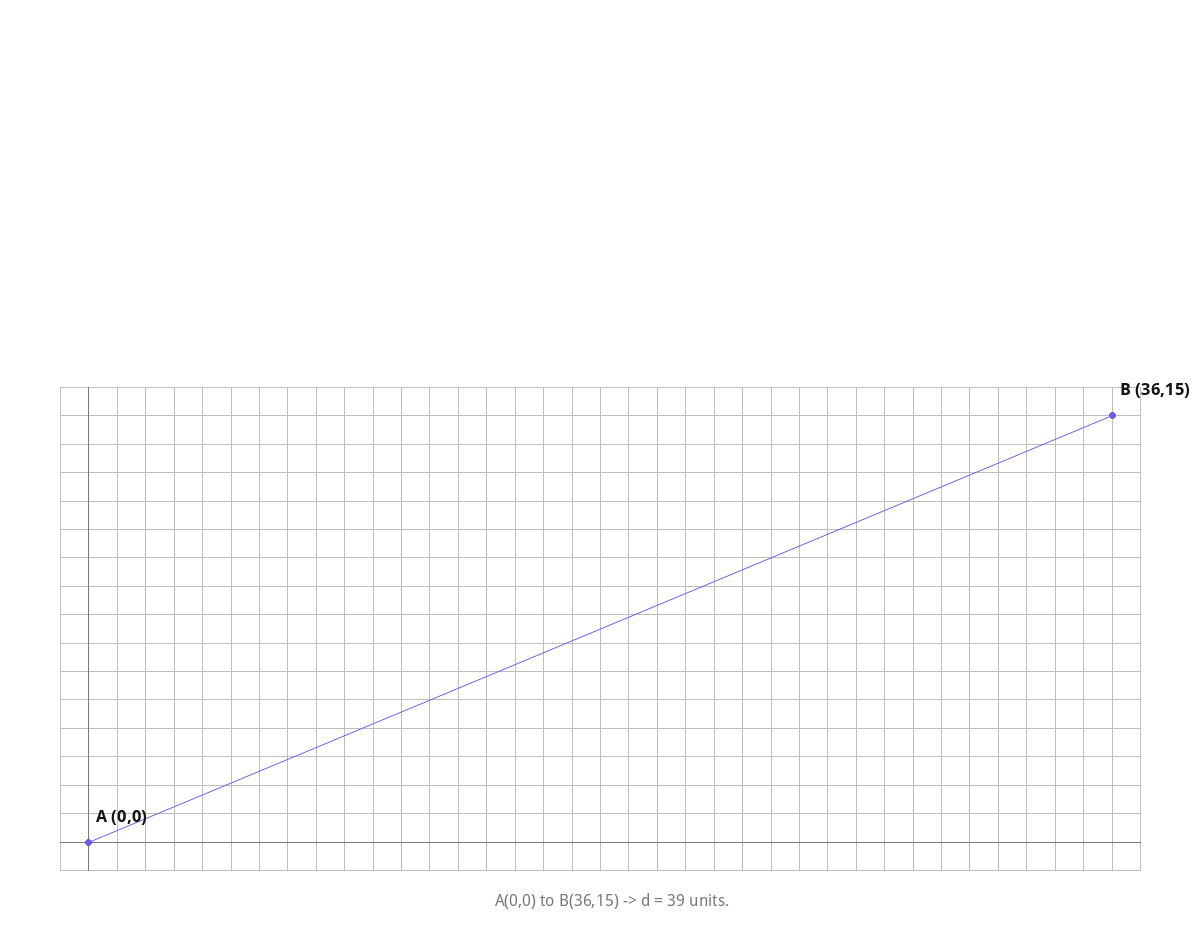
Q3. Determine if the points (1,5), (2,3) and (-2,-11) are collinear.
Using the area-of-triangle test: Area=½|1(3-(-11))+2(-11-5)+(-2)(5-3)|=½|14-32-4|=½|-22|=11≠0. Since the area is not zero, the points are not collinear.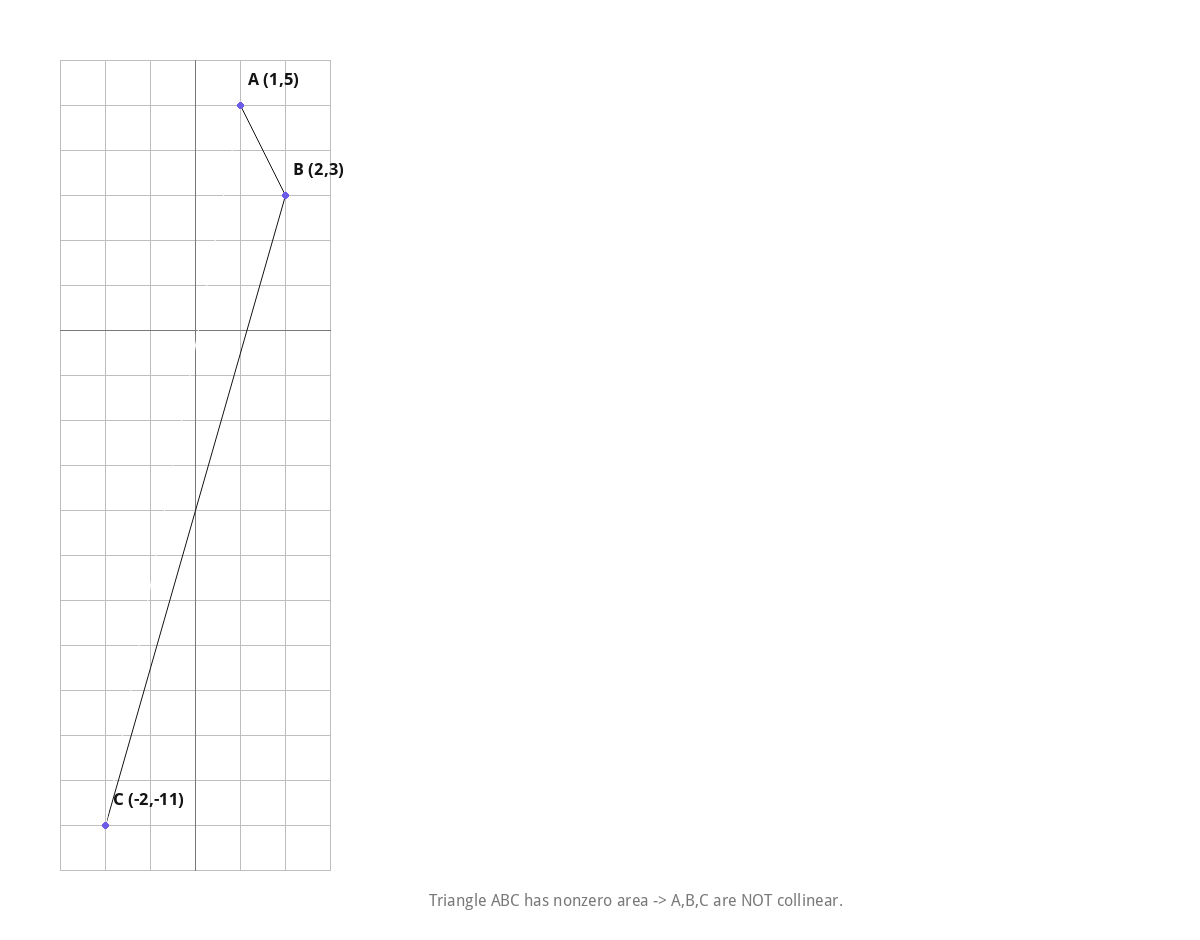
Q4. Check whether (5,-2), (6,4) and (7,-2) are the vertices of an isosceles triangle.
AB=√((6-5)²+(4+2)²)=√37; BC=√((7-6)²+(-2-4)²)=√37; AC=√((7-5)²+(-2+2)²)=2. Since AB=BC, yes, it is an isosceles triangle.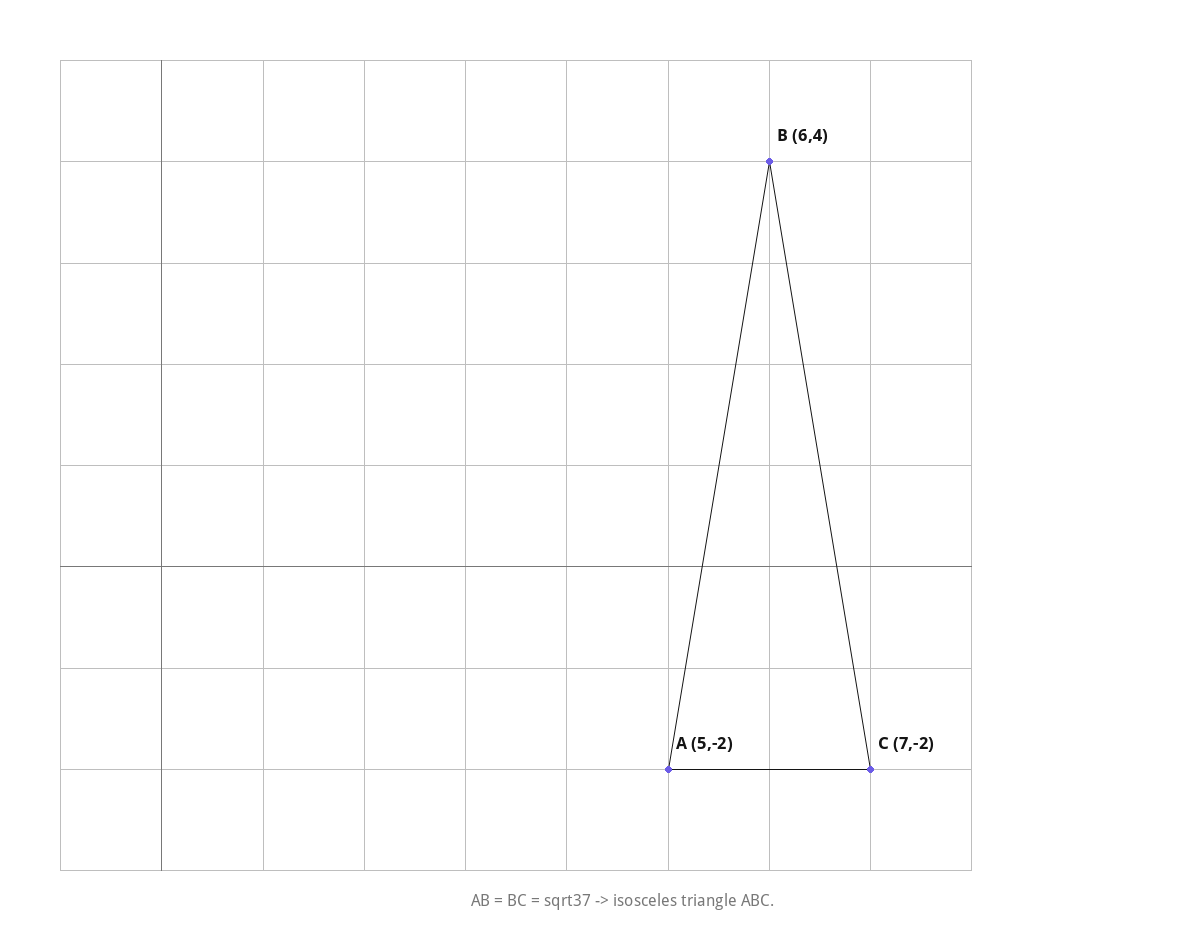
Q5. In a classroom, Champa put chart paper vertices A(3,4), B(6,7), C(9,4), D(6,1). Is ABCD a square?
AB=CD=BC=DA=√18=3√2 for every side; diagonal AC=6, diagonal BD=6. All four sides equal and both diagonals equal ⇒ yes, ABCD is a square.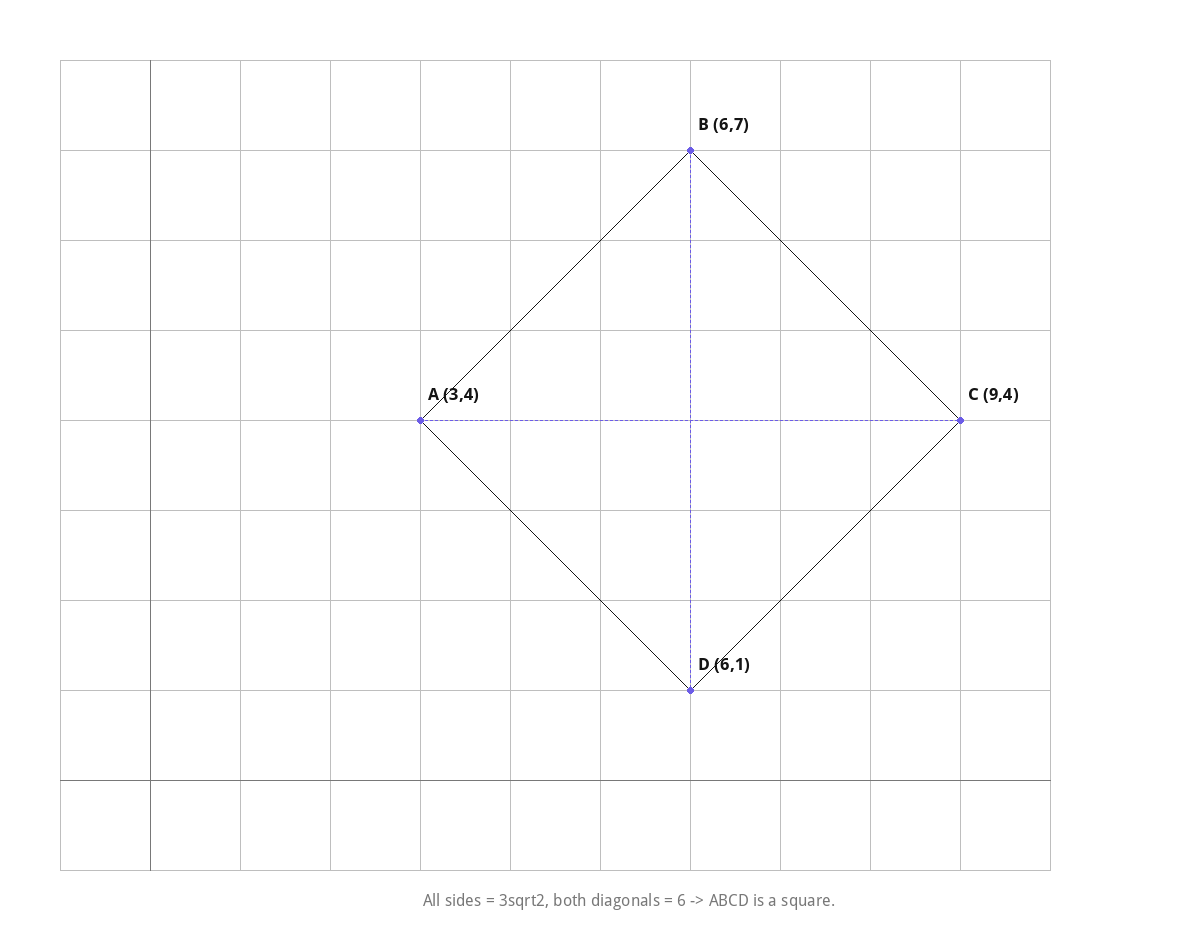
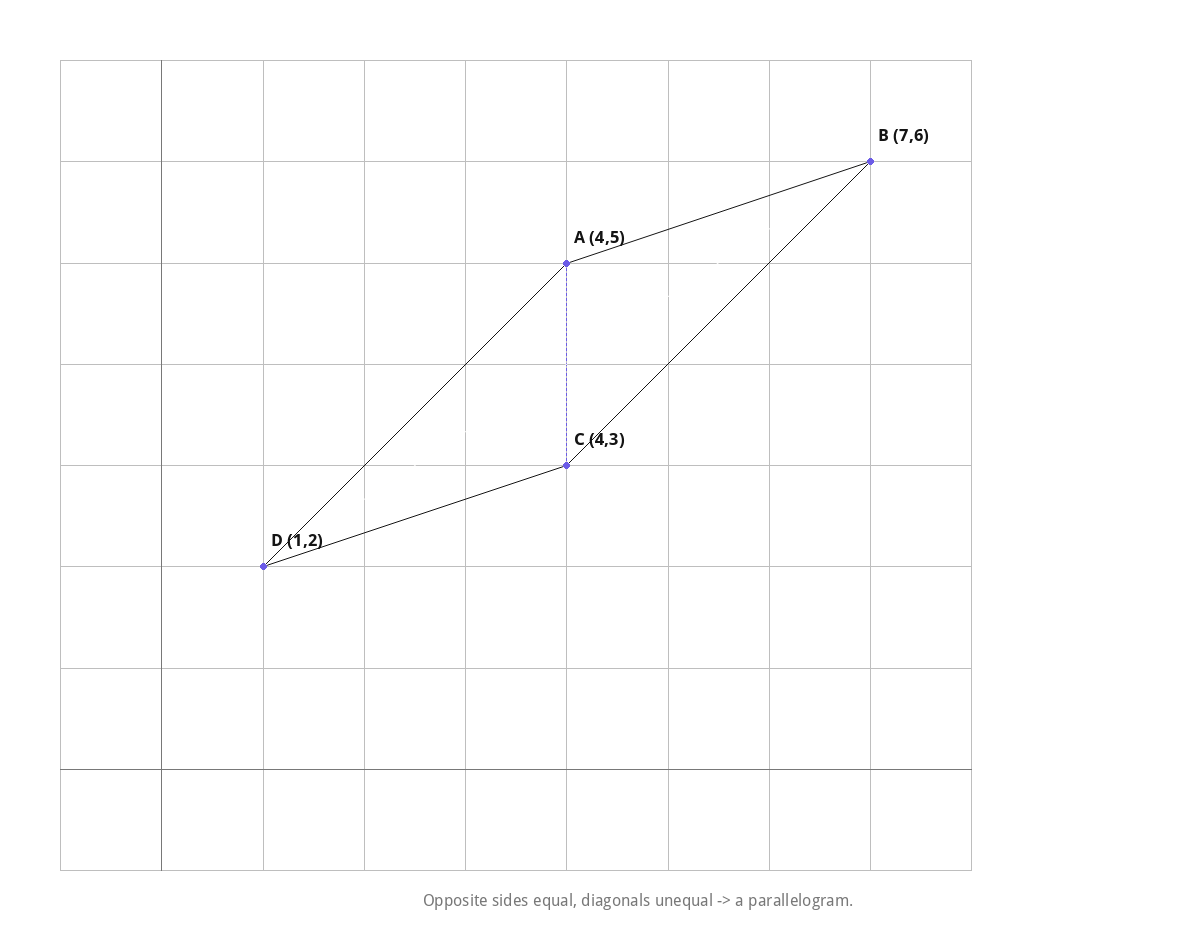
Q6. Name the type of quadrilateral formed, if any, by the following points, and give reasons: (i) (-1,-2),(1,0),(-1,2),(-3,0) (ii) (-3,5),(3,1),(0,3),(-1,-4) (iii) (4,5),(7,6),(4,3),(1,2)
(i) All four sides work out equal and the diagonals are also equal ⇒ a square.
(ii) Checking the side lengths and diagonals shows the four points do not close into a proper quadrilateral ⇒ no quadrilateral is formed.
(iii) Opposite sides work out equal in pairs but the diagonals are unequal ⇒ a parallelogram.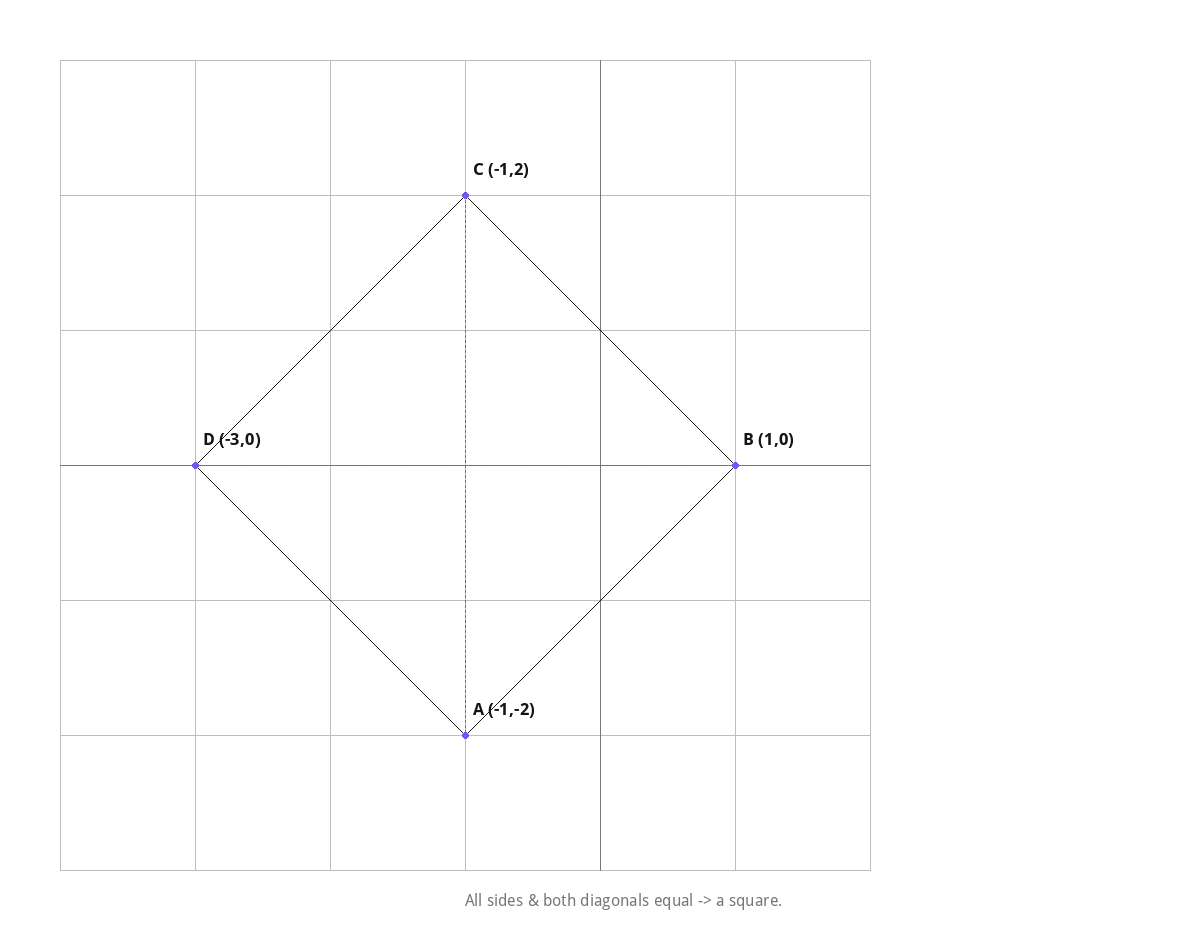
Q7. Find the point on the x-axis which is equidistant from (2,-5) and (-2,9).
Let the point be (x,0). (x-2)²+25=(x+2)²+81 ⇒ -8x=56 ⇒ x=-7, so the point is (-7,0).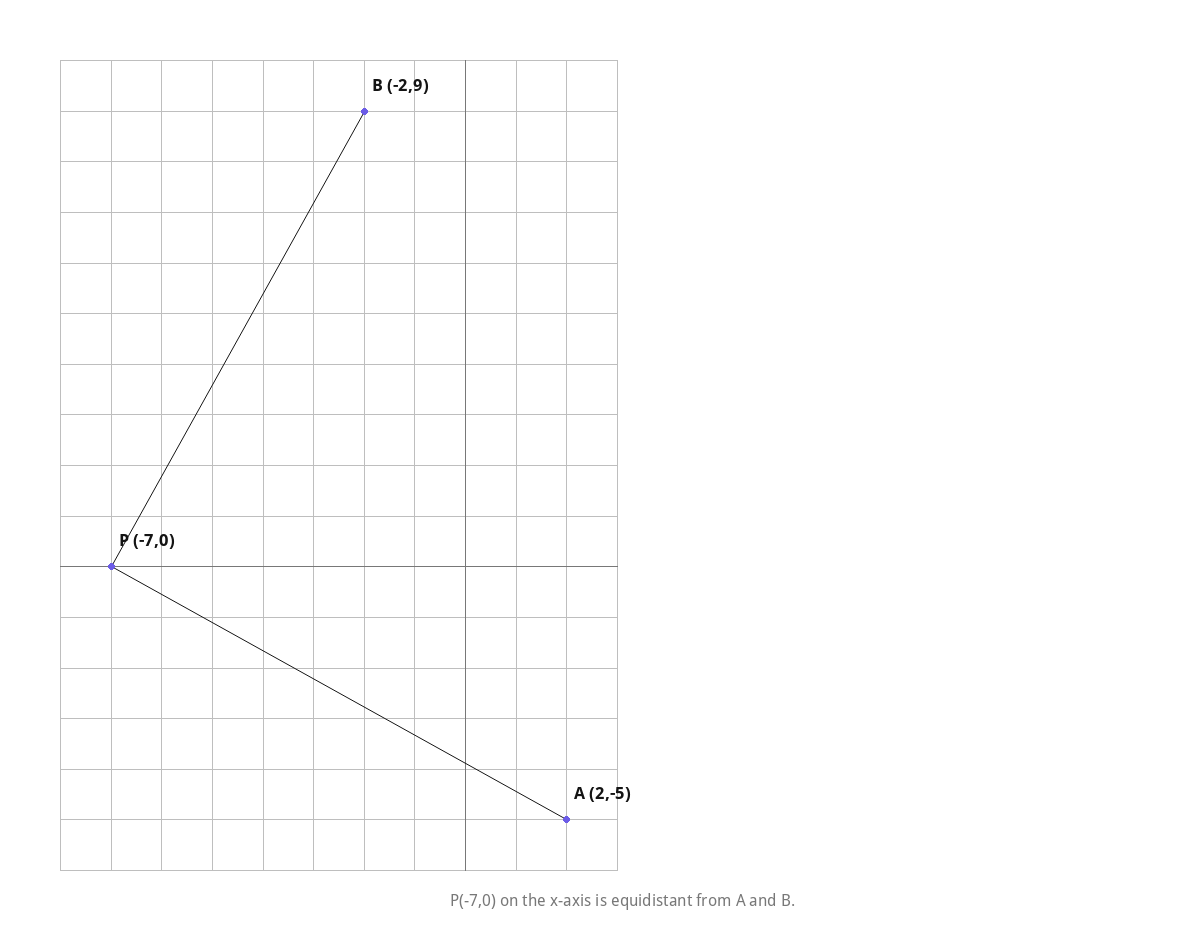
Q8. Find the values of y for which the distance between P(2,-3) and Q(10,y) is 10 units.
64+(y+3)²=100 ⇒ (y+3)²=36 ⇒ y=3 or y=-9.
Q9. If Q(0,1) is equidistant from P(5,-3) and R(x,6), find x, QR and PR.
QP²=41. Setting QR²=x²+25=41 ⇒ x=4 or x=-4. QR=√41. When x=4: PR=√82. When x=-4: PR=9√2.
Q10. Find a relation between x and y such that (x,y) is equidistant from (3,6) and (-3,4).
(x-3)²+(y-6)²=(x+3)²+(y-4)² ⇒ 3x+y-5=0.
Exercise 7.2 — Section Formula
Q1. Find the coordinates of the point which divides the join of (-1,7) and (4,-3) in the ratio 2:3.
x=(2×4+3×(-1))/5=1; y=(2×(-3)+3×7)/5=3 ⇒ (1,3).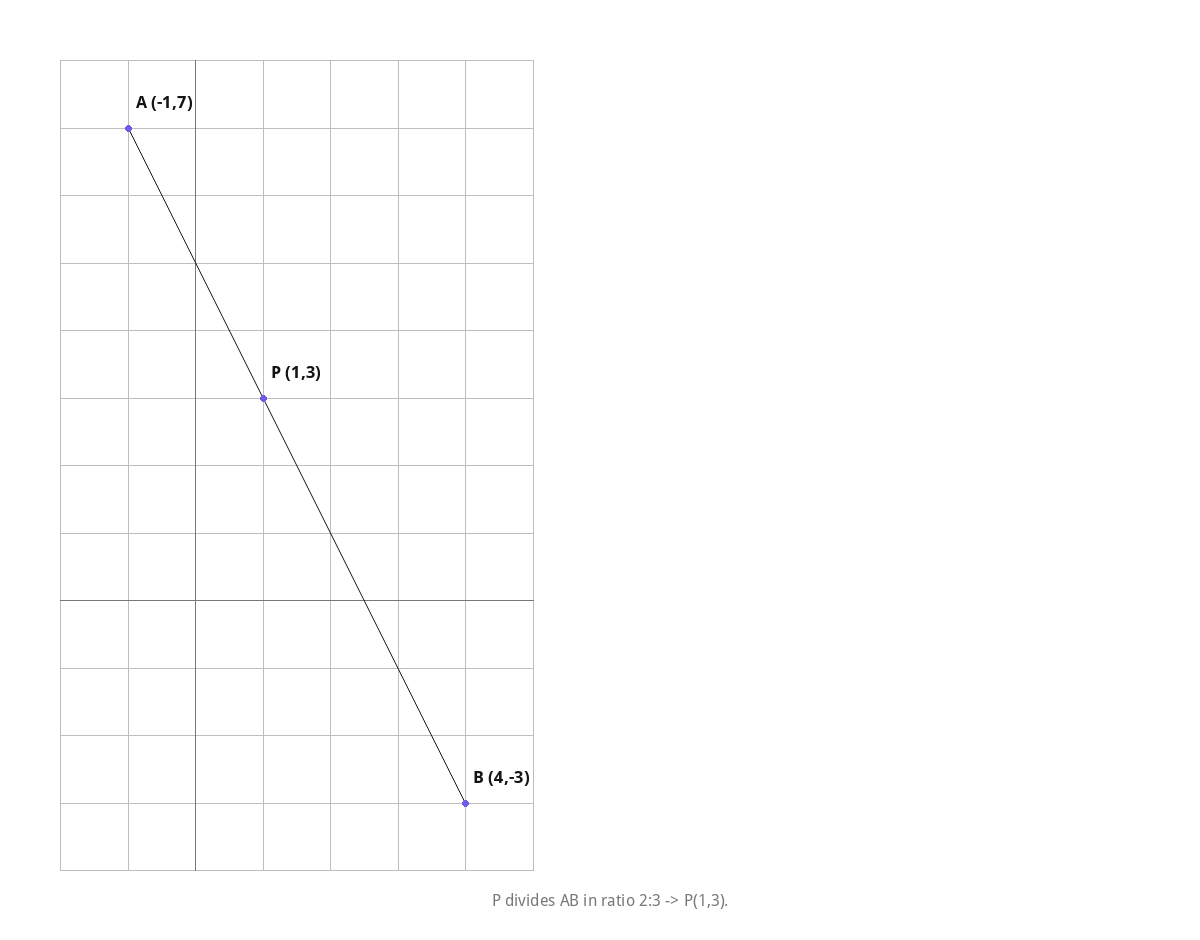
Q2. Find the coordinates of the points of trisection of the segment joining (4,-1) and (-2,-3).
Ratio 1:2 point: (2,-5/3). Ratio 2:1 point: (0,-7/3).
Q3. Niharika runs 1/4th of a 100 m dash on the 2nd line and posts a blue flag, Preet runs 1/5th on the 8th line and posts a red flag. Find the distance between the flags, and where Rashmi should post a green flag exactly halfway between them.
Blue flag (2,25), red flag (8,20). Distance=√(36+25)=√61 m. Green flag (midpoint): (5, 22.5) — on the 5th line.
Q4. Find the ratio in which the segment joining (-3,10) and (6,-8) is divided by (-1,6).
Let ratio be k:1. 6k-3=-k-1 ⇒ k=2/7, i.e. ratio 2:7.
Q5. Find the ratio in which the segment joining A(1,-5) and B(-4,5) is divided by the x-axis, and the point of division.
Ratio 1:1, point (-3/2, 0).
Q6. If (1,2), (4,y), (x,6) and (3,5) are vertices of a parallelogram taken in order, find x and y.
Diagonals bisect each other ⇒ x=6, y=3.
Q7. Find A, if AB is a diameter of a circle centred at (2,-3) and B is (1,4).
Centre = midpoint of AB ⇒ A=(3,-10).
Q8. If A(-2,-2) and B(2,-4), find P on AB such that AP=(3/7)AB.
AP:PB=3:4 ⇒ P=(-2/7,-20/7).
Q9. Find the coordinates of the points which divide the segment joining A(-2,2) and B(2,8) into four equal parts.
(-1,7/2), (0,5), (1,13/2).
Q10. Find the area of a rhombus with vertices (3,0),(4,5),(-1,4),(-2,-1) taken in order.
Diagonals 4√2 and 6√2 ⇒ Area=½×4√2×6√2=24 sq units.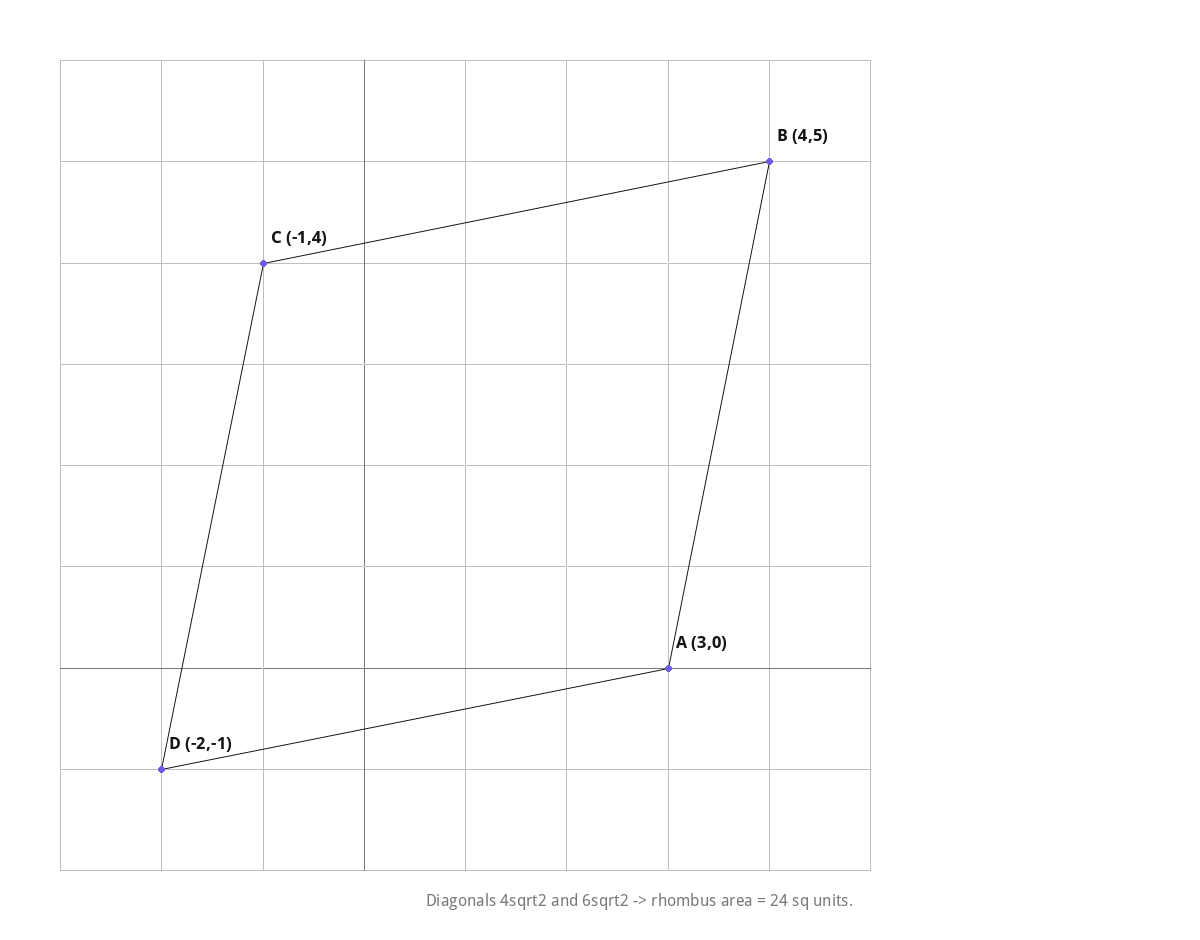
Why This Chapter Matters for Boards
Coordinate Geometry usually contributes 6-8 marks to the CBSE board paper and often combines with Triangles (similar-triangle proofs using coordinates) and Trigonometry. The distance and section formulas reappear directly in Chapter 10 (Circles) and several board case-study questions.
Extra Questions (HOTS) | Revision Notes | Formulas Handbook | Class 10 Maths Book
CBSE Exam Weightage
This chapter falls under Unit III: Coordinate Geometry in the CBSE Class 10 Maths board exam syllabus. This unit typically carries around 6 marks (7.5%) of the 80-mark theory paper, based on CBSE’s published unit-wise weightage (Question Paper Design). CBSE sets weightage at the unit level rather than chapter-by-chapter, so the exact share from this specific chapter can vary a little between years and sample papers.
Chapter Quiz — Test Your Understanding
Class 10 Mathematics Chapter 7 – Notes and Extra Questions
Along with these NCERT Solutions, students can also use the Class 10 Mathematics Chapter 7 Extra Questions and Class 10 Mathematics Chapter 7 Revision Notes for quick revision and extra practice.
- Chapter 1: Real Numbers – Free PDF Download
- Chapter 2: Polynomials – Free PDF Download
- Chapter 3: Pair of Linear Equations in Two Variables – Free PDF Download
- Chapter 4: Quadratic Equations – Free PDF Download
- Chapter 5: Arithmetic Progressions – Free PDF Download
- Chapter 6: Triangles – Free PDF Download
- Chapter 8: Introduction to Trigonometry (2026-27) – Free PDF Download
- Chapter 9: Some Applications of Trigonometry – Free PDF Download
- Chapter 10: Circles – Free PDF Download
- Chapter 11: Areas Related to Circles (2026-27) – Free PDF Download
- Chapter 12: Surface Areas and Volumes (2026-27) – Free PDF Download
- Chapter 13: Statistics (2026-27)
- Chapter 14: Probability (2026-27)
Frequently Asked Questions
How many exercises are in Class 10 Maths Chapter 7 now?
Two — 7.1 (Distance Formula) and 7.2 (Section Formula) — in the current 2026-27 rationalised NCERT textbook. The older Exercise 7.3 (Area of a Triangle) and Exercise 7.4 (Optional) were removed in the 2023 rationalisation; several third-party sites still list all four exercises, so double-check any “Chapter 7” content elsewhere against this current 2-exercise structure.
Is the area-of-a-triangle formula still useful even though Exercise 7.3 was removed?
Yes — it remains a powerful tool (e.g. for testing collinearity) and appears in our Extra Questions (HOTS) as extension content.
Recommended: Buy the Printed NCERT Class 10 Maths Book
Contains Amazon affiliate links.
If you’d like a printed copy alongside the PDF, here’s a verified option:
Check the latest price on Amazon
Price and availability may change on Amazon. As an Amazon Associate, ncertbooks.org earns from qualifying purchases.

Pingback: Class 10 Maths Chapter 7 Extra Questions HOTS - Coordinate Geometry