
Revising the Circles chapter in Class 10 Maths? These notes cover every theorem and result from Chapter 10 in one quick-reference page.
Last Updated: October 24, 2026
Common Mistakes Students Make in Circles
- Forgetting tangent-radius perpendicularity: not using the fact that a tangent is perpendicular to the radius at the point of contact.
- Confusing tangent and secant properties: applying a secant-related result to a tangent line, or vice versa.
- Equal-tangents theorem mix-ups: not correctly identifying which two tangent lengths from an external point are actually equal in a given figure.
- Missing the key construction: not drawing the radius to the point of contact, which is often the step that unlocks a tangent-based proof.
Class 10 Maths Chapter 10 – Revision Notes: Circles
- Tangent: a line that touches a circle at exactly one point (the point of contact); a secant touches it at two points.
- Core theorem 1: the tangent to a circle is perpendicular to the radius at the point of contact.
- Core theorem 2: the lengths of the two tangents drawn from an external point to a circle are equal.
- Tangent-length formula: for a point at distance d from the centre of a circle of radius r, tangent length = √(d²-r²).
- Key results built on the equal-tangent theorem: a parallelogram circumscribing a circle is a rhombus; for a quadrilateral circumscribing a circle, sum of opposite sides are equal (AB+CD=AD+BC).
- Angle result: the angle between two tangents from an external point (∠PTQ) and the angle subtended by the chord of contact at the centre (∠POQ) are supplementary; also ∠PTQ = 2∠OPQ.
- Construction skill: know how to draw a tangent and a secant parallel to a given line.
- Syllabus note (2026-27): 2 exercises — 10.1 (4 questions) and 10.2 (13 questions), 17 questions total.
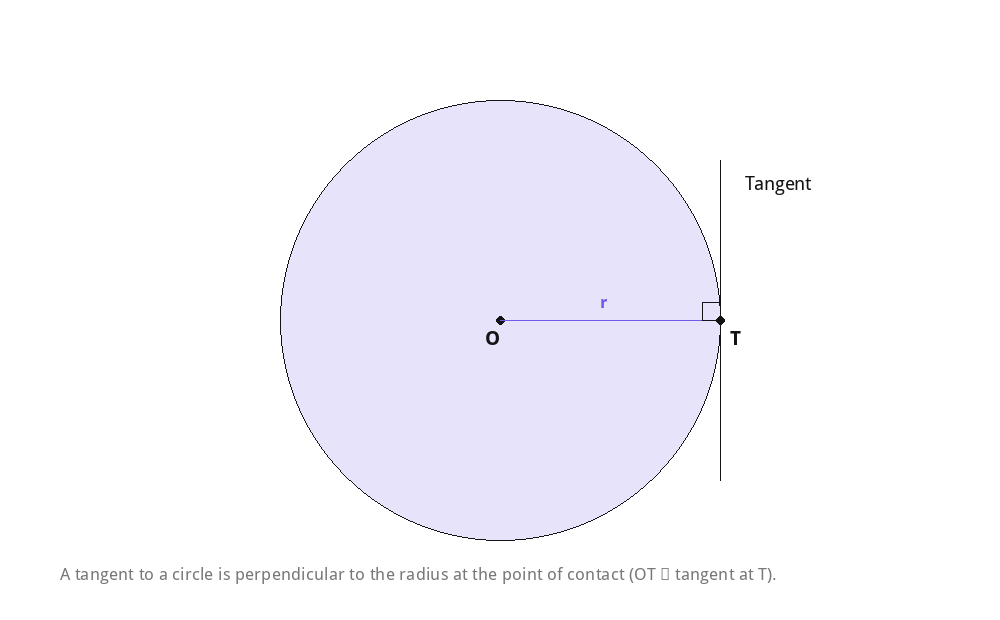 A tangent to a circle touches it at exactly one point and is perpendicular to the radius at that point.
Related
- Chapter 1: Real Numbers
- Chapter 2: Polynomials
- Chapter 3: Pair of Linear Equations in Two Variables
- Chapter 4: Quadratic Equations
- Chapter 5: Arithmetic Progressions
- Chapter 6: Triangles
- Chapter 7: Coordinate Geometry
- Chapter 8: – Introduction to Trigonometry
- Chapter 9: Revision Notes - Some Applications of Trigonometry
- Chapter 11: Areas Related to Circles Revision Notes
- Chapter 12: Surface Areas and Volumes Revision Notes
- Chapter 13: Statistics Revision Notes
- Chapter 14: Probability Revision Notes
Frequently Asked Questions
What is the length of the tangent from an external point to a circle, given the radius and distance to the center?
Using the Pythagorean theorem on the right triangle formed by the radius, the tangent, and the line joining the external point to the center: tangent length = square root of (distance to center squared minus radius squared).
Why is the point of tangency unique for a given tangent line?
Because a tangent touches the circle at exactly one point and does not cross into the circle’s interior — any line that intersects a circle at two points is a secant, not a tangent, which is the defining difference between the two.
Chapter Quiz — Test Your Understanding
Class 10 Mathematics Chapter 10 – Solutions and Important Questions
Need full answers or more practice? See the Class 10 Mathematics Chapter 10 Solutions and Class 10 Mathematics Chapter 10 Extra Questions. These Class 10 Mathematics Chapter 10 notes are ideal for quick revision just before exams.
What to Revise First (and Last) in This Chapter
Prioritise the tangent-radius perpendicularity property and the equal-tangents-from-an-external-point theorem first, since nearly every proof in this chapter uses one of these two facts. Leave more elaborate multi-step proof problems for an earlier, slower revision pass.
Recommended: Buy the Printed NCERT Class 10 Maths Book
Contains Amazon affiliate links.
If you’d like a printed copy alongside the PDF, here’s a verified option:
Check the latest price on Amazon
Price and availability may change on Amazon. As an Amazon Associate, ncertbooks.org earns from qualifying purchases.


