
Class 10 Maths Chapter 10 Extra Questions (HOTS Level) – Circles
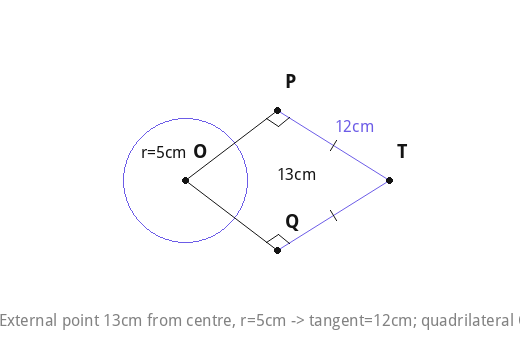
- Q1 (Fresh-number application). From an external point 13 cm from the centre of a circle of radius 5 cm, two tangents are drawn. Find the length of each tangent and the area of the quadrilateral formed by the two tangents and the two radii to the points of contact.
Answer: Tangent length = √(13²-5²) = √144 = 12 cm. The quadrilateral (centre, external point, two points of contact) splits into 2 right triangles each with legs 5 and 12, area = ½(5)(12) = 30 each, total area = 60 cm².
- Q2 (General/abstract proof). Prove that if two tangents are drawn to a circle from an external point, they are equally inclined to the line segment joining the point to the centre.
Proof: In triangles OPT and OQT (O=centre, T=external point, P,Q=points of contact): OP=OQ (radii), OT=OT (common), ∠OPT=∠OQT=90°. By RHS congruence, triangle OPT ≅ triangle OQT, so ∠OTP = ∠OTQ — the tangents are equally inclined to OT. Proved. - Q3 (Reverse-engineering). Two tangents from an external point to a circle include an angle of 60° between them. If the tangent length is 4√3 cm, find the radius.
Answer: Since ∠PTQ=60°, using Q7’s result from the Solutions post, ∠OPQ = 30°. In right triangle OPT, tan(30°) = OP/PT, so OP = PT × tan30° = 4√3 × 1/√3 = 4 cm. - Q4 (Assertion-Reason). Assertion (A): A parallelogram circumscribing a circle is always a rhombus.
Reason (R): The lengths of tangents drawn from an external point to a circle are equal.
Options: (a) Both true, R explains A. (b) Both true, R does not explain A. (c) A true, R false. (d) A false, R true.
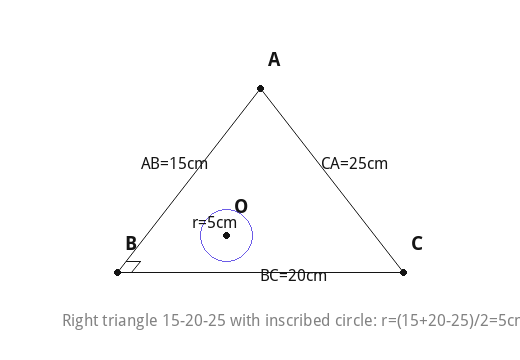
Answer: (a). R is the exact theorem used to derive A (see Solutions Q8) — R correctly explains A. - Q5 (Multi-step word problem, fresh numbers). A circle is inscribed in a triangle with sides 15 cm, 20 cm, and 25 cm (a right triangle since 15²+20²=25²), touching all three sides. Find the radius of the inscribed circle.
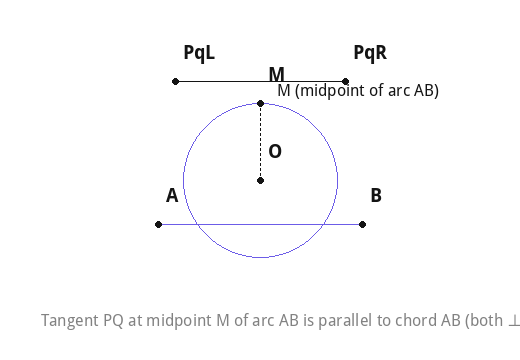
Answer: For a right triangle, inradius r = (a+b-c)/2 where c is the hypotenuse = (15+20-25)/2 = 5 cm. (This uses the same equal-tangent-length reasoning as Solutions Q9, applied to a right-angled triangle where the two legs plus the tangent segments simplify neatly.) - Q6 (General/abstract proof). Prove that if AB is a chord of a circle and PQ is the tangent at the midpoint of the arc AB, then PQ is parallel to AB.
Proof: Let M be the midpoint of arc AB, so arc AM = arc MB, meaning chords AM = MB, so M lies on the perpendicular bisector of AB, which also passes through the centre O. The tangent PQ at M is perpendicular to OM (radius-tangent theorem). Since OM is also perpendicular to AB (as the perpendicular bisector), both AB and PQ are perpendicular to the same line OM, hence AB is parallel to PQ. Proved.


Related
Class 10 Mathematics Chapter 10 – Solutions and Notes
For complete step-by-step answers and a quick summary, check the Class 10 Mathematics Chapter 10 Solutions and Class 10 Mathematics Chapter 10 Revision Notes. These Class 10 Mathematics Chapter 10 important questions are handy for last-minute exam practice.
Last Updated: September 10, 2026

📄 Want this offline? Download the free PDF of this page.Download PDF
More Class 10 Mathematics Extra Questions -- Chapter-wise:
- Chapter 1: Real Numbers
- Chapter 2: Extra Questions - Polynomials (HOTS)
- Chapter 3: Pair of Linear Equations in Two Variables
- Chapter 4: Quadratic Equations
- Chapter 5: Arithmetic Progressions
- Chapter 6: Triangles
- Chapter 7: Coordinate Geometry
- Chapter 8: – Introduction to Trigonometry
- Chapter 9: Extra Questions - Some Applications of Trigonometry (HOTS)
- Chapter 11: Areas Related to Circles Extra Questions (HOTS)
- Chapter 12: Surface Areas and Volumes Extra Questions (HOTS)
- Chapter 13: Statistics Extra Questions (HOTS)
- Chapter 14: Probability Extra Questions (HOTS)

