
Class 10 Maths Chapter 9 Extra Questions (HOTS Level)
These higher-order-thinking questions go beyond the standard Exercise 9.1 pattern — general proofs, reverse-engineering, assertion-reason, and multi-step word problems, all with numbers not used in the NCERT textbook exercise. These Class 10 Mathematics Chapter 9 important questions are handy for last-minute exam practice.
Last Updated: October 24, 2026
How to Approach the HOTS Questions in This Chapter
HOTS questions here often involve two different angles observed from the same point, or two different points observing the same object, requiring you to set up and solve two equations together — practice this two-triangle setup rather than only single-triangle problems.
- Q1 (Reverse-engineering). The angle of elevation of a tower’s top from a point 28√3 m from its base is such that its tangent equals 1/√3. Find the tower’s height.
tanθ = 1/√3 means θ = 30°. Height = 28√3 × tan30° = 28√3 × 1/√3 = 28 m.
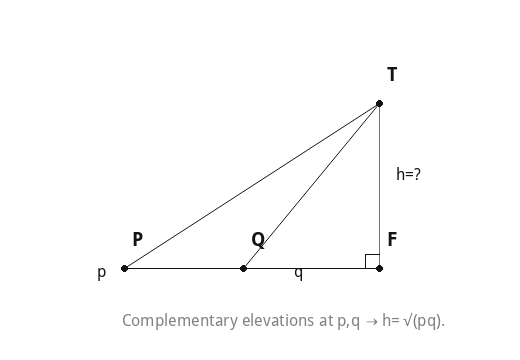
- Q2 (General/abstract proof). From two points at distances p and q (p > q) from a tower’s base, on the same side and in line with it, the angles of elevation are complementary. Prove that the tower’s height is √(pq).
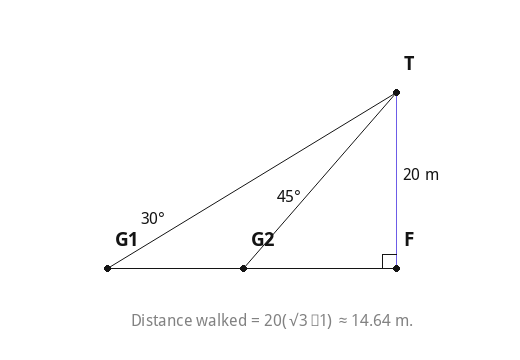
Proof: tanθ = h/q, tan(90°-θ) = cotθ = h/p. Multiplying: tanθ × cotθ = 1 = h²/(pq), so h² = pq, giving h = √(pq). (This generalises the standard textbook result, where p=9, q=4, giving h=6.) - Q3 (Multi-number word problem). A 1.6 m tall boy notices the top of a 21.6 m pillar at 30° elevation, then walks towards it until the elevation is 45°. Find the distance he walked.
Height above eye level = 21.6-1.6 = 20 m. d1 = 20/tan30° = 20√3. d2 = 20/tan45° = 20. Distance walked = 20√3-20 = 20(√3-1) m (approx 14.64 m). - Q4 (Assertion-Reason). Assertion (A): As the sun’s angle of elevation decreases through the afternoon, the shadow of a vertical pole gets longer.
Reason (R): For a pole of fixed height h and sun elevation θ, shadow length = h/tanθ, and tanθ is an increasing function of θ on (0°, 90°).
Options: (a) Both A and R true, R correctly explains A. (b) Both true, R does not explain A. (c) A true, R false. (d) A false, R true.
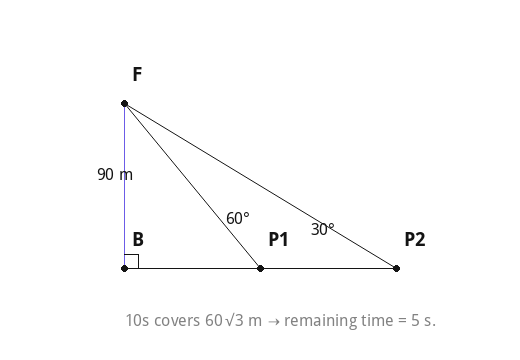
Answer: (a). Since tanθ increases with θ, a smaller θ gives a smaller tanθ, hence a larger shadow length h/tanθ — R correctly explains A. - Q5 (Reciprocal-substitution speed/time, fresh numbers). From the top of a 90 m tower, a car’s angle of depression changes from 30° to 60° in 10 seconds as it approaches at constant speed. Find the further time it takes to reach the tower’s foot.
d1 = 90√3, d2 = 90/√3 = 30√3. Distance covered in 10s = 60√3, speed = 6√3/s. Remaining distance d2 = 30√3, time = 30√3/6√3 = 5 seconds. - Q6 (General two-point formula, proof). A tower’s angle of elevation from a point is θ. After moving a distance ‘a’ towards the tower, the angle becomes φ (φ > θ). Prove the tower’s height is h = a·tanθ·tanφ / (tanφ – tanθ).
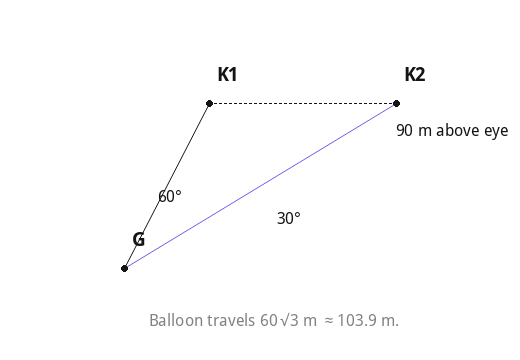
Proof: Let height h, far point at distance d = h/tanθ, near point at distance (d-a), so h = (d-a)tanφ. Equating: d·tanθ = (d-a)tanφ => d(tanφ-tanθ) = a·tanφ => d = a·tanφ/(tanφ-tanθ). Then h = a·tanθ·tanφ / (tanφ – tanθ). Use this general template for any two-position elevation problem, substituting the problem’s own values of a, θ, φ. - Q7 (Multi-number word problem). A 1.5 m tall girl spots a balloon at 91.5 m height; as the balloon drifts away horizontally, the angle of elevation reduces from 60° to 30°. Find the distance the balloon travelled.
Height above eye = 90 m. d1 = 90/tan60° = 30√3. d2 = 90/tan30° = 90√3. Distance = 90√3-30√3 = 60√3 m (approx 103.9 m).

Related
- Chapter 1: Real Numbers
- Chapter 2: Extra Questions - Polynomials (HOTS)
- Chapter 3: Pair of Linear Equations in Two Variables
- Chapter 4: Quadratic Equations
- Chapter 5: Arithmetic Progressions
- Chapter 6: Triangles
- Chapter 7: Coordinate Geometry
- Chapter 8: – Introduction to Trigonometry
- Chapter 10: Extra Questions - Circles (HOTS)
- Chapter 11: Areas Related to Circles Extra Questions (HOTS)
- Chapter 12: Surface Areas and Volumes Extra Questions (HOTS)
- Chapter 13: Statistics Extra Questions (HOTS)
- Chapter 14: Probability Extra Questions (HOTS)
Frequently Asked Questions
What is the difference between an angle of elevation and an angle of depression?
An angle of elevation is formed between the horizontal line of sight and the line of sight looking upward toward an object, while an angle of depression is formed when looking downward from a higher point toward an object below.
How are trigonometric ratios used to find the height of a tall object without physically measuring it?
By measuring the distance from the object and the angle of elevation to its top, trigonometric ratios such as tangent can be used to calculate the unknown height using the known distance and angle.
Chapter Quiz — Test Your Understanding
Class 10 Mathematics Chapter 9 – Solutions and Notes
For complete step-by-step answers and a quick summary, check the Class 10 Mathematics Chapter 9 Solutions and Class 10 Mathematics Chapter 9 Revision Notes.
Recommended: Buy the Printed NCERT Class 10 Maths Book
Contains Amazon affiliate links.
If you’d like a printed copy alongside the PDF, here’s a verified option:
Check the latest price on Amazon
Price and availability may change on Amazon. As an Amazon Associate, ncertbooks.org earns from qualifying purchases.



Pingback: Class 10 Maths Chapter 9 Revision Notes - Applications of Trigonometry