
These go beyond the standard 12 exercise questions into genuine HOTS territory — an assertion-reason question on reflex speed, a conceptual comparison of plant vs animal response speed, a step-by-step reflex-arc application question, a geotropism-vs-phototropism hormone comparison, a brain-damage diagnostic question, and a fight-or-flight physiology question. See the standard-level Chapter 6 Solutions first if you haven’t already. These Class 10 Science Chapter 6 important questions are handy for last-minute exam practice.
Last Updated: October 24, 2026
How to Approach the HOTS Questions in Control and Coordination
n
HOTS questions on this chapter usually combine the reflex arc with real-life scenarios (e.g. “why do you withdraw your hand before feeling pain?”) — practice explaining the reflex arc’s speed advantage in words, not just labelling the diagram. Another common HOTS pattern links plant tropisms to a described experiment (a seedling bending towards a window, a root growing around an obstacle) — be ready to name the tropism AND the hormone responsible, not just one or the other.
n
Extra Questions (HOTS Level): Control and Coordination (Class 10 Science Chapter 6)
Q1. (Assertion-Reason) Assertion (A): Reflex actions occur faster than voluntary actions that require conscious thought. Reason (R): A reflex arc is completed mainly at the level of the spinal cord, without waiting for the signal to reach and be processed by the brain.
Reflexes bypass the slower path of full brain-level processing (sensing → brain → decision → action), instead routing the response through the spinal cord’s relay neuron directly to a motor neuron. Both A and R are true, and R correctly explains why A is true.
Q2. (Conceptual) Explain why plant responses to stimuli are generally much slower than an animal’s nervous responses, in terms of the underlying mechanism.
Plants have no nervous system, so they coordinate entirely through chemical hormones that must be produced and then diffuse cell-to-cell or through tissue to reach their target — a relatively slow process. Animals additionally have a nervous system that transmits information as fast electrical impulses along neurons, reaching target muscles almost instantly. This structural difference (diffusion-based chemical signalling vs. wired electrical signalling) is why a plant’s response (e.g. bending towards light over hours) is far slower than an animal reflex (e.g. withdrawing a hand in a fraction of a second).
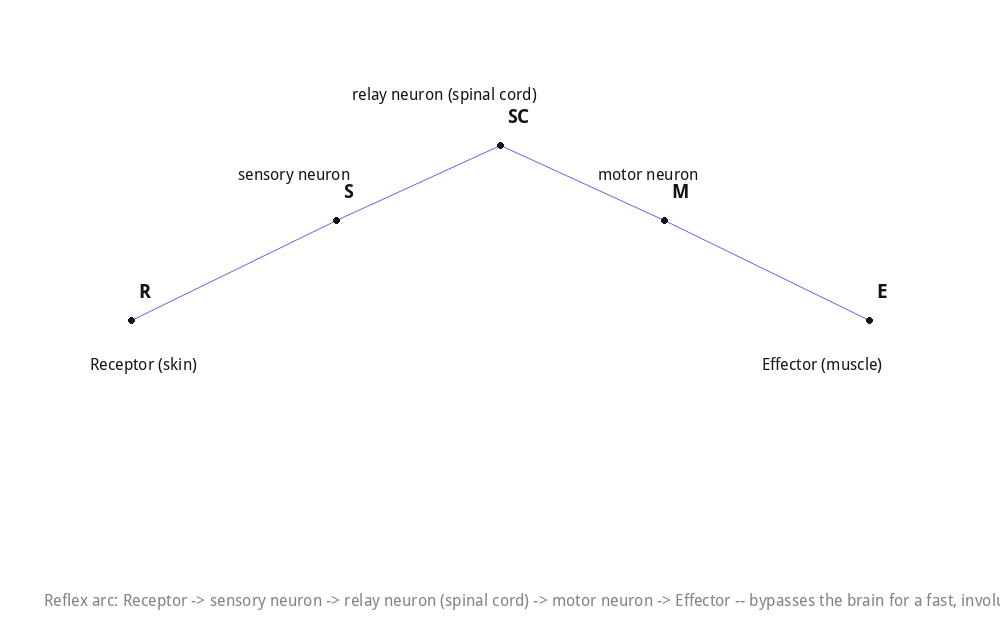
Q3. (Applied, step-by-step) A person accidentally touches a hot iron and withdraws their hand before consciously feeling the pain. Trace the exact path of the signal, naming every component involved.
Receptor (heat/pain receptors in the skin) detects the stimulus → sensory neuron carries the impulse to the relay (connector) neuron in the spinal cord → the relay neuron immediately passes the signal to a motor neuron → the motor neuron carries the impulse to the effector (the arm/hand muscle), causing it to contract and withdraw the hand. Conscious awareness of pain reaches the brain via a separate, slightly slower signal pathway running in parallel — which is why the hand is already withdrawn before the pain is consciously felt.
Q4. (Hormone comparison) Explain why a plant shoot bends towards light (phototropism) while its root bends away from light and towards gravity (geotropism), even though both responses are controlled by the same hormone, auxin.
Auxin promotes cell elongation in shoots, so it accumulates on the shaded/lower side, making that side grow faster and bend the shoot towards light or away from gravity. In roots, however, auxin is far more sensitive and actually inhibits elongation at the same concentration that promotes it in shoots — so the side of the root with more auxin (the lower side, under gravity) grows slower, causing the root to bend down towards gravity. The same hormone therefore produces opposite bending directions in shoots and roots because roots and shoots respond differently to the same auxin concentration.
Q5. (Diagnostic) A patient has trouble maintaining balance and performing precise, coordinated movements (like touching their nose with a finger), but their thinking, memory and sensory perception are completely normal. Which part of the brain is most likely affected, and why?
The cerebellum (part of the hindbrain) is most likely affected — it is specifically responsible for maintaining posture, balance, and the precision/coordination of voluntary muscular movements, but is not involved in thinking or memory (that is the cerebrum’s role) or basic involuntary functions like heartbeat (that is the medulla’s role).
Q6. (Applied physiology) During a sudden fright, a hormone is released that prepares the body for "fight or flight." Name the hormone, its source gland, and describe at least three physiological changes it causes.
Adrenaline, released by the adrenal glands. It causes: (i) increased heart rate, pumping more blood; (ii) faster breathing rate, supplying more oxygen; (iii) diversion of blood flow away from the digestion system and towards skeletal muscles, preparing the body for rapid physical action.
See also: Revision Notes | Formulas Handbook
- Chapter 1: Chemical Reactions and Equations
- Chapter 2: Acids, Bases and Salts
- Chapter 3: Metals and Non-metals
- Chapter 4: Carbon and its Compounds
- Chapter 5: Life Processes
- Chapter 7: – How do Organisms Reproduce?
- Chapter 8: Extra Questions - Heredity (HOTS)
- Chapter 9: Extra Questions - Light: Reflection and Refraction (HOTS)
- Chapter 10: Human Eye and Colourful World Extra Questions (HOTS)
- Chapter 11: Electricity Extra Questions (HOTS)
- Chapter 12: Magnetic Effects of Electric Current Extra Questions (HOTS)
- Chapter 13: Our Environment Extra Questions (HOTS)
Frequently Asked Questions
What is the difference between a reflex action and a voluntary action in terms of nervous control?
A reflex action is an automatic, rapid response controlled by the spinal cord without conscious thought, while a voluntary action is a deliberate response controlled and initiated by the brain after conscious processing.
How do plant hormones help a plant respond to stimuli like light and gravity?
Plant hormones such as auxin are produced in response to stimuli like light and gravity and cause differential growth on different sides of the plant, resulting in bending movements like phototropism and geotropism.
Chapter Quiz — Test Your Understanding
Class 10 Science Chapter 6 – Solutions and Notes
For complete step-by-step answers and a quick summary, check the Class 10 Science Chapter 6 Solutions and Class 10 Science Chapter 6 Revision Notes.
Recommended: Buy the Printed NCERT Class 10 Science Book
Contains Amazon affiliate links.
If you’d like a printed copy alongside the PDF, here’s a verified option:
Check the latest price on Amazon
Price and availability may change on Amazon. As an Amazon Associate, ncertbooks.org earns from qualifying purchases.


