
Class 10 Science Chapter 9 – Revision Notes: Light: Reflection and Refraction
- Focal length & radius of curvature: f = R/2 for spherical mirrors.
- Mirror formula: 1/v + 1/u = 1/f (sign convention: distances measured from the pole, distances against incident light direction are negative).
- Magnification (mirror): m = -v/u = h’/h.
- Lens formula: 1/v – 1/u = 1/f.
- Magnification (lens): m = v/u = h’/h.
- Power of a lens: P = 1/f (f in metres); SI unit dioptre (D). Convex lens: positive power. Concave lens: negative power.
- Lens combination in contact: Pcombined = P1 + P2 + …
- Refractive index: n = speed of light in vacuum / speed of light in medium = c/v.
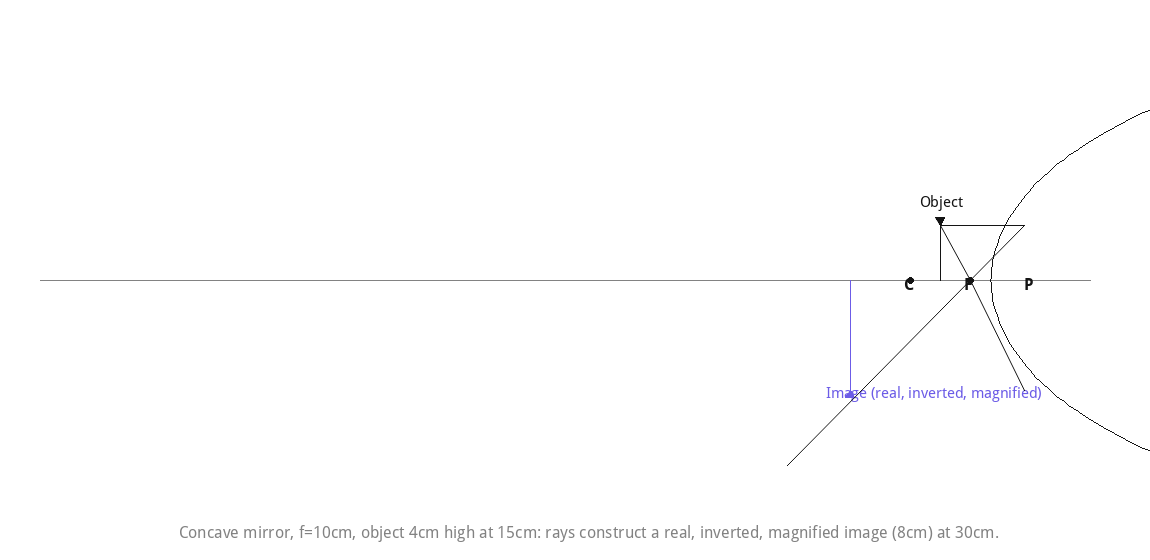
- Concave mirror images: real & inverted when object is beyond F; virtual, erect & magnified when object is between pole and F.
- Convex mirror images: always virtual, erect, and diminished, regardless of object position.
- Convex lens images: real & inverted when object is beyond F; virtual, erect & magnified when object is between the lens and F.
- Concave lens images: always virtual, erect, and diminished.
Related
Quick visual: a worked diagram from the full Solutions page, for reference.
Last Updated: October 24, 2026
Common Mistakes Students Make in Light: Reflection and Refraction
- Sign convention errors: mixing up the Cartesian sign convention for concave vs convex mirrors/lenses in the mirror/lens formula.
- Confusing real and virtual images: assuming a virtual image can be obtained on a screen, or mislabeling image nature for a given object position.
- Refractive index mix-ups: inverting the ratio in n = (speed in vacuum)/(speed in medium), or confusing which medium a relative refractive index is measured with respect to.
- Wrong ray pair in diagrams: not using the two easiest standard rays correctly when constructing an image.

- Chapter 1: Chemical Reactions and Equations
- Chapter 2: Acids, Bases and Salts
- Chapter 3: Metals and Non-metals
- Chapter 4: Carbon and its Compounds
- Chapter 5: Life Processes
- Chapter 6: Control and Coordination
- Chapter 7: – How do Organisms Reproduce?
- Chapter 8: Revision Notes - Heredity
- Chapter 10: Human Eye and Colourful World Revision Notes
- Chapter 11: Electricity Revision Notes
- Chapter 12: Magnetic Effects of Electric Current Revision Notes
- Chapter 13: Our Environment Revision Notes
Frequently Asked Questions
What is the sign convention used for mirrors and lenses in this chapter?
Distances measured in the direction of incident light are taken as positive, and against it as negative; heights above the principal axis are positive, below are negative — this New Cartesian Sign Convention must be applied consistently to get correct answers.
What is the power of a lens, and how is it related to focal length?
Power P = 1/f (f in metres), measured in dioptres (D) — a convex (converging) lens has positive power, a concave (diverging) lens has negative power, and a more strongly curved lens has a shorter focal length and hence higher power.
Chapter Quiz — Test Your Understanding
Class 10 Science Chapter 9 – Solutions and Important Questions
Need full answers or more practice? See the Class 10 Science Chapter 9 Solutions and Class 10 Science Chapter 9 Extra Questions. These Class 10 Science Chapter 9 notes are ideal for quick revision just before exams.
What to Revise First (and Last) in This Chapter
Prioritise the sign convention and the mirror/lens formula (and what each variable means) first, since nearly every numerical question depends on getting the signs right. Leave detailed ray-diagram practice for cases beyond the standard few for an earlier, slower revision pass.
Recommended: Buy the Printed NCERT Class 10 Science Book
Contains Amazon affiliate links.
If you’d like a printed copy alongside the PDF, here’s a verified option:
Check the latest price on Amazon
Price and availability may change on Amazon. As an Amazon Associate, ncertbooks.org earns from qualifying purchases.



Pingback: Class 10 Science Chapter 9 Extra Questions HOTS - Light Reflection and Refraction