
Class 10 Science Chapter 10 – The Human Eye and the Colourful World: Quick Revision Notes
- Power of accommodation: ability of the eye lens to adjust focal length via ciliary muscles
- Near point (normal eye) ≈ 25 cm; Far point (normal eye) = infinity
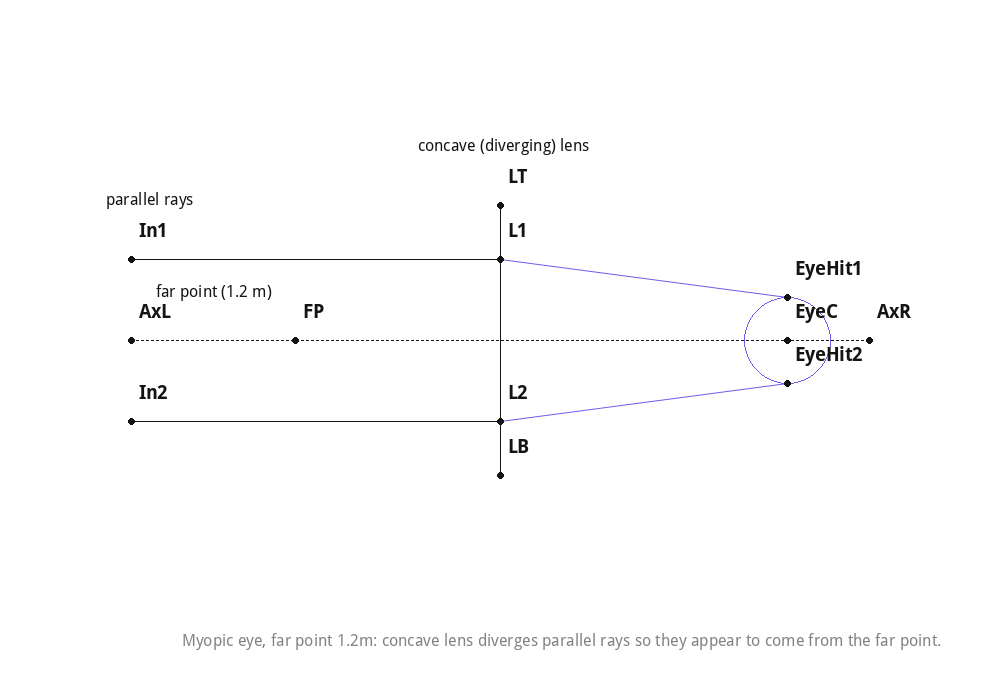
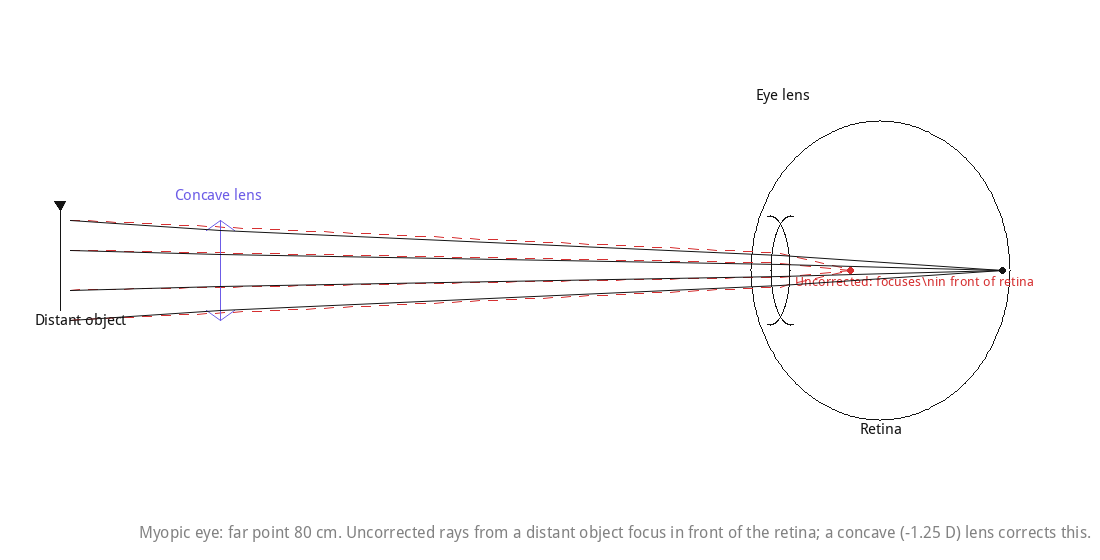
- Myopia (near-sightedness): distant objects blurred, far point < infinity → corrected with a concave (diverging) lens
- Hypermetropia (far-sightedness): near objects blurred, near point > 25 cm → corrected with a convex (converging) lens
- Presbyopia: age-related loss of accommodation → corrected with bifocal lenses
- Power of a lens: P = 1/f (f in metres); unit = dioptre (D)
- Concave lens → negative power; Convex lens → positive power
- Atmospheric refraction: bending of light due to continuously varying density of air
- Twinkling of stars: caused by atmospheric refraction of starlight through layers of varying density
- Planets do not twinkle: extended sources, twinkling effects of many points average out
- Advance sunrise / delayed sunset: each about 2 minutes, due to atmospheric refraction
- Tyndall effect: scattering of light by colloidal-sized particles
- Blue colour of sky: shorter wavelengths (blue/violet) scattered more by atmospheric molecules
- Reddish sun at sunrise/sunset: longer atmospheric path scatters away blue light, red light reaches the eye
- Sky appears black to astronauts: no atmosphere at high altitude to scatter sunlight
- NCERT Solutions – Chapter 10
- Extra Questions (HOTS) – Chapter 10
- Revision Notes – Chapter 10
- Class 10 Science Book (Catalog Page)
Quick visual: a worked diagram from the full Solutions page, for reference.
Last Updated: October 24, 2026
Common Mistakes Students Make in This Chapter
- Mixing up myopia and hypermetropia: confusing which defect needs a concave lens (myopia) versus a convex lens (hypermetropia).
- Power-of-lens sign errors: forgetting a concave (diverging) lens has negative power and a convex (converging) lens has positive power.
- Near point/far point confusion: not matching the correct definition to the specific defect being described.
- Mixing up scattering and dispersion: using the explanation for why the sky is blue (scattering) where the rainbow/prism explanation (dispersion) actually applies, or vice versa.
- Chapter 1: Chemical Reactions and Equations
- Chapter 2: Acids, Bases and Salts
- Chapter 3: Metals and Non-metals
- Chapter 4: Carbon and its Compounds
- Chapter 5: Life Processes
- Chapter 6: Control and Coordination
- Chapter 7: – How do Organisms Reproduce?
- Chapter 8: Revision Notes - Heredity
- Chapter 9: Revision Notes - Light: Reflection and Refraction
- Chapter 11: Electricity Revision Notes
- Chapter 12: Magnetic Effects of Electric Current Revision Notes
- Chapter 13: Our Environment Revision Notes
Frequently Asked Questions
What is the near point and far point of a normal human eye?
The near point (least distance of distinct vision) is about 25 cm, and the far point is at infinity for a normal eye — these two reference values are used throughout the chapter to define and diagnose vision defects.
Why does a rainbow form only when it is raining and the Sun is behind the observer?
A rainbow forms due to dispersion, refraction, and total internal reflection of sunlight inside tiny water droplets in the air; this specific combination of optical effects only happens when sunlight enters droplets at the correct angle, which requires the Sun to be behind the observer and water droplets in front.
Chapter Quiz — Test Your Understanding
Class 10 Science Chapter 10 – Solutions and Important Questions
Need full answers or more practice? See the Class 10 Science Chapter 10 Solutions and Class 10 Science Chapter 10 Extra Questions. These Class 10 Science Chapter 10 notes are ideal for quick revision just before exams.
What to Revise First (and Last) in This Chapter
Prioritise the myopia/hypermetropia correction-lens pairing and the power-sign convention first, since lens-power numericals depend directly on getting this right. Leave the detailed scattering/dispersion phenomenon explanations for an earlier, slower revision pass since they’re more descriptive.
Recommended: Buy the Printed NCERT Class 10 Science Book
Contains Amazon affiliate links.
If you’d like a printed copy alongside the PDF, here’s a verified option:
Check the latest price on Amazon
Price and availability may change on Amazon. As an Amazon Associate, ncertbooks.org earns from qualifying purchases.



Pingback: Class 10 Science Ch 10 Human Eye Extra Questions (HOTS) (2026-27)