
Alternating current brings resistors, inductors, and capacitors together under a sinusoidal voltage, and this Class 12 Physics Chapter 7 summary traces that idea through rms values, reactance, resonance, and the Q-factor.
Last Updated: September 23, 2026
RMS and Peak Values
- For a sinusoidal signal of peak value A0: Arms=A0/√2≈0.707A0.
AC Through R, L, and C
- Resistor: voltage and current in phase; XR=R.
- Inductor: current lags voltage by 90°; reactance XL=2πfL=ωL.
- Capacitor: current leads voltage by 90°; reactance XC=1/(2πfC)=1/(ωC).
- Average power over a cycle is zero for a pure L or pure C circuit (current and voltage 90° out of phase).
Series LCR Circuit and Resonance
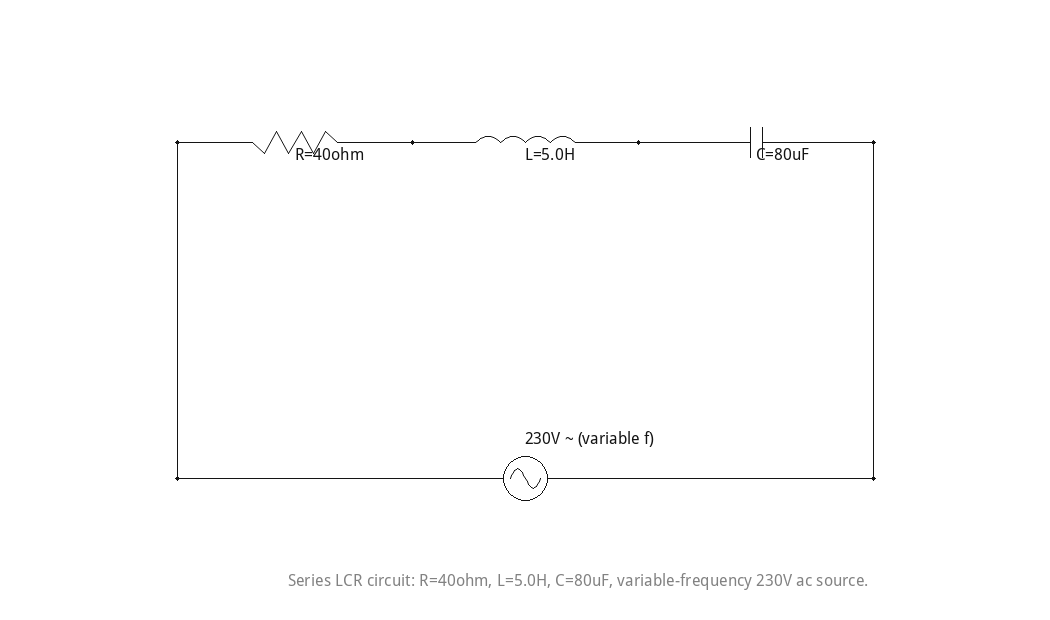
- Impedance Z=√(R²+(XL−XC)²); power factor cosφ=R/Z.
- Resonance occurs when XL=XC, at ωr=1/√(LC); impedance is then minimum (Z=R) and current is maximum.
- Q-factor Q=(1/R)√(L/C) measures the sharpness of resonance — a higher Q means a narrower, sharper resonance peak.
Average Power in AC Circuits
- Pavg=VrmsIrmscosφ; maximum (=VrmsIrms) at resonance, where cosφ=1.
LC Oscillations and Transformers
- An ideal (resistance-free) LC circuit oscillates at ω=1/√(LC), with energy continuously exchanged between the capacitor and inductor, total energy conserved.
- A transformer changes ac voltage using the turns ratio: Vs/Vp=Ns/Np; high-voltage transmission reduces line power loss (I²R) for a given power delivered.
One-Line Summary
An ac circuit’s response depends on frequency through the reactances of L and C, peaking (resonating) when these reactances cancel, with the Q-factor describing how sharply.
Quick visual: a worked diagram from the full Solutions page, for reference.
- Chapter 1: Electric Charges and Fields
- Chapter 2: Electrostatic Potential and Capacitance – Revision Notes
- Chapter 3: Current Electricity – Revision Notes
- Chapter 4: Moving Charges and Magnetism – Revision Notes
- Chapter 5: Magnetism and Matter – Revision Notes
- Chapter 6: Electromagnetic Induction – Revision Notes
Frequently Asked Questions
What is the difference between direct current and alternating current?
Direct current flows in one constant direction, while alternating current periodically reverses direction and varies in magnitude, typically following a sinusoidal pattern with time, which is the form of current supplied to homes.
What is the significance of the rms value of an alternating current?
The rms value of an alternating current is the equivalent steady direct current that would produce the same heating effect in a resistor, making it the practical value used to rate household appliances and electrical equipment.
Chapter Quiz — Test Your Understanding
Class 12 Physics Chapter 7 – Solutions and Important Questions
Need full answers or more practice? See the Class 12 Physics Chapter 7 Solutions and Class 12 Physics Chapter 7 Extra Questions.
See also: Chapter 1 | Chapter 2 | Chapter 3 | Chapter 4 | Chapter 5 | Chapter 6 | Chapter 7
Practice more: Chapter 1 | Chapter 2 | Chapter 3 | Chapter 4 | Chapter 5 | Chapter 6 | Chapter 7
Quick revision: Chapter 1 | Chapter 2 | Chapter 3 | Chapter 4 | Chapter 5 | Chapter 6
Recommended: Buy the Printed NCERT Class 12 Physics Book
Contains Amazon affiliate links.
If you’d like a printed copy alongside the PDF, here’s a verified option:
Check the latest price on Amazon
Price and availability may change on Amazon. As an Amazon Associate, ncertbooks.org earns from qualifying purchases.



Pingback: Class 12 Physics Chapter 8 Electromagnetic Waves Extra Questions (2026-27)