
A bar magnet behaves like a pair of magnetic poles, and this Class 12 Physics Chapter 5 summary traces that idea through axial and equatorial field formulas, Earth’s own magnetism, and how different materials classify by their response to a field.
Last Updated: September 23, 2026
Bar Magnet
- Magnetic moment: m=qm×2l.
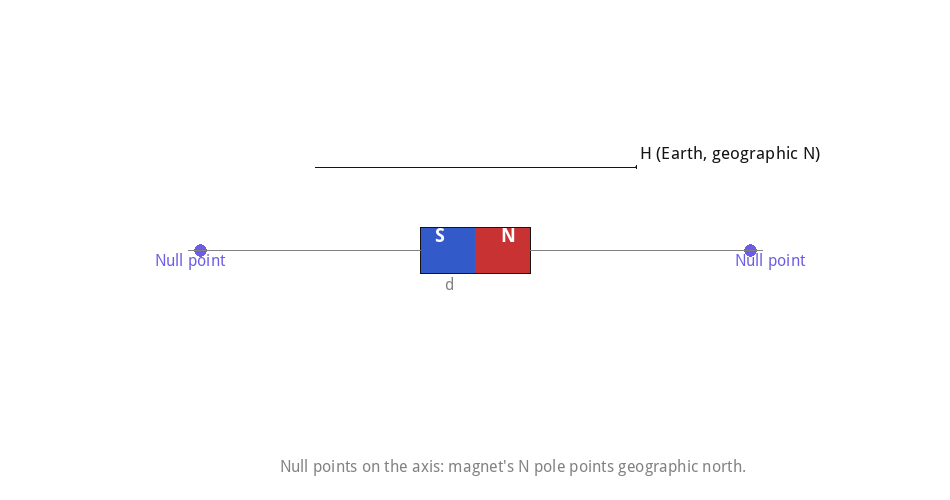
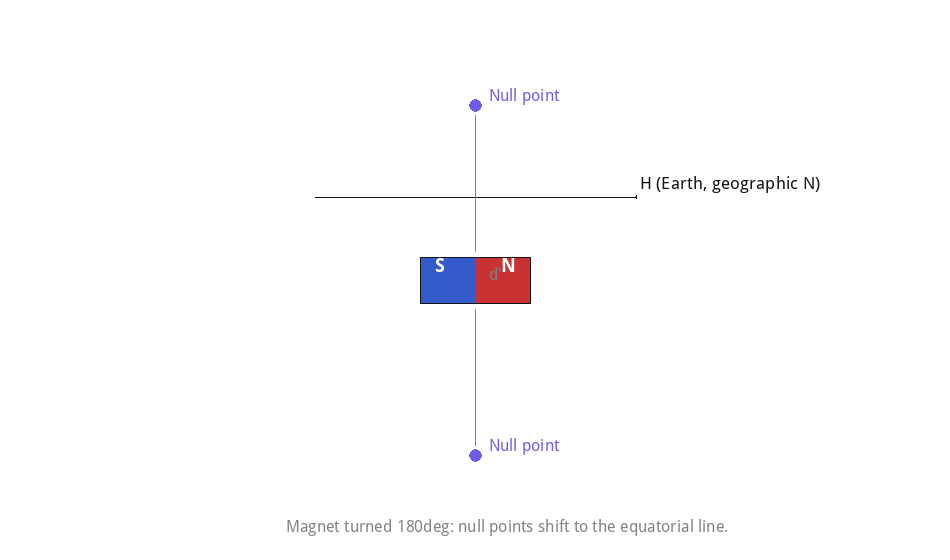
- Axial field: B=(μ₀/4π)(2m/r³); Equatorial: B=(μ₀/4π)(m/r³).
- Torque τ=mB sinθ; PE U=−mB cosθ.
Earth’s Magnetism
- Declination, dip/inclination, horizontal component BH=B cos(dip).
Material Classification
- Diamagnetic: χ<0, weakly repelled (e.g. bismuth).
- Paramagnetic: χ>0 small, weakly attracted (e.g. aluminium); Curie’s law χ∝1/T.
- Ferromagnetic: large χ>0, strongly attracted, hysteresis (e.g. iron).
One-Line Summary
A bar magnet behaves as an equivalent solenoid producing dipole-like fields; materials are classified as diamagnetic, paramagnetic, or ferromagnetic based on their magnetic susceptibility.
Quick visual: a worked diagram from the full Solutions page, for reference.
- Chapter 1: Electric Charges and Fields
- Chapter 2: Electrostatic Potential and Capacitance – Revision Notes
- Chapter 3: Current Electricity – Revision Notes
- Chapter 4: Moving Charges and Magnetism – Revision Notes
- Chapter 6: Electromagnetic Induction – Revision Notes
- Chapter 7: Alternating Current – Revision Notes
Frequently Asked Questions
What are the three types of magnetic materials described in this chapter?
Materials are classified as diamagnetic (weakly repelled), paramagnetic (weakly attracted), and ferromagnetic (strongly attracted and capable of retaining magnetism), based on how their atomic magnetic moments respond to an external field.
How is the Earth modeled as a magnet in this chapter?
The Earth behaves approximately like a giant bar magnet tilted at an angle to its rotational axis, which explains the existence of magnetic declination and magnetic inclination at different locations on the surface.
Chapter Quiz — Test Your Understanding
Class 12 Physics Chapter 5 – Solutions and Important Questions
Need full answers or more practice? See the Class 12 Physics Chapter 5 Solutions and Class 12 Physics Chapter 5 Extra Questions.
See also: Chapter 1 | Chapter 2 | Chapter 3 | Chapter 5
Practice more: Chapter 1 | Chapter 2 | Chapter 3 | Chapter 5
Recommended: Buy the Printed NCERT Class 12 Physics Book
Contains Amazon affiliate links.
If you’d like a printed copy alongside the PDF, here’s a verified option:
4.4 out of 5 stars (159 ratings) · Rs. 155
Price and availability may change on Amazon. As an Amazon Associate, ncertbooks.org earns from qualifying purchases.



Pingback: Class 12 Physics Chapter 7 Alternating Current Solutions (2026-27)
Pingback: Class 12 Physics Chapter 7 Alternating Current Revision Notes (2026-27)
Pingback: Class 12 Physics Chapter 8 Electromagnetic Waves Revision Notes (2026-27)