
Current electricity explains how charge moves through a conductor and how that flow is governed by resistance, and this Class 12 Physics Chapter 3 recap covers Ohm’s law, resistor combinations, and Kirchhoff’s junction and loop rules.
Last Updated: September 23, 2026
Common Mistakes Students Make in Current Electricity
- Confusing EMF and terminal voltage: forgetting internal resistance makes terminal voltage less than EMF whenever current flows.
- Series/parallel resistor mix-ups: using the wrong combination formula in a more advanced circuit involving internal resistance.
- Kirchhoff’s law sign errors: not consistently assigning a current direction and loop-traversal direction before writing the equations.
- Wheatstone/meter bridge balance errors: misapplying the ratio condition or misreading the null-point position.
Basics
- I=Q/t=nAevd; Ohm’s law: V=IR.
- R=ρl/A; RT=R₀(1+αΔT).
Combinations & Laws
- Series: R=R₁+R₂+…; Parallel: 1/R=1/R₁+1/R₂+…
- Kirchhoff’s junction rule (ΣI=0) and loop rule (ΣV=0).
- Wheatstone bridge balance: P/Q=R/S.
One-Line Summary
Current electricity models charge flow via Ohm’s law and resistivity, with Kirchhoff’s laws and the Wheatstone bridge enabling analysis of complex resistor networks.
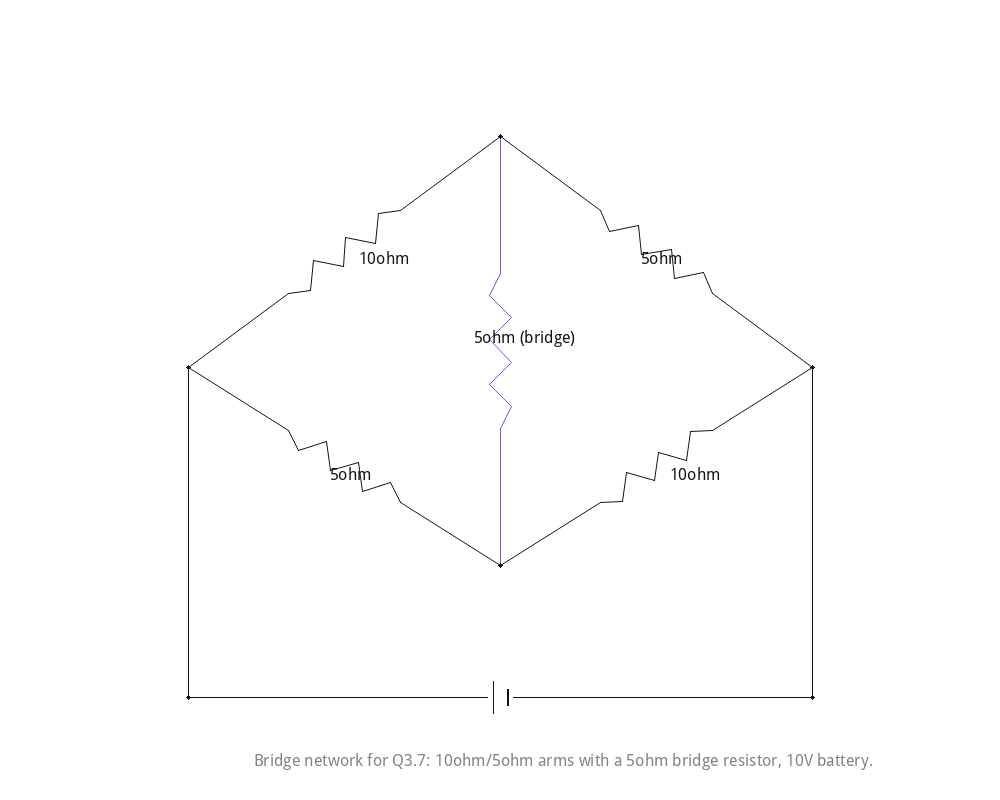
Quick visual: a worked diagram from the full Solutions page, for reference.
- Chapter 1: Electric Charges and Fields
- Chapter 2: Electrostatic Potential and Capacitance – Revision Notes
- Chapter 4: Moving Charges and Magnetism – Revision Notes
- Chapter 5: Magnetism and Matter – Revision Notes
- Chapter 6: Electromagnetic Induction – Revision Notes
- Chapter 7: Alternating Current – Revision Notes
Frequently Asked Questions
What is the difference between drift velocity and the speed of electrons in a conductor?
Individual electrons move randomly at high speeds, but drift velocity is the small net average velocity electrons gain in the direction opposite to the electric field when a current flows, which is what actually produces the observable current.
What does Ohm Law state, and what materials do not obey it?
Ohm Law states that the current through a conductor is directly proportional to the voltage across it at constant temperature; non-ohmic materials like diodes and transistors do not follow this proportionality.
Chapter Quiz — Test Your Understanding
Class 12 Physics Chapter 3 – Solutions and Important Questions
Need full answers or more practice? See the Class 12 Physics Chapter 3 Solutions and Class 12 Physics Chapter 3 Extra Questions.
What to Revise First (and Last) in This Chapter
Prioritise Ohm’s law with internal resistance (EMF vs terminal voltage) and the series/parallel resistor rules first, since they anchor most numericals. Leave detailed Kirchhoff’s law and Wheatstone bridge derivations for an earlier, slower revision pass.
Recommended: Buy the Printed NCERT Class 12 Physics Book
Contains Amazon affiliate links.
If you’d like a printed copy alongside the PDF, here’s a verified option:
4.4 out of 5 stars (159 ratings) · Rs. 155
Price and availability may change on Amazon. As an Amazon Associate, ncertbooks.org earns from qualifying purchases.



Pingback: Class 12 Physics Chapter 4 Moving Charges and Magnetism Solutions (2026-27)
Pingback: Class 12 Physics Chapter 5 Magnetism and Matter Solutions (2026-27)
Pingback: Class 12 Physics Chapter 6 Electromagnetic Induction Solutions (2026-27)
Pingback: Class 12 Physics Chapter 6 Electromagnetic Induction Revision Notes (2026-27)
Pingback: Class 12 Physics Chapter 8 Electromagnetic Waves Extra Questions (2026-27)