
The current electricity chapter connects Ohm’s law, resistivity, and circuit analysis using Kirchhoff’s rules. The exercise solutions below work through numerical problems on resistance, EMF, and the Wheatstone bridge.
Last Updated: September 23, 2026
How to Approach This Chapter
Before applying Kirchhoff’s laws, assign a consistent current direction and loop-traversal direction on your circuit diagram, and stick to it throughout — most sign errors come from switching conventions partway through. For EMF/terminal-voltage questions, always check whether current is actually flowing, since the two only differ when it is.
Exam Weightage: How Important Is This Chapter?
Current Electricity carries 6 marks in the CBSE Class 12 Physics board exam.
NCERT Exercise Solutions
3.1 The storage battery of a car has an emf of 12V. If the internal resistance of the battery is 0.4Ω, what is the maximum current that can be drawn from the battery?
Ans: Maximum current is drawn when the external resistance is zero (short-circuit condition), so I=E/r=12/0.4=30A.
3.2 A battery of emf 10V and internal resistance 3Ω is connected to a resistor. If the current in the circuit is 0.5A, what is the resistance of the resistor? What is the terminal voltage of the battery when the circuit is closed?
Ans: E=I(R+r) ⇒ 10=0.5(R+3) ⇒ R+3=20 ⇒ R=17Ω. Terminal voltage V=E−Ir=10−0.5×3=8.5V.
3.3 At room temperature (27.0°C) the resistance of a heating element is 100Ω. What is the temperature of the element if the resistance is found to be 117Ω, given that the temperature coefficient of the material of the resistor is 1.70×10⁻⁴ °C⁻¹?
Ans: R₂=R₁[1+α(T₂−T₁)] ⇒ 117=100[1+1.70×10⁻⁴(T₂−27)] ⇒ 0.17=1.70×10⁻⁴(T₂−27) ⇒ T₂−27=1000 ⇒ T₂=1027°C.
3.4 A negligibly small current is passed through a wire of length 15m and uniform cross-section 6.0×10⁻⁷m², and its resistance is measured to be 5.0Ω. What is the resistivity of the material at the temperature of the experiment?
Ans: ρ=RA/l=(5.0×6.0×10⁻⁷)/15=2.0×10⁻⁷ Ωm.
3.5 A silver wire has a resistance of 2.1Ω at 27.5°C, and a resistance of 2.7Ω at 100°C. Determine the temperature coefficient of resistivity of silver.
Ans: α=(R₂−R₁)/(R₁(T₂−T₁))=(2.7−2.1)/(2.1×(100−27.5))=0.6/(2.1×72.5)≈3.9×10⁻³ /°C.
3.6 A heating element using nichrome connected to a 230V supply draws an initial current of 3.2A which settles after a few seconds to a steady value of 2.8A. What is the steady temperature of the heating element if the room temperature is 27.0°C? Temperature coefficient of resistance of nichrome averaged over the temperature range involved is 1.70×10⁻⁴ °C⁻¹.
Ans: The initial (room-temperature) resistance is R₁=V/I₁=230/3.2≈71.9Ω, and the steady resistance is R₂=V/I₂=230/2.8≈82.1Ω. Using R₂=R₁[1+α(T₂−T₁)]: 82.1=71.9[1+1.70×10⁻⁴(T₂−27)] ⇒ T₂−27≈840 ⇒ T₂≈867°C.
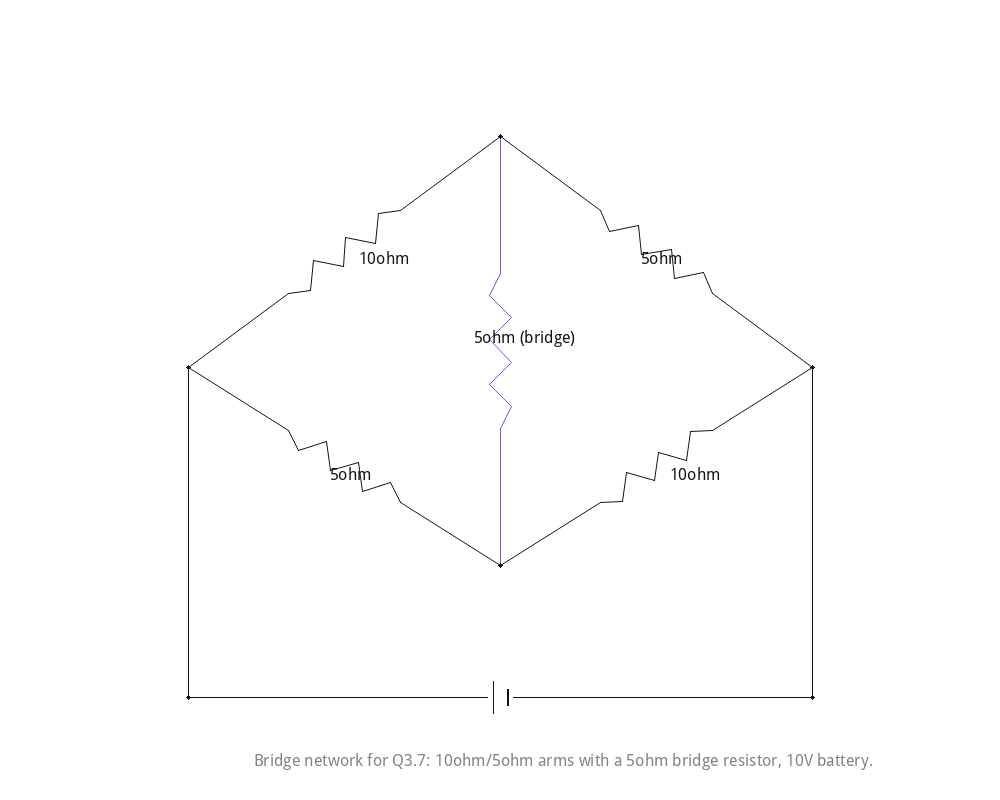
3.7 Determine the current in each branch of the network shown in Fig. 3.20.
Ans: The network is a bridge-type arrangement of four 10Ω/5Ω resistors plus a 5Ω bridge resistor, fed by a 10V battery. Applying Kirchhoff’s junction rule at each node and the loop rule around each independent closed loop gives a system of simultaneous equations in the branch currents. Solving this system: the currents in the outer branches work out to 4/17 A and 6/17 A, the current through the bridge resistor works out to 2/17 A (flowing opposite to the direction initially assumed), and the total current drawn from the battery is 10/17 A ≈ 0.588A.
3.8 A storage battery of emf 8.0V and internal resistance 0.5Ω is being charged by a 120V dc supply using a series resistor of 15.5Ω. What is the terminal voltage of the battery during charging? What is the purpose of having a series resistor in the charging circuit?
Ans: The charging current is I=(V−E)/(R+r)=(120−8)/(15.5+0.5)=112/16=7A. Since the battery is being charged, the terminal voltage exceeds the emf: V_terminal=E+Ir=8+7×0.5=11.5V. The series resistor limits the charging current to a safe value, protecting the battery (and the supply circuit) from an excessively large current that would flow if the battery were connected directly across the 120V supply.
3.9 The number density of free electrons in a copper conductor estimated in Example 3.1 is 8.5×10²⁸m⁻³. How long does an electron take to drift from one end of a wire 3.0m long to its other end? The area of cross-section of the wire is 2.0×10⁻⁶m² and it is carrying a current of 3.0A.
Ans: Drift velocity v_d=I/(nAe)=3.0/(8.5×10²⁸×2.0×10⁻⁶×1.6×10⁻¹⁹)≈1.10×10⁻⁴ m/s. Time taken t=l/v_d=3.0/(1.10×10⁻⁴)≈2.72×10⁴ s ≈ 7.56 hours.
- Chapter 1: Electric Charges and Fields – Free PDF Download
- Chapter 2: Electrostatic Potential and Capacitance – Free PDF Download
- Chapter 4: Moving Charges and Magnetism – Free PDF Download
- Chapter 5: Magnetism and Matter – Free PDF Download
- Chapter 6: Electromagnetic Induction – Free PDF Download
- Chapter 7: Alternating Current – Free PDF Download
Frequently Asked Questions
What is the formula for equivalent resistance in series vs. parallel?
Series: R=R₁+R₂+…; Parallel: 1/R=1/R₁+1/R₂+…
What does the temperature coefficient of resistivity tell us?
How much a material’s resistance changes per degree of temperature change; positive for metals (resistance rises with heat).
Chapter Quiz — Test Your Understanding
Class 12 Physics Chapter 3 – Notes and Extra Questions
Along with these NCERT Solutions, students can also use the Class 12 Physics Chapter 3 Extra Questions and Class 12 Physics Chapter 3 Revision Notes for quick revision and extra practice.
Recommended: Buy the Printed NCERT Class 12 Physics Book
Contains Amazon affiliate links.
If you’d like a printed copy alongside the PDF, here’s a verified option:
4.4 out of 5 stars (159 ratings) · Rs. 155
Price and availability may change on Amazon. As an Amazon Associate, ncertbooks.org earns from qualifying purchases.



Pingback: Class 12 Physics Ch 11 Dual Nature Extra Questions (2026-27)
Pingback: Class 12 Physics Chapter 8 Electromagnetic Waves Extra Questions (2026-27)
Pingback: Class 12 Physics Ch 9 Ray Optics Revision Notes (2026-27)
Pingback: Class 12 Physics Ch 9 Ray Optics Extra Questions (2026-27)
Pingback: Class 12 Physics Chapter 3 Current Electricity Extra Questions (2026-27)