
Bar magnets, the Earth’s magnetic field, and the magnetic properties of materials are the focus of Chapter 5. These worked solutions cover the exercise questions on magnetic dipole moment, declination, and classifying materials as diamagnetic, paramagnetic, or ferromagnetic.
Last Updated: September 23, 2026
NCERT Exercise Solutions
5.1 A short bar magnet placed with its axis at 30° with a uniform external magnetic field of 0.25T experiences a torque of magnitude equal to 4.5×10⁻² J. What is the magnitude of magnetic moment of the magnet?
Ans: τ=mBsinθ ⇒ m=τ/(Bsinθ)=0.045/(0.25×sin30°)=0.045/(0.25×0.5)=0.36 J/T.
5.2 A short bar magnet of magnetic moment m=0.32 JT⁻¹ is placed in a uniform magnetic field of 0.15T. If the bar is free to rotate in the plane of the field, which orientation would correspond to its (a) stable, and (b) unstable equilibrium? What is the potential energy of the magnet in each case?
Ans: (a) Stable equilibrium is when the magnetic moment is aligned parallel to B (θ=0°): PE=−mBcosθ=−mB=−0.32×0.15=−0.048 J. (b) Unstable equilibrium is when the magnetic moment is anti-parallel to B (θ=180°): PE=−mBcos180°=+mB=+0.048 J.
5.3 A closely wound solenoid of 800 turns and area of cross section 2.5×10⁻⁴m² carries a current of 3.0A. Explain the sense in which the solenoid acts like a bar magnet. What is its associated magnetic moment?
Ans: The solenoid acts like a bar magnet because the circulating current sets up a magnetic field pattern outside the solenoid that is identical to that of a bar magnet, with one end acting as a north pole and the other as a south pole (determined by the sense of current flow). Magnetic moment m=NIA=800×3.0×2.5×10⁻⁴=0.6 J/T.
5.4 If the solenoid in Exercise 5.5 [i.e. the solenoid of Q5.3 above] is free to turn about the vertical direction and a uniform horizontal magnetic field of 0.25T is applied, what is the magnitude of torque on the solenoid when its axis makes an angle of 30° with the direction of applied field?
Ans: Using m=0.6 J/T from Q5.3: τ=mBsinθ=0.6×0.25×sin30°=0.6×0.25×0.5=0.075 N·m.
5.5 A bar magnet of magnetic moment 1.5 JT⁻¹ lies aligned with the direction of a uniform magnetic field of 0.22T. (a) What is the amount of work required by an external torque to turn the magnet so as to align its magnetic moment: (i) normal to the field direction, (ii) opposite to the field direction? (b) What is the torque on the magnet in cases (i) and (ii)?
Ans: (a)(i) Turning from 0° to 90°: W=mB(cos0°−cos90°)=1.5×0.22×(1−0)=0.33 J. (ii) Turning from 0° to 180°: W=mB(cos0°−cos180°)=1.5×0.22×(1+1)=0.66 J. (b)(i) At θ=90°: τ=mBsin90°=1.5×0.22×1=0.33 N·m. (ii) At θ=180°: τ=mBsin180°=0 (the torque is zero at both the aligned and anti-aligned positions, since these are the equilibrium orientations).
5.6 A closely wound solenoid of 2000 turns and area of cross-section 1.6×10⁻⁴m², carrying a current of 4.0A, is suspended through its centre allowing it to turn in a horizontal plane. (a) What is the magnetic moment associated with the solenoid? (b) What is the force and torque on the solenoid if a uniform horizontal magnetic field of 7.5×10⁻²T is set up at an angle of 30° with the axis of the solenoid?
Ans: (a) m=NIA=2000×4.0×1.6×10⁻⁴=1.28 J/T. (b) The net force is zero (the field is uniform, so the forces on the equivalent poles cancel). Torque τ=mBsinθ=1.28×7.5×10⁻²×sin30°=1.28×0.075×0.5=0.048 N·m.
5.7 A short bar magnet has a magnetic moment of 0.48 JT⁻¹. Give the direction and magnitude of the magnetic field produced by the magnet at a distance of 10cm from the centre of the magnet on (a) the axis, (b) the equatorial lines (normal bisector) of the magnet.
Ans: (a) Axial: B=(μ₀/4π)×2m/r³=10⁻⁷×2×0.48/(0.1)³=9.6×10⁻⁵ T, along the direction of the magnetic moment. (b) Equatorial: B=(μ₀/4π)×m/r³=10⁻⁷×0.48/(0.1)³=4.8×10⁻⁵ T, anti-parallel to the magnetic moment (i.e., opposite to its direction).
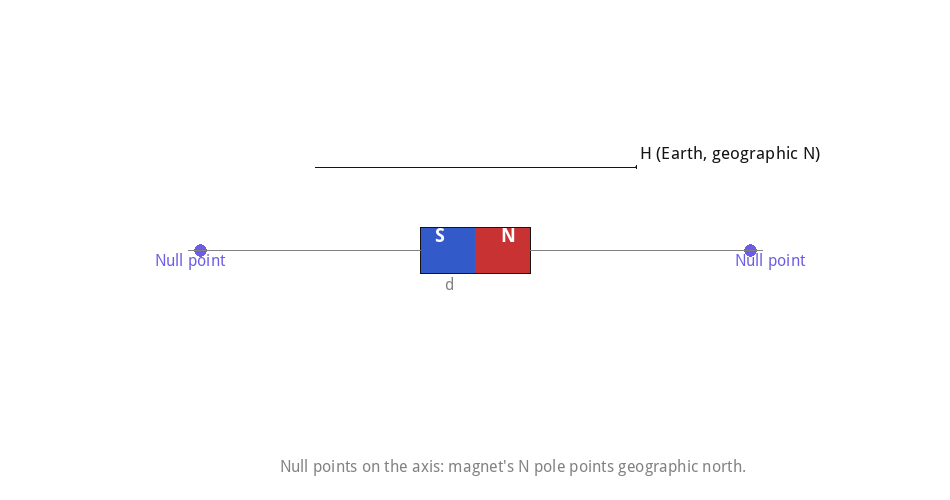
5.8 A short bar magnet placed in a horizontal plane has its axis aligned along the magnetic north-south direction. Null points are found on the axis of the magnet at 14cm from the centre of the magnet. The earth’s magnetic field at the place is 0.36G and the angle of dip is zero. What is the total magnetic field on the normal bisector of the magnet at the same distance (14cm) from the centre of the magnet?
Ans: At a null point on the axis, the magnet’s own axial field exactly cancels the horizontal component of the Earth’s field, so the magnet’s axial field at r=14cm equals H=0.36G. Since the equatorial field of a bar magnet at the same distance is exactly half the axial field, the magnet’s equatorial field there is 0.18G. On the equatorial line the magnet’s field and the Earth’s field add (rather than cancel, as they do on the axis): B_total=H+0.18G=0.36G+0.18G=0.54G.
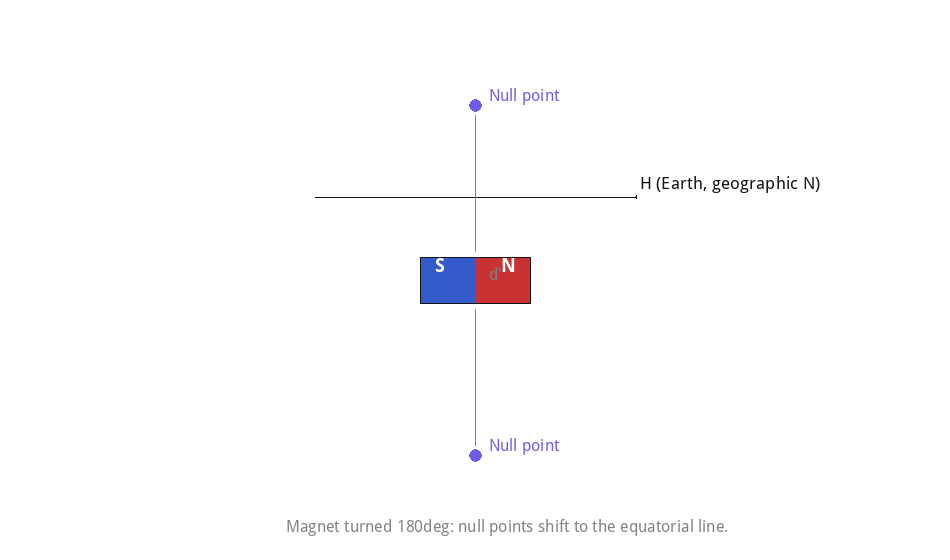
5.9 If the bar magnet in exercise 5.13 [i.e. the magnet of Q5.8 above] is turned around by 180°, where will the new null points be located?
Ans: Turning the magnet by 180° reverses its polarity, so the null points — where the magnet’s field cancels the Earth’s horizontal field — move from the axis to the equatorial line (normal bisector). Using the same field magnitude relation, the new distance d satisfies (equatorial field at d) = (axial field at the old r=14cm), which works out to d³=r³/2, giving d≈11.1cm from the centre, on the normal bisector.
- Chapter 1: Electric Charges and Fields – Free PDF Download
- Chapter 2: Electrostatic Potential and Capacitance – Free PDF Download
- Chapter 3: Current Electricity – Free PDF Download
- Chapter 4: Moving Charges and Magnetism – Free PDF Download
- Chapter 6: Electromagnetic Induction – Free PDF Download
- Chapter 7: Alternating Current – Free PDF Download
Frequently Asked Questions
What is the formula for the axial field of a bar magnet?
B=(μ₀/4π)(2m/r³) for short bar magnet, along the magnet’s axis.
At what angle is the torque on a magnetic dipole maximum?
At θ=90° (dipole perpendicular to the field), where τ=mB.
Chapter Quiz — Test Your Understanding
Class 12 Physics Chapter 5 – Notes and Extra Questions
Along with these NCERT Solutions, students can also use the Class 12 Physics Chapter 5 Extra Questions and Class 12 Physics Chapter 5 Revision Notes for quick revision and extra practice.
Recommended: Buy the Printed NCERT Class 12 Physics Book
Contains Amazon affiliate links.
If you’d like a printed copy alongside the PDF, here’s a verified option:
4.4 out of 5 stars (159 ratings) · Rs. 155
Price and availability may change on Amazon. As an Amazon Associate, ncertbooks.org earns from qualifying purchases.



Pingback: Class 12 Physics Chapter 4 Moving Charges and Magnetism Solutions (2026-27)
Pingback: NCERT Solutions for Class 12 Physics Chapter 6: Electromagnetic Induction xe2x80x93 Free PDF Download - NCERTBooks.org
Pingback: Class 12 Physics Chapter 6 Electromagnetic Induction Extra Questions (2026-27)
Pingback: NCERT Solutions for Class 12 Physics Chapter 7: Alternating Current – Free PDF Download - NCERTBooks.org
Pingback: Class 12 Physics Chapter 7 Alternating Current Extra Questions (2026-27)
Pingback: Class 12 Physics Ch 10 Wave Optics Extra Questions (2026-27)
Pingback: NCERT Solutions for Class 12 Physics Chapter 11: Dual Nature of Radiation and Matter – Free PDF Download - NCERTBooks.org
Pingback: Class 12 Physics Chapter 8 Electromagnetic Waves Revision Notes (2026-27)