
Class 12 Physics Chapter 1 – Electric Charges and Fields: Quick Revision Notes
- Coulomb’s law: F = kq₁q₂/r², k = 1/(4πε₀) ≈ 9×10⁹ N·m²/C²
- Principle of superposition: net force/field from multiple charges = vector sum of individual contributions
- Electric field: E = F/q₀ (force per unit positive test charge); field of a point charge: E = kq/r²
- Field lines: start on + charge, end on − charge (or infinity); never cross; density indicates field strength; perpendicular to a conductor’s surface
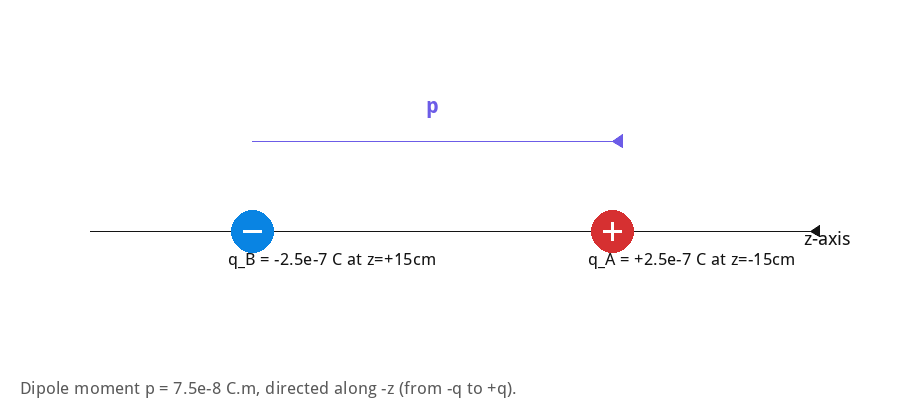
- Electric dipole moment: p = q×2a (from −q to +q); field on axial line ≈ 2kp/r³; field on equatorial line ≈ kp/r³ (for r»a)
- Torque on a dipole: τ = pE sinθ = p×E (vector); potential energy U = −pE cosθ = −p·E
- Continuous charge distributions: linear density λ = q/l, surface density σ = q/A, volume density ρ = q/V
- Electric flux: φ = E·A = EA cosθ (flat surface in uniform field)
- Gauss’s law: φ(closed surface) = Q_enclosed/ε₀ — depends only on enclosed charge, not surface shape or size
- Field of an infinite line charge: E = λ/(2πε₀r)
- Field of an infinite charged sheet: E = σ/(2ε₀); between two oppositely charged parallel plates: E = σ/ε₀
- Field due to a charged spherical shell: outside (r>R): E = kQ/r² (acts as if all charge at centre); inside (r<R): E = 0
- Charge is quantised (q = ne) and conserved (never created/destroyed, only transferred)
- Not currently CBSE-examinable: Q1.13 and Q1.25–Q1.34 of the textbook exercise (2023-24 rationalisation) — still useful for JEE/NEET
NCERT Solutions | Extra Questions (HOTS) | Class 12 Physics Book These Class 12 Physics Chapter 1 notes are ideal for quick revision just before exams.
Last Updated: September 23, 2026
Common Mistakes Students Make in Electric Charges and Fields
- Dropping the sign of charge: leaving out the sign in Coulomb’s law calculations, which gives the wrong direction for the force.
- Using the point-charge formula for extended charges: applying the simple point-charge field formula where the charge is actually distributed (a rod, ring, sheet) and integration is really needed.
- Adding fields/forces as scalars: summing magnitudes directly from multiple charges instead of adding them as vectors.
- Misapplying Gauss’s law: reaching for it on an asymmetric charge distribution, where it doesn’t simplify anything, instead of the three standard symmetric cases it’s meant for.
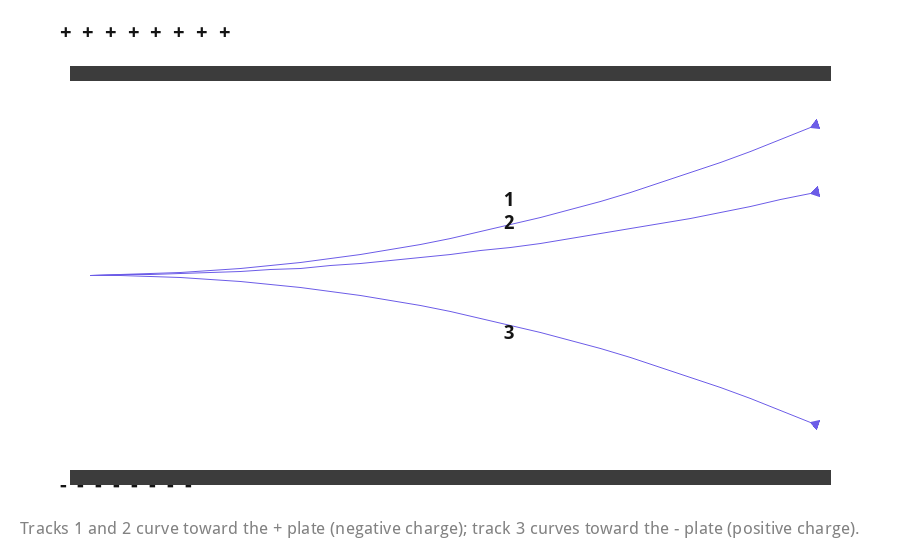
Quick visual: a worked diagram from the full Solutions page, for reference.
- Chapter 2: Electrostatic Potential and Capacitance – Revision Notes
- Chapter 3: Current Electricity – Revision Notes
- Chapter 4: Moving Charges and Magnetism – Revision Notes
- Chapter 5: Magnetism and Matter – Revision Notes
- Chapter 6: Electromagnetic Induction – Revision Notes
- Chapter 7: Alternating Current – Revision Notes
Frequently Asked Questions
What is Coulomb Law, and what does it describe?
Coulomb Law describes the force between two point charges, stating that the force is directly proportional to the product of the charges and inversely proportional to the square of the distance between them.
What is an electric field, and why is the concept useful?
An electric field is the region around a charge where another charge experiences a force; it lets us describe the effect of a charge at every point in space without needing to place a test charge there physically.
Chapter Quiz — Test Your Understanding
Class 12 Physics Chapter 1 – Solutions and Important Questions
Need full answers or more practice? See the Class 12 Physics Chapter 1 Solutions and Class 12 Physics Chapter 1 Extra Questions.
What to Revise First (and Last) in This Chapter
Prioritise Coulomb’s law, the electric field due to a point charge, and Gauss’s law for the three standard symmetric cases (sphere, cylinder, infinite sheet) first, since together they cover the widest range of questions. Leave detailed continuous-charge-distribution integration for an earlier, slower revision pass.
Recommended: Buy the Printed NCERT Class 12 Physics Book
Contains Amazon affiliate links.
If you’d like a printed copy alongside the PDF, here’s a verified option:
4.4 out of 5 stars (159 ratings) · Rs. 155
Price and availability may change on Amazon. As an Amazon Associate, ncertbooks.org earns from qualifying purchases.



Pingback: Class 12 Physics Chapter 4 Moving Charges and Magnetism Solutions (2026-27)
Pingback: Class 12 Physics Chapter 7 Alternating Current Solutions (2026-27)
Pingback: Class 12 Physics Chapter 7 Alternating Current Revision Notes (2026-27)