
A moving charge creates its own magnetic field — that’s the core idea behind Chapter 4. These solutions work through the exercise questions on the Biot-Savart law, Ampere’s circuital law, and forces on current-carrying conductors.
Last Updated: September 23, 2026
How to Approach This Chapter
Before applying a formula, identify the geometry (straight wire, loop, or solenoid), since each has its own field formula — using the wrong one is the most common error here. For force-on-a-charge problems, always account for the sign of the charge when determining direction, not just magnitude.
Exam Weightage: How Important Is This Chapter?
Moving Charges and Magnetism carries 6 marks, part of the 11-mark Unit III (Magnetic Effects of Current and Magnetism, together with Magnetism and Matter at 5 marks) in the CBSE Class 12 Physics board exam.
NCERT Exercise Solutions
4.1 A circular coil of wire consisting of 100 turns, each of radius 8.0 cm carries a current of 0.40 A. What is the magnitude of the magnetic field B at the centre of the coil?
Ans: B=μ₀NI/2R=(4π×10⁻⁷)(100)(0.40)/(2×0.08)=3.14×10⁻⁴ T.
4.2 A long straight wire carries a current of 35 A. What is the magnitude of the field B at a point 20cm from the wire?
Ans: B=μ₀I/2πr=(4π×10⁻⁷)(35)/(2π×0.20)=3.5×10⁻⁵ T.
4.3 A long straight wire in the horizontal plane carries a current of 50A in north to south direction. Give the magnitude and direction of B at a point 2.5m east of the wire.
Ans: B=μ₀I/2πr=(4π×10⁻⁷)(50)/(2π×2.5)=4×10⁻⁶ T, directed vertically upward (by the right-hand rule: point the right thumb south along the current, and at a point to the east the curling fingers point upward).
4.4 A horizontal overhead power line carries a current of 90A in east to west direction. What is the magnitude and direction of B due to the current 1.5m below the line?
Ans: B=μ₀I/2πr=(4π×10⁻⁷)(90)/(2π×1.5)=1.2×10⁻⁵ T, directed horizontally toward the south (by the right-hand rule: point the right thumb west along the current, and at a point directly below, the curling fingers point toward the south).
4.5 What is the magnitude of magnetic force per unit length on a wire carrying a current of 8A and making an angle of 30° with the direction of a uniform magnetic field of 0.15T?
Ans: F/L=BI sinθ=0.15×8×sin30°=0.15×8×0.5=0.6 N/m.
4.6 A 3.0cm wire carrying a current of 10A is placed inside a solenoid perpendicular to its axis. The magnetic field inside the solenoid is given to be 0.27T. What is the magnetic force on the wire?
Ans: F=BIL=0.27×10×0.03=0.081 N.
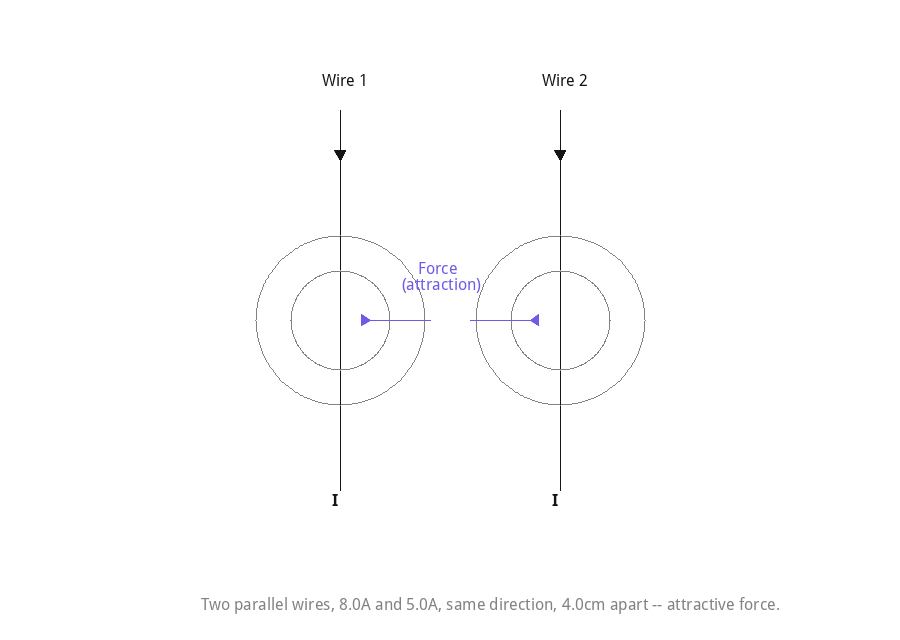
4.7 Two long and parallel straight wires A and B carrying currents of 8.0A and 5.0A in the same direction are separated by a distance of 4.0cm. Estimate the force on a 10cm section of wire A.
Ans: Force per unit length between the wires is F/L=μ₀I₁I₂/(2πd)=(4π×10⁻⁷×8.0×5.0)/(2π×0.04)=2.0×10⁻⁴ N/m. For a 10cm=0.10m section: F=2.0×10⁻⁴×0.10=2.0×10⁻⁵ N, attractive (since the currents are in the same direction).
4.8 A closely wound solenoid 80cm long has 5 layers of windings of 400 turns each. The diameter of the solenoid is 1.8cm. If the current carried is 8.0A, estimate the magnitude of B inside the solenoid near its centre.
Ans: Total turns N=5×400=2000, so turns per unit length n=N/l=2000/0.80=2500 turns/m. B=μ₀nI=(4π×10⁻⁷)×2500×8.0≈2.5×10⁻² T.
4.9 A square coil of side 10cm consists of 20 turns and carries a current of 12A. The coil is suspended vertically and the normal to the plane of the coil makes an angle of 30° with the direction of a uniform horizontal magnetic field of magnitude 0.80T. What is the magnitude of torque experienced by the coil?
Ans: Area A=(0.10)²=0.01m². τ=NIAB sinθ=20×12×0.01×0.80×sin30°=20×12×0.01×0.80×0.5=0.96 N·m.
4.10 Two moving coil meters, M₁ and M₂, have the following particulars: R₁=10Ω, N₁=30, A₁=3.6×10⁻³m², B₁=0.25T; R₂=14Ω, N₂=42, A₂=1.8×10⁻³m², B₂=0.50T (the spring constants are identical for the two meters). Determine the ratio of (a) current sensitivity and (b) voltage sensitivity of M₂ and M₁.
Ans: Current sensitivity is I_s=NAB/k (k is the identical spring constant), so the ratio depends only on N×A×B: I_s2/I_s1=(N₂A₂B₂)/(N₁A₁B₁)=(42×1.8×10⁻³×0.50)/(30×3.6×10⁻³×0.25)=0.0378/0.027=1.4. Voltage sensitivity is V_s=I_s/R, so V_s2/V_s1=(I_s2/R₂)/(I_s1/R₁)=(I_s2/I_s1)×(R₁/R₂)=1.4×(10/14)=1.
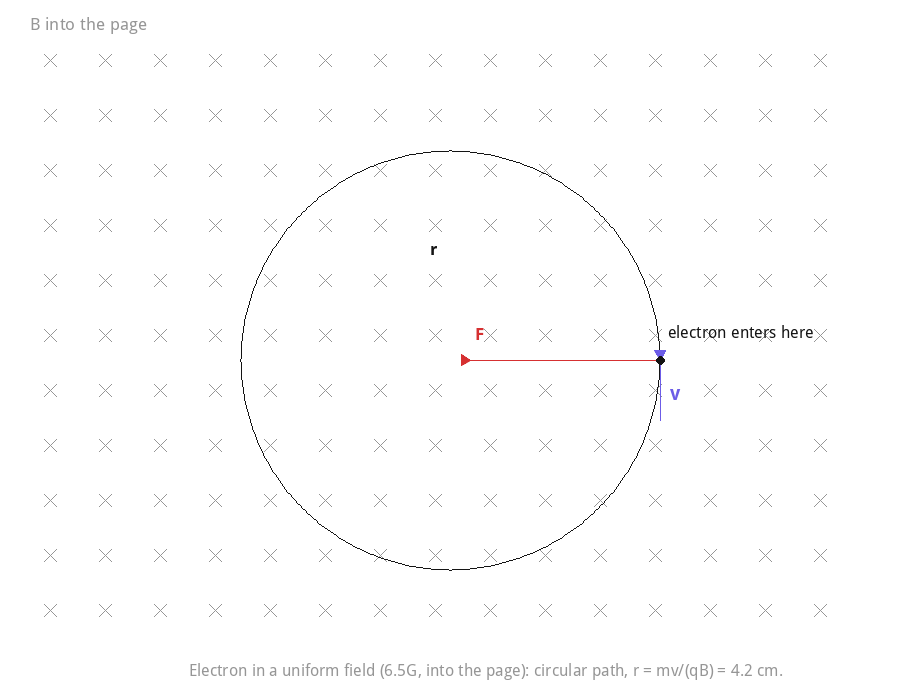
4.11 In a chamber, a uniform magnetic field of 6.5G (1G=10⁻⁴T) is maintained. An electron is shot into the field with a speed of 4.8×10⁶m/s normal to the field. Explain why the path of the electron is a circle. Determine the radius of the circular orbit.
Ans: Since the electron’s velocity is always perpendicular to the magnetic force (F=qv×B), the force acts as a centripetal force of constant magnitude, so the electron moves in a circle. Radius r=mv/(qB)=(9.11×10⁻³¹×4.8×10⁶)/(1.6×10⁻¹⁹×6.5×10⁻⁴)≈4.2×10⁻² m (4.2 cm).
4.12 In Exercise 4.11, obtain the frequency of revolution of the electron in its circular orbit. Does the answer depend on the speed of the electron? Explain.
Ans: Frequency f=qB/(2πm)=(1.6×10⁻¹⁹×6.5×10⁻⁴)/(2π×9.11×10⁻³¹)≈1.8×10⁷ Hz (≈18 MHz). This does not depend on the speed of the electron — a faster electron moves in a proportionally larger circle, so the time for one revolution (and hence the frequency) stays the same.
4.13 (a) A circular coil of 30 turns and radius 8.0cm carrying a current of 6.0A is suspended vertically in a uniform horizontal magnetic field of magnitude 1.0T. The field lines make an angle of 60° with the normal of the coil. Calculate the magnitude of the counter torque that must be applied to prevent the coil from turning. (b) Would your answer change if the circular coil in (a) were replaced by a planar coil of some irregular shape that encloses the same area? (All other particulars are also unaltered.)
Ans: (a) Area A=πr²=π×(0.08)²≈0.0201m². τ=NIAB sinθ=30×6.0×0.0201×1.0×sin60°≈3.13 N·m. (b) No, the answer would not change — the torque on a current loop depends only on its magnetic moment m=NIA (which depends on the enclosed area, not the loop’s particular shape) and on B and θ, so any planar coil enclosing the same area experiences the same torque.
- Chapter 1: Electric Charges and Fields – Free PDF Download
- Chapter 2: Electrostatic Potential and Capacitance – Free PDF Download
- Chapter 3: Current Electricity – Free PDF Download
- Chapter 5: Magnetism and Matter – Free PDF Download
- Chapter 6: Electromagnetic Induction – Free PDF Download
- Chapter 7: Alternating Current – Free PDF Download
Frequently Asked Questions
What is the magnetic field formula at the centre of a circular coil?
B=μ₀NI/2R.
What is the difference between current sensitivity and voltage sensitivity of a galvanometer?
Current sensitivity is the deflection per unit current (NAB/k); voltage sensitivity is the deflection per unit voltage (NAB/kR). Two galvanometers can have equal voltage sensitivity even with different current sensitivities if their resistances differ proportionally, as in Q4.10.
Chapter Quiz — Test Your Understanding
Class 12 Physics Chapter 4 – Notes and Extra Questions
Along with these NCERT Solutions, students can also use the Class 12 Physics Chapter 4 Extra Questions and Class 12 Physics Chapter 4 Revision Notes for quick revision and extra practice.
See also: Chapter 1 | Chapter 2 | Chapter 3 | Chapter 5
Practice more: Chapter 1 | Chapter 2 | Chapter 3 | Chapter 5
Quick revision: Chapter 1 | Chapter 2 | Chapter 3 | Chapter 5
Recommended: Buy the Printed NCERT Class 12 Physics Book
Contains Amazon affiliate links.
If you’d like a printed copy alongside the PDF, here’s a verified option:
4.4 out of 5 stars (159 ratings) · Rs. 155
Price and availability may change on Amazon. As an Amazon Associate, ncertbooks.org earns from qualifying purchases.



Pingback: Class 12 Physics Chapter 6 Electromagnetic Induction Revision Notes (2026-27)