
Moving charges generate their own magnetic fields and, in turn, feel a force from external ones — the Lorentz force, Ampere’s law, and circular motion in a field are all fair game in these Class 12 Physics Chapter 4 questions.
Last Updated: September 23, 2026
How to Approach the HOTS Questions in This Chapter
HOTS questions here often combine a moving charge in both electric and magnetic fields (velocity-selector-type problems), or ask you to compare the field at different points around a current-carrying conductor — practice problems combining multiple field sources or crossed fields, not just single-source, single-point calculations.
Very Short Answer Questions (1 mark)
Q1. Write the formula for the Lorentz magnetic force.
Ans: F=qv×B.
Q2. Write the radius of circular motion of a charged particle in a magnetic field.
Ans: r=mv/(qB).
Q3. State Ampere’s circuital law.
Ans: ∮B·dl=μ₀Ienclosed.
Q4. What is the magnetic field at the center of a current loop of radius R carrying current I?
Ans: B=μ₀I/2R.
Q5. Do like currents attract or repel?
Ans: Attract.
Short Answer Questions (2–3 marks)
Q6. Find the magnetic field at a distance 0.1m from a long straight wire carrying 5A current.
Ans: B=μ₀I/2πr=(4π×10⁻⁷)(5)/(2π×0.1)=10⁻⁵ T.
Q7. A proton moves with velocity 2×10⁶ m/s perpendicular to a field of 0.5T. Find the force.
Ans: F=qvB=(1.6×10⁻¹⁹)(2×10⁶)(0.5)=1.6×10⁻¹³ N.
Q8. Two parallel wires carry 3A and 4A separated by 0.2m. Find the force per unit length.
Ans: F/l=μ₀I₁I₂/2πd=(4π×10⁻⁷)(3)(4)/(2π×0.2)=1.2×10⁻⁵ N/m.
Higher-Order Thinking / Application Questions
Q9. A charged particle enters a region with perpendicular electric field E=2×10⁴ V/m and magnetic field B=0.5T (velocity selector configuration) and passes through undeflected. It then enters a region with only the magnetic field B=0.5T and moves in a circle of radius 0.02m. Find the charge-to-mass ratio of the particle.
Ans: In the velocity selector, undeflected motion means the electric force balances the magnetic force: qE=qvB, so v=E/B=(2×10⁴)/(0.5)=4×10⁴ m/s. In the region with only the magnetic field, the particle moves in a circle with radius r=mv/(qB), so rearranging: q/m=v/(rB)=(4×10⁴)/(0.02×0.5)=(4×10⁴)/(0.01)=4×10⁶ C/kg. This two-stage method (velocity selector to fix v, then circular motion to relate q/m) is exactly the technique used historically (e.g., by J.J. Thomson) to measure the charge-to-mass ratio of the electron.
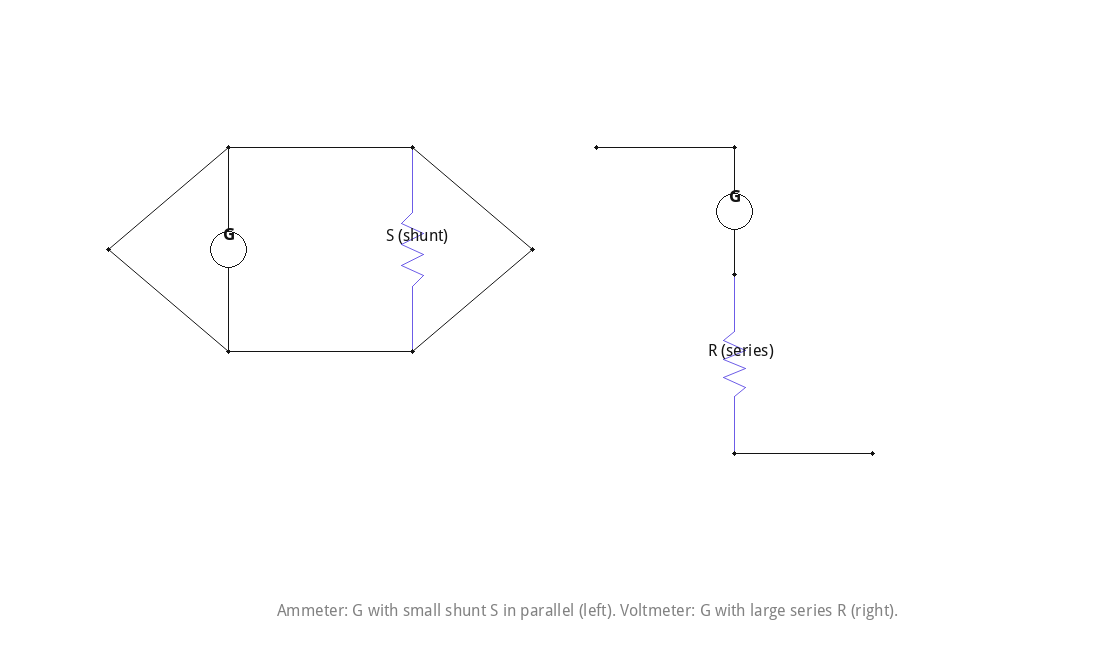
Q10. A moving coil galvanometer has resistance 50Ω and gives full-scale deflection for a current of 5mA. Convert it into (a) an ammeter reading up to 5A, and (b) a voltmeter reading up to 10V, finding the required shunt/series resistance in each case.
Ans: (a) Ammeter conversion: We need a shunt S in parallel with the galvanometer so that most of the 5A current bypasses the galvanometer, with only 5mA=0.005A flowing through it. The remaining current through the shunt is Is=5−0.005=4.995A. Since the galvanometer and shunt are in parallel, they have the same voltage: IgG=IsS, so 0.005×50=4.995×S, giving S=0.25/4.995≈0.05Ω (a very small shunt resistance). (b) Voltmeter conversion: We need a series resistance R such that at full-scale deflection current Ig=0.005A, the total voltage across (galvanometer+R) equals 10V. Using V=Ig(G+R): 10=0.005(50+R), so 50+R=10/0.005=2000, giving R=2000−50=1950Ω (a large series resistance). This illustrates the general principle: ammeters need a very small parallel shunt (low resistance, to divert most current), while voltmeters need a large series resistance (to limit current through the sensitive galvanometer while dropping most of the voltage across the added resistor).
- Chapter 1: Electric Charges and Fields
- Chapter 2: Electrostatic Potential and Capacitance – Extra Questions with Answers
- Chapter 3: Current Electricity – Extra Questions with Answers
- Chapter 5: Magnetism and Matter – Extra Questions with Answers
- Chapter 6: Electromagnetic Induction – Extra Questions with Answers
- Chapter 7: Alternating Current – Extra Questions with Answers
Frequently Asked Questions
How would you find the force on a current carrying conductor of length 0.5 m carrying 2 A placed in a magnetic field of 0.3 T perpendicular to it?
Using F = BIL = 0.3 times 2 times 0.5 = 0.3 N.
How would you determine the direction of the magnetic field around a straight current carrying wire?
Using the right hand thumb rule, if the thumb points in the direction of current, the curled fingers show the direction of the magnetic field.
Chapter Quiz — Test Your Understanding
Class 12 Physics Chapter 4 – Solutions and Notes
For complete step-by-step answers and a quick summary, check the Class 12 Physics Chapter 4 Solutions and Class 12 Physics Chapter 4 Revision Notes.
See also: Chapter 1 | Chapter 2 | Chapter 3 | Chapter 5 | Chapter 4
Practice more: Chapter 1 | Chapter 2 | Chapter 3 | Chapter 5
Quick revision: Chapter 1 | Chapter 2 | Chapter 3 | Chapter 5
Recommended: Buy the Printed NCERT Class 12 Physics Book
Contains Amazon affiliate links.
If you’d like a printed copy alongside the PDF, here’s a verified option:
4.4 out of 5 stars (159 ratings) · Rs. 155
Price and availability may change on Amazon. As an Amazon Associate, ncertbooks.org earns from qualifying purchases.



Pingback: Class 12 Physics Chapter 4 Moving Charges and Magnetism Solutions (2026-27)
Pingback: Class 12 Physics Chapter 6 Electromagnetic Induction Solutions (2026-27)