
Genuinely harder, HOTS-level practice for Class 12 Physics Chapter 1 (Electric Charges and Fields), going beyond the standard exercise. These Class 12 Physics Chapter 1 important questions are handy for last-minute exam practice.
Last Updated: September 23, 2026
How to Approach the HOTS Questions in This Chapter
HOTS questions on this chapter often place multiple charges in a non-symmetric arrangement, requiring vector addition of fields or forces rather than a single-formula answer, or ask you to justify why Gauss’s law does or doesn’t apply to a given scenario — practice both the vector-addition case and the symmetry-justification case separately.
- Q1 (Hollow conductor, HOTS). A hollow spherical conductor carries a charge Q. An insulated point charge q is placed inside the cavity, not at the centre. Where does charge appear on the inner and outer surfaces, and does the OFF-CENTRE position of q change the charge distribution on the outer surface?
Solution: The inner surface develops an induced charge of exactly −q (non-uniformly distributed, concentrated closer to where q sits), and the outer surface carries Q+q. Crucially, the outer surface’s charge distribution is uniform regardless of where q sits inside the cavity — the conductor’s bulk material completely shields the outside from the exact position of q inside, which is the basis of electrostatic shielding. - Q2 (Assertion-Reason). Assertion (A): The electric field inside a uniformly charged spherical shell is zero. Reason (R): By Gauss’s law, a Gaussian surface inside the shell encloses zero net charge.
Solution: Both A and R are true, and R correctly explains A — since the entire charge resides on the shell’s surface, any Gaussian sphere drawn strictly inside encloses no charge, forcing the enclosed flux (and hence the field, by symmetry) to be zero. Answer: Both true, R is the correct explanation of A. - Q3 (Combining dipole + flux). An electric dipole of moment p is placed at the centre of a sphere of radius R. What is the total electric flux through the sphere?
Solution: Zero. A dipole’s net charge is zero (+q and −q are equal and opposite), and Gauss’s law depends only on the net enclosed charge — so despite the dipole producing a strong, complex field pattern, the total outward flux through any closed surface around it is always exactly zero. - Q4 (Numerical synthesis). Two identical small conducting spheres, one with charge +12µC and the other with charge −4µC, are brought into contact and then separated to their original distance. If they originally repelled with force F₀ when both had their initial charges (calculate assuming initial force was attractive), what is the ratio of the new force to the magnitude of the old force?
Solution: Original force (attractive, opposite signs): F₁ ∝ |12×(−4)| = 48 (in µC² units). After contact, charge redistributes equally: each sphere gets (12+(−4))/2 = 4µC. New force (repulsive, same sign): F₂ ∝ 4×4 = 16. Ratio F₂/F₁ = 16/48 = 1/3 — the new force is one-third the magnitude of the old, and has switched from attractive to repulsive.
NCERT Solutions | Revision Notes | Class 12 Physics Book
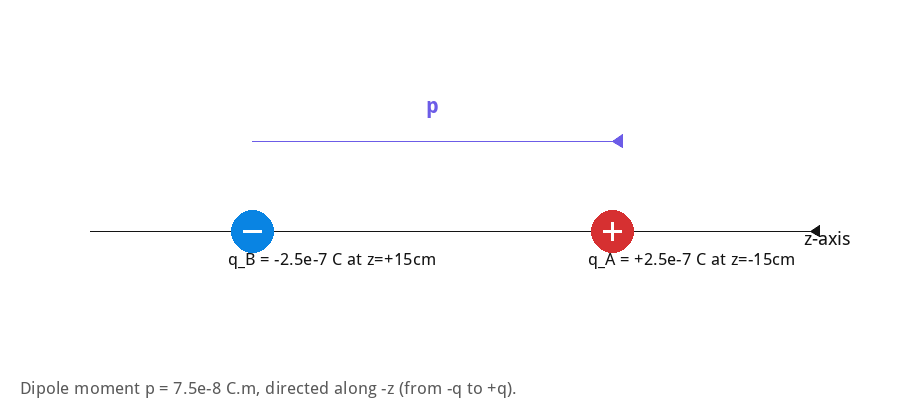
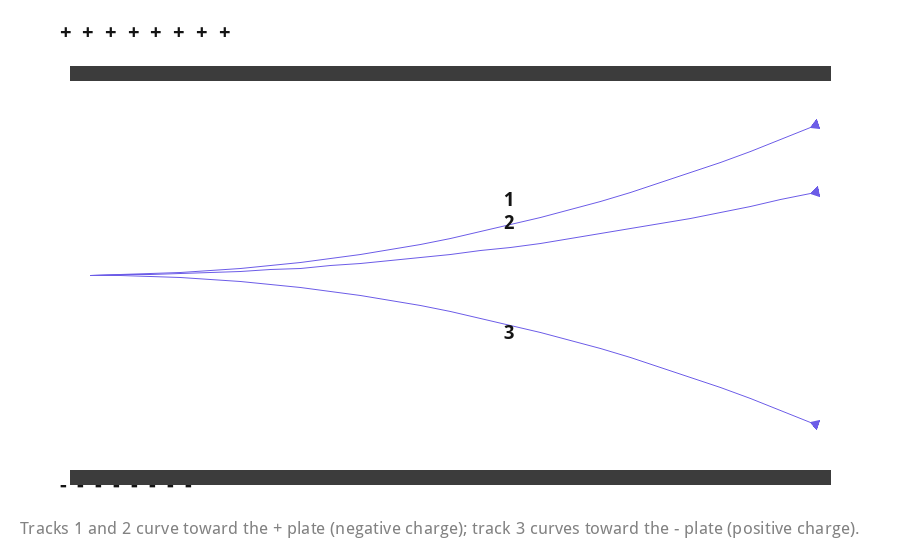
Quick visual: a worked diagram from the full Solutions page, for reference.
Chapter Quiz — Test Your Understanding
Class 12 Physics Chapter 1 – Solutions and Notes
For complete step-by-step answers and a quick summary, check the Class 12 Physics Chapter 1 Solutions and Class 12 Physics Chapter 1 Revision Notes.
- Chapter 2: Electrostatic Potential and Capacitance – Extra Questions with Answers
- Chapter 3: Current Electricity – Extra Questions with Answers
- Chapter 4: Moving Charges and Magnetism – Extra Questions with Answers
- Chapter 5: Magnetism and Matter – Extra Questions with Answers
- Chapter 6: Electromagnetic Induction – Extra Questions with Answers
- Chapter 7: Alternating Current – Extra Questions with Answers
Frequently Asked Questions
Are these HOTS questions from the CBSE board exam pattern?
These go beyond the standard textbook exercise to test deeper conceptual understanding, in the style CBSE uses for its ‘competency-based’/assertion-reason and case-study questions.
Recommended: Buy the Printed NCERT Class 12 Physics Book
Contains Amazon affiliate links.
If you’d like a printed copy alongside the PDF, here’s a verified option:
4.4 out of 5 stars (159 ratings) · Rs. 155
Price and availability may change on Amazon. As an Amazon Associate, ncertbooks.org earns from qualifying purchases.



Pingback: Class 12 Physics Chapter 4 Moving Charges and Magnetism Solutions (2026-27)
Pingback: Class 12 Physics Chapter 5 Magnetism and Matter Solutions (2026-27)
Pingback: Class 12 Physics Chapter 8 Electromagnetic Waves Extra Questions (2026-27)
Pingback: Class 12 Physics Chapter 7 Alternating Current Revision Notes (2026-27)