
Chapter 1 — Electric Charges and Fields — covers Coulomb’s law, the principle of superposition, electric field and field lines, electric dipoles, continuous charge distributions, electric flux, and Gauss’s law. Note: the printed NCERT textbook has 34 numbered exercise questions, but the current CBSE 2023-24 rationalised syllabus (carried forward to 2026-27) has dropped Q1.13 and Q1.25–Q1.34 from board examinability. Below are complete, original answers to the 23 currently board-examinable questions (Q1.1–Q1.12, Q1.14–Q1.24), followed by a compact section covering the additional questions for students preparing for JEE/NEET or other boards.
Last Updated: September 23, 2026
How to Approach This Chapter
Draw a clear diagram with charge positions and field/force directions before writing any equation — most errors in this chapter come from a sign or direction mistake, not the formula itself. Reach for Gauss’s law only for the three standard symmetric cases it’s designed for; for anything else, go back to direct Coulomb’s law or integration.
Exam Weightage: How Important Is This Chapter?
Electric Charges and Fields carries 5 marks, paired with Electrostatic Potential and Capacitance (also 5 marks) to form the 10-mark Electrostatics unit in the CBSE Class 12 Physics board exam.
NCERT Solutions for Class 12 Physics Chapter 1: Electric Charges and Fields
Q1.1. What is the force between two small charged spheres having charges of 2×10⁻⁷ C and 3×10⁻⁷ C placed 30 cm apart in air?
Coulomb’s law: F = kq₁q₂/r² = (9×10⁹×2×10⁻⁷×3×10⁻⁷)/(0.3)² = 6×10⁻³ N, repulsive (both charges are positive).
Q1.2. A sphere of charge 0.4 µC experiences a force of 0.2 N from a nearby sphere of charge −0.8 µC in air. (a) Find the separation. (b) Find the force on the second sphere due to the first.
(a) r² = kq₁q₂/F = (9×10⁹×0.4×10⁻⁶×0.8×10⁻⁶)/0.2 = 144×10⁻⁴ m² → r = 0.12 m. (b) By Newton’s third law, equal and opposite: 0.2 N.
Q1.3. Check that ke²/(Gm_em_p) is dimensionless. Evaluate it and state its significance.
Substituting SI units for every quantity, all units cancel — confirming the ratio is a dimensionless pure number. Using k=9×10⁹, e=1.6×10⁻¹⁹ C, G=6.67×10⁻¹¹, m_e=9.1×10⁻³¹ kg, m_p=1.67×10⁻²⁷ kg gives ≈2.3×10³⁹. This is the ratio of the electrostatic to the gravitational force between a proton and electron, showing gravity is utterly negligible at atomic scale.
Q1.4. (i) What does it mean that electric charge is ‘quantised’? (ii) Why is this ignored for macroscopic charges?
(i) Charge can only exist in integer multiples of the elementary charge e; a body can never carry a fractional amount of e. (ii) Everyday charges involve enormous numbers of electrons, so the discreteness becomes negligible and charge behaves as if continuous.
Q1.5. When a glass rod is rubbed with silk, the silk acquires a positive charge equal in magnitude to the negative charge on the glass rod. Explain in terms of charge conservation.
Rubbing does not create charge, it only transfers electrons between the two surfaces. Here, electrons move from the silk to the glass rod, leaving the silk short of electrons (positively charged) and the glass with a surplus (negatively charged). The magnitudes are exactly equal because every electron that leaves the silk arrives on the glass — the total charge of the two-body system, zero before rubbing, remains exactly zero afterward, consistent with charge conservation.
Q1.6. Four point charges q_A=2µC, q_B=−5µC, q_C=2µC, q_D=−5µC are at the corners of a 10 cm square ABCD. What is the force on a 1µC charge placed at the centre of the square?
By symmetry, A and C are diagonally opposite with equal charge, so their forces on a charge at the centre are equal in magnitude and opposite in direction — they cancel exactly. The same is true for B and D. The net force is zero.
Q1.7. (i) An electric field line cannot have sudden breaks. Why not? (ii) Why can’t two field lines cross each other?
(i) A field line traces the direction of the force on a test charge, which varies continuously in space — it cannot jump discontinuously, so the line cannot break suddenly. (ii) The field at any point has one single, well-defined direction; if two lines crossed, the field at that point would have to point in two directions at once, which is impossible.
Q1.8. Two point charges q_A=3µC and q_B=−3µC are located 20 cm apart in vacuum. (a) What is the electric field at the midpoint O? (b) A test charge of −1.5×10⁻ⁿ C is placed at O. Find the force on it.
(a) At the midpoint (r=0.1 m from each charge), both charges produce a field of equal magnitude, and both point in the same direction (from + towards −, i.e. from A towards B), so they add: E = 2×(9×10⁹×3×10⁻⁶)/(0.1)² = 5.4×10⁶ N/C, directed from A to B. (b) F = qE = 1.5×10⁻ⁿ×5.4×10⁶ = 8.1×10⁻³ N, directed from O towards A (a negative test charge is attracted towards positive A and repelled from negative B — both effects point the same way).
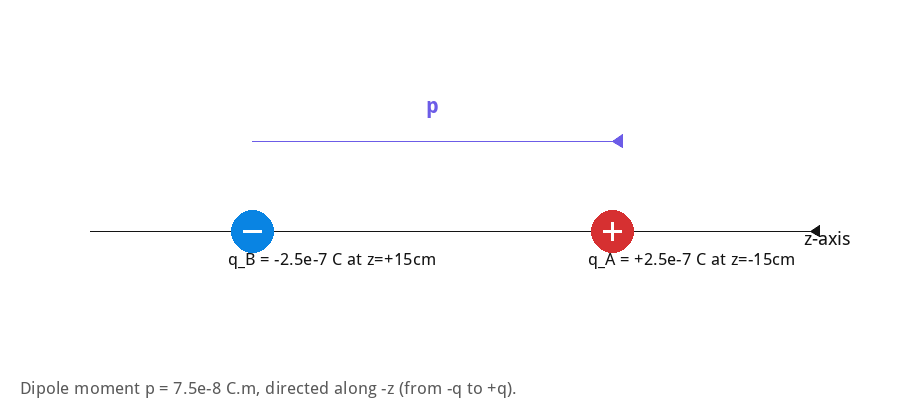
Q1.9. A system has two charges q_A=2.5×10⁻⁷ C at (0,0,−15 cm) and q_B=−2.5×10⁻⁷ C at (0,0,+15 cm). What are the total charge and electric dipole moment of the system?
Total charge = q_A+q_B = 0. Separation d = 30 cm = 0.3 m. Dipole moment magnitude p = q×d = 2.5×10⁻⁷×0.3 = 7.5×10⁻⁸ C·m. Direction: a dipole moment points from the negative charge to the positive charge — here that is from q_B (at z=+15 cm) toward q_A (at z=−15 cm), i.e. along the negative z-axis.
Q1.10. An electric dipole with dipole moment 4×10⁻⁹ C·m is aligned at 30° with an electric field of 5×10⁴ N/C. Calculate the magnitude of the torque acting on the dipole.
τ = pE sinθ = 4×10⁻⁹×5×10⁴×sin30° = 1×10⁻⁴ N·m.
Q1.11. Polythene rubbed with wool is found to acquire a negative charge of 3×10⁻⁷ C. (a) Estimate the number of electrons transferred, and to which body. (b) Is there a transfer of mass from wool to polythene?
(a) Since polythene becomes negative, electrons transferred from wool to polythene. n = q/e = 3×10⁻⁷/1.6×10⁻ⁿⁿ ≈ 1.87×10¹² electrons. (b) Yes — electrons carry mass, so mass moves from wool to polythene: n×m_e = 1.87×10¹²×9.1×10⁻³⁹ ≈ 1.7×10⁻¹⁸ kg, an entirely negligible amount.
Q1.12. (a) Two insulated copper spheres A and B, 50 cm apart, carry equal charges of 6.5×10⁻⁷ C. What is the repulsive force? (b) If each sphere is charged double and the distance halved, what is the new force?
(a) F = kq²/r² = 9×10⁹×(6.5×10⁻⁷)²/(0.5)² = 1.52×10⁻² N. (b) Doubling both charges multiplies q_Aq_B by 4; halving r multiplies 1/r² by another 4 — combined, the force becomes 16× larger: ≈0.243 N.
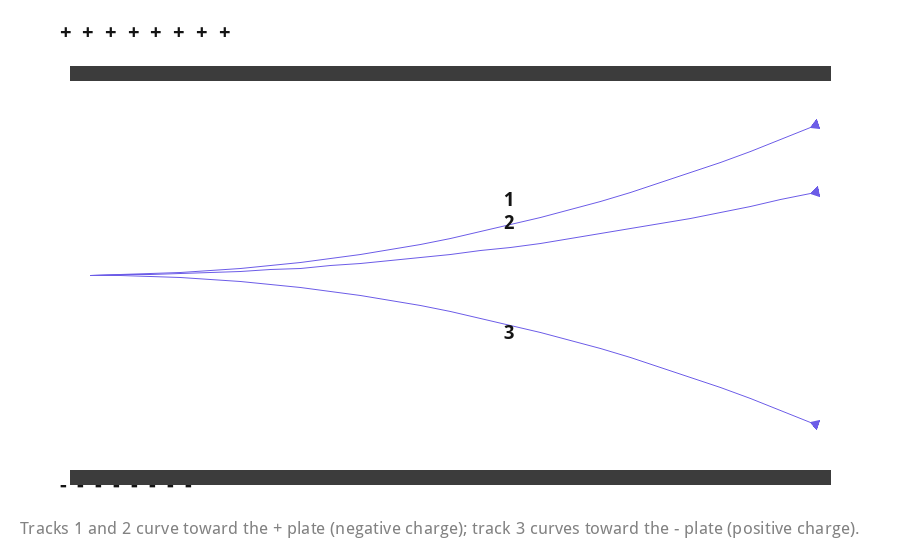
Q1.14. Figure shows tracks of three charged particles in a uniform electrostatic field. Give the signs of the three charges and identify which particle has the highest charge-to-mass ratio.
Two of the tracks curve toward the positive plate, meaning those particles are negatively charged; the third curves the opposite way, so it is positively charged. Whichever particle shows the sharpest curvature for the same field and transit time has the largest charge-to-mass ratio, since the deflection produced by a given field scales directly with q/m.
Q1.15. Consider a uniform electric field E = 3×10³ î N/C. (a) What is the flux of this field through a 10 cm × 10 cm square whose plane is parallel to the y-z plane? (b) What is the flux through the same square if its plane makes a 60° angle with the x-axis?
Area A = (0.1)² = 0.01 m². (a) A plane parallel to the y-z plane has its normal along x, so θ=0°: φ = EA cosθ = 3×10³×0.01 = 30 N·m²/C. (b) With θ=60°: φ = 3×10³×0.01×cos60° = 15 N·m²/C.
Q1.16. What is the net flux of the uniform electric field of Q1.15 through a cube of side 20 cm oriented so that its faces are parallel to the coordinate planes?
Zero. With no charge enclosed by the cube, every field line entering through one face exits through the opposite face, so the net flux through the whole closed surface is zero — consistent with Gauss’s law for zero enclosed charge.
Q1.17. Careful measurement of the electric field at the surface of a black box tells you that the net outward flux through the surface is 8.0×10³ N·m²/C. (a) What is the net charge inside the box? (b) If the net outward flux through the surface were zero, could you conclude there were no charges inside the box?
(a) By Gauss’s law, q = ε₀φ = 8.854×10⁻¹²×8.0×10³ ≈ 7.08×10⁻⁸ C (≈0.07 µC). (b) No — zero net flux only guarantees the net enclosed charge is zero; there could still be equal and opposite charges inside that cancel each other’s flux contribution.
Q1.18. A point charge of +10 µC is placed at a distance of 5 cm directly above the centre of a square of side 10 cm. Find the flux through the square.
Treat the square as one face of an imaginary 10 cm cube centred on the charge. Total flux through the whole cube is q/ε₀, shared equally among its six identical faces: φ = q/(6ε₀) = (10×10⁻⁶)/(6×8.854×10⁻¹²) ≈ 1.88×10⁵ N·m²/C.
Q1.19. A point charge of 2.0 µC is at the centre of a cubic Gaussian surface 9 cm on edge. What is the net electric flux through the surface?
φ = q/ε₀ = 2×10⁻⁶/8.854×10⁻¹² ≈ 2.26×10⁵ N·m²/C (independent of the cube’s size, since only the enclosed charge matters).
Q1.20. A point charge causes an electric flux of −1.0×10³ N·m²/C through a spherical Gaussian surface of 10 cm radius centred on it. (a) If the radius is doubled, how much flux passes through? (b) What is the value of the point charge?
(a) Unchanged — still −1.0×10³ N·m²/C, since flux depends only on the enclosed charge, not the surface’s size. (b) q = φε₀ = −1.0×10³×8.854×10⁻¹² ≈ −8.85×10⁻ⁿ C (−8.85 nC).
Q1.21. A conducting sphere of radius 10 cm has an unknown charge. If the electric field 20 cm from the centre of the sphere is 1.5×10³ N/C and points radially inward, what is the net charge on the sphere?
Magnitude from E = kq/d²: q = Ed²/k = (1.5×10³×0.2²)/9×10⁹ ≈ 6.67×10⁻ⁿ C. Since the field points radially inward (toward the sphere), the charge is negative: q ≈ −6.67 nC.
Q1.22. A conducting sphere of radius 2.4 m has a surface charge density of 80.0 µC/m². (a) Find the charge on the sphere. (b) What is the total electric flux leaving the surface?
Radius = diameter/2 = 1.2 m. (a) Q = σ×4πr² = 80×10⁻⁶×4π(1.2)² ≈ 1.45×10⁻³ C. (b) φ = Q/ε₀ = 1.45×10⁻³/8.854×10⁻¹² ≈ 1.63×10⁸ N·m²/C.
Q1.23. An infinite line charge produces a field of 9×10⁴ N/C at a distance of 2 cm. Calculate the linear charge density.
From E = λ/(2πε₀d): λ = 2πε₀Ed = 2π×8.854×10⁻¹²×9×10⁴×0.02 ≈ 1.0×10⁻⁷ C/m = 0.1 µC/m.
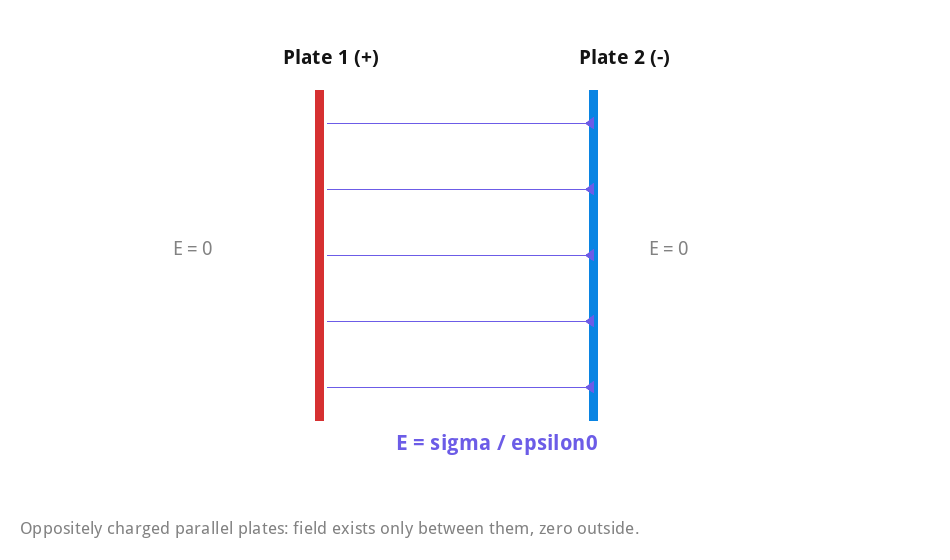
Q1.24. Two large, thin metal plates are parallel and close to each other. On their inner faces, the plates have surface charge densities of opposite signs and of magnitude 17.0×10⁻²² C/m². What is the electric field (a) in the outer region of the first plate, (b) in the outer region of the second plate, (c) between the plates?
(a) and (b) Outside either plate, the fields from the two oppositely-charged sheets point in opposite directions and exactly cancel: E = 0 in both outer regions. (c) Between the plates, the two fields point the same way and add: E = σ/ε₀ = 17.0×10⁻²²/8.854×10⁻¹² ≈ 1.92×10⁻¹₀ N/C, directed from the positive plate towards the negative plate.
Additional Questions (Not in Current CBSE Board Syllabus)
Q1.13 and Q1.25–Q1.34 were removed from CBSE board examinability in the 2023-24 rationalisation, but remain in the printed textbook and are useful for JEE/NEET preparation or other boards. Brief answers:
- Q1.13 (third identical sphere touches A then B from Q1.12, then removed): repeated contact-sharing leaves A with half its original charge and B with three-quarters of the original — new force = (3/8)× the original repulsive force ≈ 5.70×10⁻³ N, repulsive.
- Q1.25 (Millikan oil-drop, 12 excess electrons, field 2.55×10⁴ N/C, oil density 1.26 g/cm³): balancing electric force against gravity gives a drop radius of ≈9.82×10⁻⁷ m.
- Q1.26: valid field-line sketches must meet a conductor at right angles, run from + to − charge, never cross, and never form closed loops in charge-free space — any sketch violating these rules is invalid.
- Q1.27 (dipole in a field gradient growing along +z at 10⁵ N/C per metre, dipole moment 10⁻⁷ C·m along −z): force ≈ −10⁻² N along z (i.e. 0.01 N along −z); torque = 0, since the dipole is anti-parallel to the field.
- Q1.28 (charge on a hollow conductor): Gauss’s law applied just inside the cavity wall shows the field inside conductor material is zero, so all charge must reside on the outer surface; an insulated charge q placed in the cavity induces −q on the inner wall and forces the outer surface to carry Q+q; sensitive instruments are shielded using a grounded conducting enclosure (Faraday cage).
- Q1.29 (field at a small hole in a charged conductor): equals half the total surface field, σ/(2ε₀), since the hole’s own contribution and the rest of the conductor’s contribution are equal and together make up the full σ/ε₀.
- Q1.30 (field of an infinite wire via direct integration of Coulomb’s law): integrating the perpendicular field components from each charge element along the wire reproduces the standard result E = λ/(2πε₀r).
- Q1.31 (quark composition of proton/neutron): a proton (charge +e) = two up quarks + one down quark; a neutron (charge 0) = one up quark + two down quarks.
- Q1.32 (stability of equilibrium at a field-null point): always unstable, since Gauss’s law forbids field lines converging inward from all directions onto a charge-free point; verified for two equal like charges, where the null point is stable along the connecting line but unstable perpendicular to it.
- Q1.33 (deflection of a charged particle between parallel plates): s = qEL²/(2mv_x²), derived exactly like projectile motion with the electric force replacing gravity.
- Q1.34 (electron, v_x=2.0×10⁶ m/s, plates 0.5 cm apart, E=9.1×10² N/C): the electron strikes a plate about 1.6 cm from where it entered.
Why This Chapter Matters
Electric Charges and Fields lays the entire foundation for electrostatics — Gauss’s law and field concepts introduced here are used continuously through capacitance, current electricity, and magnetism later in the syllabus, making it one of the highest-leverage chapters in Class 12 Physics.
Extra Questions (HOTS) | Revision Notes | Class 12 Physics Book
Chapter Quiz — Test Your Understanding
Class 12 Physics Chapter 1 – Notes and Extra Questions
Along with these NCERT Solutions, students can also use the Class 12 Physics Chapter 1 Extra Questions and Class 12 Physics Chapter 1 Revision Notes for quick revision and extra practice.
- Chapter 2: Electrostatic Potential and Capacitance – Free PDF Download
- Chapter 3: Current Electricity – Free PDF Download
- Chapter 4: Moving Charges and Magnetism – Free PDF Download
- Chapter 5: Magnetism and Matter – Free PDF Download
- Chapter 6: Electromagnetic Induction – Free PDF Download
- Chapter 7: Alternating Current – Free PDF Download
Frequently Asked Questions
Are all 34 exercise questions in this chapter examinable for CBSE boards?
No — only 23 are (Q1.1–Q1.12, Q1.14–Q1.24). Q1.13 and Q1.25–Q1.34 were dropped from the CBSE board syllabus in the 2023-24 rationalisation, though they remain in the printed book and are useful for JEE/NEET.
Is Gauss’s law itself examinable?
Yes — Gauss’s law and its applications (Q1.15–Q1.24) remain fully part of the current board syllabus.
Recommended: Buy the Printed NCERT Class 12 Physics Book
Contains Amazon affiliate links.
If you’d like a printed copy alongside the PDF, here’s a verified option:
4.4 out of 5 stars (159 ratings) · Rs. 155
Price and availability may change on Amazon. As an Amazon Associate, ncertbooks.org earns from qualifying purchases.



Pingback: NCERT Solutions for Class 12 Physics Chapter 6: Electromagnetic Induction xe2x80x93 Free PDF Download - NCERTBooks.org
Pingback: Class 12 Physics Chapter 6 Electromagnetic Induction Extra Questions (2026-27)
Pingback: NCERT Solutions for Class 12 Physics Chapter 7: Alternating Current – Free PDF Download - NCERTBooks.org
Pingback: Class 12 Physics Chapter 7 Alternating Current Extra Questions (2026-27)
Pingback: NCERT Solutions for Class 12 Physics Chapter 11: Dual Nature of Radiation and Matter–Free PDF Download - NCERTBooks.org
Pingback: Class 12 Physics Chapter 5 Magnetism and Matter Revision Notes (2026-27)
Pingback: Revision Notes: Class 12 Physics Chapter 1 Electric Charges and Fields
Pingback: Class 12 Physics Chapter 3 Current Electricity Revision Notes (2026-27)