
In electrostatics, potential tells you how much work is needed to bring a charge to a point, and capacitors are simply devices built to store that energy — this Class 12 Physics Chapter 2 summary walks through both ideas along with the series and parallel combination rules.
Last Updated: September 23, 2026
Potential
- V=kq/r (point charge); scalar quantity.
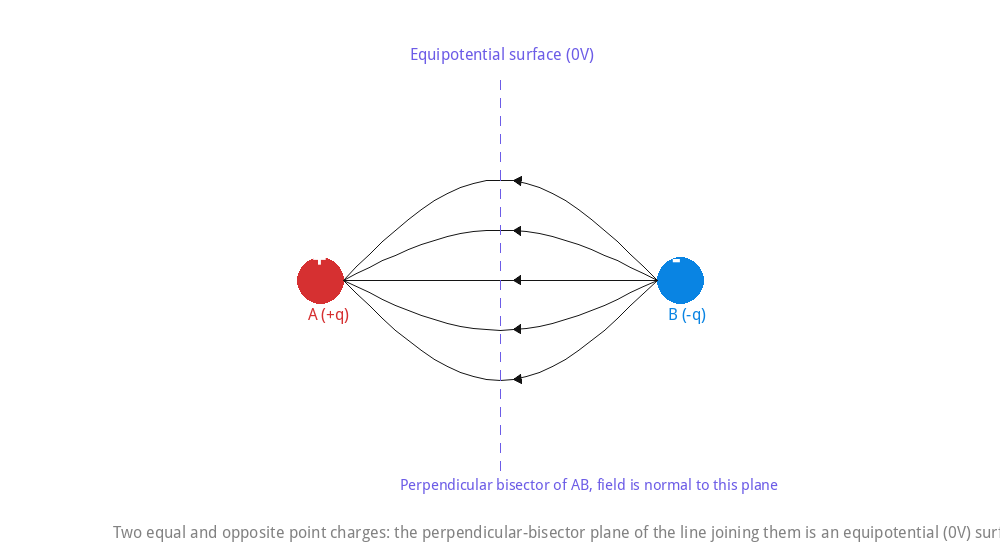
- Equipotential surfaces: perpendicular to field lines; no work done moving charge along them.
- E=−dV/dr.
Capacitors
- C=Q/V; parallel plate: C=ε₀A/d (vacuum), Kε₀A/d (dielectric).
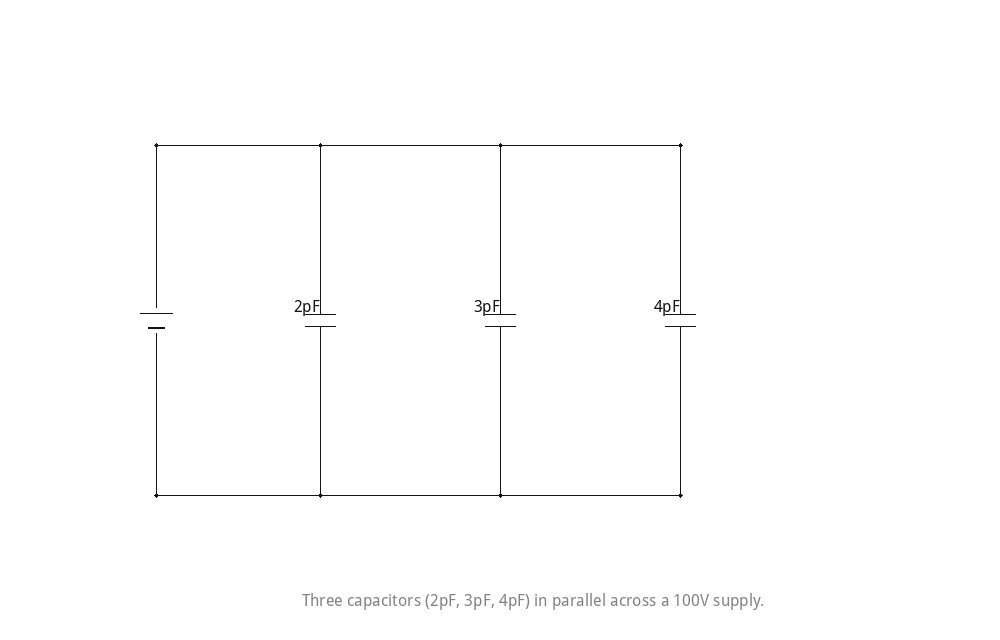
- Series: 1/C=1/C₁+1/C₂+…; Parallel: C=C₁+C₂+…
- Energy: U=½CV²=Q²/2C.
One-Line Summary
Electric potential is the scalar potential energy per unit charge; capacitors store charge and energy, with capacitance boosted by dielectrics and combined via series/parallel rules.
Quick visual: a worked diagram from the full Solutions page, for reference.
Frequently Asked Questions
What is electric potential, and how is it related to electric field?
Electric potential at a point is the work done per unit positive charge in bringing it from infinity to that point without acceleration; the electric field is the negative gradient of the potential.
What does the capacitance of a capacitor measure?
Capacitance measures the ability of a capacitor to store electric charge per unit potential difference applied across it, and it depends on the geometry of the conductors and the dielectric medium between them, not on the charge or voltage themselves.
Chapter Quiz — Test Your Understanding
Class 12 Physics Chapter 2 – Solutions and Important Questions
Need full answers or more practice? See the Class 12 Physics Chapter 2 Solutions and Class 12 Physics Chapter 2 Extra Questions.
Recommended: Buy the Printed NCERT Class 12 Physics Book
Contains Amazon affiliate links.
If you’d like a printed copy alongside the PDF, here’s a verified option:
4.4 out of 5 stars (159 ratings) · Rs. 155
Price and availability may change on Amazon. As an Amazon Associate, ncertbooks.org earns from qualifying purchases.



Pingback: Class 12 Physics Chapter 8 Electromagnetic Waves Revision Notes (2026-27)
Pingback: Class 12 Physics Chapter 10 Wave Optics Solutions (2026-27)