
Ohm’s law, Kirchhoff’s rules, and the Wheatstone bridge form the backbone of circuit analysis in Class 12 Physics Chapter 3, and the questions below test each of these ideas with short, exam-style answers.
Last Updated: September 23, 2026
How to Approach the HOTS Questions in This Chapter
HOTS questions here often combine an internal-resistance calculation with a Wheatstone-bridge or meter-bridge setup, or ask you to analyse a circuit with cells connected in a specific way — practice multi-step circuit problems that require applying more than one rule in sequence.
Very Short Answer Questions (1 mark)
Q1. State Ohm’s law.
Ans: V=IR, at constant temperature for an ohmic conductor.
Q2. Write the formula for equivalent resistance of two resistors in parallel.
Ans: 1/R=1/R₁+1/R₂.
Q3. What is the balance condition of a Wheatstone bridge?
Ans: P/Q=R/S.
Q4. State Kirchhoff’s junction rule.
Ans: Sum of currents entering a junction equals sum of currents leaving it.
Q5. What is the SI unit of resistivity?
Ans: Ohm-metre (Ω·m).
Short Answer Questions (2–3 marks)
Q6. Two resistors of 4Ω and 6Ω are connected in series to a 10V battery. Find the current.
Ans: R=4+6=10Ω. I=V/R=10/10=1A.
Q7. A wire of resistance 10Ω is stretched to double its length. Find the new resistance.
Ans: R∝l²/V(volume constant), so R′=R×2²=10×4=40Ω.
Q8. Find the equivalent resistance of three 6Ω resistors all in parallel.
Ans: 1/R=1/6+1/6+1/6=3/6=1/2, so R=2Ω.
Higher-Order Thinking / Application Questions
Q9. Using Kirchhoff’s laws, find the current through each branch of a circuit with two batteries: a 10V battery with internal resistance 1Ω and a 6V battery with internal resistance 1Ω, both connected to a common external resistor of 4Ω in a single loop opposing each other.
Ans: Since the batteries oppose each other in the loop, the net EMF driving the current is the difference: 10−6=4V. The total resistance in the loop is the sum of both internal resistances plus the external resistor: Rtotal=1+1+4=6Ω. By Kirchhoff’s voltage law (or simply Ohm’s law applied to the net EMF and total resistance), the current is I=Vnet/Rtotal=4/6=2/3 A≈0.67 A, flowing in the direction of the stronger (10V) battery. This demonstrates how Kirchhoff’s loop rule correctly handles opposing EMFs by taking their algebraic (signed) sum around the loop, rather than simply adding magnitudes.
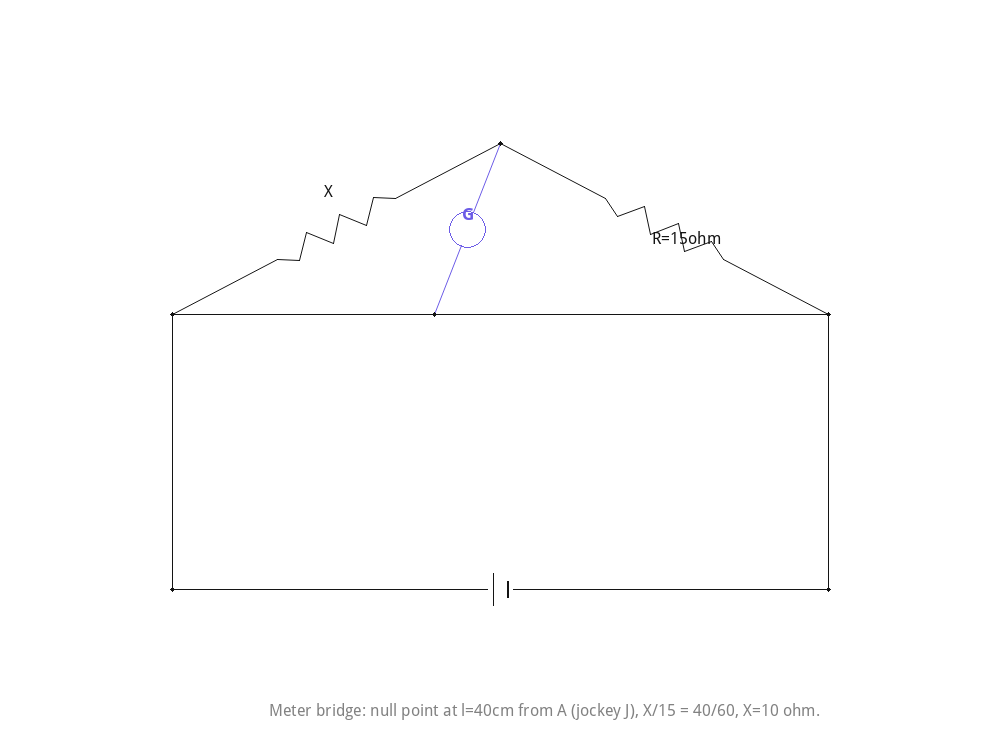
Q10. In a meter bridge experiment, the null point is obtained at 40cm from the left end when an unknown resistance X is in the left gap and a known resistance of 15Ω is in the right gap. Find X, and explain why the meter bridge is more accurate near the midpoint (50cm).
Ans: In a meter bridge, the balance condition is X/R=l/(100−l), where l is the balance length from the end with the unknown resistance. Here l=40cm, R=15Ω: X/15=40/(100−40)=40/60=2/3. So X=15×2/3=10Ω. Regarding accuracy: the meter bridge is most accurate when the null point is near the midpoint (50cm) because the bridge wire has uniform resistance per unit length, and the percentage error in reading the balance length (a fixed absolute error, e.g. ±0.1cm from parallax) has the LEAST relative impact on the calculated resistance ratio when l is close to 50cm (since the sensitivity of the bridge to small changes in resistance is maximized there, following from the mathematics of the l/(100−l) ratio, whose derivative with respect to l is most favorable to error-cancellation near the center). This is why experimentalists choose the value of the known resistance R to bring the balance point close to the 50cm mark.
- Chapter 1: Electric Charges and Fields
- Chapter 2: Electrostatic Potential and Capacitance – Extra Questions with Answers
- Chapter 4: Moving Charges and Magnetism – Extra Questions with Answers
- Chapter 5: Magnetism and Matter – Extra Questions with Answers
- Chapter 6: Electromagnetic Induction – Extra Questions with Answers
- Chapter 7: Alternating Current – Extra Questions with Answers
Frequently Asked Questions
How would you find the current flowing through a 10 ohm resistor connected to a 5 V battery?
Using Ohm law, I = V over R = 5 over 10 = 0.5 A.
If two resistors of 4 ohm and 6 ohm are connected in parallel, how would you find the equivalent resistance?
Using 1 over Req = 1 over 4 + 1 over 6 = 5 over 12, giving Req = 12 over 5 = 2.4 ohm.
Chapter Quiz — Test Your Understanding
Class 12 Physics Chapter 3 – Solutions and Notes
For complete step-by-step answers and a quick summary, check the Class 12 Physics Chapter 3 Solutions and Class 12 Physics Chapter 3 Revision Notes.
Recommended: Buy the Printed NCERT Class 12 Physics Book
Contains Amazon affiliate links.
If you’d like a printed copy alongside the PDF, here’s a verified option:
4.4 out of 5 stars (159 ratings) · Rs. 155
Price and availability may change on Amazon. As an Amazon Associate, ncertbooks.org earns from qualifying purchases.



Pingback: Class 12 Physics Chapter 3 Current Electricity Solutions (2026-27)
Pingback: Class 12 Physics Chapter 6 Electromagnetic Induction Extra Questions (2026-27)
Pingback: Class 12 Physics Chapter 7 Alternating Current Solutions (2026-27)
Pingback: NCERT Solutions for Class 12 Physics Chapter 10: Wave Optics – Free PDF Download - NCERTBooks.org
Pingback: Class 12 Physics Chapter 8 Electromagnetic Waves Revision Notes (2026-27)