
Electrostatic potential describes the work needed to bring a charge from infinity to a point in a field, and capacitors store that energy. Chapter 2’s exercises on potential, capacitance, and dielectrics are solved in full below.
Last Updated: September 23, 2026
NCERT Exercise Solutions
2.1 Two charges 5×10⁻⁸ C and −3×10⁻⁸ C are located 16 cm apart. At what point(s) on the line joining the two charges is the electric potential zero?
Ans: Between the charges, at distance x from the +5μC charge: 5/x = 3/(16−x) ⇒ x = 10 cm. Outside the charges, on the side of the smaller (−3μC) charge, at distance y from it: 5/(16+y)=3/y ⇒ y=24 cm from the −3μC charge.
2.2 A regular hexagon of side 10 cm has a charge 5μC at each vertex. Calculate the potential at the centre.
Ans: Distance of each vertex from centre = side = 0.1 m. V = 6kq/r = 6×(9×10⁹)(5×10⁻⁸)/0.1 = 2.7×10⁶ V.
2.3 Two charges 2μC and −2μC are placed at A and B, 6 cm apart. (a) Identify an equipotential surface. (b) Direction of field on it?
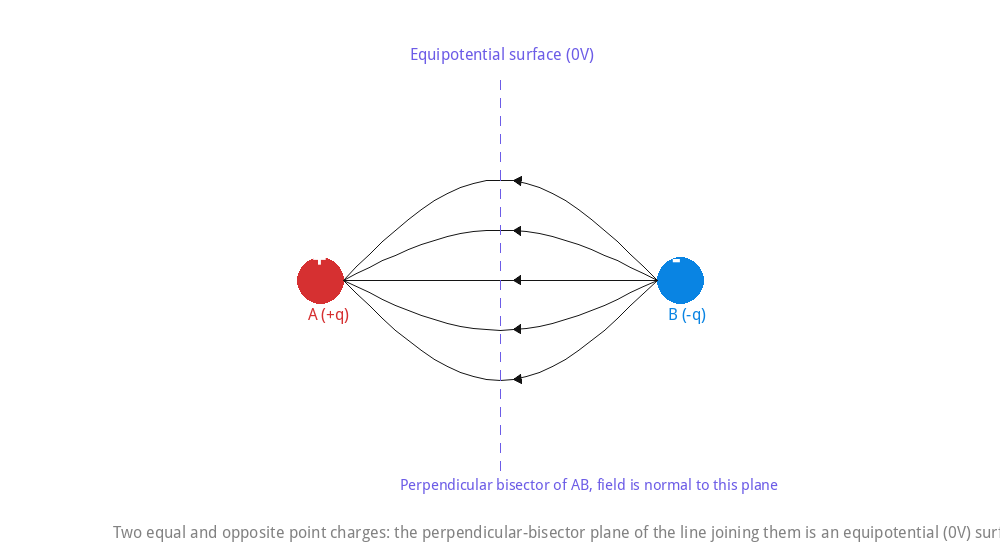
Two equal and opposite point charges: the perpendicular-bisector plane of the line joining them is an equipotential (0V) surface.
Ans: (a) The plane perpendicular to AB, passing through its midpoint (the perpendicular bisector plane), is an equipotential surface at 0 V. (b) The electric field at every point on this surface is normal (perpendicular) to the surface, directed from the positive to the negative charge (along AB direction).
2.4 A spherical conductor of radius 12 cm has a charge of 1.6×10⁻⁷ C. (a) Field at surface? (b) Field at 18 cm from centre? (c) Field at centre?
Ans: (a) E=kq/r²=(9×10⁹)(1.6×10⁻⁷)/(0.12)²=10⁵ N/C. (b) At 18 cm (outside): E=kq/r²=(9×10⁹)(1.6×10⁻⁷)/(0.18)²≈4.4×10⁴ N/C, directed radially outward. (c) Field inside a conductor is zero.
2.5 A parallel plate capacitor with air between the plates has capacitance 8 pF. What will be the capacitance if the distance is reduced by half and the space filled with a substance of dielectric constant 6?
Ans: C′ = K×C/(d′/d) = K×C×(d/d′) = 6×8×2 = 96 pF (since halving d doubles C, and dielectric multiplies by K=6).
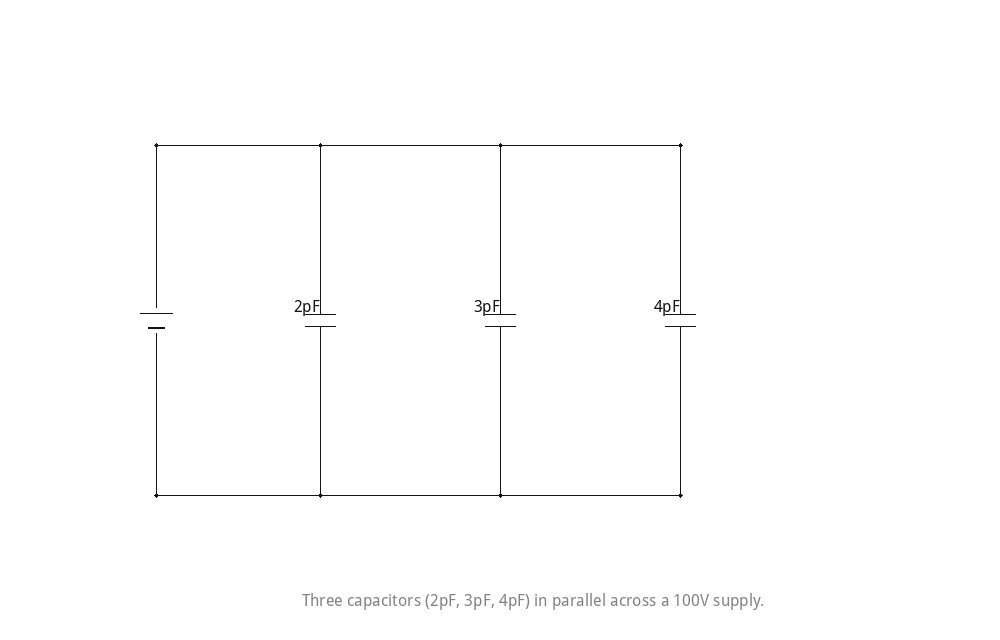
2.6 Three capacitors 2pF, 3pF, 4pF connected in parallel. (a) Total capacitance. (b) Determine charge on each if the combination is connected to a 100V supply.
Ans: (a) C=2+3+4=9pF. (b) Each has full 100V: Q₁=200pC, Q₂=300pC, Q₃=400pC.
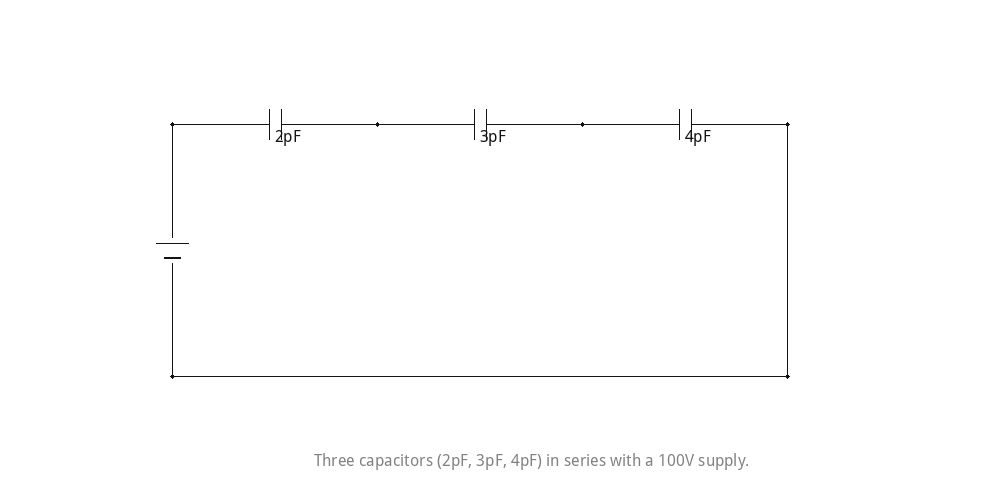
2.7 Three capacitors 2pF, 3pF, 4pF connected in series to a 100V supply. Determine (a) total capacitance, (b) charge and voltage on each.
Ans: (a) 1/C = 1/2+1/3+1/4 = 13/12, C=12/13≈0.92pF. (b) In series, same charge Q on each = C×V = (12/13)×100≈92.3pC. Voltages: V₁=Q/2≈46.2V, V₂=Q/3≈30.8V, V₃=Q/4≈23.1V (sum ≈100V).
2.8 A parallel plate capacitor, plate area 6×10⁻³ m², separation 3mm. (a) Capacitance. (b) Charge on each plate if 100V applied.
Ans: (a) C=ε₀A/d=(8.85×10⁻¹²)(6×10⁻³)/(3×10⁻³)≈1.77×10⁻¹¹ F≈17.7 pF. (b) Q=CV=17.7pF×100V=1.77×10⁻⁹ C.
2.9 Explain what happens when a dielectric slab is introduced between the plates of a charged (isolated) capacitor.
Ans: With charge Q constant (isolated), capacitance increases (C′=KC), so voltage decreases (V′=V/K) and stored energy decreases (U′=U/K), since energy is used to partially polarise/pull in the dielectric.
- Chapter 1: Electric Charges and Fields – Free PDF Download
- Chapter 3: Current Electricity – Free PDF Download
- Chapter 4: Moving Charges and Magnetism – Free PDF Download
- Chapter 5: Magnetism and Matter – Free PDF Download
- Chapter 6: Electromagnetic Induction – Free PDF Download
- Chapter 7: Alternating Current – Free PDF Download
Frequently Asked Questions
What is an equipotential surface?
A surface on which the electric potential is the same at every point; the electric field is always perpendicular to it.
How does a dielectric affect capacitance?
Inserting a dielectric of dielectric constant K increases capacitance by a factor of K.
Chapter Quiz — Test Your Understanding
Class 12 Physics Chapter 2 – Notes and Extra Questions
Along with these NCERT Solutions, students can also use the Class 12 Physics Chapter 2 Extra Questions and Class 12 Physics Chapter 2 Revision Notes for quick revision and extra practice.
Recommended: Buy the Printed NCERT Class 12 Physics Book
Contains Amazon affiliate links.
If you’d like a printed copy alongside the PDF, here’s a verified option:
4.4 out of 5 stars (159 ratings) · Rs. 155
Price and availability may change on Amazon. As an Amazon Associate, ncertbooks.org earns from qualifying purchases.



Pingback: Class 12 Physics Chapter 6 Electromagnetic Induction Revision Notes (2026-27)
Pingback: NCERT Solutions for Class 12 Physics Chapter 10: Wave Optics – Free PDF Download - NCERTBooks.org
Pingback: Class 12 Physics Ch 11 Dual Nature Revision Notes (2026-27)
Pingback: Class 12 Physics Ch 9 Ray Optics Revision Notes (2026-27)
Pingback: Class 12 Physics Ch 9 Ray Optics Extra Questions (2026-27)