
This Class 12 Physics Chapter 4 recap starts with the Lorentz force on a moving charge, then works through the Biot-Savart law, Ampere’s circuital law, and the field patterns produced by a straight wire, loop, and solenoid.
Last Updated: September 23, 2026
Common Mistakes Students Make in Moving Charges and Magnetism
- Mixing up right-hand rules: confusing the rule for magnetic field due to a current-carrying wire with the rule for force on a moving charge (F = qv × B).
- Ignoring the sign of charge: forgetting force direction depends on whether the charge is positive or negative.
- Biot-Savart law errors: misidentifying the direction or contribution of a current element in non-standard geometries (loop, solenoid).
- Wrong-geometry formula: using the field formula for a straight wire where a loop or solenoid formula was actually needed.
Forces
- Lorentz force: F=qv×B; on wire: F=IL×B.
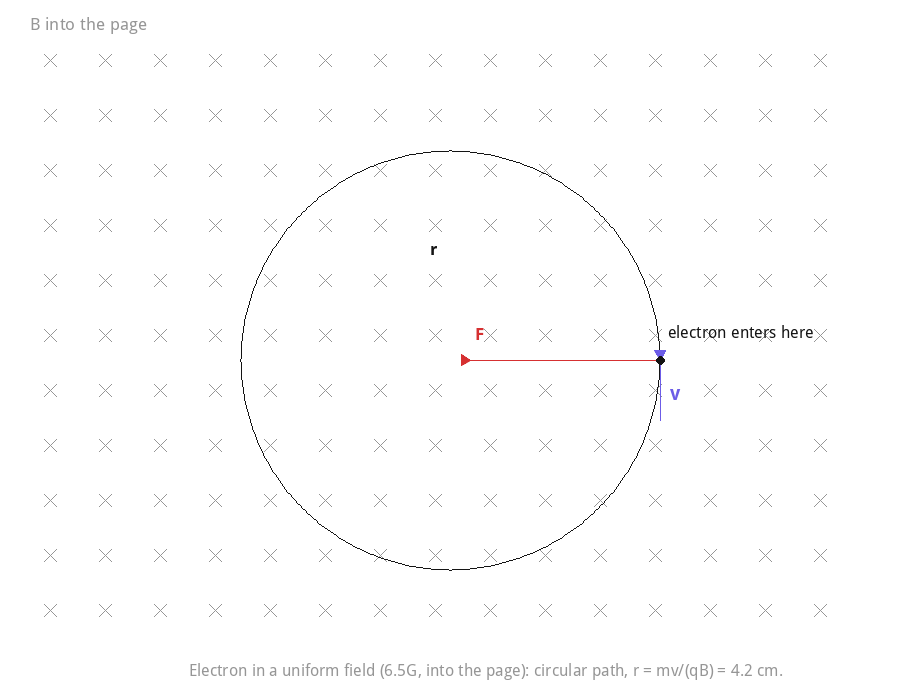
- Circular motion: r=mv/(qB); T=2πm/(qB).
- Velocity selector: v=E/B.
Fields & Laws
- Biot-Savart: dB=(μ₀/4π)(I dl×r̂)/r².
- Straight wire: B=μ₀I/2πr; solenoid: B=μ₀nI.
- Ampere’s law: ∮B·dl=μ₀Ienc.
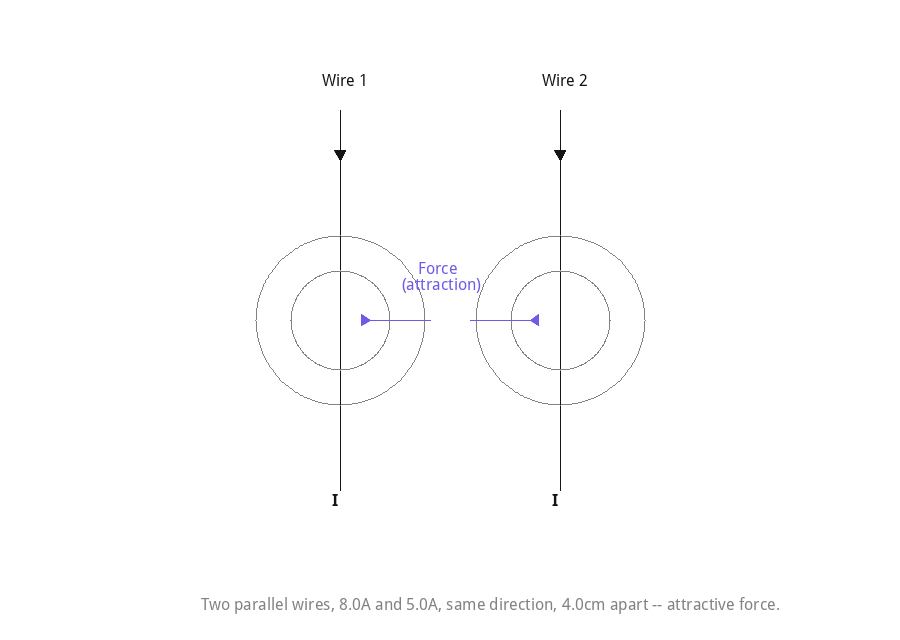
- Parallel currents: F/l=μ₀I₁I₂/2πd.
One-Line Summary
Moving charges experience magnetic (Lorentz) forces causing circular motion, while currents generate magnetic fields per Biot-Savart and Ampere’s laws, enabling galvanometer-based current/voltage measurement.
Quick visual: a worked diagram from the full Solutions page, for reference.
- Chapter 1: Electric Charges and Fields
- Chapter 2: Electrostatic Potential and Capacitance – Revision Notes
- Chapter 3: Current Electricity – Revision Notes
- Chapter 5: Magnetism and Matter – Revision Notes
- Chapter 6: Electromagnetic Induction – Revision Notes
- Chapter 7: Alternating Current – Revision Notes
Frequently Asked Questions
What is the source of a magnetic field according to this chapter?
Unlike electric fields which originate from charges, magnetic fields are produced by moving charges or electric currents, as described by the Biot-Savart Law and Ampere Circuital Law.
What is the force experienced by a current-carrying conductor placed in a magnetic field?
A current-carrying conductor in a magnetic field experiences a force given by F equals BIL sine theta, where the direction is found using the right-hand rule, and this principle is the basis of electric motors.
Chapter Quiz — Test Your Understanding
Class 12 Physics Chapter 4 – Solutions and Important Questions
Need full answers or more practice? See the Class 12 Physics Chapter 4 Solutions and Class 12 Physics Chapter 4 Extra Questions.
See also: Chapter 1 | Chapter 2 | Chapter 3 | Chapter 5 | Chapter 4
Practice more: Chapter 1 | Chapter 2 | Chapter 3 | Chapter 5 | Chapter 4
Quick revision: Chapter 1 | Chapter 2 | Chapter 3 | Chapter 5
What to Revise First (and Last) in This Chapter
Prioritise the right-hand rules (for field direction and for force direction) and the standard field formulas for a straight wire, loop, and solenoid first, since these cover most questions. Leave detailed Biot-Savart law derivations for non-standard geometries for an earlier, slower revision pass.
Recommended: Buy the Printed NCERT Class 12 Physics Book
Contains Amazon affiliate links.
If you’d like a printed copy alongside the PDF, here’s a verified option:
4.4 out of 5 stars (159 ratings) · Rs. 155
Price and availability may change on Amazon. As an Amazon Associate, ncertbooks.org earns from qualifying purchases.



Pingback: Class 12 Physics Chapter 4 Moving Charges and Magnetism Solutions (2026-27)