
These questions on Electrostatic Potential and Capacitance cover the farad as the unit of capacitance, the potential at a dipole’s equatorial point, and how a dielectric raises a capacitor’s capacitance.
Last Updated: September 23, 2026
Very Short Answer Questions (1 mark)
Q1. What is the SI unit of capacitance?
Ans: Farad (F).
Q2. What is the potential at the equatorial point of a dipole?
Ans: Zero.
Q3. Write the formula for energy stored in a capacitor.
Ans: U=½CV².
Q4. What is an equipotential surface?
Ans: A surface where the potential is the same at every point.
Q5. How does capacitance change when a dielectric is inserted?
Ans: It increases by a factor K, the dielectric constant.
Short Answer Questions (2–3 marks)
Q6. Two capacitors of 2μF and 3μF are connected in series. Find the equivalent capacitance.
Ans: 1/C=1/2+1/3=5/6, so C=6/5=1.2μF.
Q7. A parallel plate capacitor has C=2μF. Find the new capacitance if a dielectric of K=5 fully fills the gap.
Ans: C′=KC=5×2=10μF.
Q8. Find the potential energy of two charges +2μC and −3μC placed 0.5m apart.
Ans: U=kq₁q₂/r=(9×10⁹)(2×10⁻⁶)(−3×10⁻⁶)/0.5=−0.108 J.
Higher-Order Thinking / Application Questions
Q9. Derive the expression for capacitance of a parallel plate capacitor with a dielectric slab of thickness t (t<d) and dielectric constant K partially filling the gap between plates separated by distance d.
Ans: Consider a parallel plate capacitor with plate area A, plate separation d, and a dielectric slab of thickness t (t<d, so there is still an air gap of thickness d−t) inserted between the plates. The electric field in the air gap is E₀=σ/ε₀=Q/(Aε₀), and the electric field inside the dielectric is E=E₀/K=Q/(AKε₀). The total potential difference across the capacitor is the sum of the potential drops across the air gap and the dielectric: V=E₀(d−t)+Et=[Q/(Aε₀)](d−t)+[Q/(AKε₀)]t=[Q/(Aε₀)][(d−t)+t/K]. The capacitance is C=Q/V=Aε₀/[(d−t)+t/K]. Verification: if t=0 (no dielectric), C=Aε₀/d, the standard vacuum formula ✓. If t=d (dielectric fills entire gap), C=Aε₀/(d/K)=KAε₀/d, matching the fully-dielectric-filled formula ✓. This shows how a partial dielectric slab increases capacitance from the vacuum value but less than a fully-filled capacitor would.
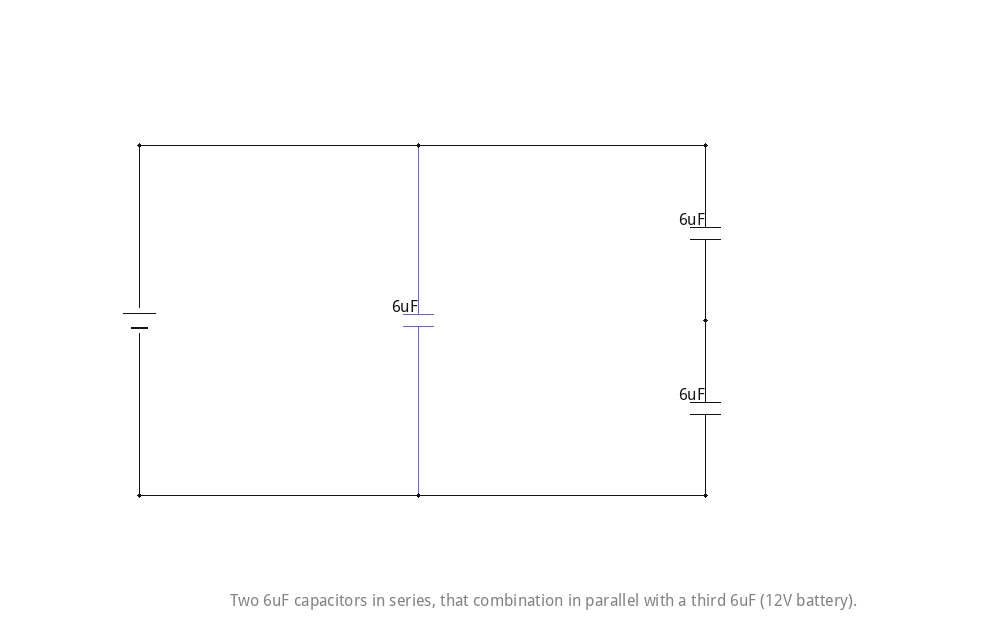
Q10. Three capacitors of 6μF each are connected such that two are in series and this combination is in parallel with the third. Find the equivalent capacitance, and calculate the total charge stored if a 12V battery is connected across the combination.
Ans: First find the series combination of two 6μF capacitors: 1/Cseries=1/6+1/6=2/6=1/3, so Cseries=3μF. This series combination (3μF) is now in parallel with the third 6μF capacitor: Ceq=Cseries+Cthird=3+6=9μF. With a 12V battery connected across this 9μF equivalent capacitance, the total charge stored is Q=CeqV=9×10⁻⁶×12=108×10⁻⁶ C=1.08×10⁻⁶ C=108μC. This demonstrates the standard method for reducing mixed series-parallel capacitor networks: simplify series branches first into their equivalent, then combine that with parallel branches, applying Q=CV only at the final equivalent stage (since voltage is not necessarily equal across all original capacitors in a mixed network).
- Chapter 1: Electric Charges and Fields
- Chapter 3: Current Electricity – Extra Questions with Answers
- Chapter 4: Moving Charges and Magnetism – Extra Questions with Answers
- Chapter 5: Magnetism and Matter – Extra Questions with Answers
- Chapter 6: Electromagnetic Induction – Extra Questions with Answers
- Chapter 7: Alternating Current – Extra Questions with Answers
Frequently Asked Questions
How would you find the potential at a point 0.1 m away from a point charge of 2×10 to the -8 C?
Using V = kq over r = (9×10 to the 9 times 2×10 to the -8) over 0.1 = 1800 V.
If a parallel plate capacitor has its plate separation doubled, how does its capacitance change?
Since capacitance is inversely proportional to plate separation, doubling the separation halves the capacitance.
Chapter Quiz — Test Your Understanding
Class 12 Physics Chapter 2 – Solutions and Notes
For complete step-by-step answers and a quick summary, check the Class 12 Physics Chapter 2 Solutions and Class 12 Physics Chapter 2 Revision Notes.
Recommended: Buy the Printed NCERT Class 12 Physics Book
Contains Amazon affiliate links.
If you’d like a printed copy alongside the PDF, here’s a verified option:
4.4 out of 5 stars (159 ratings) · Rs. 155
Price and availability may change on Amazon. As an Amazon Associate, ncertbooks.org earns from qualifying purchases.



Pingback: Class 12 Physics Chapter 3 Current Electricity Solutions (2026-27)
Pingback: Class 12 Physics Chapter 5 Magnetism and Matter Revision Notes (2026-27)