
Genuinely harder, HOTS-level practice for Class 10 Science Chapter 12 (Magnetic Effects of Electric Current), going beyond the standard exercise. These Class 10 Science Chapter 12 important questions are handy for last-minute exam practice.
- Q1 (Assertion-Reason). Assertion (A): A current-carrying solenoid behaves like a bar magnet with distinct N and S poles. Reason (R): Inside a solenoid, field lines are parallel to each other and to the axis, making the field strong and nearly uniform.
Solution: The parallel, uniform internal field is exactly what gives the solenoid’s ends N/S-pole-like behaviour, so R explains A. Answer: Both A and R true, R is the correct explanation of A. - Q2 (Numerical). A 20 cm copper rod carries 5 A current in a 0.4 T field at 30° to the field. Find the force (i) at 30° (ii) if instead placed perpendicular to the field.
Solution: L=0.2m, I=5A, B=0.4T. (i) F=BIL sin30°=0.4×5×0.2×0.5=0.2 N. (ii) F=BIL sin90°=0.4×5×0.2×1=0.4 N — exactly double, confirming force is maximum at 90°. - Q3 (Comparison). Compare an electromagnet and a permanent magnet on: source, strength, polarity, core material, and typical use.
Solution: Electromagnet: exists only while current flows; strength/polarity adjustable via current; soft-iron core (low retentivity); used in cranes, bells, relays. Permanent magnet: exists without current; fixed strength and polarity; steel/alloy core (high retentivity); used in compasses, loudspeakers. - Q4 (Concept). Why is soft iron used for electromagnets and steel for permanent magnets, not the reverse?
Solution: Soft iron has low retentivity — magnetises easily when current flows and loses magnetism almost fully when switched off, exactly what an on/off electromagnet needs. Steel has high retentivity — holds magnetism long-term once magnetised, ideal for a permanent magnet but unsuitable for an electromagnet (it wouldn’t switch off). - Q5 (Applied reasoning). Two long parallel wires carry current in the same direction. Do they attract or repel? Justify.
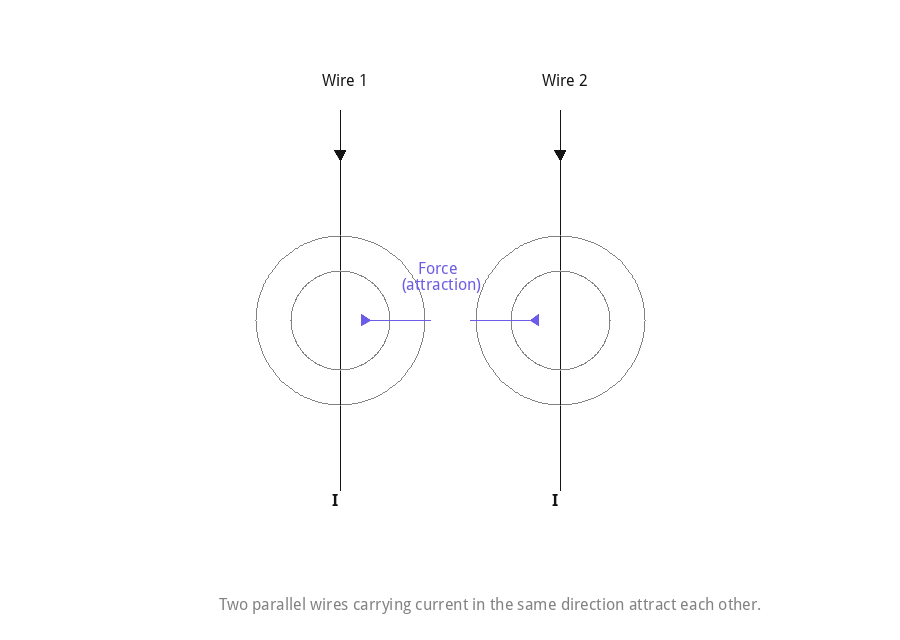
Two parallel wires carrying current in the same direction attract each other.
Solution: They attract. Each wire’s circular field (right-hand rule) acts on the other, and for same-direction currents this mutual force is attractive; opposite-direction currents would repel.
- Q6 (Case-based). A student winds wire around a steel (not soft iron) rod to build an electromagnet; after switching off, it still weakly holds iron pins. Explain why, and what she should change.
Solution: Steel’s high retentivity means it stays partly magnetised after the current stops, behaving like a weak permanent magnet instead of switching off cleanly. She should replace the steel rod with a soft iron rod, which loses its magnetism almost completely once current stops. - Q7 (Applied/conceptual). In a DC motor, a student replaces the split-ring commutator with two continuous slip rings. Predict what happens to the coil’s rotation and explain why.
Solution: Without the commutator’s current-reversal every half turn, the force/torque direction on the coil reverses after each half rotation (since current no longer reverses), so instead of spinning continuously, the coil will just oscillate back and forth and come to rest — a commutator (not slip rings) is essential for continuous DC motor rotation.
- NCERT Solutions – Chapter 12
- Extra Questions (HOTS) – Chapter 12
- Revision Notes – Chapter 12
- Class 10 Science Book (Catalog Page)
Class 10 Science Chapter 12 – Solutions and Notes
For complete step-by-step answers and a quick summary, check the Class 10 Science Chapter 12 Solutions and Class 10 Science Chapter 12 Revision Notes.

📄 Want this offline? Download the free PDF of this page.Download PDF
More Class 10 Science Extra Questions -- Chapter-wise:
- Chapter 2: Acids, Bases and Salts
- Chapter 3: Metals and Non-metals
- Chapter 4: Carbon and its Compounds
- Chapter 5: Extra Questions: Class 10 Science Periodic Classification of Elements (Supplementary)
- Chapter 6: Life Processes
- Chapter 7: Control and Coordination
- Chapter 8: – How do Organisms Reproduce?
- Chapter 9: Extra Questions - Heredity (HOTS)
- Chapter 10: Extra Questions - Light: Reflection and Refraction (HOTS)
- Chapter 11: Human Eye and Colourful World Extra Questions (HOTS)
- Chapter 12: Electricity Extra Questions (HOTS)

