
NCERT Class 11 Physics Chapter 9, Mechanical Properties of Fluids, is the second chapter of Physics Part II in the current (2023 rationalised, 2026–27 reprint) syllabus. It covers pressure and Pascal’s law, buoyancy, the equation of continuity, Bernoulli’s principle, viscosity and Poiseuille’s law, Reynolds number, surface tension, surface energy, angle of contact, and excess pressure inside drops and bubbles. Below are complete, independently worked solutions to every exercise question currently in this chapter (9.1 to 9.20), followed by exam-focused notes and a short FAQ.
NCERT Exercise Solutions – Chapter 9, Mechanical Properties of Fluids
Question 9.1
Explain why
(a) The blood pressure in humans is greater at the feet than at the brain.
(b) Atmospheric pressure at a height of about 6 km decreases to nearly half of its value at the sea level, though the height of the atmosphere is more than 100 km.
(c) Hydrostatic pressure is a scalar quantity even though pressure is force divided by area.
Last Updated: September 23, 2026
Solution:
(a) Blood is a fluid, and hydrostatic pressure within it increases with depth as P = P0 + ρgh. The feet lie at a greater vertical distance below the heart than the brain does, so there is a taller column of blood (larger h) pressing down above the feet than above the brain. This extra ρgh term makes the blood pressure at the feet higher.
(b) Atmospheric density and pressure fall off roughly exponentially with height (P decreases as e−h/H, where H is a characteristic scale height of a few km), not linearly. Because the air is compressible, the lower layers are compressed by the weight of all the air above them and are far denser than the upper layers. Consequently, most of the atmosphere’s mass (and therefore most of the pressure drop) is concentrated within the first several kilometres, so pressure can fall to half its sea-level value by ~6 km even though rarefied air extends to 100 km and beyond.
(c) At any point inside a fluid at rest, the force exerted by the fluid on a small area element acts perpendicular to that area, and Pascal’s law shows this force per unit area is the same in every direction around that point — there is no preferred direction associated with pressure itself. The direction only appears when pressure (a scalar) is multiplied by the area vector to give the force vector on a particular surface. Hence hydrostatic pressure at a point is a scalar.
Question 9.2
Explain why
(a) The angle of contact of mercury with glass is obtuse, while that of water with glass is acute.
(b) Water on a clean glass surface tends to spread out, while mercury on the same surface tends to form drops (water wets glass, mercury does not).
(c) Surface tension of a liquid is independent of the area of the surface.
(d) Water with detergent dissolved in it should have small angles of contact.
(e) A liquid drop under no external forces is always spherical in shape.
Solution:
(a) The angle of contact depends on the balance between the cohesive force between the liquid’s own molecules and the adhesive force between the liquid and the solid surface. For mercury on glass, mercury–mercury cohesion is much stronger than mercury–glass adhesion, so mercury “pulls back” on itself, giving an obtuse angle of contact. For water on glass, water–glass adhesion exceeds water–water cohesion, giving an acute angle.
(b) Because adhesive forces dominate for water–glass, water molecules are pulled towards the glass and the liquid spreads out to maximise contact. For mercury–glass, cohesive forces dominate, so mercury molecules pull inward toward each other and minimise contact with the glass, forming beads/drops instead.
(c) Surface tension arises from the net inward molecular cohesive force experienced by molecules at the surface layer, a property of the liquid’s intermolecular forces and temperature. It is defined as force per unit length along the surface, so it is an intensive property that does not depend on how large the surface area is.
(d) A small angle of contact means the liquid wets the surface well and can penetrate narrow spaces such as the fine fibres of cloth. Detergents are designed to lower the effective surface tension/contact angle of water so that the soapy solution can seep into the fibres and lift out dirt and grease trapped there.
(e) Surface tension acts to minimise the surface area of a liquid for a given volume. Among all shapes of a fixed volume, the sphere has the least surface area. With no external force to distort it, a small drop therefore settles into a spherical shape to minimise its surface energy.
Question 9.3
Fill in the blanks using the word(s) from the list appended with each statement.
Solution:
(a) Surface tension of liquids generally decreases with temperature.
(b) Viscosity of gases increases with temperature, whereas viscosity of liquids decreases with temperature.
(c) For solids with the elastic modulus of rigidity, the shearing force is proportional to the shear strain; for fluids it is proportional to the rate of shear strain.
(d) For a fluid in steady flow, the increase in flow speed at a constriction follows from conservation of mass (the equation of continuity), while the decrease of pressure there follows from Bernoulli’s principle.
(e) For the model of a plane in a wind tunnel, turbulence occurs at a greater speed than for the actual plane. This is because the onset of turbulence is governed by the Reynolds number Re = ρvL/η; since the model’s characteristic length L is much smaller than the real aircraft’s, a much higher test speed v is needed in the tunnel to reach the same Reynolds number (and hence the same flow behaviour) as the full-scale plane.
Question 9.4
Explain why
(a) To keep a piece of paper horizontal, you should blow over, not under, it.
(b) When we try to close a water tap with our fingers, fast jets of water gush through the openings between our fingers.
(c) The size of the needle of a syringe controls flow rate better than the thumb pressure exerted by a doctor while administering an injection.
(d) A fluid flowing out of a small hole in a vessel results in a backward thrust on the vessel.
(e) A spinning cricket ball in air does not follow a parabolic trajectory.
Solution:
(a) Blowing over the top increases the air speed above the paper. By Bernoulli’s principle, faster-moving air has lower pressure, so the pressure above the paper drops below the (unchanged) atmospheric pressure acting from below. This net upward pressure difference holds the paper up and roughly horizontal. Blowing underneath does not create this pressure imbalance in the required direction.
(b) Partly covering the tap opening with your fingers reduces its effective cross-sectional area. By the equation of continuity (A1v1 = A2v2), the same volume of water must now pass through a smaller area per second, so its speed must increase — producing fast jets through the narrow gaps.
(c) By Poiseuille’s law, volume flow rate through a narrow tube varies as the fourth power of its radius (Q ∝ r4) but only linearly with the applied pressure difference. The needle’s fixed small bore therefore dominates and stabilises the flow rate, giving fine, repeatable control, whereas relying on manually varying thumb pressure alone would cause much larger, less predictable swings in flow rate.
(d) The escaping fluid carries momentum out of the vessel in one direction. By Newton’s third law (conservation of momentum), the vessel experiences an equal and opposite reaction force — a backward thrust — exactly as a rocket is pushed forward by expelling exhaust backward.
(e) A spinning ball drags a thin layer of air around with it. On the side where the ball’s surface motion is in the same direction as its forward flight (and hence relative to the on-coming air), the local air speed is higher than on the opposite side; by Bernoulli’s principle this creates a pressure difference across the ball (the Magnus effect), producing a sideways force. This extra transverse force curves the trajectory away from the simple parabolic path followed by a non-spinning projectile.
Question 9.5
A 50 kg girl wearing high-heel shoes balances on a single heel. The heel is circular with a diameter of 1.0 cm. What is the pressure exerted by the heel on the horizontal floor?
Solution:
Weight, F = mg = 50 × 9.8 = 490 N.
Radius of heel, r = 0.5 cm = 0.005 m; Area, A = πr² = π × (0.005)² = 7.854 × 10⁻⁵ m².
Pressure, P = F/A = 490 / 7.854 × 10⁻⁵ ≈ 6.24 × 10⁶ Pa.
Question 9.6
Toricelli’s barometer used mercury. Pascal duplicated it using French wine of density 984 kg m−3. Determine the height of the wine column for normal atmospheric pressure.
Solution:
At equilibrium, P0 = ρgh, so h = P0/(ρg).
h = (1.01 × 10⁵) / (984 × 9.8) = 1.01 × 10⁵ / 9643.2 ≈ 10.5 m (10.47 m).
This is much taller than a mercury barometer (~0.76 m) because wine is far less dense than mercury, so a much longer column is needed to produce the same pressure.
Question 9.7
A vertical off-shore structure is built to withstand a maximum stress of 109 Pa. Is the structure suitable for putting up on top of an oil well in the ocean? Take the depth of the ocean to be roughly 3 km, and ignore ocean currents.
Solution:
Pressure at depth h due to sea water: P = ρgh = 1000 × 9.8 × 3000 = 2.94 × 10⁷ Pa.
Since 2.94 × 10⁷ Pa is far less than the structure’s withstand limit of 109 Pa (roughly 34 times smaller), the structure is suitable for use at this depth.
Question 9.8
A hydraulic automobile lift is designed to lift cars with a maximum mass of 3000 kg. The area of cross-section of the piston carrying the load is 425 cm². What maximum pressure would the smaller piston have to bear?
Solution:
By Pascal’s law, pressure is transmitted equally throughout the fluid, so the pressure the smaller piston must supply equals the pressure needed to support the load at the larger piston.
Force = mg = 3000 × 9.8 = 29,400 N; Area = 425 cm² = 425 × 10−4 m² = 0.0425 m².
P = F/A = 29,400 / 0.0425 ≈ 6.92 × 10⁵ Pa.
Question 9.9
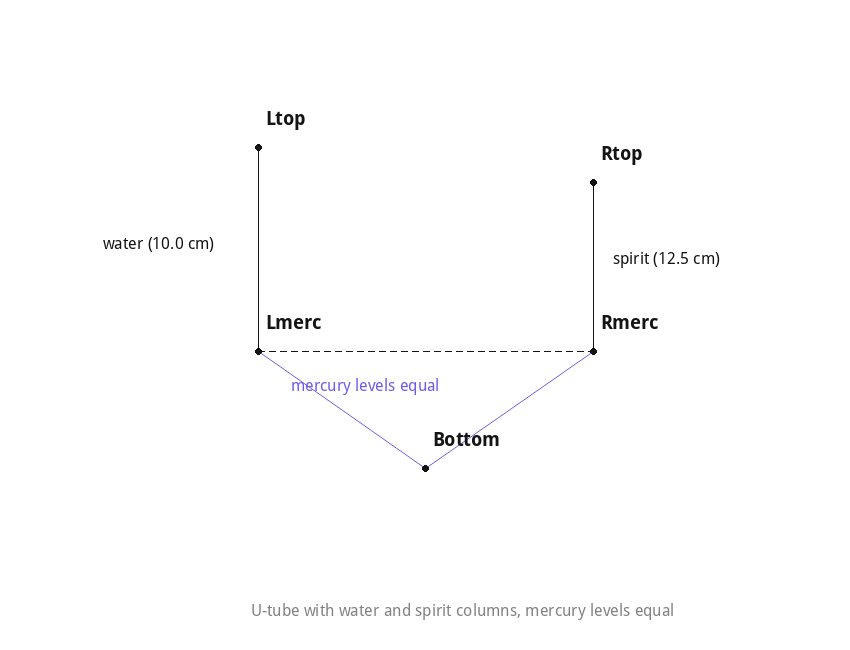
A U-tube contains water and methylated spirit separated by mercury. The mercury columns in the two arms are level with 10.0 cm of water in one arm and 12.5 cm of spirit in the other. What is the relative density of spirit?
Solution:
Since the mercury levels are equal, the pressures exerted by the two liquid columns at that common level must be equal:
ρwaterghwater = ρspiritghspirit
ρspirit/ρwater = hwater/hspirit = 10.0/12.5 = 0.8.
Question 9.10
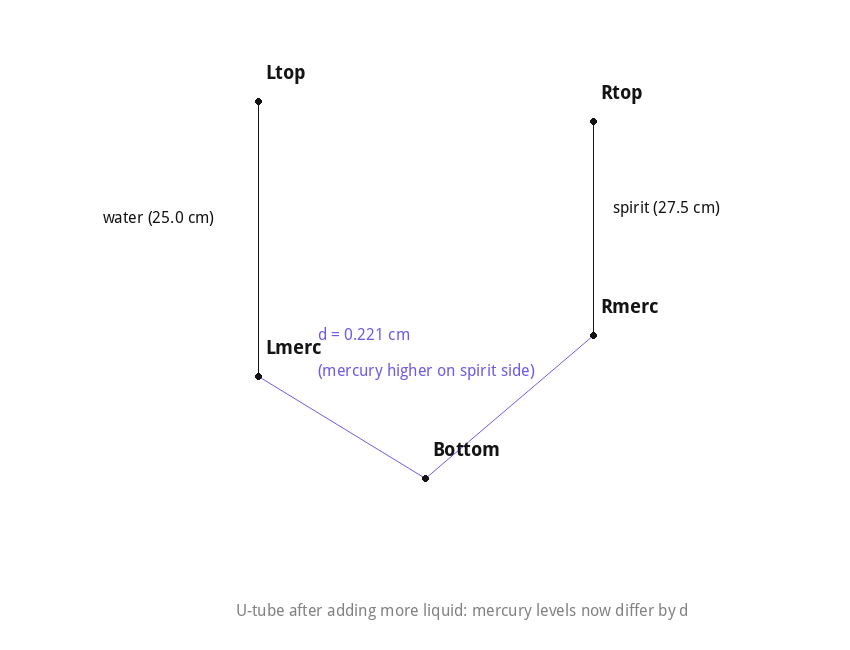
In the previous problem, if 15.0 cm of water and spirit are each further poured into the respective arms of the tube, what is the difference in the levels of mercury in the two arms? (Relative density of mercury = 13.6)
Solution:
New column heights: water = 10.0 + 15.0 = 25.0 cm; spirit = 12.5 + 15.0 = 27.5 cm.
Let d be the resulting difference in mercury levels between the two arms. Equating pressures at the lower mercury surface (working in relative-density units, water = 1):
ρwaterhwater + ρHgd = ρspirithspirit
(1)(25.0) + (13.6)d = (0.8)(27.5) = 22.0
13.6d = 22.0 − 25.0 = −3.0 ⇒ d = −3.0/13.6 = −0.221 cm
The magnitude of the mercury-level difference is 0.221 cm (the mercury stands higher on the spirit side).
Question 9.11
Can Bernoulli’s equation be used to describe the flow of water through a rapid in a river? Explain.
Solution:
No. Bernoulli’s equation applies strictly to steady, streamline (laminar), irrotational flow of a non-viscous, incompressible fluid. Water flowing through river rapids is turbulent — it has eddies, vortices, and significant energy dissipation due to friction/viscosity — so the conditions required for Bernoulli’s equation are violated and it cannot be applied there.
Question 9.12
Does it matter if one uses gauge pressure instead of absolute pressure in applying Bernoulli’s equation? Explain.
Solution:
It does not matter, provided the atmospheric pressure is the same at the two points being compared. Gauge pressure = absolute pressure − atmospheric pressure. Since Bernoulli’s equation equates the sum P + ½ρv² + ρgh at two points, subtracting the same constant atmospheric pressure from the P term at both points leaves the equation unchanged. If the atmospheric pressure differs meaningfully between the two points, however, gauge pressure should not be substituted directly.
Question 9.13
Glycerine flows steadily through a horizontal tube of length 1.5 m and radius 1.0 cm. If the amount of glycerine collected per second at one end is 4.0 × 10⁻³ kg s−1, what is the pressure difference between the two ends of the tube? (Density of glycerine = 1.3 × 10³ kg m−3 and viscosity of glycerine = 0.83 Pa s.) Check whether the assumption of laminar flow is justified.
Solution:
Volume flow rate, Q = (mass rate)/ρ = 4.0 × 10⁻³ / 1.3 × 103 = 3.077 × 10⁻⁶ m³/s.
By Poiseuille’s law, Q = πPr4/(8ηl), so P = 8ηlQ/(πr4).
r = 0.01 m, so r4 = 1 × 10⁻⁸ m4.
P = (8 × 0.83 × 1.5 × 3.077 × 10−6) / (π × 1 × 10⁻⁸) = 3.065 × 10⁻⁵ / 3.1416 × 10⁻⁸ ≈ 9.8 × 10² Pa.
Laminar-flow check: average speed v = Q/(πr²) = 3.077 × 10⁻⁶ / (3.1416 × 10⁻⁴) ≈ 9.8 × 10⁻³ m/s.
Reynolds number, Re = ρv(2r)/η = (1.3 × 103 × 9.8 × 10−3 × 0.02) / 0.83 ≈ 0.3.
Since Re is far below the critical value of about 2000, the flow is indeed laminar, confirming Poiseuille’s law was valid to use. (Note: some secondary solution sites confuse this Reynolds number, ~0.3, with the pressure-difference answer — they are two different quantities. The pressure difference is ~9.8 × 10² Pa; the Reynolds number is ~0.3.)
Question 9.14
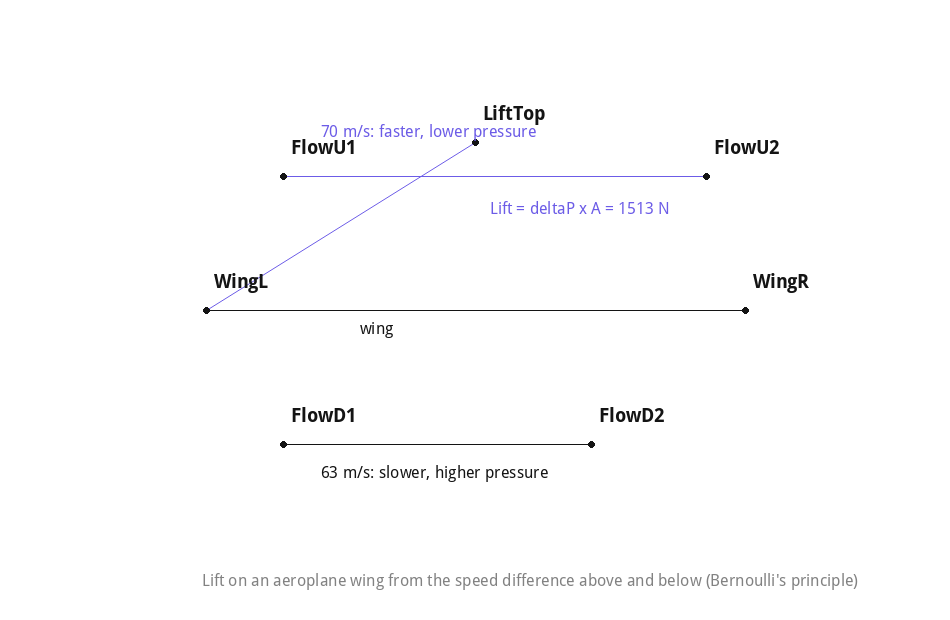
In a test experiment on a model aeroplane in a wind tunnel, the flow speeds on the upper and lower surfaces of the wing are 70 m/s and 63 m/s respectively. What is the lift on the wing if its area is 2.5 m²? Take the density of air to be 1.3 kg m−3.
Solution:
By Bernoulli’s equation at the same height: Plower − Pupper = ½ρ(vupper² − vlower²).
= ½ × 1.3 × (70² − 63²) = 0.65 × (4900 − 3969) = 0.65 × 931 = 605.15 Pa.
Lift force = ΔP × Area = 605.15 × 2.5 ≈ 1.51 × 10³ N (about 1513 N).
Question 9.15
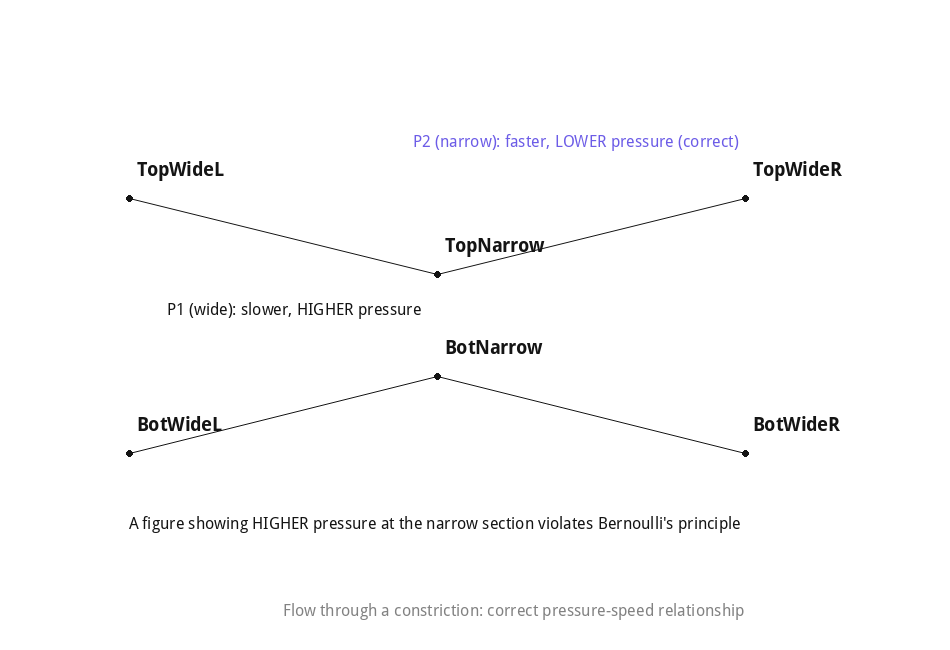
Two figures show the steady flow of a non-viscous liquid, each with streamlines drawn closer together at a constriction in the tube, along with pressure indicators at the wide and narrow sections. Which figure is incorrect? Why?
Solution:
The figure in which the pressure indicator shows a higher pressure at the narrow (constricted) section is incorrect. By the equation of continuity, streamlines crowding together at a constriction mean the flow speed there must be greater (A1v1 = A2v2). By Bernoulli’s principle, a region of higher flow speed must have lower pressure (at the same height), not higher. Any figure showing increased pressure together with closer streamlines at the constriction violates this and is the incorrect one.
Question 9.16
The cylindrical tube of a spray pump has a cross-section of 8.0 cm², one end of which has 40 fine holes each of diameter 1.0 mm. If the liquid flow inside the tube is 1.5 m/min, what is the speed of ejection of the liquid through the holes?
Solution:
A1 = 8.0 cm² = 8.0 × 10⁻⁴ m²; v1 = 1.5 m/min = 0.025 m/s.
Area of one hole = π(d/2)² = π(0.5 × 10⁻³)² = 7.854 × 10⁻⁷ m²; total area of 40 holes, A2 = 40 × 7.854 × 10−7 = 3.1416 × 10⁻⁵ m².
By continuity, A1v1 = A2v2 ⇒ v2 = (8.0 × 10−4 × 0.025) / 3.1416 × 10⁻⁵ ≈ 0.637 m/s.
Question 9.17
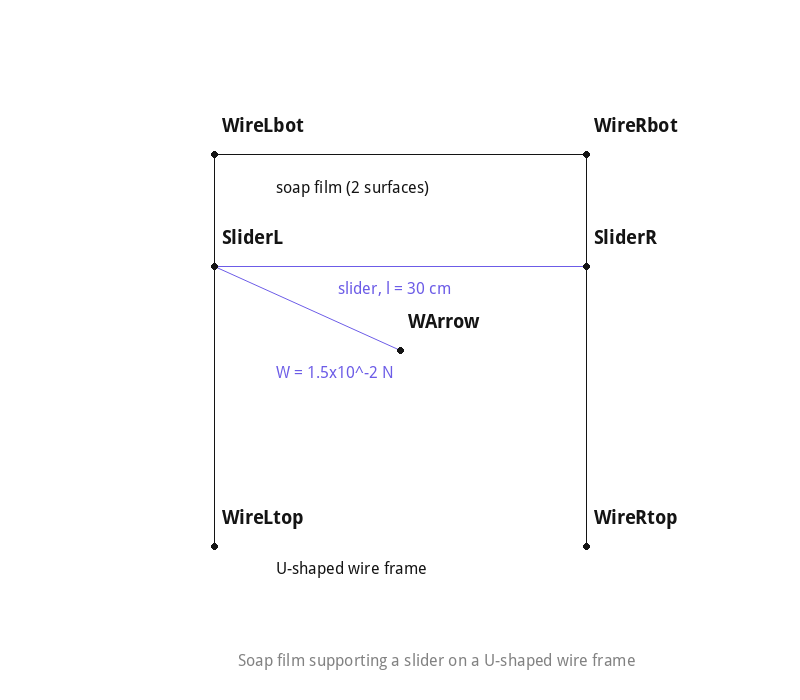
A U-shaped wire is dipped in a soap solution and removed. The thin soap film formed between the wire and a light slider supports a weight of 1.5 × 10⁻² N (which includes the small weight of the slider). The length of the slider is 30 cm. What is the surface tension of the film?
Solution:
A soap film has two surfaces, so the total upward force due to surface tension = 2Tl, which balances the weight W.
T = W/(2l) = 1.5 × 10⁻² / (2 × 0.30) = 1.5 × 10⁻² / 0.6 = 2.5 × 10⁻² N/m.
Question 9.18
A thin liquid film supporting a small weight of 4.5 × 10⁻² N is stretched on differently shaped/sized wire frames. What is the weight supported by a film of the same liquid at the same temperature on the other frames? Explain your answer physically.
Solution:
The weight a film can support is W = 2Tl, which depends only on the surface tension T of the liquid (fixed by the liquid and temperature) and the length l of the slider/edge along which the film pulls — not on the overall shape or size of the supporting frame. As long as the slider length in contact with the film is the same, the supported weight is the same, 4.5 × 10⁻² N, in each case, because surface tension is an intrinsic property of the liquid surface and is independent of the frame’s shape.
Question 9.19
What is the pressure inside a drop of mercury of radius 3.00 mm at room temperature? Surface tension of mercury at that temperature (20°C) is 4.65 × 10⁻¹ N m−1. The atmospheric pressure is 1.01 × 10⁵ Pa. Also find the excess pressure inside the drop.
Solution:
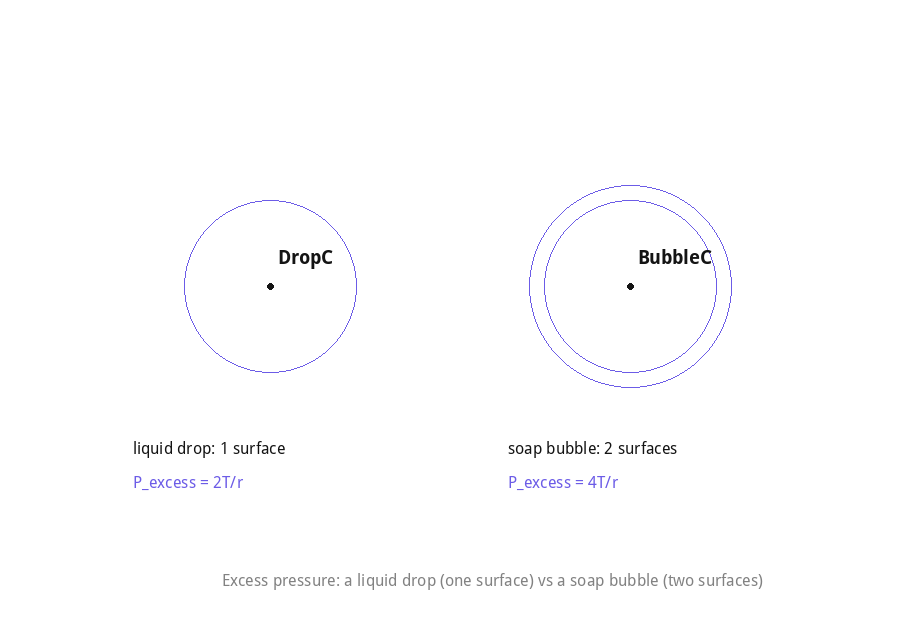
A liquid drop has only one liquid–air surface, so the excess pressure inside it is given by Pexcess = 2T/r (not 4T/r, which applies only to a thin two-surface film like a soap bubble).
r = 3.00 × 10⁻³ m, T = 0.465 N/m.
Pexcess = 2 × 0.465 / (3.00 × 10⁻³) = 310 Pa.
Total pressure inside the drop = Patm + Pexcess = 1.01 × 10⁵ + 310 ≈ 1.0131 × 10⁵ Pa.
Question 9.20
What is the excess pressure inside a bubble of soap solution of radius 5.00 mm, given that the surface tension of the soap solution at that temperature (20°C) is 2.50 × 10⁻² N/m? If an air bubble of the same dimensions were formed at a depth of 40.0 cm inside a container of the soap solution (relative density 1.20), what would be the pressure inside that bubble? (1 atmospheric pressure = 1.01 × 10⁵ Pa.)
Solution:
Soap bubble in air has two surfaces, so excess pressure = 4T/r = 4 × 2.50 × 10−2 / (5.00 × 10⁻³) = 20 Pa.
Air bubble inside the liquid has only one relevant liquid–air surface, so its excess pressure due to surface tension = 2T/r = 2 × 2.50 × 10−2 / (5.00 × 10⁻³) = 10 Pa.
Hydrostatic pressure at depth 40.0 cm: ρgh = (1.20 × 1000) × 9.8 × 0.40 = 4704 Pa.
Total pressure inside the submerged air bubble = Patm + ρgh + 2T/r = 1.01 × 10⁵ + 4704 + 10 ≈ 1.057 × 10⁵ Pa.
Notes and Extra Questions
Key formulas to remember for this chapter:
• Hydrostatic pressure: P = P0 + ρgh
• Pascal’s law: pressure applied at any point of an enclosed, incompressible fluid is transmitted undiminished to every point of the fluid and to the walls of the container.
• Equation of continuity (conservation of mass for incompressible flow): A1v1 = A2v2
• Bernoulli’s equation: P + ½ρv² + ρgh = constant, along a streamline, for steady, non-viscous, incompressible, irrotational flow.
• Poiseuille’s law for laminar flow through a tube: Q = πPr4/(8ηl)
• Reynolds number: Re = ρvD/η (flow is generally laminar for Re below ~1000–2000 and turbulent above that).
• Terminal velocity of a small sphere falling through a viscous fluid (Stokes’ law): vt = 2r²(ρ − σ)g / (9η)
• Excess pressure inside a liquid drop/bubble (single surface): P = 2T/r
• Excess pressure inside a soap film/bubble (two surfaces): P = 4T/r
Frequent exam traps in this chapter: mixing up the single-surface (2T/r) and double-surface (4T/r) excess-pressure formulas for a drop versus a soap bubble; forgetting to convert cm/mm to metres before substituting into r4 or r² terms (a very common source of power-of-ten errors); and using gauge pressure and absolute pressure inconsistently within the same Bernoulli calculation.
Extra practice question: A water pipe of diameter 3.0 cm narrows to a diameter of 1.5 cm at a joint. If the speed of water in the wider section is 1.2 m/s, find its speed in the narrower section. (Hint: use the equation of continuity, A1v1 = A2v2, with A ∝ d². Since the diameter is halved, the area becomes one-quarter, so the speed becomes four times: v2 = 4.8 m/s.)
- Chapter 1: Units and Measurements (2026-27)
- Chapter 2: Motion in a Straight Line – Free PDF Download
- Chapter 3: Motion in a Plane – Free PDF Download
- Chapter 4: Laws of Motion – Free PDF Download
- Chapter 5: Work, Energy and Power – Free PDF Download
- Chapter 6: System of Particles and Rotational Motion – Free PDF Download
- Chapter 7: Gravitation – Free PDF Download
- Chapter 8: Mechanical Properties of Solids – Free PDF Download
- Chapter 10: Thermal Properties of Matter – Free PDF Download
- Chapter 11: Thermodynamics – Free PDF Download
- Chapter 12: Kinetic Theory – Free PDF Download
- Chapter 13: Oscillations – Free PDF Download
- Chapter 14: Waves – Free PDF Download
FAQs on Mechanical Properties of Fluids
Q1. Why is the excess pressure inside a soap bubble twice that inside a liquid drop of the same radius and surface tension?
A soap film has two liquid–air surfaces (an inner and an outer surface), each contributing a term of T/r to the excess pressure, giving 4T/r in total. A liquid drop (or an air bubble submerged in a liquid) has only a single interface, so its excess pressure is just 2T/r — exactly half that of a bubble with the same radius and surface tension.
Q2. What is the difference between streamline (laminar) flow and turbulent flow?
In streamline flow, fluid particles follow smooth, well-defined paths that never cross, and the velocity at any given point stays constant over time. In turbulent flow, the motion becomes chaotic and irregular, with eddies and vortices forming, typically once the Reynolds number exceeds a critical value (around 1000–2000 for flow in pipes). Bernoulli’s equation only holds for streamline flow.
Q3. Why does a small piece of iron sink in water but a large iron ship float?
Flotation depends on the average density of the whole object, not the material alone. A solid block of iron has a density much greater than water, so it sinks. A ship is shaped as a hollow structure that displaces a large volume of water; its total weight divided by the volume it displaces (its effective average density, including the enclosed air) is less than the density of water, so the buoyant force (Archimedes’ principle) can support its weight and it floats.
Q4. Why does surface tension decrease as temperature increases?
Surface tension arises from cohesive intermolecular forces pulling surface molecules inward. As temperature rises, molecules gain kinetic energy and move faster, weakening the effect of these cohesive attractions and increasing the average distance between molecules. This reduces the net inward pull at the surface, so surface tension decreases with rising temperature (and becomes zero at the liquid’s critical temperature).
Frequently Asked Questions
What is the difference between pressure and thrust?
Thrust is the total perpendicular force acting on a surface (measured in newtons); pressure is thrust per unit area (thrust/area, measured in pascals) — the same thrust can produce very different pressure depending on how the area over which it acts.
What is Bernoulli principle used for in this chapter?
It relates a fluid pressure, speed and height along a streamline (pressure + kinetic energy per volume + potential energy per volume = constant), and is used to explain phenomena like the lift on an aircraft wing and why fast-flowing fluids exert lower pressure.
Recommended: Buy the Printed NCERT Class 11 Physics Book Set
Contains Amazon affiliate links.
If you’d like a printed copy alongside the PDF, here’s a verified option:
Rs. 280
Price and availability may change on Amazon. As an Amazon Associate, ncertbooks.org earns from qualifying purchases.


