
Complete NCERT Solutions for Class 7 Science Chapter 11 “Light: Shadows and Reflections” from the Curiosity textbook, covering luminous and non-luminous objects, rectilinear propagation of light, shadow formation, reflection, plane mirror images, lateral inversion, and the working of a pinhole camera and a periscope.
Last Updated: September 23, 2026
In-Text Questions
Q1. Why can we see the Moon at night even though it does not produce light of its own?
Answer: The Moon is a non-luminous object — it does not emit light of its own. We are able to see it because it reflects sunlight falling on it towards the Earth.
Q2. Why can we not see an object hidden behind an opaque wall, even when the room is well lit?
Answer: Light always travels in a straight line and cannot bend around an obstacle. Since the opaque wall blocks the straight-line path between the hidden object and our eyes, no light from the object can reach us, so we cannot see it.
Exercise Questions (Let Us Enhance Our Learning)
Q1. Classify the following as luminous or non-luminous: Sun, Moon, Pole Star, Mars, Venus, a mirror reflecting sunlight.
Answer: Luminous (produce their own light): Sun, Pole Star (it is a star). Non-luminous (do not produce their own light; we see them only because they reflect or scatter light falling on them): Moon, Mars, Venus, and a mirror reflecting sunlight.
Q2. Match each item in Column A with the correct description in Column B: pinhole camera, opaque object, transparent object, shadow.
Answer: Pinhole camera -> forms a small, inverted real image of a distant object; Opaque object -> completely blocks the passage of light through it; Transparent object -> allows almost all light to pass through, giving a clear view of what lies beyond; Shadow -> the dark region formed on a screen when an opaque object blocks light coming from a source.
Q3. Four friends stand at different points around a long, bent metal pipe and try to see a lit candle held at one open end. Explain who among them, if anyone, will be able to see the candle’s flame, and why.
Answer: Only the friend whose eye lines up exactly with the straight section of the pipe leading to the candle can see the flame. This is because light travels only in straight lines and cannot turn corners inside a bent pipe, so anyone looking through the bent portion sees nothing.
Q4. A boy is standing with a lamp placed to one side and slightly behind him. Describe the direction and general shape in which his shadow will fall.
Answer: The shadow will fall on the side of the boy that is opposite to the lamp, stretching away from the light source along the straight line joining the lamp to the boy and extending further onward — taller and more slanted the lower the lamp is compared to his height.
Q5. A ball is (i) held close to a torch and far from a wall, and (ii) held close to the wall and far from the torch. Describe and explain the difference between the two shadows formed.
Answer: (i) When the ball is close to the torch and far from the wall, the shadow is large and has blurred, fuzzy edges, because the light rays have diverged (spread out) a great deal by the time they reach the wall. (ii) When the ball is close to the wall and far from the torch, the shadow is smaller, close to the ball’s actual size, with sharp, well-defined edges, because the rays have diverged very little before reaching the wall.
Q6. Match each torch arrangement with the shadow it produces: torch held close to the object; torch held far from the object; no object placed in the beam; two torches shone on the same object from different directions.
Answer: Torch close to the object -> large, blurred shadow; torch far from the object -> smaller, sharper shadow close to the object’s true size; no object in the beam -> a bright patch of light with no shadow at all; two torches from different directions -> two separate shadows of the same object, one corresponding to each light source.
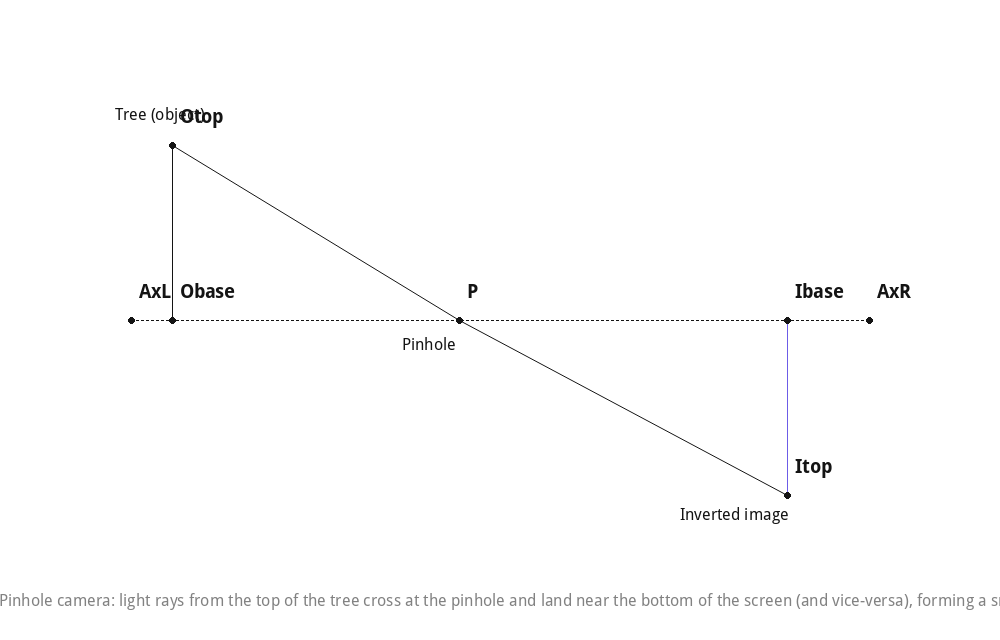
Q7. A pinhole camera is pointed at a tall tree outside a window. Describe and sketch the image that would form on the camera’s screen.
Answer: The image of the tree that forms on the screen is a real, inverted (upside-down) image. This happens because light rays from the top of the tree travel in a straight line, cross over exactly at the pinhole, and land near the bottom of the screen, while rays from the bottom of the tree cross over at the pinhole and land near the top of the screen.
Q8. A student writes her name on a sheet of paper and holds it up in front of a plane mirror. Describe what she will observe in the mirror, and explain why.
Answer: Her name will appear laterally inverted — reversed from left to right, as if it needs to be read from the opposite direction (“mirror writing”). This happens because a plane mirror reverses left and right in the image it forms, while keeping the up-down orientation unchanged.
Q9. A student measures the length of her own shadow in the morning, at noon, and in the late afternoon. State at which time her shadow will be shortest, and explain the reason using the position of the Sun.
Answer: Her shadow will be shortest around noon, when the Sun is closest to being directly overhead (at its highest point/altitude in the sky), so sunlight falls almost vertically and the shadow is compressed to a minimum. The shadow is longest in the early morning and late evening, when the Sun is low near the horizon and light falls at a shallow angle.
Q10. Are the following statements true or false: (i) every image formed by a plane mirror is laterally inverted; (ii) a letter that is symmetric about a vertical line looks unchanged in a plane mirror? Give reasons.
Answer: Both statements are true. (i) is a basic property of reflection from a plane mirror — left and right are always interchanged. (ii) is also true for letters with vertical-line symmetry, such as A, H, I, M, O, T, U, V, W, X and Y — because the mirror only swaps left and right, and such letters look exactly the same after being flipped left-to-right, even though the lateral inversion is still happening.
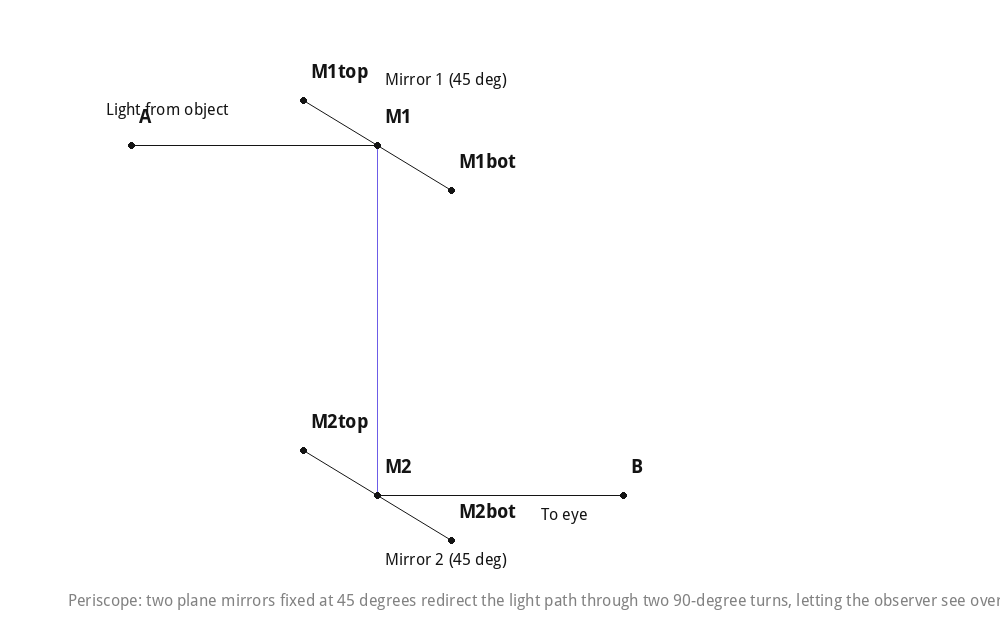
Q11. Can a bent tube fitted with two small mirrors be used to see over an obstacle, such as a wall? Describe how such a device should be arranged.
Answer: Yes — this describes a periscope. Two plane mirrors, each fixed at a 45° angle to the tube and facing each other (parallel to one another) at the two bends, will redirect the light: light entering the top mirror is turned 90° downward through the tube, strikes the bottom mirror, and is turned another 90° into the observer’s eye — allowing them to see over the obstacle without being seen.
Q12. Explain why we rarely notice the shadow of a bird flying very high in the sky, even though the bird itself may be fairly large.
Answer: A shadow’s sharpness and visibility on the ground depend on how far the object is from the ground (its “screen”). A bird flying very high is far from the ground, so the small patch of light it blocks spreads out over a large, very faint, poorly-defined area by the time it reaches the ground — making the shadow’s darkness too diluted to notice. A bird flying low casts a much more concentrated, sharply-defined, and therefore noticeable shadow.
Chapter Activities
Activity 11.1: Let Us Investigate — Light travels in a straight line
Three cards, each with a small hole, are lined up in a row with a lit candle behind the last card and the eye at the front. Observation: the candle flame is visible only when all three holes are perfectly aligned in a straight line; the flame disappears the moment any one card is shifted out of line. Conclusion: light travels in a straight line.
Activity 11.2: Let Us Explore — Light cannot bend around a corner
Try to view a lit candle through a bent pipe from either end. Observation: the flame cannot be seen through the bent portion, no matter which end is used. Conclusion: light cannot turn corners — it travels only in straight lines, confirming Activity 11.1.
Activity 11.3: Let Us Experiment — Classifying materials as transparent, translucent, or opaque
Various everyday materials — clear glass, plain water, butter paper, thin cloth, tracing paper, cardboard, and aluminium foil — are held up to a light source, and how clearly objects behind each can be seen is noted. Conclusion: glass and water are transparent (clear view, nearly all light passes through); butter paper, thin cloth and tracing paper are translucent (blurred view, only some light passes through); cardboard and foil are opaque (no view at all, light is completely blocked).
Activity 11.4: Let Us Explore — Shadow size and shape change with position
An opaque object is held at different distances from a torch and from a screen, and the shadow’s size and sharpness are noted at each position. Conclusion: the shadow grows larger and blurrier as the object moves closer to the light source (and farther from the screen), and shrinks toward the object’s true size and becomes sharper as the object moves closer to the screen.
Activity 11.5: Let Us Investigate — Reflection from a smooth, polished surface
A narrow beam of light (from a torch through a slit) is directed onto a plane mirror or a polished steel plate tilted at different angles, and the reflected beam is observed on a screen. Conclusion: light bounces off a smooth, shiny surface in a definite direction that changes as the angle of the surface is changed; this bouncing back of light is called reflection.
Activity 11.6: Let Us Experiment — Regular reflection vs. scattering
The same beam of light is shone onto a smooth, mirror-like surface and separately onto a rough surface, such as a sheet of paper. Conclusion: a smooth, polished surface reflects light in one well-defined direction (regular reflection), while a rough surface scatters the reflected light in many directions (diffuse reflection), so no clear beam is seen.
Activity 11.7: Let Us Experiment — Nature of the image formed by a plane mirror
An object, such as a lit candle or a coin, is placed in front of a plane mirror, and an attempt is made to catch its image on a screen held behind the mirror’s surface. Conclusion: the image formed by a plane mirror is virtual (it cannot be caught on a screen), erect (right-side up), and the same size as the object.
Activity 11.8: Let Us Experiment — Object distance equals image distance; lateral inversion
An object is placed at measured distances in front of a plane mirror, and the distance at which its image appears to form behind the mirror is checked; a written word is also held up to the mirror. Conclusion: the image forms exactly as far behind the mirror as the object is placed in front of it, and a written word appears reversed left-to-right (laterally inverted) in the mirror.
Activity 11.9: Let Us Explore — Pinhole camera and image inversion
A simple pinhole camera is made from a box with a small pinhole on one side and a translucent screen (tracing paper) on the opposite inner side, and pointed at a bright object such as a sunlit window. Conclusion: a small, inverted real image of the object forms on the screen, because light rays travelling in straight lines cross over exactly at the pinhole.
Activity 11.10: Let Us Construct — Building a working periscope
Using a long box or tube and two small plane mirrors fixed at 45° at each end, facing each other, a simple periscope is constructed to see over an obstacle such as a wall or a crowd. Conclusion: a working periscope confirms that light can be redirected using two correctly-angled mirrors, letting the user see around corners or over obstacles.
Practice more: Extra Questions for Class 7 Science Chapter 11
Quick revision: Revision Notes for Class 7 Science Chapter 11
For the full chapter list, see the Class 7 Science book page and the Class 7 Science Formulas Handbook.
- Chapter 1: The Ever-Evolving World of Science - Curiosity
- Chapter 2: Exploring Substances - Acidic, Basic and Neutral - Curiosity
- Chapter 3: Electricity - Circuits and their Components - Curiosity
- Chapter 4: The World of Metals and Non-metals - Curiosity
- Chapter 5: Changes Around Us - Physical and Chemical - Curiosity
- Chapter 6: Adolescence - A Stage of Growth and Change - Curiosity
- Chapter 7: Heat Transfer in Nature - Curiosity
- Chapter 8: Measurement of Time and Motion - Curiosity
- Chapter 9: Life Processes in Animals - Curiosity
- Chapter 10: Life Processes in Plants - Curiosity
- Chapter 12: Earth, Moon and the Sun - Curiosity
Frequently Asked Questions
Why do shadows form, and what determines their size?
A shadow forms because light travels in straight lines and cannot pass through an opaque object, creating a dark region behind it; the shadow’s size depends on the size of the object, the position/distance of the light source, and the angle at which light falls on the object.
What is the difference between reflection and shadow formation?
Reflection occurs when light bounces off a surface (like a mirror) and lets us see an image; shadow formation occurs when light is blocked by an opaque object, creating a dark area where light cannot reach — both depend on light travelling in straight lines, but the effect produced is very different.
Chapter Quiz — Test Your Understanding
Class 7 Science Chapter 11 – Notes and Extra Questions
Along with these NCERT Solutions, students can also use the Class 7 Science Chapter 11 Extra Questions and Class 7 Science Chapter 11 Revision Notes for quick revision and extra practice.
Recommended: Buy the Printed NCERT Class 7 Science Book
Contains Amazon affiliate links.
If you’d like a printed copy alongside the PDF, here’s a verified option:
Rs. 130
Price and availability may change on Amazon. As an Amazon Associate, ncertbooks.org earns from qualifying purchases.


