
Chapter 5, Linear Inequalities, introduces statements involving <, >, ≤ and ≥ instead of the equality sign, and teaches students how to solve linear inequalities in one variable both algebraically and on the number line. In the current NCERT syllabus this chapter covers one exercise (Exercise 5.1) built around the rules for solving inequalities, followed by a Miscellaneous Exercise that combines these ideas with real-life word problems on temperature ranges, mixtures, and averages.
Last Updated: September 23, 2026
Exercise 5.1
Q1. Solve 24x < 100, when (i) x is a natural number. (ii) x is an integer — We have 24x < 100, so dividing both sides by 24 (a positive number, so the inequality…
We have 24x < 100, so dividing both sides by 24 (a positive number, so the inequality sign does not change):
x < 100/24 = 25/6 = 4.1666…
- x is a natural number: The natural numbers less than 25/6 are 1, 2, 3, 4. Solution set = {1, 2, 3, 4}.
- x is an integer: The integers less than 25/6 are …, −3, −2, −1, 0, 1, 2, 3, 4. Solution set = {…, −3, −2, −1, 0, 1, 2, 3, 4}.
Q2. Solve −12x > 30, when (i) x is a natural number. (ii) x is an integer — We have −12x > 30. Dividing both sides by −12 (a negative number reverses the…
We have −12x > 30. Dividing both sides by −12 (a negative number reverses the inequality sign):
x < 30/(−12) = −5/2 = −2.5
- x is a natural number: Natural numbers are 1, 2, 3, … which are always positive, so none of them can be less than −2.5. Solution set = ∅ (no solution).
- x is an integer: The integers less than −2.5 are −3, −4, −5, …. Solution set = {…, −5, −4, −3}.
Q3. Solve 5x − 3 < 7, when (i) x is an integer. (ii) x is a real number — 5x − 3 < 7 ⇒ 5x < 10 ⇒ x < 2.
5x − 3 < 7 ⇒ 5x < 10 ⇒ x < 2.
- x is an integer: Integers less than 2 are …, −2, −1, 0, 1. Solution set = {…, −2, −1, 0, 1}.
- x is a real number: Solution set = (−∞, 2).
Q4. Solve 3x + 8 > 2, when (i) x is an integer. (ii) x is a real number — 3x + 8 > 2 ⇒ 3x > −6 ⇒ x > −2.
3x + 8 > 2 ⇒ 3x > −6 ⇒ x > −2.
- x is an integer: Integers greater than −2 are −1, 0, 1, 2, …. Solution set = {−1, 0, 1, 2, …}.
- x is a real number: Solution set = (−2, ∞).
Solve the inequalities in Exercises 5 to 16 for real x.
Q5. 4x + 3 < 5x + 7 — 4x − 5x < 7 − 3 ⇒ −x < 4 ⇒ x > −4 (dividing by −1 reverses the sign).…
4x − 5x < 7 − 3 ⇒ −x < 4 ⇒ x > −4 (dividing by −1 reverses the sign).
Solution set = (−4, ∞).
Q6. 3x − 7 > 5x − 1 — 3x − 5x > −1 + 7 ⇒ −2x > 6 ⇒ x < −3. Solution set = (−∞, −3).
3x − 5x > −1 + 7 ⇒ −2x > 6 ⇒ x < −3.
Solution set = (−∞, −3).
Q7. 3(x − 1) ≤ 2(x − 3) — 3x − 3 ≤ 2x − 6 ⇒ x ≤ −3. Solution set = (−∞, −3].
3x − 3 ≤ 2x − 6 ⇒ x ≤ −3.
Solution set = (−∞, −3].
Q8. 3(2 − x) ≥ 2(1 − x) — 6 − 3x ≥ 2 − 2x ⇒ 6 − 2 ≥ 3x − 2x ⇒ 4 ≥ x ⇒ x ≤ 4. Solution set =…
6 − 3x ≥ 2 − 2x ⇒ 6 − 2 ≥ 3x − 2x ⇒ 4 ≥ x ⇒ x ≤ 4.
Solution set = (−∞, 4].
Q9. x + x/2 + x/3 < 11 — Multiplying throughout by 6 (LCM of 1, 2, 3): 6x + 3x + 2x < 66 ⇒ 11x < 66 ⇒ x < 6.…
Multiplying throughout by 6 (LCM of 1, 2, 3): 6x + 3x + 2x < 66 ⇒ 11x < 66 ⇒ x < 6.
Solution set = (−∞, 6).
Q10. x/3 > x/2 + 1 — Multiplying throughout by 6: 2x > 3x + 6 ⇒ −x > 6 ⇒ x < −6. Solution set =…
Multiplying throughout by 6: 2x > 3x + 6 ⇒ −x > 6 ⇒ x < −6.
Solution set = (−∞, −6).
Q11. 3(x − 2)/5 ≤ 5(2 − x)/3 — Multiplying throughout by 15: 9(x − 2) ≤ 25(2 − x) ⇒ 9x − 18 ≤ 50 − 25x…
Multiplying throughout by 15: 9(x − 2) ≤ 25(2 − x) ⇒ 9x − 18 ≤ 50 − 25x ⇒ 34x ≤ 68 ⇒ x ≤ 2.
Solution set = (−∞, 2].
Q12. (1/2)(3x/5 + 4) ≥ (1/3)(x − 6) — Multiplying throughout by 6 (LCM of 2 and 3): 3(3x/5 + 4) ≥ 2(x − 6) ⇒ 9x/5 + 12…
Multiplying throughout by 6 (LCM of 2 and 3): 3(3x/5 + 4) ≥ 2(x − 6) ⇒ 9x/5 + 12 ≥ 2x − 12.
Multiplying throughout by 5: 9x + 60 ≥ 10x − 60 ⇒ 120 ≥ x ⇒ x ≤ 120.
Solution set = (−∞, 120].
Q13. 2(2x + 3) − 10 < 6(x − 2) — 4x + 6 − 10 < 6x − 12 ⇒ 4x − 4 < 6x − 12 ⇒ 8 < 2x ⇒ x > 4. Solution set =…
4x + 6 − 10 < 6x − 12 ⇒ 4x − 4 < 6x − 12 ⇒ 8 < 2x ⇒ x > 4.
Solution set = (4, ∞).
Q14. 37 − (3x + 5) ≥ 9x − 8(x − 3) — 37 − 3x − 5 ≥ 9x − 8x + 24 ⇒ 32 − 3x ≥ x + 24 ⇒ 8 ≥ 4x ⇒ x ≤ 2.…
37 − 3x − 5 ≥ 9x − 8x + 24 ⇒ 32 − 3x ≥ x + 24 ⇒ 8 ≥ 4x ⇒ x ≤ 2.
Solution set = (−∞, 2].
Q15. x/4 < (5x − 2)/3 − (7x − 3)/5 — Multiplying throughout by 60 (LCM of 4, 3, 5): 15x < 20(5x − 2) − 12(7x − 3) ⇒…
Multiplying throughout by 60 (LCM of 4, 3, 5): 15x < 20(5x − 2) − 12(7x − 3) ⇒ 15x < 100x − 40 − 84x + 36 ⇒ 15x < 16x − 4 ⇒ −x < −4 ⇒ x > 4.
Solution set = (4, ∞).
Q16. (2x − 1)/3 ≥ (3x − 2)/4 − (2 − x)/5 — Multiplying throughout by 60 (LCM of 3, 4, 5): 20(2x − 1) ≥ 15(3x − 2) − 12(2…
Multiplying throughout by 60 (LCM of 3, 4, 5): 20(2x − 1) ≥ 15(3x − 2) − 12(2 − x) ⇒ 40x − 20 ≥ 45x − 30 − 24 + 12x ⇒ 40x − 20 ≥ 57x − 54 ⇒ 34 ≥ 17x ⇒ x ≤ 2.
Solution set = (−∞, 2].
Solve the inequalities in Exercises 17 to 20 and show the graph of the solution in each case on number line.
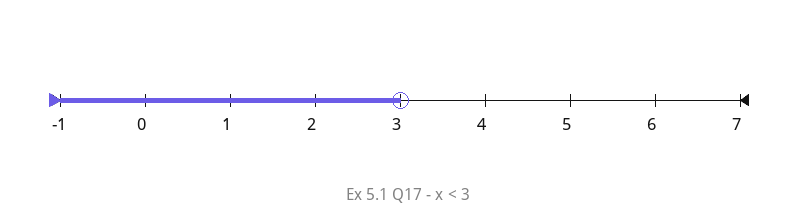
Q17. 3x − 2 < 2x + 1 — 3x − 2x < 1 + 2 ⇒ x < 3. Solution set = (−∞, 3). On the number line, this is…
3x − 2x < 1 + 2 ⇒ x < 3.
Solution set = (−∞, 3). On the number line, this is shown by an open (unfilled) circle at 3 with the line shaded to the left of 3.
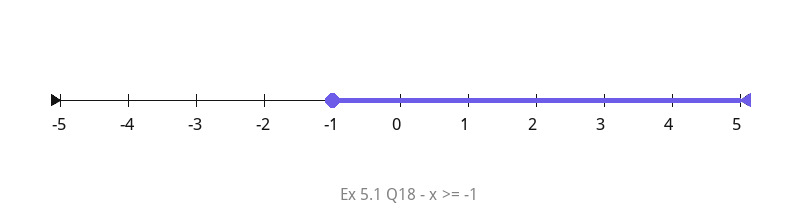
Q18. 5x − 3 ≥ 3x − 5 — 5x − 3x ≥ −5 + 3 ⇒ 2x ≥ −2 ⇒ x ≥ −1. Solution set = [−1, ∞). On…
5x − 3x ≥ −5 + 3 ⇒ 2x ≥ −2 ⇒ x ≥ −1.
Solution set = [−1, ∞). On the number line, this is shown by a dark (filled) circle at −1 with the line shaded to the right of −1.
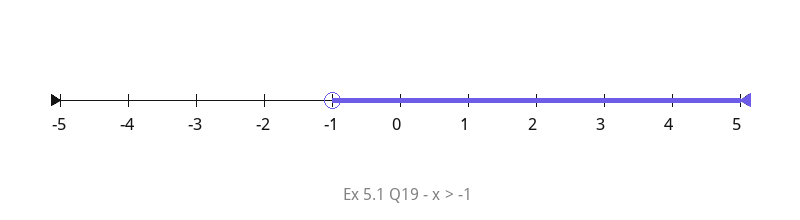
Q19. 3(1 − x) < 2(x + 4) — 3 − 3x < 2x + 8 ⇒ 3 − 8 < 2x + 3x ⇒ −5 < 5x ⇒ x > −1. Solution set =…
3 − 3x < 2x + 8 ⇒ 3 − 8 < 2x + 3x ⇒ −5 < 5x ⇒ x > −1.
Solution set = (−1, ∞). On the number line, this is shown by an open circle at −1 with the line shaded to the right of −1.
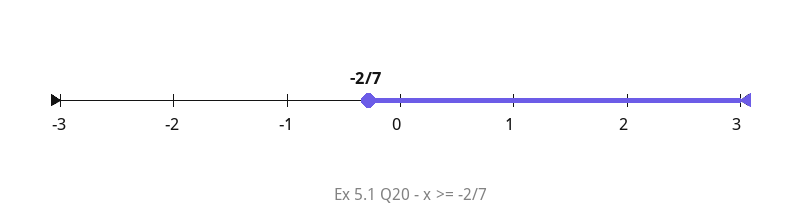
Q20. x/2 ≥ (5x − 2)/3 − (7x − 3)/5 — Multiplying throughout by 30 (LCM of 2, 3, 5): 15x ≥ 10(5x − 2) − 6(7x − 3) ⇒…
Multiplying throughout by 30 (LCM of 2, 3, 5): 15x ≥ 10(5x − 2) − 6(7x − 3) ⇒ 15x ≥ 50x − 20 − 42x + 18 ⇒ 15x ≥ 8x − 2 ⇒ 7x ≥ −2 ⇒ x ≥ −2/7.
Solution set = [−2/7, ∞). On the number line, this is shown by a dark circle at −2/7 with the line shaded to the right of −2/7.
Q21. Ravi obtained 70 and 75 marks in first two unit test. Find the minimum marks he should get in the third test to have an average of at least 60 marks — Let x be the marks Ravi obtains in the third test. For the average of the three tests to…
Let x be the marks Ravi obtains in the third test. For the average of the three tests to be at least 60:
(70 + 75 + x)/3 ≥ 60 ⇒ 145 + x ≥ 180 ⇒ x ≥ 35.
Ravi must obtain at least 35 marks in the third test.
Q22. To receive Grade 'A' in a course, one must obtain an average of 90 marks or more in five examinations (each of 100 marks). If Sunita's marks in first four examinations are 87, 92, 94 and 95, find minimum marks that Sunita must obtain in fifth examination to get grade 'A' in the course — Let x be the marks Sunita obtains in the fifth examination. Sum of first four marks = 87…
Let x be the marks Sunita obtains in the fifth examination. Sum of first four marks = 87 + 92 + 94 + 95 = 368. For an average of at least 90 over 5 exams:
(368 + x)/5 ≥ 90 ⇒ 368 + x ≥ 450 ⇒ x ≥ 82.
Sunita must obtain at least 82 marks (and at most 100, the maximum possible) in the fifth examination to secure grade ‘A’.
Q23. Find all pairs of consecutive odd positive integers both of which are smaller than 10 such that their sum is more than 11 — Let x be the smaller of the two consecutive odd positive integers, so the other is x +…
Let x be the smaller of the two consecutive odd positive integers, so the other is x + 2. Since both are smaller than 10: x < 10 and x + 2 < 10, i.e., x < 8. Also, their sum is more than 11:
x + (x + 2) > 11 ⇒ 2x + 2 > 11 ⇒ x > 4.5.
So 4.5 < x < 8, and since x must be an odd positive integer, x = 5 or x = 7.
The required pairs are (5, 7) and (7, 9).
Q24. Find all pairs of consecutive even positive integers, both of which are larger than 5 such that their sum is less than 23 — Let x be the smaller of the two consecutive even positive integers, so the other is x +…
Let x be the smaller of the two consecutive even positive integers, so the other is x + 2. Since both are larger than 5: x > 5, i.e., x ≥ 6 (as x is even). Also, their sum is less than 23:
x + (x + 2) < 23 ⇒ 2x + 2 < 23 ⇒ x < 10.5.
So 6 ≤ x < 10.5, and since x must be even, x = 6, 8, or 10.
The required pairs are (6, 8), (8, 10) and (10, 12).
Q25. The longest side of a triangle is 3 times the shortest side and the third side is 2 cm shorter than the longest side. If the perimeter of the triangle is at least 61 cm, find the minimum length of the shortest side — Let the shortest side be x cm. Then the longest side = 3x cm, and the third side = (3x…
Let the shortest side be x cm. Then the longest side = 3x cm, and the third side = (3x − 2) cm. Since the perimeter is at least 61 cm:
x + 3x + (3x − 2) ≥ 61 ⇒ 7x − 2 ≥ 61 ⇒ 7x ≥ 63 ⇒ x ≥ 9.
The minimum length of the shortest side is 9 cm.
Q26. A man wants to cut three lengths from a single piece of board of length 91cm. The second length is to be 3cm longer than the shortest and the third length is to be twice as long as the shortest. What are the possible lengths of the shortest board if the third piece is to be at least 5cm longer than the second? [Hint: If x is the length of the shortest board, then x, (x + 3) and 2x are the lengths of the second and third piece, respectively. Thus, x + (x + 3) + 2x ≤ 91 and 2x ≥ (x + 3) + 5] — Let x be the length of the shortest piece. The second piece = (x + 3) cm and the third…
Let x be the length of the shortest piece. The second piece = (x + 3) cm and the third piece = 2x cm.
Since the total length cannot exceed 91 cm: x + (x + 3) + 2x ≤ 91 ⇒ 4x + 3 ≤ 91 ⇒ 4x ≤ 88 ⇒ x ≤ 22.
Since the third piece must be at least 5 cm longer than the second: 2x ≥ (x + 3) + 5 ⇒ 2x ≥ x + 8 ⇒ x ≥ 8.
Combining both: 8 ≤ x ≤ 22.
The possible lengths of the shortest board lie between 8 cm and 22 cm (inclusive).
Miscellaneous Exercise
Solve the inequalities in Exercises 1 to 6.
Q1. 2 ≤ 3x − 4 ≤ 5 — Adding 4 throughout: 6 ≤ 3x ≤ 9. Dividing throughout by 3: 2 ≤ x ≤ 3. Solution…
Adding 4 throughout: 6 ≤ 3x ≤ 9. Dividing throughout by 3: 2 ≤ x ≤ 3.
Solution set = [2, 3].
Q2. 6 ≤ −3(2x − 4) < 12 — Simplifying: −3(2x − 4) = −6x + 12, so 6 ≤ −6x + 12 < 12. Subtracting 12…
Simplifying: −3(2x − 4) = −6x + 12, so 6 ≤ −6x + 12 < 12. Subtracting 12 throughout: −6 ≤ −6x < 0.
Dividing throughout by −6 (inequality signs reverse): 1 ≥ x > 0, i.e., 0 < x ≤ 1.
Solution set = (0, 1].
Q3. −3 ≤ 4 − 7x/2 ≤ 18 — Subtracting 4 throughout: −7 ≤ −7x/2 ≤ 14. Multiplying throughout by −2/7…
Subtracting 4 throughout: −7 ≤ −7x/2 ≤ 14. Multiplying throughout by −2/7 (inequality signs reverse): 2 ≥ x ≥ −4, i.e., −4 ≤ x ≤ 2.
Solution set = [−4, 2].
Q4. −15 < 3(x − 2)/5 ≤ 0 — Multiplying throughout by 5: −75 < 3(x − 2) ≤ 0. Dividing throughout by 3: −25 <…
Multiplying throughout by 5: −75 < 3(x − 2) ≤ 0. Dividing throughout by 3: −25 < x − 2 ≤ 0. Adding 2 throughout: −23 < x ≤ 2.
Solution set = (−23, 2].
Q5. −12 < 4 − 3x/(−5) ≤ 2 — Note that 4 − 3x/(−5) = 4 + 3x/5, so the inequality becomes −12 < 4 + 3x/5 ≤ 2.…
Note that 4 − 3x/(−5) = 4 + 3x/5, so the inequality becomes −12 < 4 + 3x/5 ≤ 2. Subtracting 4 throughout: −16 < 3x/5 ≤ −2.
Multiplying throughout by 5/3: −80/3 < x ≤ −10/3.
Solution set = (−80/3, −10/3].
Q6. 7 ≤ (3x + 11)/2 ≤ 11 — Multiplying throughout by 2: 14 ≤ 3x + 11 ≤ 22. Subtracting 11 throughout: 3 ≤ 3x…
Multiplying throughout by 2: 14 ≤ 3x + 11 ≤ 22. Subtracting 11 throughout: 3 ≤ 3x ≤ 11. Dividing throughout by 3: 1 ≤ x ≤ 11/3.
Solution set = [1, 11/3].
Solve the inequalities in Exercises 7 to 10 and represent the solution graphically on number line.
Q7. 5x + 1 > −24, 5x − 1 < 24 — From the first inequality: 5x > −25 ⇒ x > −5. From the second inequality: 5x < 25…
From the first inequality: 5x > −25 ⇒ x > −5.
From the second inequality: 5x < 25 ⇒ x < 5.
Combining both: −5 < x < 5. Solution set = (−5, 5). On the number line, this is the region between −5 and 5 (both open circles), shown by a bold line joining them.
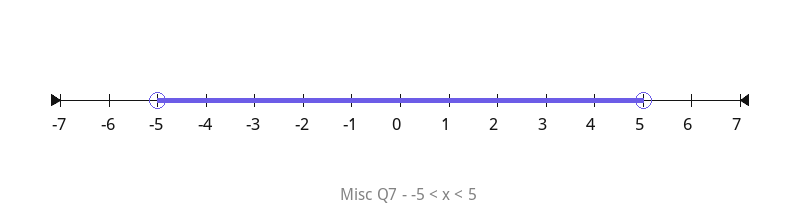
Q8. 2(x − 1) < x + 5, 3(x + 2) > 2 − x — From the first inequality: 2x − 2 < x + 5 ⇒ x < 7. From the second inequality: 3x +…
From the first inequality: 2x − 2 < x + 5 ⇒ x < 7.
From the second inequality: 3x + 6 > 2 − x ⇒ 4x > −4 ⇒ x > −1.
Combining both: −1 < x < 7. Solution set = (−1, 7), shown on the number line as the bold region between −1 and 7 (both open circles).
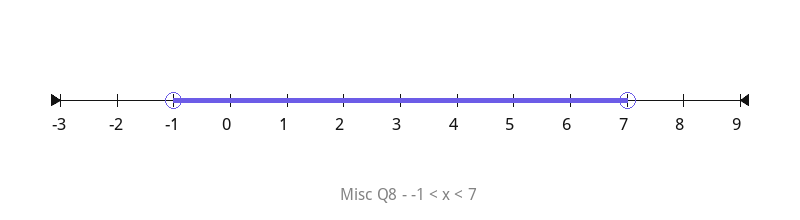
Q9. 3x − 7 > 2(x − 6), 6 − x > 11 − 2x — From the first inequality: 3x − 7 > 2x − 12 ⇒ x > −5. From the second…
From the first inequality: 3x − 7 > 2x − 12 ⇒ x > −5.
From the second inequality: 6 − x > 11 − 2x ⇒ x > 5.
Combining both (the stricter condition governs): x > 5. Solution set = (5, ∞), shown on the number line as an open circle at 5 with the line shaded to the right.
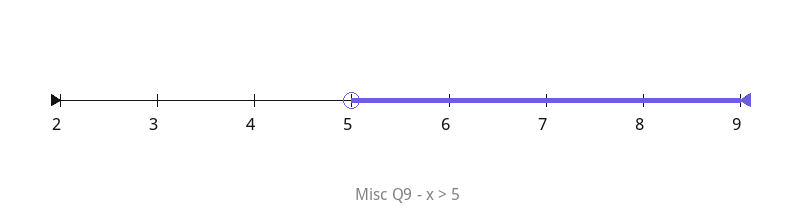
Q10. 5(2x − 7) − 3(2x + 3) ≤ 0, 2x + 19 ≤ 6x + 47 — From the first inequality: 10x − 35 − 6x − 9 ≤ 0 ⇒ 4x − 44 ≤ 0 ⇒ x ≤…
From the first inequality: 10x − 35 − 6x − 9 ≤ 0 ⇒ 4x − 44 ≤ 0 ⇒ x ≤ 11.
From the second inequality: 2x + 19 ≤ 6x + 47 ⇒ −28 ≤ 4x ⇒ x ≥ −7.
Combining both: −7 ≤ x ≤ 11. Solution set = [−7, 11], shown on the number line as the bold region between −7 and 11 (both filled circles).
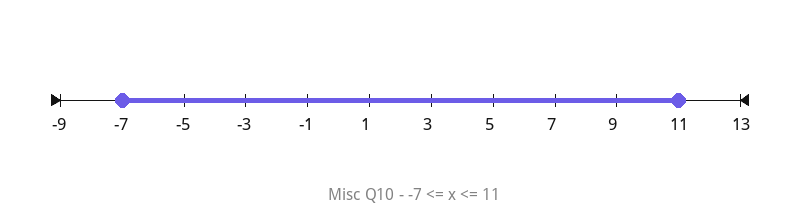
Q11. A solution is to be kept between 68° F and 77° F. What is the range in temperature in degree Celsius (C) if the Celsius/Fahrenheit conversion formula is given by F = 9/5 C + 32? — We are given 68 < F < 77. Substituting F = 9C/5 + 32: 68 < 9C/5 + 32 < 77. Subtracting…
We are given 68 < F < 77. Substituting F = 9C/5 + 32:
68 < 9C/5 + 32 < 77. Subtracting 32 throughout: 36 < 9C/5 < 45. Multiplying throughout by 5/9: 20 < C < 25.
The temperature must range between 20°C and 25°C.
Q12. A solution of 8% boric acid is to be diluted by adding a 2% boric acid solution to it. The resulting mixture is to be more than 4% but less than 6% boric acid. If we have 640 litres of the 8% solution, how many litres of the 2% solution will have to be added? — Let x litres of the 2% boric acid solution be added. Total mixture = (640 + x) litres.…
Let x litres of the 2% boric acid solution be added. Total mixture = (640 + x) litres. The amount of pure boric acid must satisfy:
4% of (640 + x) < 8% of 640 + 2% of x < 6% of (640 + x).
From the left part: (4/100)(640 + x) < (8/100)(640) + (2/100)x. Multiplying throughout by 100: 4(640 + x) < 8(640) + 2x ⇒ 2560 + 4x < 5120 + 2x ⇒ 2x < 2560 ⇒ x < 1280.
From the right part: (8/100)(640) + (2/100)x < (6/100)(640 + x). Multiplying throughout by 100: 5120 + 2x < 3840 + 6x ⇒ 1280 < 4x ⇒ x > 320.
Combining both: 320 < x < 1280.
More than 320 litres but less than 1280 litres of the 2% solution must be added.
Q13. How many litres of water will have to be added to 1125 litres of the 45% solution of acid so that the resulting mixture will contain more than 25% but less than 30% acid content? — Let x litres of water be added. The amount of pure acid stays fixed at 45% of 1125 =…
Let x litres of water be added. The amount of pure acid stays fixed at 45% of 1125 = 506.25 litres, and the total mixture becomes (1125 + x) litres. We need:
25% of (1125 + x) < 506.25 < 30% of (1125 + x).
From the left part: (25/100)(1125 + x) < 506.25 ⇒ 1125 + x < 2025 ⇒ x < 900.
From the right part: 506.25 < (30/100)(1125 + x) ⇒ 1687.5 < 1125 + x ⇒ x > 562.5.
Combining both: 562.5 < x < 900.
More than 562.5 litres but less than 900 litres of water must be added.
Q14. IQ of a person is given by the formula IQ = MA/CA × 100, where MA is mental age and CA is chronological age. If 80 ≤ IQ ≤ 140 for a group of 12 years old children, find the range of their mental age — Here CA = 12. We are given 80 ≤ IQ ≤ 140, so: 80 ≤ (MA/12) × 100 ≤ 140.…
Here CA = 12. We are given 80 ≤ IQ ≤ 140, so:
80 ≤ (MA/12) × 100 ≤ 140. Dividing throughout by 100: 0.8 ≤ MA/12 ≤ 1.4. Multiplying throughout by 12: 9.6 ≤ MA ≤ 16.8.
The mental age of the children ranges between 9.6 years and 16.8 years.
Class 11 Maths Chapter 5 – Notes and Extra Questions
- Two real numbers or two algebraic expressions related by the symbols <, >, ≤ or ≥ form an inequality. If it contains only numbers it is a numerical inequality; if it contains variables it is a literal (or linear) inequality.
- Rule 1 (Addition/Subtraction): Equal numbers may be added to or subtracted from both sides of an inequality without affecting the sign of the inequality.
- Rule 2 (Multiplication/Division): Both sides of an inequality can be multiplied or divided by the same positive number without changing the sign. But when both sides are multiplied or divided by a negative number, the inequality sign is reversed.
- A value of the variable that makes an inequality a true statement is called a solution of that inequality, and the collection of all such values is its solution set.
- On a number line, x < a or x > a is represented with an open (unfilled) circle at a, since a itself is not included; x ≤ a or x ≥ a is represented with a dark (filled) circle at a, since a is included.
- For a system of two or more inequalities in one variable, solve each inequality separately, then take the intersection of their individual solution sets to get the combined solution.
- Word problems on inequalities usually involve phrases like “at least” (≥), “at most” (≤), “more than” (>) and “less than” (<) — translating these correctly into symbols is the key first step before solving.
- Compound inequalities of the form a < px + q ≤ b can be solved directly by performing the same operation on all three parts simultaneously, keeping careful track of the direction of each inequality sign.
- Chapter 1: Sets (2026-27)
- Chapter 2: Relations and Functions – Free PDF Download
- Chapter 3: Trigonometric Functions – Free PDF Download
- Chapter 4: Complex Numbers and Quadratic Equations – Free PDF Download
- Chapter 6: Permutations and Combinations – Free PDF Download
- Chapter 7: Binomial Theorem – Free PDF Download
- Chapter 8: Sequences and Series – Free PDF Download
- Chapter 9: Straight Lines – Free PDF Download
- Chapter 10: Conic Sections – Free PDF Download
- Chapter 11: Introduction to Three Dimensional Geometry – Free PDF Download
- Chapter 12: Limits and Derivatives – Free PDF Download
- Chapter 13: Statistics – Free PDF Download
- Chapter 14: Probability – Free PDF Download
Frequently Asked Questions
How many exercises are there in Class 11 Maths Chapter 5, Linear Inequalities?
In the current (2026-27) NCERT textbook, Chapter 5 contains a single exercise, Exercise 5.1 (26 questions), followed by a Miscellaneous Exercise (14 questions). Earlier editions of this chapter also included separate exercises on graphing linear inequalities in two variables and on systems of linear inequalities in two variables, but these topics and their exercises have been removed from the current rationalised syllabus.
What is the difference between an equation and an inequality?
An equation states that two expressions are equal (using the sign =), and it usually has one or a few specific solutions. An inequality compares two expressions using <, >, ≤ or ≥, and its solution is typically an entire range or interval of values rather than a single number.
Why does the inequality sign reverse when multiplying or dividing by a negative number?
Multiplying or dividing both sides of an inequality by a negative number flips the relative order of the numbers on the number line. For example, 3 > 2, but multiplying both sides by −1 gives −3 < −2. This is why Rule 2 requires reversing the inequality sign whenever both sides are multiplied or divided by a negative quantity.
How do you solve a word problem based on linear inequalities?
First, identify the unknown quantity and assign it a variable (usually x). Then translate the given condition into an inequality using the correct symbol for phrases such as “at least” (≥), “at most” (≤), “more than” (>), or “less than” (<). Solve the resulting inequality using the standard rules, and finally interpret the solution set in the context of the original problem (for example, rounding to a sensible whole number where the situation demands it).
Recommended: Buy the Printed NCERT Class 11 Maths Book
Contains Amazon affiliate links.
If you’d like a printed copy alongside the PDF, here’s a verified option:
4.2 out of 5 stars (953 ratings) · Rs. 170
Price and availability may change on Amazon. As an Amazon Associate, ncertbooks.org earns from qualifying purchases.



Pingback: Class 11 Maths Chapter 5 Linear Inequalities Revision Notes (2026-27)