
Chapter 3 of the Class 9 Science “Exploration” textbook (NCERT, 2026–27 session), Tissues in Action, moves from the cell-level study of the previous chapter to how groups of similar cells organise themselves into tissues to divide labour efficiently in plants and animals. It covers meristematic and permanent plant tissues, the vascular tissues xylem and phloem, animal tissues (epithelial, connective, muscular and nervous), joints, and plant tissue culture. The formal end-of-chapter exercise in this book is titled “Revise, Reflect, Refine” (NCERT Textbook, Page No. 44), and these solutions have been cross-checked against multiple current sources discussing the same “Exploration” edition of the book.
Last Updated: September 23, 2026
NCERT Solutions for Class 9 Science Chapter 3: Tissues in Action
Revise, Reflect, Refine (NCERT Textbook, Page No. 44)
1. Meristematic tissues divide repeatedly. What property of their cells allows them to do this?
(i) They have thick walls for protection.
(ii) They contain large vacuoles that store nutrients.
(iii) They have thin walls, dense cytoplasm, and a large, prominent nucleus.
(iv) They are functionally differentiated cells.
(iii) They have thin walls, dense cytoplasm, and a large, prominent nucleus. Meristematic cells are unspecialised and actively dividing. Thin walls allow the cell to expand and split easily, dense cytoplasm packed with organelles supports the high metabolic activity needed for division, and the large nucleus controls this repeated division. These cells lack large vacuoles, which is exactly what keeps them compact and ready to divide rather than store material like mature cells do.
2. If a plant is unable to transport food from leaves to roots, which tissue is malfunctioning?
(i) Xylem
(ii) Phloem
(iii) Epidermis
(iv) Sclerenchyma
(ii) Phloem. Phloem is the vascular tissue that carries the food (sugars) made during photosynthesis in the leaves down to the roots and other non-green parts, a process called translocation. Xylem instead carries water and minerals upward from the roots, so a food-transport failure points to phloem, not xylem.
3. Why are the epithelial tissues that line an animal’s internal organs usually only one or a few cells thick?
(i) To store food efficiently.
(ii) To provide maximum strength.
(iii) To allow quick exchange of materials across them.
(iv) To reduce friction.
(iii) To allow quick exchange of materials across them. A thin epithelium keeps the diffusion distance short, so gases, nutrients, and wastes can cross rapidly — essential in the lungs (oxygen and carbon dioxide exchange) and the intestine (nutrient absorption). Thicker epithelium, such as skin, is built for protection rather than exchange.
4. You can perform these two jumps (Fig. 3.21): a straight-leg jump (keep knees and ankles stiff) and a normal jump (bend knees and ankles naturally). How did your ankle, knee, and hip positions differ between the two jumps?
In a straight-leg jump, the ankle, knee, and hip joints stay stiff and largely straight, so there is little or no bending, and landing feels jarring and hard to balance. In a normal jump, the ankles, knees, and hips bend naturally on take-off and landing. This flexing absorbs shock, helps maintain balance, and allows better height and a smoother, more controlled landing.
5. Which type of joint is involved when you bend your knees and ankles?
(i) Ball and socket
(ii) Hinge
(iii) Pivot
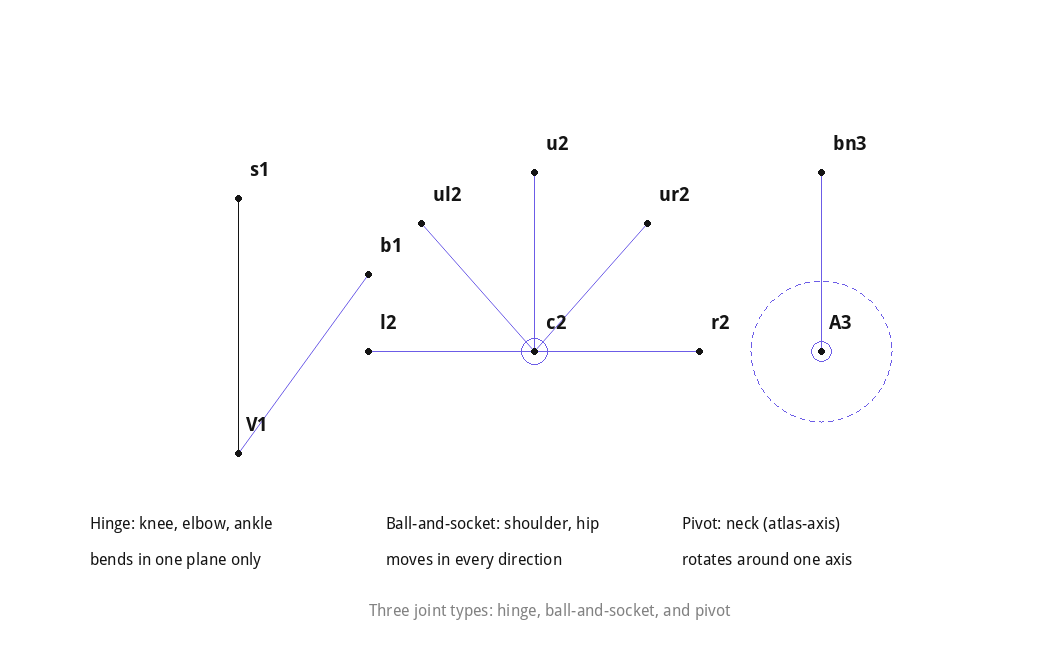
(ii) Hinge. The knee and ankle work like a door hinge, allowing movement mainly in one plane — bending (flexion) and straightening (extension) — but not rotation or sideways movement, unlike ball-and-socket joints (e.g., shoulder, hip) or pivot joints (e.g., neck).
6. In each of the following cases (A, B, C, and D), choose the correct option: (i) Both (A) and (R) are true, and (R) is the correct explanation of (A). (ii) Both (A) and (R) are true, but (R) is not the correct explanation of (A). (iii) (A) is true, but (R) is false. (iv) (A) is false, but (R) is true.
A. Assertion: Epithelium is well-suited for gas exchange in the lungs. Reason: It consists of multiple layers of tall cells that slow down diffusion.
Answer: (iii) (A) is true, but (R) is false — the epithelium lining the lungs (alveoli) is actually a single thin layer of flat (squamous) cells, which speeds up rather than slows down diffusion.
B. Assertion: Cardiac muscle can contract continuously without fatigue. Reason: Cardiac muscle cells have a high number of mitochondria and an abundant blood supply.
Answer: (i) Both (A) and (R) are true, and (R) is the correct explanation of (A) — the many mitochondria provide a constant, rich energy supply that lets heart muscle keep contracting rhythmically for a lifetime without tiring.
C. Assertion: Tendons connect bone to bone and allow joint movement. Reason: Tendons are made of tough connective tissue that transmits force from muscle to bone.
Answer: (iv) (A) is false, but (R) is true — tendons actually connect muscle to bone (it is ligaments that connect bone to bone); the reason statement about tough connective tissue transmitting force is correct, but it describes what a tendon does, not what the assertion claims.
D. Assertion: In a hinge joint, movement occurs primarily in one plane. Reason: The bone ends are shaped to allow sliding in all directions.
Answer: (iii) (A) is true, but (R) is false — hinge joints do restrict movement to one plane, but this is because the bone ends are shaped to permit movement in only that one plane, not to slide in all directions (that description fits a ball-and-socket joint).
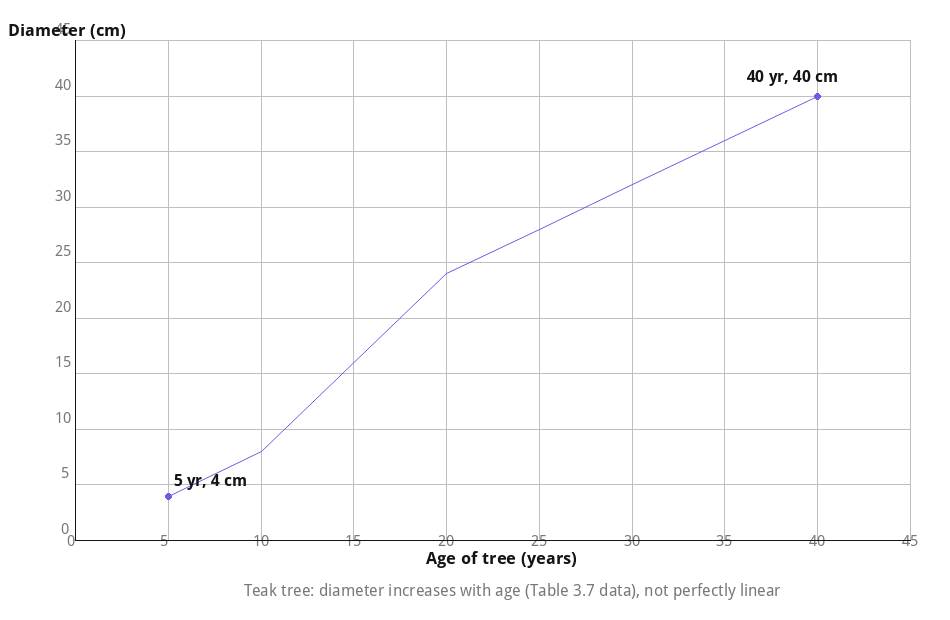
7. Plot a graph between the age of a teak tree (years, x-axis) and the diameter of the tree (cm) along with the number of annual rings formed (y-axis), using the given data (Table 3.7: ages 5, 10, 20, 25, 30, 40 years with corresponding diameters 4, 8, 24, 28, 32, 40 cm and equal numbers of annual rings). (i) Analyse the graph in terms of stem diameter over time. (ii) What is the relation between diameter and annual rings? (iii) Which specialised tissue is responsible for the girth of the stem, and where is it located?
(i) The graph shows a generally rising trend: as the age of the tree increases, the diameter of the stem also increases, reflecting continuous secondary growth (growth is not perfectly linear, since the increase from year 10 to 20 is steeper than later intervals, but the overall trend is a steady increase in girth with age). (ii) The number of annual rings is directly related to the diameter — each ring represents one year’s growth in girth, so the diameter increases roughly in step with the number of rings formed, and counting rings can be used to estimate a tree’s age. (iii) The tissue responsible for increasing the girth of the stem is the lateral meristem, specifically the vascular cambium, a thin layer of dividing cells located between the xylem and phloem in the stem; it produces new xylem and phloem each growing season, forming the annual rings.
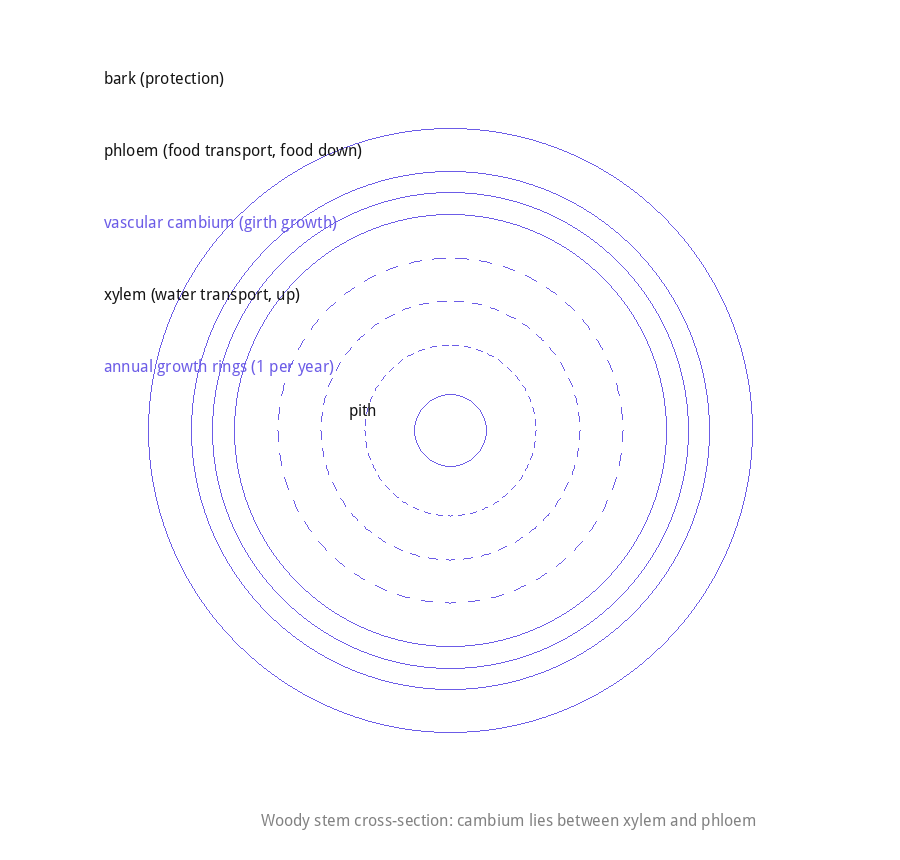
8. In a forest, a tree was severely debarked by an elephant to feed on the nutrient-rich bark (Fig. 3.22). (i) Which function(s) of the tree are hampered by debarking? (ii) Which plant tissue would be affected by further damage to the trunk even after debarking? (iii) Which function would be hampered if the tissues beneath the bark were severely damaged? (iv) What assumptions are you making, and how would the answer change if the assumptions changed?
(i) Debarking removes the outer protective covering, so the tree’s protection against pathogens, pests and water loss is compromised; since the bark region also contains phloem, food transport (translocation) from the leaves to the rest of the plant is affected too. (ii) If damage continues inward past the bark, the phloem and the vascular cambium (the growth tissue lying just beneath the bark) would be affected next. (iii) If the tissues beneath the bark — phloem and cambium — are severely damaged, the plant loses its ability to transport food to roots and other parts and to add new girth (secondary growth); over time this starves the roots and can kill the tree, a phenomenon called girdling. (iv) These answers assume that only the bark and immediately underlying phloem/cambium are removed while the xylem deeper inside remains intact, and that the damage is localised rather than encircling the whole trunk. If the assumption changes — for instance, if the xylem is also destroyed or the tree is girdled all the way around the trunk — then water and mineral transport would fail too, and the tree would wilt and die much faster.
9. Aamrapali observed that a young mango sapling’s stem bends flexibly during monsoon winds and does not break. Which tissue is responsible for this flexibility? Predict the impact if the existing tissue was replaced by sclerenchyma.
The flexibility comes from collenchyma tissue, whose cells are living and have unevenly thickened walls (thickened at the corners), giving young stems and leaf stalks both mechanical support and the ability to bend without snapping. If collenchyma were replaced by sclerenchyma — dead cells with uniformly thick, lignified walls that provide rigid, hard support — the stem would become stiff and brittle. Instead of bending safely in strong monsoon winds, it would be far more likely to snap and break.
10. Sohan tried to regenerate sugarcane using two types of stem cuttings, type ‘A’ and type ‘B’ (Fig. 3.23). After a few weeks, type ‘B’ cuttings sprouted into sugarcane plants while type ‘A’ did not. (i) Why could type ‘B’ grow but not type ‘A’? (ii) What difference existed between them? (iii) What observation confirmed the effect? (iv) What parameters should be kept the same for a fair comparison?
(i) Type ‘B’ cuttings sprouted because they included nodes, which carry buds made of meristematic tissue capable of developing into new shoots and roots; type ‘A’ cuttings lacked nodes, so they had no meristematic tissue to initiate new growth. (ii) The key difference was the presence of nodes with buds in type ‘B’ versus their absence in type ‘A’. (iii) The observation used to judge the effect was simply whether each type of cutting sprouted and developed into a growing sugarcane plant — type ‘B’ did, type ‘A’ did not. (iv) For a fair comparison, all other variables should be kept constant across both sets of cuttings: the same soil type, the same amount of water, equal sunlight exposure, the same temperature/environmental conditions, and cuttings of similar size and length — so that node presence remains the only variable being tested.
11. Rohan states, “A tissue is a group of similar cells performing similar functions.” Rajiv counters that this is true for simple tissues but different for complex tissues. Explain in light of this discussion.
Both students have a valid point. Rohan’s definition correctly describes simple tissues — such as parenchyma, collenchyma, and sclerenchyma — which are made of one type of cell all performing the same function. Rajiv is also right about complex tissues: xylem and phloem are each made of more than one type of cell (for example, xylem contains tracheids, vessels, xylem fibres, and xylem parenchyma) that are structurally different from one another but work together to carry out a shared overall function, such as water transport in xylem or food transport in phloem. So a tissue is best defined as a group of cells, similar or dissimilar in structure, working together toward a common function.
12. Coconut husk fibres are used for mats, which are tough and fibrous. Which tissue has structural features suitable for providing this strength? Explain why living parenchyma couldn’t serve the same purpose.
The strength of coconut husk fibres comes from sclerenchyma tissue. Sclerenchyma cells are dead at maturity and have thick, lignified secondary walls, which make the fibres rigid, tough, and mechanically strong — ideal for weaving into mats and ropes. Parenchyma cannot serve this purpose because its cells are living, thin-walled, and loosely packed with large intercellular spaces; they are adapted for storage, photosynthesis, or packing tissue, not for withstanding mechanical stress, so they are soft rather than fibrous or tough.
13. Vibha claims to Neha that “Meristematic cells are located only at the root and shoot apices.” What do you think of this statement? What question can Neha ask Vibha to help her understand further if the statement is incorrect?
Vibha’s statement is incorrect. Meristematic tissue is not limited to the root and shoot tips (apical meristem); it is also found at the base of leaves and internodes (intercalary meristem, which allows quick regrowth, e.g., after grass is cut) and as a cylindrical layer such as the vascular cambium and cork cambium within stems and roots (lateral meristem, responsible for increase in girth). Neha could ask, “If meristematic cells exist only at the tips, then how does a plant’s stem or root grow thicker over the years, and how does grass regrow so quickly after being mowed?” — a question that exposes the need for intercalary and lateral meristems.
14. A plant cell and an animal cell are of the same size. (i) Which cell will have a larger vacuole? Give reasons. (ii) What assumptions are you making to answer the question above?
(i) The plant cell will have the larger vacuole. Mature plant cells typically contain one large, central vacuole that can occupy most of the cell’s volume, storing water, ions, and waste products and maintaining turgor pressure, which keeps the cell (and the plant) firm. Animal cells, by contrast, have only small vacuoles, if any. (ii) This comparison assumes that the plant cell being considered is a mature, fully differentiated cell (since young/meristematic plant cells have very small vacuoles), that both cells are healthy and under normal physiological conditions, and that we are comparing typical, generalised plant and animal cells rather than unusual specialised ones.
15. A textbook states, “Each plant tissue performs only one specific function.” What questions would you ask to critically examine the correctness of this statement, and what examples would you use to test it?
This statement is not entirely accurate, since several plant tissues perform more than one function at once. Useful questions to probe it would be: Does every tissue really have just one job, or can a single tissue serve several roles simultaneously? Can one tissue provide both support and store food? Do the different cell types that make up a complex tissue each contribute a different function? These can be tested with examples: parenchyma performs storage, photosynthesis (when it contains chloroplasts, as chlorenchyma), and packing/filling roles all at once; collenchyma provides both mechanical support and flexibility; xylem simultaneously conducts water and provides mechanical strength to the plant body; and phloem, being a complex tissue, has different cell types (sieve tubes, companion cells, phloem fibres, phloem parenchyma) each contributing a distinct role within the overall function of food transport. These examples show that many plant tissues are multifunctional rather than single-purpose.
In-Text Questions (Think It Over, Pause and Ponder, and Think as a Scientist)
How is the study of cells and tissues significant for understanding life processes and human welfare? (Think It Over, Page 28)
Cells and tissues are the basic structural and functional units of every living organism, so studying them explains how everyday life processes — respiration, digestion, movement, growth — actually happen at the microscopic level. This knowledge also has direct benefits for human welfare: it helps in diagnosing diseases (many, such as cancer, begin as abnormal cell or tissue growth), understanding how injuries heal, and developing medical applications like tissue grafting, wound repair, and organ transplantation.
How are tissues in plants and animals different, and why? (Think It Over, Page 28)
Plant and animal tissues differ because plants and animals have very different lifestyles. Plants are stationary, so many of their tissues (like xylem, made largely of dead, lignified cells) exist mainly to provide rigid mechanical support, transport water/food, and enable slow growth. Animal tissues, in contrast, are almost entirely made of living cells and are far more specialised for movement, rapid coordination, and quick responses — muscle tissue contracts to produce movement, and nervous tissue transmits electrical impulses for fast communication between body parts. In short, plant tissues are built around support and transport, while animal tissues are built around movement and coordination.
How is the division of labour at various levels of organisation in multicellular organisms correlated with their structure and function? (Think It Over, Page 28)
In multicellular organisms, structure and function become progressively specialised at each higher level of organisation. At the cell level, individual cells are shaped and structured for a specific job (e.g., a long nerve cell for transmitting impulses). At the tissue level, many similar cells group together and combine their individual efforts into a single collective function (e.g., muscle tissue producing coordinated movement). At the organ level, different tissues combine — for instance, the heart contains muscular, connective, and nervous tissue together — to perform a more complex function like pumping blood. At the organ system level, multiple organs cooperate, as in the digestive system. At every level, the structural arrangement is closely matched to the function being carried out, which is what makes multicellular life efficient.
Why do meristematic tissue cells not have large vacuoles? (Think It Over, Page 31)
Meristematic cells are constantly and actively dividing, so all their internal space needs to be devoted to dense cytoplasm packed with organelles that support this high rate of division, along with a large nucleus to control it. A large vacuole, which is a feature of mature, differentiated cells used for storage and maintaining turgor, would take up space that is instead needed for active metabolic machinery, so meristematic cells stay compact with little or no vacuolation until they differentiate. (Note: some third-party solution sets reproduce this question with the wording reversed, i.e., asking “why do meristematic cells have vacuoles” — this is treated here as the same underlying textbook question about the absence, not presence, of large vacuoles in dividing cells, which is the biologically correct framing.)
Fibres of coconut husk are hard and brittle, whereas the leaf stalks of coriander are soft and flexible. Find out the reason. (Pause and Ponder, Page 33)
The difference comes down to which tissue dominates each structure. Coconut husk is rich in sclerenchyma, made of dead cells with thick, lignified walls that make it hard and brittle. Coriander leaf stalks are made largely of parenchyma and collenchyma, which have thin or only unevenly thickened walls and remain living, giving the stalk softness and flexibility.
Why is a thick cuticle on the outer wall of the epidermis advantageous for a desert plant but disadvantageous for a plant living underwater? (Pause and Ponder, Page 34)
The cuticle is a waterproof, waxy layer that limits water loss through the epidermis. In a desert, this is a major advantage because it minimises water loss by transpiration, helping the plant survive in dry, water-scarce conditions. In an aquatic plant, however, a thick cuticle would be disadvantageous because it would block the direct absorption of water and dissolved gases from the surrounding water across the epidermis, which many submerged aquatic plants rely on. So the same adaptation is beneficial in one habitat and harmful in the other.
Once water is absorbed by plant roots, it must travel upward against gravity through the xylem. How do the dead cells of the xylem work together with the living cells of the leaves to keep water moving? (Pause and Ponder, Page 34)
Water moves upward mainly by the transpiration pull mechanism. Xylem cells (tracheids and vessels) are dead and hollow, forming continuous pipe-like channels with no living contents to obstruct flow, which lets water rise with minimal resistance. In the leaves, living mesophyll cells lose water by evaporation from the stomata (transpiration); this loss creates a “pull” or negative pressure that draws more water upward through the xylem to replace it. The upward water column stays unbroken because of cohesion (water molecules attracting each other) and adhesion (water molecules attracting the walls of the xylem vessels). So the dead xylem provides the physical pipeline while the living leaf cells generate the pulling force — together, they move water against gravity.
What do you think will happen if there were no stomata in the epidermis of the stem or leaves? (Pause and Ponder, Page 34)
Without stomata, the plant would be unable to exchange gases efficiently — carbon dioxide could not enter for photosynthesis, and oxygen produced during photosynthesis could not be released, which would severely limit food production. Transpiration would also stop almost completely, removing the transpiration pull that drives the upward movement of water and dissolved minerals through the xylem. As a result, both photosynthesis and water/mineral transport would be badly disrupted, and the plant’s growth and survival would be seriously threatened.
Look at the picture of various poses of classical and folk dances of India (Fig. 3.17). Can you identify which joints are involved, and what type of movement each allows? (Pause and Ponder, Page 40)
Several joints work together during dance movements: the neck (a pivot joint) allows side-to-side rotation of the head; the shoulder (a ball-and-socket joint) allows movement in almost every direction, enabling graceful, sweeping arm gestures; the elbow (a hinge joint) allows the arm to bend and straighten; the wrist (a gliding joint) allows small multidirectional movements important for hand gestures (mudras); the hip (a ball-and-socket joint) allows all-round leg movement; the knee (a hinge joint) allows bending and straightening for steps and jumps; and the ankle (a gliding joint) helps with foot movement and balance during the performance.
(Think as a Scientist, Page 42 — based on tissue culture of carrot phloem cells) (a) What do you conclude about the characteristics of the phloem cells of the carrot? (b) In which combination of conditions would you obtain the highest and lowest biomass, and why? (c) Would you get the same results with animal cells instead of carrot cells? (d) Mention two commercial applications of this study.
(a) Carrot phloem cells show totipotency — living, differentiated cells can dedifferentiate into an unspecialised, actively dividing mass and then redifferentiate into all the cell and tissue types needed to regenerate a complete new plant, provided they are given the right nutrients, growth hormones, and culture conditions. (b) The highest biomass is obtained in the combination with a liquid nutrient medium plus adequate nutrients, light, and air, since a liquid medium allows more efficient nutrient uptake, light supports photosynthesis, and air supplies oxygen for cellular respiration; the lowest biomass results when a key factor is withheld, such as a solid medium lacking free air exchange, which limits nutrient uptake and respiration and slows cell division. (c) No — most differentiated animal cells are not totipotent under normal culture conditions, so they cannot dedifferentiate and regenerate into a whole new organism the way many plant cells can; this is why techniques like plant tissue culture do not have a direct, simple animal-cell equivalent. (d) Two commercial applications of plant tissue culture are: micropropagation, used to rapidly produce large numbers of genetically identical, disease-free plants (for example, bananas, sugarcane, and orchids); and crop improvement/plant breeding, where tissue culture combined with genetic engineering helps develop disease-resistant, high-yield, or otherwise improved crop varieties.
Why This Chapter Matters
Tissues in Action builds directly on the previous chapter’s study of cell structure, showing how individual cells specialise and organise into tissues that divide labour efficiently — a concept that recurs throughout the rest of the book whenever organs and organ systems are discussed. Understanding the structural differences between meristematic and permanent plant tissues, or between epithelial, connective, muscular and nervous tissues in animals, also gives students the vocabulary and conceptual foundation needed for later topics on plant and human physiology, movement, and the applications of tissue culture in agriculture and medicine.
Extra Questions | Revision Notes | Formulas Handbook
Chapter Quiz — Test Your Understanding
Class 9 Science Chapter 3 – Notes and Extra Questions
Along with these NCERT Solutions, students can also use the Class 9 Science Chapter 3 Extra Questions and Class 9 Science Chapter 3 Revision Notes for quick revision and extra practice.
- Chapter 1: Entering the World of Secondary Science – Free PDF Download
- Chapter 2: Cell: The Building Block of Life – Free PDF Download
- Chapter 4: Describing Motion Around Us – Free PDF Download
- Chapter 5: Exploring Mixtures and their Separation – Free PDF Download
- Chapter 6: How Forces Affect Motion – Free PDF Download
- Chapter 7: Work, Energy and Simple Machines – Free PDF Download
- Chapter 8: Journey Inside the Atom – Free PDF Download
- Chapter 9: Atomic Foundations of Matter – Free PDF Download
- Chapter 10: Sound Waves: Characteristics and Applications – Free PDF Download
- Chapter 11: Reproduction: How Life Continues – Free PDF Download
- Chapter 12: Patterns in Life: Diversity and Classification – Free PDF Download
- Chapter 13: Earth as a System: Energy, Matter and Life – Free PDF Download
Frequently Asked Questions
What is the difference between meristematic and permanent tissue in this chapter?
Meristematic tissue consists of actively, continuously dividing cells (thin walls, dense cytoplasm, large nucleus, little or no vacuole) found at growing regions like root/shoot tips, nodes, and cambium. Permanent tissue is made of cells that have stopped dividing and have differentiated to perform a specific function — such as parenchyma, collenchyma, sclerenchyma, xylem, and phloem — and typically shows more vacuolation and structural specialisation.
How should a student remember the difference between xylem and phloem quickly?
A simple way to remember it: xylem moves water and minerals “up” from roots to leaves (mostly through dead, hollow cells), while phloem moves food “down and around” from leaves to the rest of the plant (through living, sieve-tube cells) — think “X for xylem, up from roots” and “P for phloem, food to the plant.”
What are the three types of joints covered in this chapter, and how do they differ?
The chapter discusses ball-and-socket joints (allow movement in all directions, e.g., shoulder, hip), hinge joints (allow movement in one plane only, like a door — bending and straightening, e.g., knee, elbow, ankle), and pivot joints (allow rotation around a single axis, e.g., the joint between the first two neck vertebrae).
Are all the ‘extra questions’ circulating online for this chapter genuine NCERT content?
Not always — some third-party sites publish self-authored practice questions not found in the actual textbook. Everything above (the exercise and the in-text questions) has been verified directly against the official NCERT PDF or cross-checked reputable sources.
Recommended: Buy the Printed NCERT Class 9 Science Book
Contains Amazon affiliate links.
If you’d like a printed copy alongside the PDF, here’s a verified option:
3.8 out of 5 stars (931 ratings) · Rs. 187
Price and availability may change on Amazon. As an Amazon Associate, ncertbooks.org earns from qualifying purchases.


