
Chapter 14 of NCERT Class 11 Physics Part II, “Waves,” explains how disturbances travel through elastic media — from a jerk sent down a stretched string to sound propagating through air, water, and steel. Below you will find independently worked, step-by-step solutions to every exercise question from the current (2023 rationalised, 2026-27 reprint) NCERT textbook, covering wave speed on strings, the speed of sound in gases, travelling and stationary waves, resonance in pipes and rods, and beats. Each answer is derived from first principles rather than copied from any single source, so you can follow the exact reasoning and reproduce it in your own exam answers.
NCERT Solutions: Class 11 Physics Chapter 14 Waves – Exercises 14.1 to 14.19
14.1 Time for a transverse disturbance to cross a stretched string
Question: A string of mass 2.50 kg is under a tension of 200 N. The length of the stretched string is 20.0 m. If the transverse jerk is struck at one end of the string, how long does the disturbance take to reach the other end?
Last Updated: September 23, 2026
Solution: Mass per unit length, μ = 2.50 kg / 20.0 m = 0.125 kg/m.
Speed of a transverse wave on a string: v = √(T/μ) = √(200 / 0.125) = √1600 = 40 m/s.
Time taken, t = length / v = 20.0 m / 40 m/s = 0.50 s.
14.2 Splash from a falling stone
Question: A stone dropped from the top of a tower of height 300 m splashes into the water of a pond near the base of the tower. When is the splash heard at the top, given that the speed of sound in air is 340 m/s? (g = 9.8 m/s²)
Solution: Time for the stone to fall: h = ½gt²¹ ⇒ t₁ = √(2h/g) = √(2 × 300 / 9.8) = √61.22 = 7.82 s.
Time for sound of the splash to travel back up: t₂ = h/v = 300/340 = 0.88 s.
Total time = t₁ + t₂ = 7.82 + 0.88 = 8.71 s (approximately).
14.3 Tension needed to match the speed of sound in air
Question: A steel wire has a length of 12.0 m and a mass of 2.10 kg. What should be the tension in the wire so that speed of a transverse wave on the wire equals the speed of sound in dry air at 20°C = 343 m/s?
Solution: μ = 2.10/12.0 = 0.175 kg/m.
T = v²μ = (343)² × 0.175 = 117649 × 0.175 = ≈ 2.06 × 10⁴ N.
14.4 Speed of sound formula v = √(γP/ρ)
Question: Use the formula v = √(γP/ρ) to explain why the speed of sound in air (a) is independent of pressure, (b) increases with temperature, (c) increases with humidity.
Solution: (a) From the ideal gas equation, PV = nRT so P/ρ = RT/M, which depends only on temperature T and molar mass M, not on P alone (since P and ρ both change proportionally at fixed T, keeping P/ρ constant). Hence v is independent of pressure at constant temperature.
(b) Since v = √(γRT/M), v ∝ √T, so as temperature rises, v increases.
(c) Moist air contains water vapour (molar mass 18 g/mol) which is lighter than the average molar mass of dry air (≈28.8 g/mol). This lowers the effective density ρ of humid air, and since v ∝ 1/√ρ, the speed of sound increases with humidity.
14.5 Which functions represent travelling waves?
Question: Which of the following functions of x and t represent (i) a travelling wave, (ii) a stationary wave, or (iii) neither? Give reasons. (a) (x − vt)² (b) log[(x + vt)/x₀] (c) 1/(x + vt)
Solution: A function represents a travelling wave only if it is a finite, single-valued function of (x − vt) or (x + vt) for all values of x and t.
(a) (x − vt)² is of the form f(x − vt), so it moves with speed v, but it grows without bound as x, t → ∞ and never repeats/oscillates — it is not a physically acceptable (finite, bounded) wave profile.
(b) log[(x + vt)/x₀] is a function of (x + vt), but it diverges to −∞ when x + vt → 0, so it is not finite everywhere and does not represent a physical wave.
(c) 1/(x + vt) is also a function of (x + vt) but becomes infinite at x = −vt, so it too is not finite for all x, t and does not represent a physical wave.
None of the three functions represents a travelling wave because none stays finite for all values of x and t.
14.6 Ultrasonic wave from a bat at a water surface
Question: A bat emits ultrasonic sound of frequency 1000 kHz in air. The sound meets a water surface. What is the wavelength of (a) the reflected sound, (b) the transmitted sound? (Speed of sound in air = 340 m/s, in water = 1486 m/s.)
Solution: f = 1000 kHz = 1 × 10⁶ Hz.
(a) Reflected sound stays in air: λ = v/f = 340 / 10⁶ = 3.4 × 10⁻⁴ m = 0.34 mm.
(b) Transmitted sound travels in water: λ = 1486 / 10⁶ = 1.486 × 10⁻³ m ≈ 1.49 mm.
14.7 Wavelength of an ultrasonic scanner in tissue
Question: A hospital uses an ultrasonic scanner to locate tumours in tissue. The operating frequency of the scanner is 4.2 MHz. What is the wavelength of sound in tissue, given the speed of sound there is 1.7 km/s?
Solution: v = 1.7 km/s = 1700 m/s, f = 4.2 × 10⁶ Hz.
λ = v/f = 1700 / (4.2 × 10⁶) = ≈ 4.05 × 10⁻⁴ m (0.405 mm).
14.8 Analysing a transverse harmonic wave
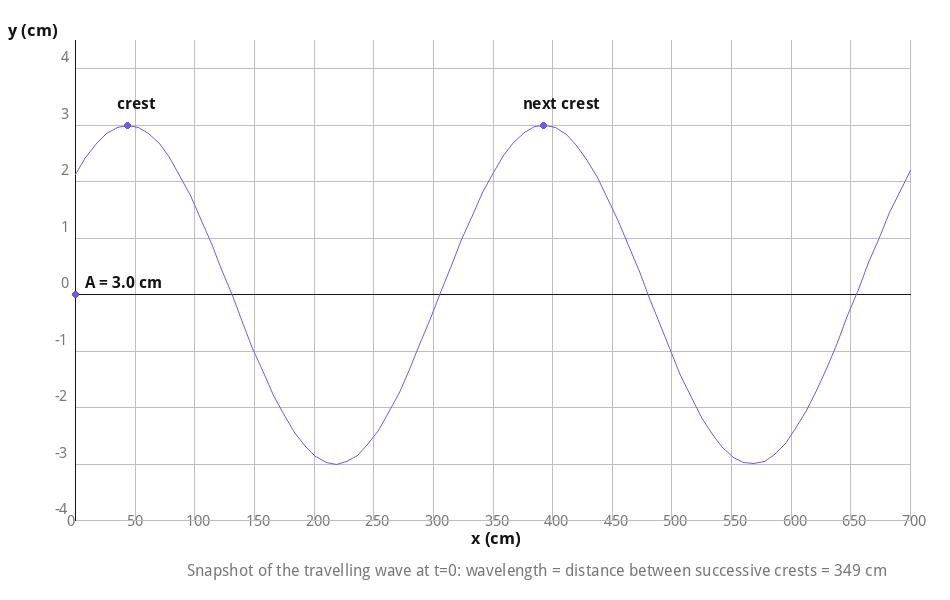
Question: For the travelling harmonic wave y(x,t) = 3.0 sin(36t + 0.018x + π/4), where x and y are in cm and t in s: (a) is this a travelling or stationary wave, what is its speed and direction of propagation? (b) what are its amplitude and frequency? (c) what is the initial phase at the origin? (d) what is the least distance between two successive crests?
Solution: The equation has the form sin(ωt + kx + φ), i.e., a single function of (kx + ωt), so it is a travelling wave, and since x and t appear with the same sign it moves in the negative x-direction.
Speed v = ω/k = 36/0.018 = 2000 cm/s = 20 m/s.
(b) Amplitude = 3.0 cm; frequency ν = ω/2π = 36/(2π) ≈ 5.73 Hz.
(c) Initial phase (at x = 0, t = 0) = π/4 rad.
(d) λ = 2π/k = 2π/0.018 ≈ 349 cm. The distance between successive crests equals one wavelength ≈ 3.49 m.
14.9 Displacement–time graphs at different points
Question: For the wave described in Question 14.8, plot the displacement (y) versus time (t) graphs for x = 0, 2 and 4 cm. What are the shapes of these graphs? In which respects does the oscillatory motion at these points differ from one another (amplitude, frequency, or phase)?
Solution: At each fixed x, y(t) = 3.0 sin(36t + 0.018x + π/4) is a sinusoid in t, so all three graphs are identical sine curves of the same amplitude (3.0 cm) and the same frequency (≈5.73 Hz); they differ only in phase, since each point has an extra phase offset of 0.018x rad relative to x = 0 (0.036 rad at x = 2 cm and 0.072 rad at x = 4 cm), which shifts each curve slightly along the time axis relative to the others.
14.10 Phase difference between two points
Question: For the wave y(x,t) = 2.0 cos 2π(10t − 0.0080x + 0.35), where x and y are in cm and t in s, calculate the phase difference between oscillatory motion of two points separated by a distance of (a) 4 m, (b) 0.5 m, (c) λ/2, (d) 3λ/4.
Solution: Wave number k = 2π(0.0080) rad/cm, so λ = 1/0.0080 = 125 cm. Phase difference Δφ = kΔx = 2π(0.0080)Δx, with Δx in cm.
(a) Δx = 4 m = 400 cm: Δφ = 2π(0.0080)(400) = 6.4π rad. Subtracting 3 full cycles (6π), the effective phase difference is 0.4π rad = 72°.
(b) Δx = 0.5 m = 50 cm: Δφ = 2π(0.0080)(50) = 0.8π rad = 144°.
(c) Δx = λ/2: Δφ = k(λ/2) = (2π/λ)(λ/2) = π rad = 180° (independent of the actual value of λ).
(d) Δx = 3λ/4: Δφ = (2π/λ)(3λ/4) = 3π/2 rad = 270°.
14.11 Standing wave on a clamped string
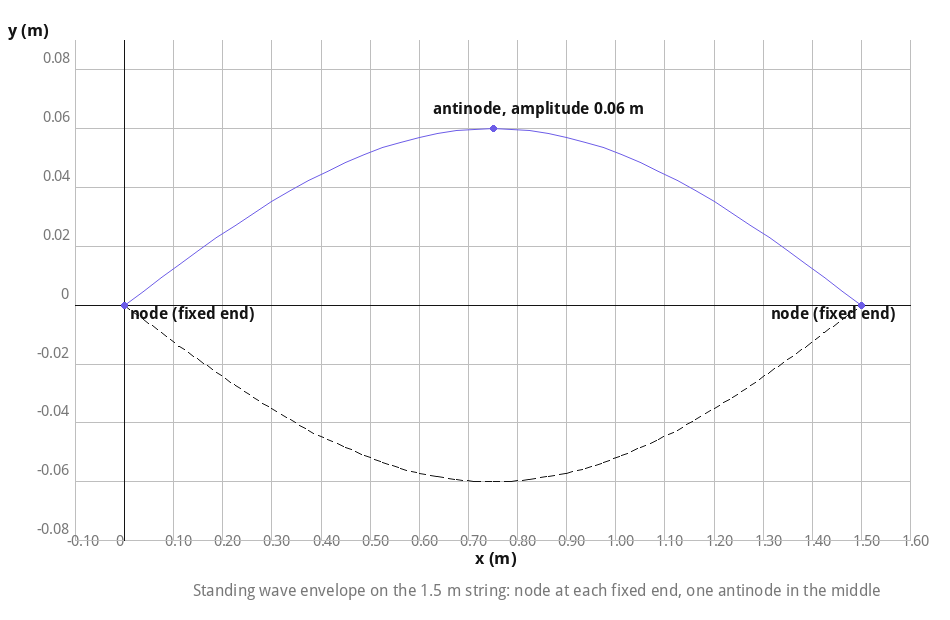
Question: The transverse displacement of a string (clamped at both ends) is given by y(x,t) = 0.06 sin(2πx/3) cos(120πt), where x and y are in metres and t is in seconds. The length of the string is 1.5 m and its mass is 3.0 × 10⁻² kg. (a) Does the equation represent a travelling or a stationary wave? (b) Interpret the wave as a superposition of two waves travelling in opposite directions; what are the wavelength, frequency, and speed of each? (c) Determine the tension in the string.
Solution: (a) Since y is a product of a function of x alone and a function of t alone, this is a stationary (standing) wave, not a travelling wave.
(b) Comparing with y = a sin(kx) cos(ωt): k = 2π/3 rad/m ⇒ λ = 3 m; ω = 120π rad/s ⇒ frequency = 60 Hz. Speed of each component travelling wave v = ω/k = 120π/(2π/3) = 180 m/s.
(c) μ = mass/length = 3.0 × 10⁻² / 1.5 = 0.02 kg/m. Tension T = v²μ = (180)²(0.02) = 32400 × 0.02 = 648 N.
14.12 Frequency, phase, and amplitude of the standing wave
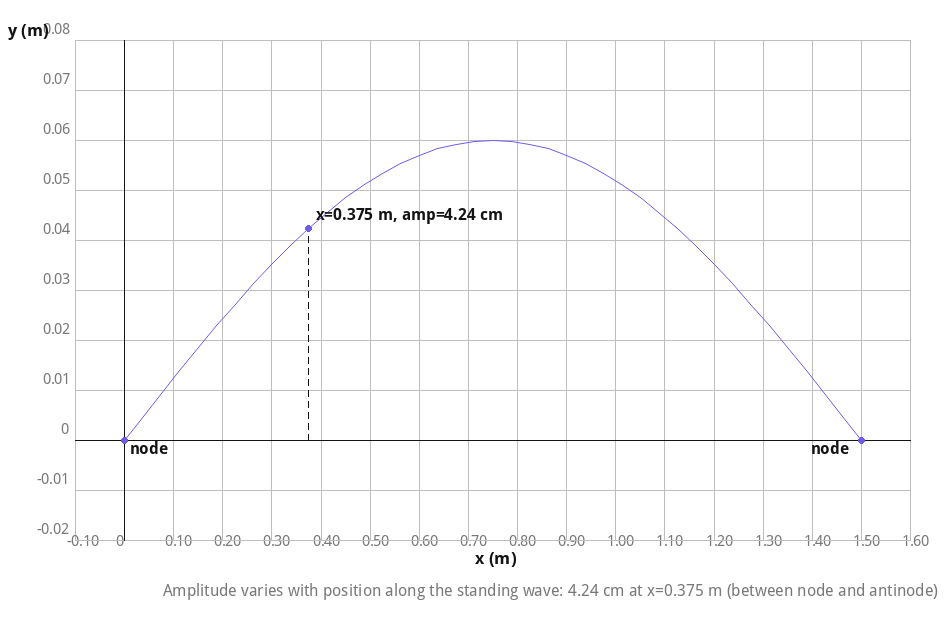
Question: (i) For the wave in Question 14.11, do all the points on the string oscillate with the same (a) frequency (b) phase (c) amplitude? Explain your answers. (ii) What is the amplitude of vibration of a point 0.375 m from one end?
Solution: (a) Every point of the string (except at the nodes, where it does not oscillate at all) vibrates with the same frequency, 60 Hz.
(b) All points lying between two consecutive nodes oscillate in phase with each other, but points on opposite sides of a node are exactly out of phase (phase difference of π) with one another — so not all points share a single common phase.
(c) The amplitude 0.06 sin(2πx/3) is a function of position x, so it varies from point to point — it is zero at the nodes and maximum (0.06 m) at the antinodes.
(ii) At x = 0.375 m: Amplitude = 0.06 sin(2π × 0.375/3) = 0.06 sin(0.25π) = 0.06 sin45° = 0.06 × 0.7071 = ≈ 4.24 × 10⁻² m (4.24 cm).
14.13 Classifying wave equations
Question: The transverse displacement of a string is given by four equations. Identify which of them represent (i) a travelling wave, (ii) a stationary wave, or (iii) neither, giving reasons. (a) y = 2cos(3x)sin(10t) (b) y = 2√(x − vt) (c) y = 3sin(5x − 0.5t) + 4cos(5x − 0.5t) (d) y = cos x sin t + cos 2x sin 2t
Solution: (a) Product of a function of x and a function of t ⇒ stationary wave.
(b) A single function of (x − vt) ⇒ travelling wave, moving in the +x direction with speed v.
(c) Both terms are functions of the same combination (5x − 0.5t), so their sum can be written as a single sinusoid R sin(5x − 0.5t + φ) ⇒ still a function of (5x − 0.5t) only, so it represents a single travelling wave moving in the +x direction.
(d) This is a sum of two independent stationary waves of different frequencies (each term individually is a product of a function of x and a function of t) ⇒ it is neither a pure travelling wave nor a single stationary wave of one frequency; it is a superposition of two stationary waves.
14.14 Fundamental mode of a vibrating wire
Question: A wire, of mass 3.5 × 10⁻² kg and linear mass density 4.0 × 10⁻² kg/m, is stretched between two rigid supports. The wire is vibrating in its fundamental mode with a frequency of 45 Hz. (a) What is the speed of a transverse wave on the wire? (b) What is the tension in the wire?
Solution: Length of the wire, L = mass/μ = 3.5 × 10⁻² / 4.0 × 10⁻² = 0.875 m.
In the fundamental mode, L = λ/2 ⇒ λ = 1.75 m.
(a) v = fλ = 45 × 1.75 = 78.75 m/s.
(b) T = v²μ = (78.75)²(4.0 × 10⁻²) = 6201.56 × 0.04 = ≈ 248 N.
14.15 Speed of sound from a resonance column
Question: A resonance-column apparatus, essentially a 1 m tube closed at one end by water level (a piston), is set into resonance with a tuning fork of frequency 340 Hz when the piston (air column length) is at 25.5 cm and then again at 79.3 cm from the open end. Determine the speed of sound in air.
Solution: Consecutive resonance lengths in a closed pipe are separated by λ/2:
λ/2 = 79.3 − 25.5 = 53.8 cm ⇒ λ = 107.6 cm = 1.076 m.
v = fλ = 340 × 1.076 = ≈ 366 m/s.
14.16 Speed of sound in steel from a clamped rod
Question: A steel rod 100 cm long is clamped at its middle. The fundamental frequency of longitudinal vibrations of the rod is given to be 2.53 kHz. What is the speed of sound in steel?
Solution: Clamping at the middle creates a node there, with antinodes at the two free ends. Each half of the rod (0.5 m) spans from a node to an antinode, i.e., a quarter wavelength:
0.5 m = λ/4 ⇒ λ = 2.0 m.
v = fλ = 2530 × 2.0 = 5.06 × 10³ m/s (5060 m/s).
14.17 Resonance in a closed pipe
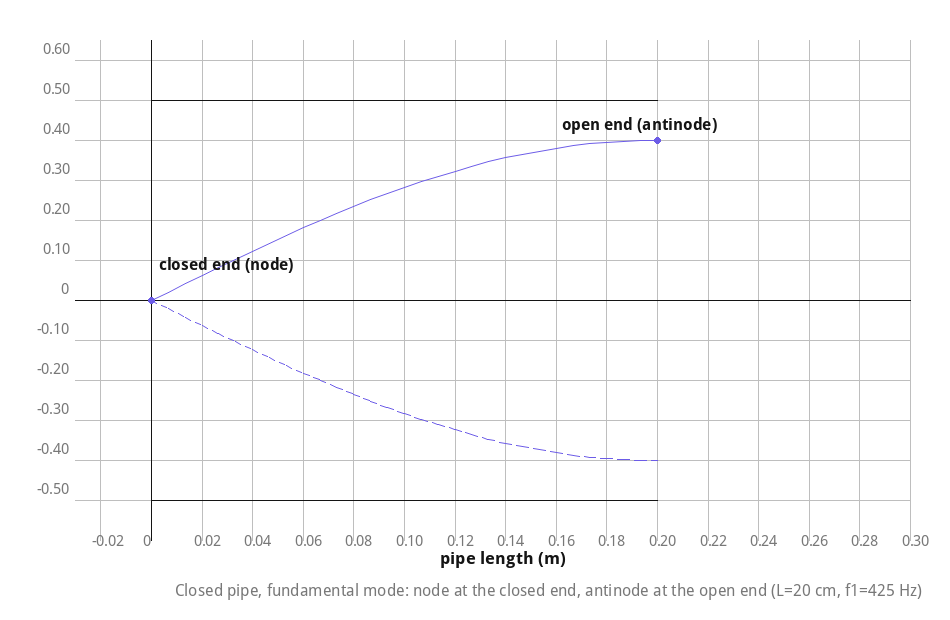
Question: A pipe 20 cm long is closed at one end. Which harmonic mode of the pipe is resonantly excited by a 430 Hz source? Will the same source excite resonance in the pipe if it were open at both ends? (Speed of sound = 340 m/s.)
Solution: For a pipe closed at one end, resonant (natural) frequencies are fₙ = (2n − 1)v/4L, n = 1, 2, 3, …
v/4L = 340/(4 × 0.20) = 425 Hz.
So the natural frequencies are 425 Hz, 1275 Hz, 2125 Hz, … The source frequency, 430 Hz, is very close to the fundamental (first harmonic) 425 Hz, so it predominantly excites the fundamental mode (first harmonic) of the closed pipe.
If the pipe were open at both ends, resonant frequencies would be fₙ = nv/2L = n × 340/0.40 = n × 850 Hz, i.e. 850 Hz, 1700 Hz, … None of these is close to 430 Hz, so the pipe would not resonate with this source if open at both ends.
14.18 Beats between two sitar strings
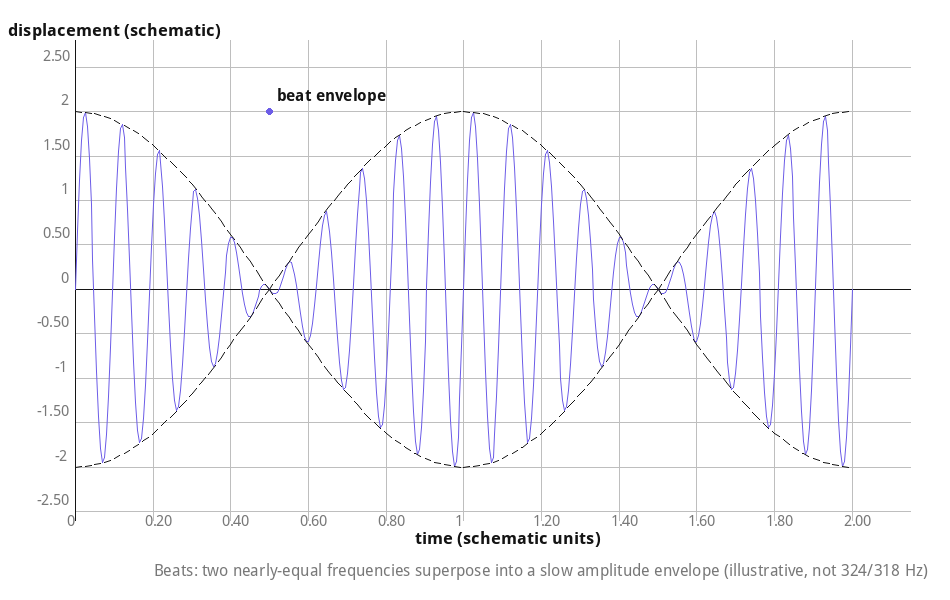
Question: Two sitar strings A and B playing the same note are slightly out of tune and produce beats of frequency 6 Hz. The tension in string A is slightly reduced, and the beat frequency is found to reduce to 3 Hz. If the original frequency of A is 324 Hz, what is the frequency of B?
Solution: Reducing the tension in A lowers f (since f ∝ √T). The beat frequency decreased when f decreased, which means f was moving towards fᶿ, i.e., f was originally greater than fᶿ.
So fᶿ = f − 6 = 324 − 6 = 318 Hz.
14.19 Conceptual questions on wave phenomena
Question: Explain briefly: (a) why a displacement node is a pressure antinode and vice versa, (b) why bats can ascertain distances, directions, sizes of obstacles without any “eyes”, (c) why a violin note and sitar note of the same fundamental frequency can be distinguished, (d) why solids can support both longitudinal and transverse waves but gases can only support longitudinal waves, (e) why a sharp pulse (not a pure sine wave) sent down a stretched string gets progressively distorted as it travels.
Solution:
(a) Pressure change is related to the spatial rate of change (compression/rarefaction) of displacement, not to the displacement itself. Where displacement is zero (a node) the compression/rarefaction — and hence the pressure variation — is maximum, i.e., it is a pressure antinode; the reverse is true at a displacement antinode.
(b) Bats emit high-frequency ultrasonic squeaks and detect the echoes reflected from obstacles or prey. By analysing the time delay, intensity, and direction of these echoes (echolocation), they can judge distance, direction, and size without using vision.
(c) Both notes have the same fundamental frequency, but each instrument produces the fundamental together with a different mix of overtones (harmonics) of different relative strengths. This difference in overtone content (waveform/timbre) lets the ear/brain distinguish the two instruments even though the basic pitch is the same.
(d) Transverse waves require a restoring force against a change in shape (shear), which needs a medium with a non-zero shear modulus (rigidity). Solids possess rigidity, so they support both transverse and longitudinal waves. Gases (and liquids) cannot sustain shear stress — they have no rigidity — so they support only longitudinal (compressional) waves.
(e) A sharp pulse contains many different frequency (Fourier) components. In a real string, wave speed depends slightly on frequency (dispersion), so different components travel at slightly different speeds and gradually separate from one another. This causes the pulse shape to progressively distort/spread out as it travels.
Notes and Extra Questions
Key formulas from Chapter 14 – Waves:
Speed of a transverse wave on a stretched string: v = √(T/μ), where T is tension and μ is mass per unit length.
Speed of sound (Newton’s–Laplace formula): v = √(γP/ρ), where γ = Cₛ/Cᵛ and P, ρ are pressure and density of the medium.
General progressive (travelling) wave: y(x,t) = a sin(kx − ωt + φ), with wave number k = 2π/λ and angular frequency ω = 2πν = 2π/T; wave speed v = ω/k = νλ.
Standing (stationary) wave from two identical waves travelling in opposite directions: y(x,t) = 2a sin(kx) cos(ωt); nodes occur where sin(kx) = 0 and antinodes where sin(kx) = ±1.
String fixed at both ends (both a musical string and an air column open at both ends behave similarly): allowed frequencies νₙ = n v/2L, n = 1, 2, 3, … (n₂ harmonic).
Pipe closed at one end (open pipe with one closed end, e.g. resonance tube): allowed frequencies νₙ = (2n−1)v/4L, n = 1, 2, 3, … — only odd harmonics are present.
Beat frequency of two sources of nearly equal frequency: νᵇᵔᵇᵗ = |ν₁ − ν₂|.
Extra practice questions:
1. A wire of length 1.0 m and mass 5.0 g is stretched with a tension of 40 N. Find the speed of a transverse wave on it and the fundamental frequency if both ends are fixed.
2. A closed organ pipe of length 30 cm resonates in its fundamental mode with a tuning fork. If the speed of sound is 340 m/s, find the frequency of the tuning fork.
3. Two tuning forks of frequency 256 Hz and 260 Hz are sounded together. Calculate the beat frequency and the time interval between successive maxima of loudness.
4. Explain, with the help of a diagram, why the fundamental note of a pipe closed at one end is an octave lower (roughly) than that of a similar pipe open at both ends for the same length.
- Chapter 1: Units and Measurements (2026-27)
- Chapter 2: Motion in a Straight Line – Free PDF Download
- Chapter 3: Motion in a Plane – Free PDF Download
- Chapter 4: Laws of Motion – Free PDF Download
- Chapter 5: Work, Energy and Power – Free PDF Download
- Chapter 6: System of Particles and Rotational Motion – Free PDF Download
- Chapter 7: Gravitation – Free PDF Download
- Chapter 8: Mechanical Properties of Solids – Free PDF Download
- Chapter 9: Mechanical Properties of Fluids – Free PDF Download
- Chapter 10: Thermal Properties of Matter – Free PDF Download
- Chapter 11: Thermodynamics – Free PDF Download
- Chapter 12: Kinetic Theory – Free PDF Download
- Chapter 13: Oscillations – Free PDF Download
FAQs on NCERT Solutions for Class 11 Physics Chapter 14 Waves
Q1. How many exercise questions are there in the current NCERT Class 11 Physics Chapter 14, Waves?
After the 2023 CBSE rationalisation, the current chapter has 19 exercise questions (14.1 to 14.19), several of which have multiple sub-parts. The old “Additional Exercises” (which mainly dealt with the Doppler effect, a topic that has been entirely dropped from this chapter) have been removed from the current syllabus, so you should not expect to see any question numbered 14.20 or higher in the up-to-date textbook.
Q2. Is the Doppler effect still part of the Class 11 Waves chapter?
No. As part of the CBSE/NCERT syllabus rationalisation, the Doppler effect section along with its associated additional exercise questions has been deleted from the current Class 11 Physics Waves chapter. You will not find Doppler-effect numericals in the up-to-date NCERT exercise list, even though many older solution guides online still show them under outdated question numbers.
Q3. What is the difference between a travelling wave and a stationary (standing) wave, and how do I tell them apart from an equation?
A travelling wave is a single function of (x − vt) or (x + vt) — the entire waveform shifts along the medium with time. A stationary wave is a product of a function of position and a function of time, such as y = a sin(kx) cos(ωt) — the waveform does not shift; instead, fixed points called nodes never move while antinodes oscillate with maximum amplitude. The quickest test is algebraic: if you can write y purely as f(x ± vt), it is travelling; if it factors as (function of x) × (function of t), it is stationary.
Q4. Why does the speed of sound depend on temperature but not on pressure (at constant temperature)?
From v = √(γP/ρ) and the ideal gas law, the ratio P/ρ simplifies to (RT/M), which depends only on the absolute temperature T (and the gas’s molar mass M), not on pressure alone. So at a fixed temperature, increasing or decreasing atmospheric pressure does not change the speed of sound, whereas raising the temperature directly increases the speed of sound since v ∝ √T.
Frequently Asked Questions
What is the difference between transverse and longitudinal waves?
In a transverse wave, particles oscillate perpendicular to the direction of wave propagation (e.g. waves on a string); in a longitudinal wave, particles oscillate parallel to the direction of propagation, creating compressions and rarefactions (e.g. sound waves).
What is the principle of superposition of waves used for in this chapter?
It states that when two or more waves overlap, the resultant displacement at any point is the vector sum of the individual displacements — this principle is the basis for explaining interference, beats, and standing (stationary) waves in the chapter.
Recommended: Buy the Printed NCERT Class 11 Physics Book Set
Contains Amazon affiliate links.
If you’d like a printed copy alongside the PDF, here’s a verified option:
Rs. 280
Price and availability may change on Amazon. As an Amazon Associate, ncertbooks.org earns from qualifying purchases.



Pingback: Class 11 Physics Chapter 14 Waves Extra Questions (2026-27)