
Chapter 1 of Ganita Manjari, “Orienting Yourself: The Use of Coordinates,” opens Class 9 Mathematics with a very practical question: how do we describe the exact position of something, whether it is a door in a room, a piece of furniture, or a street crossing in a city? The chapter builds the two-dimensional Cartesian coordinate system from the ground up through the story of Reiaan, who is settling into a new room with his sister Shalini, and it traces coordinate thinking back to the planned street-grids of the Sindhu-Sarasvati (Indus Valley) cities and the work of Baudhāyana, Āryabhata and Brahmagupta, centuries before René Descartes formalised the idea in Europe in 1637 CE. Along the way, students learn to read and plot ordered pairs, identify the four quadrants, and use the Baudhāyana-Pythagoras Theorem to derive and apply the distance formula to real situations such as furniture placement, room layouts and city maps. This page provides complete NCERT solutions for Class 9 Maths Chapter 1 Orienting Yourself: The Use of Coordinates, with detailed, step-by-step answers to every question from Exercise 1.1, Exercise 1.2, and the End of Chapter Exercises of the Ganita Manjari textbook.
Last Updated: September 23, 2026
1.1 Reiaan’s Room — Exercise 1.1 (Page 5)
Q1. Fig. 1.3 shows Reiaan's room with points OABC marking its corners. The x- and y-axes are marked in the figure, and point O is the origin. Referring to the figure, answer the following questions — Answer:
Answer:
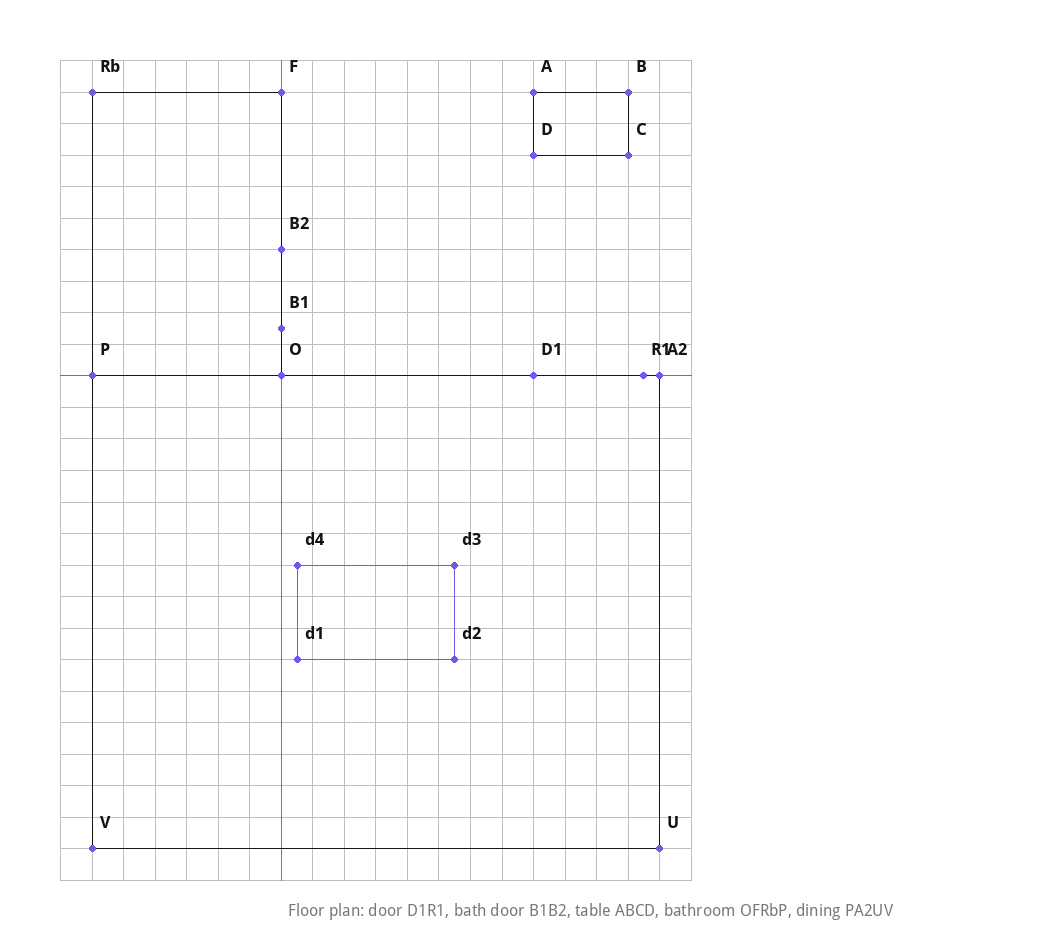
(i) If D₁R₁ represents the door to Reiaan’s room, how far is the door from the left wall (the y-axis) of the room? How far is the door from the x-axis?
From the figure, D₁ = (8, 0) and R₁ = (11.5, 0). Since both points lie on the x-axis, the door itself lies on the x-axis, so its distance from the x-axis is 0 units. The door begins 8 units from the y-axis (the left wall), since the x-coordinate of D₁ is 8.
(ii) What are the coordinates of D₁?
Since D₁ lies on the x-axis, 8 units to the right of the origin O, its coordinates are D₁ = (8, 0).
(iii) If R₁ is the point (11.5, 0), how wide is the door? Do you think this is a comfortable width for the room door? If a person in a wheelchair wants to enter the room, will he/she be able to do so easily?
Width of the door = distance between D₁ (8, 0) and R₁ (11.5, 0) = 11.5 − 8 = 3.5 units.
Taking 1 unit = 1 foot, the door is 3.5 feet (42 inches) wide. A standard room door is usually 2.5 to 3 feet wide, so a 3.5-foot door is comfortably wide. A wheelchair typically needs a clear width of about 2 to 2.25 feet to pass through, and since 3.5 feet is well above this requirement, a person using a wheelchair should be able to enter the room easily.
(iv) If B₁ (0, 1.5) and B₂ (0, 4) represent the ends of the bathroom door, is the bathroom door narrower or wider than the room door?
Width of the bathroom door = distance between B₁ (0, 1.5) and B₂ (0, 4) = 4 − 1.5 = 2.5 units.
Since the room door is 3.5 units wide and the bathroom door is 2.5 units wide, and 2.5 < 3.5, the bathroom door is narrower than the room door.
1.2 Furnishing the House — Exercise 1.2 (Page 7)
On a graph sheet, mark the x-axis and y-axis and the origin O. Mark points from (−7, 0) to (13, 0) on the x-axis and from (0, −15) to (0, 12) on the y-axis (using the scale 1 cm = 1 unit). Using Fig. 1.5, answer the following questions.
Q1. Place Reiaan's rectangular study table with three of its feet at the points (8, 9), (11, 9) and (11, 7) — Answer:
Answer:
(i) Where will the fourth foot of the table be?
The three given points form three corners of a rectangle: A = (8, 9), B = (11, 9), C = (11, 7). To complete the rectangle, the fourth vertex must share its x-coordinate with A (which is 8) and its y-coordinate with C (which is 7). Therefore, the fourth foot is at D = (8, 7).
(ii) Is this a good spot for the table?
Yes. Based on the layout of the room, the table sits neatly inside the room, does not block the door or any walking space, and is placed close to a wall, which is convenient for studying.
(iii) What is the width of the table? The length? Can you make out the height of the table?
Length of the table = distance between (8, 9) and (11, 9) = 11 − 8 = 3 units.
Width of the table = distance between (11, 9) and (11, 7) = 9 − 7 = 2 units.
The height of the table cannot be determined from the figure, because the diagram is a top (plan) view of the room in two dimensions — it carries no information about vertical height.
Q2. If the bathroom door has a hinge at B₁ and opens into the bedroom, will it hit the wardrobe? Are there any changes you would suggest if the door is made wider? — Answer: From the figure, B₁ = (0, 1.5) and B₂ = (0, 4), so the bathroom door is 4…
Answer: From the figure, B₁ = (0, 1.5) and B₂ = (0, 4), so the bathroom door is 4 − 1.5 = 2.5 units wide. If it is hinged at B₁ and swings open into the bedroom, it sweeps out a quarter-circle of radius 2.5 units centred at B₁ (0, 1.5). The wardrobe stands along the line x = 3, with its nearest edge 3 units away from the y-axis, so its closest point to B₁ is 3 units away — more than the door’s swing radius of 2.5 units. Since 2.5 < 3, the door will not hit the wardrobe when it opens.
If the door were made noticeably wider (so its swing radius exceeded 3 units), it could strike the wardrobe. In that case, sensible changes would be to hinge the door so it opens inward into the bathroom instead, to shift the wardrobe further to the right, or to cap how much wider the door is made.
Q3. Look at Reiaan's bathroom — Answer:
Answer:
(i) What are the coordinates of the four corners O, F, R, and P of the bathroom?
From the figure: O = (0, 0), F = (0, 9), R = (−6, 9), P = (−6, 0).
(ii) What is the shape of the showering area SHWR in Reiaan’s bathroom? Write the coordinates of the four corners.
The corners are S = (−6, 6), H = (−3, 6), W = (−2, 9), R = (−6, 9). Side SH is horizontal (both points have y = 6) and side WR is horizontal (both points have y = 9), so SH and WR are parallel to each other, but SH (length 3 units) and WR (length 1 unit) are of different lengths, and the other two sides are not parallel. Since exactly one pair of opposite sides is parallel, SHWR is a trapezium.
(iii) Mark off a 3 ft × 2 ft space for the washbasin and a 2 ft × 3 ft space for the toilet. Write the coordinates of the corners of these spaces.
Placing both spaces along the left wall (PR) of the bathroom, next to each other:
Washbasin (3 ft wide along x, 2 ft deep along y): corners P = (−6, 0), (−3, 0), (−3, 2), (−6, 2).
Toilet (2 ft wide along x, 3 ft deep along y), stacked directly above the washbasin: corners (−6, 2), (−4, 2), (−4, 5), (−6, 5).
Both rectangles satisfy the required dimensions exactly and do not overlap with each other or with the showering area SHWR.
Q4. Other rooms in the house — Answer:
Answer:
(i) Reiaan’s room door leads from the dining room, which has length 18 ft and width 15 ft. The length of the dining room extends from point P to point A. Sketch the dining room and mark the coordinates of its corners.
P = (−6, 0) and A = (12, 0), so PA = 12 − (−6) = 18 units, which matches the given length of 18 ft. Taking the dining room to be 15 ft wide and lying below PA (extending in the negative y-direction), its four corners are: P = (−6, 0), A = (12, 0), U = (12, −15), V = (−6, −15).
(ii) Place a rectangular 5 ft × 3 ft dining table precisely in the centre of the dining room. Write down the coordinates of the feet of the table.
The dining room spans x = −6 to x = 12 and y = 0 to y = −15.
Centre of the room: x = (−6 + 12) ⁄ 2 = 3, y = (0 + (−15)) ⁄ 2 = −7.5, i.e. centre = (3, −7.5).
For a 5 ft × 3 ft table, half-length = 2.5 and half-width = 1.5. The four feet of the table are therefore:
(3 − 2.5, −7.5 − 1.5) = (0.5, −9)
(3 + 2.5, −7.5 − 1.5) = (5.5, −9)
(3 + 2.5, −7.5 + 1.5) = (5.5, −6)
(3 − 2.5, −7.5 + 1.5) = (0.5, −6)
End of Chapter Exercises (Page 12)
Q1. What are the x-coordinate and y-coordinate of the point of intersection of the two axes? — Answer: The x-axis and y-axis intersect at the origin, where x-coordinate = 0 and…
Answer: The x-axis and y-axis intersect at the origin, where x-coordinate = 0 and y-coordinate = 0. So the point of intersection is (0, 0).
Q2. Point W has x-coordinate equal to −5. Can you predict the coordinates of point H, which is on the line through W parallel to the y-axis? Which quadrants can H lie in? — Answer: Every point on a line parallel to the y-axis has the same x-coordinate. So H has…
Answer: Every point on a line parallel to the y-axis has the same x-coordinate. So H has the form (−5, y), where y can be any real number.
- If y > 0, H lies in Quadrant II.
- If y < 0, H lies in Quadrant III.
- If y = 0, H lies on the x-axis (not inside any quadrant).
Q3. Consider the points R (3, 0), A (0, −2), M (−5, −2) and P (−5, 2). If they are joined in the same order, predict — Answer:
Answer:
(i) Two sides of RAMP that are perpendicular to each other.
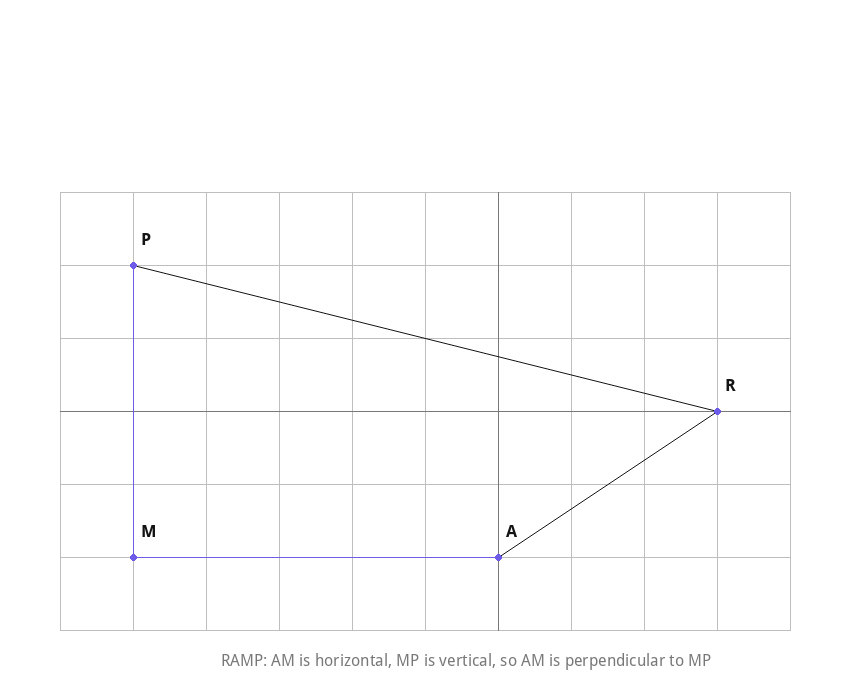
Side AM joins A (0, −2) to M (−5, −2); since both points share y = −2, AM is horizontal. Side MP joins M (−5, −2) to P (−5, 2); since both points share x = −5, MP is vertical. A horizontal line is always perpendicular to a vertical line, so AM ⊥ MP.
(ii) One side of RAMP that is parallel to one of the axes.
AM is parallel to the x-axis (A and M share the same y-coordinate), and MP is parallel to the y-axis (M and P share the same x-coordinate).
(iii) Two points that are mirror images of each other in one axis. Which axis will this be? Now plot the points and verify your predictions.
M (−5, −2) and P (−5, 2) share the same x-coordinate, while their y-coordinates are equal in magnitude but opposite in sign. This means M and P are mirror images of each other in the x-axis. Plotting all four points confirms RAMP is a right-angled trapezium with AM ⊥ MP as predicted.
Q4. Plot point Z (5, −6) on the Cartesian plane. Construct a right-angled triangle IZN and find the lengths of the three sides. (Answers may differ from person to person.) — Answer: One natural way to build a right-angled triangle at Z is to drop a vertical and…
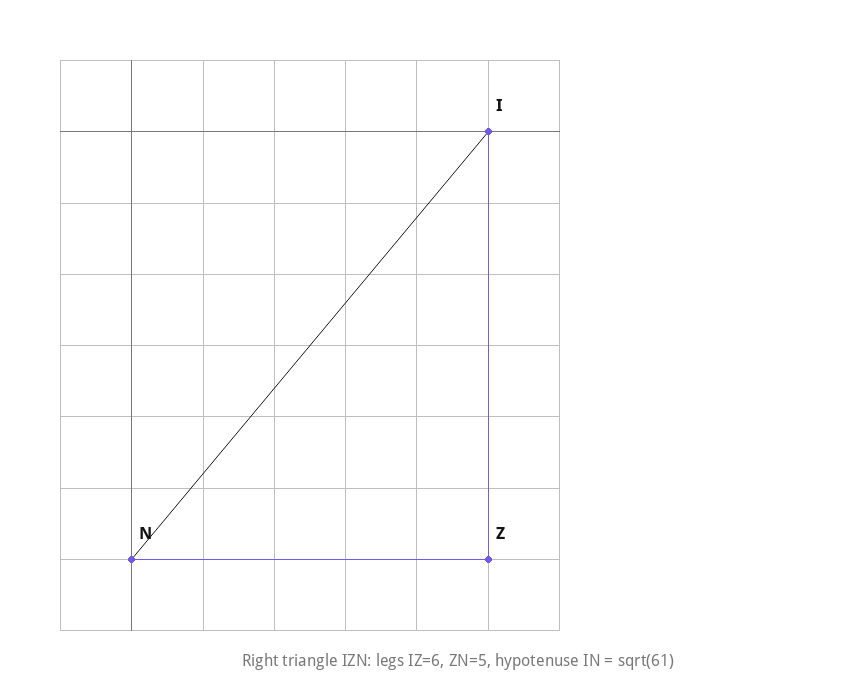
Answer: One natural way to build a right-angled triangle at Z is to drop a vertical and a horizontal line from Z to the axes: take I = (5, 0) on the x-axis (directly above/below Z) and N = (0, −6) on the y-axis (directly left of Z). Then IZ is vertical, ZN is horizontal, and the triangle is right-angled at Z.
IZ = distance between (5, 0) and (5, −6) = 0 − (−6) = 6 units.
ZN = distance between (5, −6) and (0, −6) = 5 − 0 = 5 units.
IN (hypotenuse), using the distance formula:
IN = √[(5 − 0)² + (0 − (−6))²] = √(5² + 6²) = √(25 + 36) = √61 units.
So the three sides of triangle IZN are 6 units, 5 units and √61 units. (Any other pair of perpendicular lines through Z would give an equally valid, differently-sized right triangle.)
Q5. What would a system of coordinates be like if we did not have negative numbers? Would this system allow us to locate all the points on a 2-D plane? — Answer: Without negative numbers, coordinates could only be zero or positive. On the…
Answer: Without negative numbers, coordinates could only be zero or positive. On the x-axis we could mark only points to the right of the origin, and on the y-axis only points above the origin. This would let us locate points only in Quadrant I, on the positive x-axis, on the positive y-axis, and at the origin. We would have no way to represent points in Quadrant II, III or IV, or on the negative parts of either axis. So such a system would not allow us to locate all the points on a 2-D plane — it would cover only one-quarter of it.
Q6. Are the points M (−3, −4), A (0, 0) and G (6, 8) on the same straight line? Suggest a method to check this without plotting and joining the points — Answer: Three points are collinear if the sum of the distances between two pairs of them…
Answer: Three points are collinear if the sum of the distances between two pairs of them equals the distance between the remaining (outer) pair. Using the distance formula d = √[(x₂ − x₁)² + (y₂ − y₁)²]:
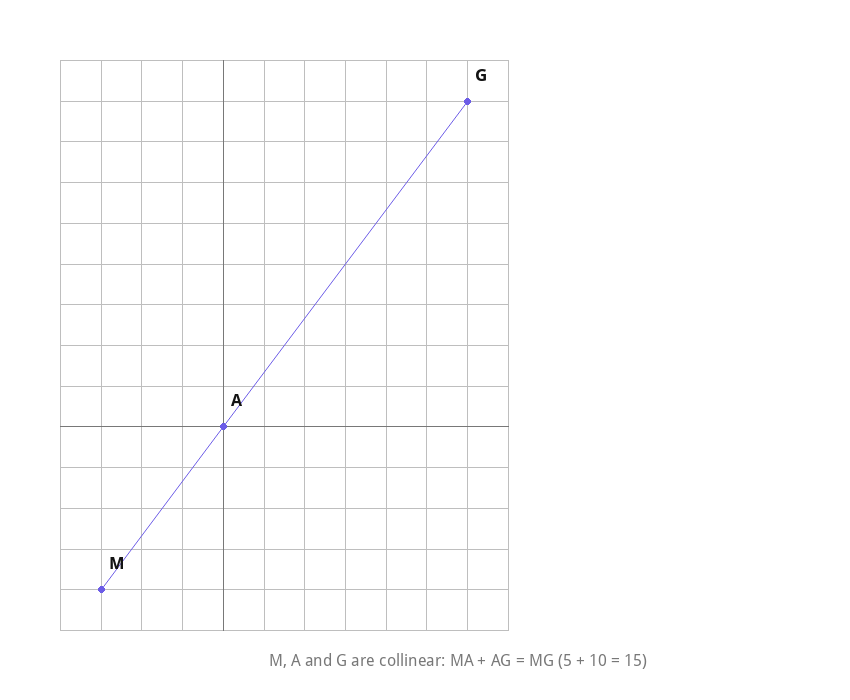
MA = √[(0 − (−3))² + (0 − (−4))²] = √(3² + 4²) = √(9 + 16) = √25 = 5 units.
AG = √[(6 − 0)² + (8 − 0)²] = √(6² + 8²) = √(36 + 64) = √100 = 10 units.
MG = √[(6 − (−3))² + (8 − (−4))²] = √(9² + 12²) = √(81 + 144) = √225 = 15 units.
Since MA + AG = 5 + 10 = 15 = MG, point A lies exactly between M and G on the same line. So M, A and G are collinear.
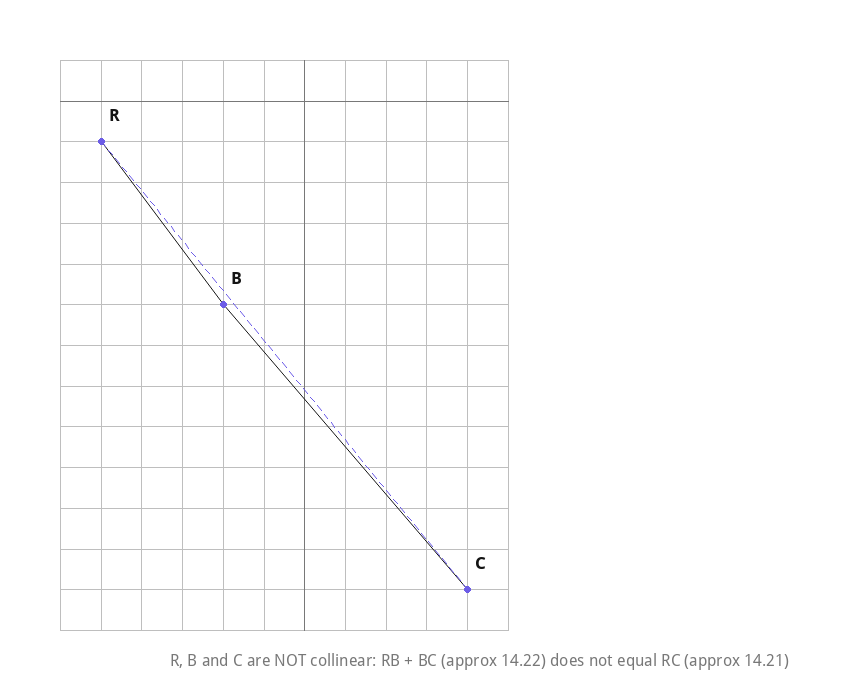
Q7. Use your method (from Q6) to check if the points R (−5, −1), B (−2, −5) and C (4, −12) are on the same straight line. Now plot both sets of points and check your answers — Answer:
Answer:
RB = √[(−2 − (−5))² + (−5 − (−1))²] = √(3² + (−4)²) = √(9 + 16) = √25 = 5 units.
BC = √[(4 − (−2))² + (−12 − (−5))²] = √(6² + (−7)²) = √(36 + 49) = √85 units.
RC = √[(4 − (−5))² + (−12 − (−1))²] = √(9² + (−11)²) = √(81 + 121) = √202 units.
Checking: RB + BC = 5 + √85 ≈ 5 + 9.22 = 14.22, while RC = √202 ≈ 14.21 — the two are not exactly equal (5 + √85 ≠ √202, since one is a sum of an integer and a surd while the other is a single surd, and squaring confirms they are unequal). So R, B and C do NOT lie on the same straight line — unlike M, A, G in Q6, this triple is not collinear. Plotting both sets of points on graph paper confirms this: M, A, G fall in a straight row, while R, B, C form a visible (very flat) triangle.
Q8. Using the origin as one vertex, plot the vertices of — Answer: (These are open-ended construction questions; one valid set of answers is given…
Answer: (These are open-ended construction questions; one valid set of answers is given below — other correct placements are also possible.)
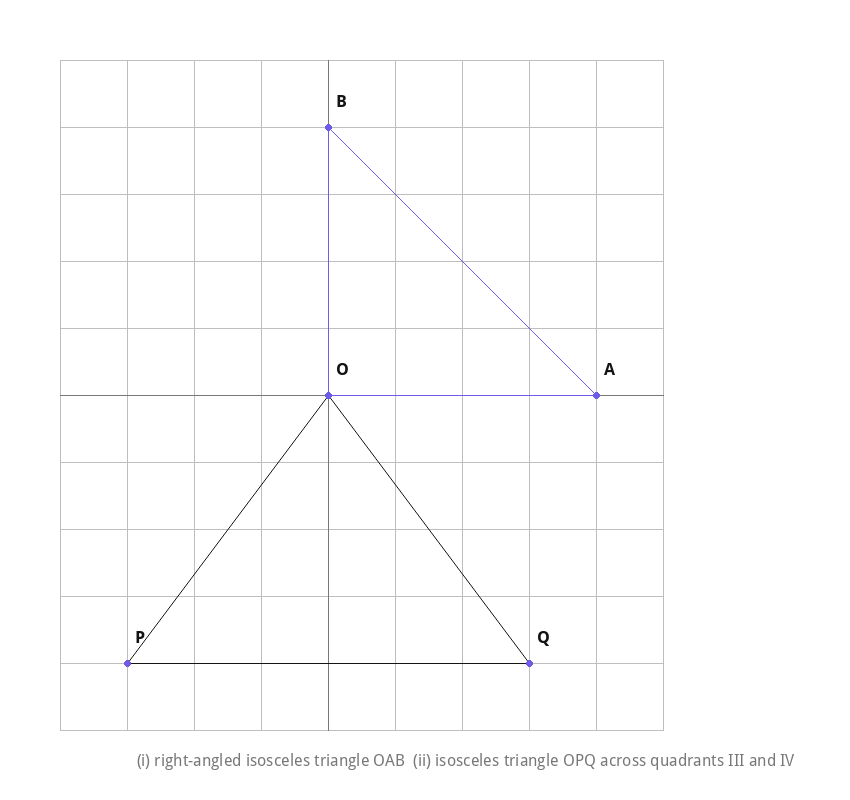
(i) A right-angled isosceles triangle.
Take O = (0, 0), A = (4, 0), B = (0, 4). Then OA = 4 units and OB = 4 units (equal legs), and OA lies along the x-axis while OB lies along the y-axis, so OA ⊥ OB. Since two sides are equal and the angle between them is 90°, triangle OAB is a right-angled isosceles triangle.
(ii) An isosceles triangle with one vertex in Quadrant III and the other in Quadrant IV.
Take O = (0, 0), P = (−3, −4), Q = (3, −4). P lies in Quadrant III (both coordinates negative) and Q lies in Quadrant IV (x positive, y negative). OP = √(3² + 4²) = √25 = 5 units and OQ = √(3² + 4²) = √25 = 5 units, so OP = OQ, making triangle OPQ isosceles.
Q9. The table below shows the coordinates of points S, M and T. In each case, state whether M is the midpoint of segment ST. Justify your answer. When M is the midpoint of ST, can you find any connection between the coordinates of M, S and T? — Answer: M is the midpoint of ST exactly when SM = MT and S, M, T are collinear…
Answer: M is the midpoint of ST exactly when SM = MT and S, M, T are collinear (equivalently, when SM + MT = ST).
Row 1: S (−3, 0), M (0, 0), T (3, 0)
SM = √[(0−(−3))² + (0−0)²] = √9 = 3; MT = √[(3−0)² + (0−0)²] = √9 = 3. Since SM = MT = 3 and all three points lie on the x-axis, M is the midpoint.
Row 2: S (2, 3), M (3, 4), T (4, 5)
SM = √[(3−2)² + (4−3)²] = √2; MT = √[(4−3)² + (5−4)²] = √2. Since SM = MT = √2, M is the midpoint.
Row 3: S (0, 0), M (0, 5), T (0, −10)
SM = √[(0−0)² + (5−0)²] = 5; MT = √[(0−0)² + (−10−5)²] = √225 = 15. Since SM ≠ MT (5 ≠ 15), M is NOT the midpoint of ST.
Row 4: S (−8, 7), M (0, −2), T (6, −3)
SM = √[(0−(−8))² + (−2−7)²] = √(64+81) = √145; MT = √[(6−0)² + (−3−(−2))²] = √(36+1) = √37. Since SM ≠ MT, M is NOT the midpoint of ST.
Connection: Whenever M (x, y) is the midpoint of S (x₁, y₁) and T (x₂, y₂), its coordinates are simply the averages of the corresponding coordinates of S and T:
M = (x, y) = ( (x₁ + x₂)⁄2 , (y₁ + y₂)⁄2 ).
Q10. Use the connection you found (in Q9) to find the coordinates of B, given that M (−7, 1) is the midpoint of A (3, −4) and B (x, y) — Answer: Using the midpoint formula, M = ( (x₁+x₂)⁄2 , (y₁+y₂)⁄2 ), with A =…
Answer: Using the midpoint formula, M = ( (x₁+x₂)⁄2 , (y₁+y₂)⁄2 ), with A = (3, −4), B = (x, y), M = (−7, 1):
(3 + x) ⁄ 2 = −7 ⟹ 3 + x = −14 ⟹ x = −17
(−4 + y) ⁄ 2 = 1 ⟹ −4 + y = 2 ⟹ y = 6
Therefore, the coordinates of B are (−17, 6).
Q11. Let P, Q be points of trisection of AB, with P closer to A and Q closer to B. Using your knowledge of how to find the coordinates of the midpoint of a segment, how would you find the coordinates of P and Q? Do this for the case when the points are A (4, 7) and B (16, −2) — Answer: Since P and Q divide AB into three equal parts (with P nearer A and Q nearer B),…
Answer: Since P and Q divide AB into three equal parts (with P nearer A and Q nearer B), P is the midpoint of A and Q, and Q is the midpoint of P and B. Let P = (x₁, y₁) and Q = (x₂, y₂), with A (4, 7) and B (16, −2).
From “P is midpoint of A and Q”: x₁ = (4 + x₂)⁄2 …(1), y₁ = (7 + y₂)⁄2 …(2)
From “Q is midpoint of P and B”: x₂ = (x₁ + 16)⁄2 …(3), y₂ = (y₁ − 2)⁄2 …(4)
Substituting (1) into (3): x₂ = [ (4 + x₂)⁄2 + 16 ] ⁄ 2 = (x₂ + 36) ⁄ 4 ⟹ 4x₂ = x₂ + 36 ⟹ 3x₂ = 36 ⟹ x₂ = 12. Then from (1): x₁ = (4 + 12)⁄2 = 8.
Substituting (2) into (4): y₂ = [ (7 + y₂)⁄2 − 2 ] ⁄ 2 = (y₂ + 3) ⁄ 4 ⟹ 4y₂ = y₂ + 3 ⟹ 3y₂ = 3 ⟹ y₂ = 1. Then from (2): y₁ = (7 + 1)⁄2 = 4.
Therefore, P = (8, 4) and Q = (12, 1).
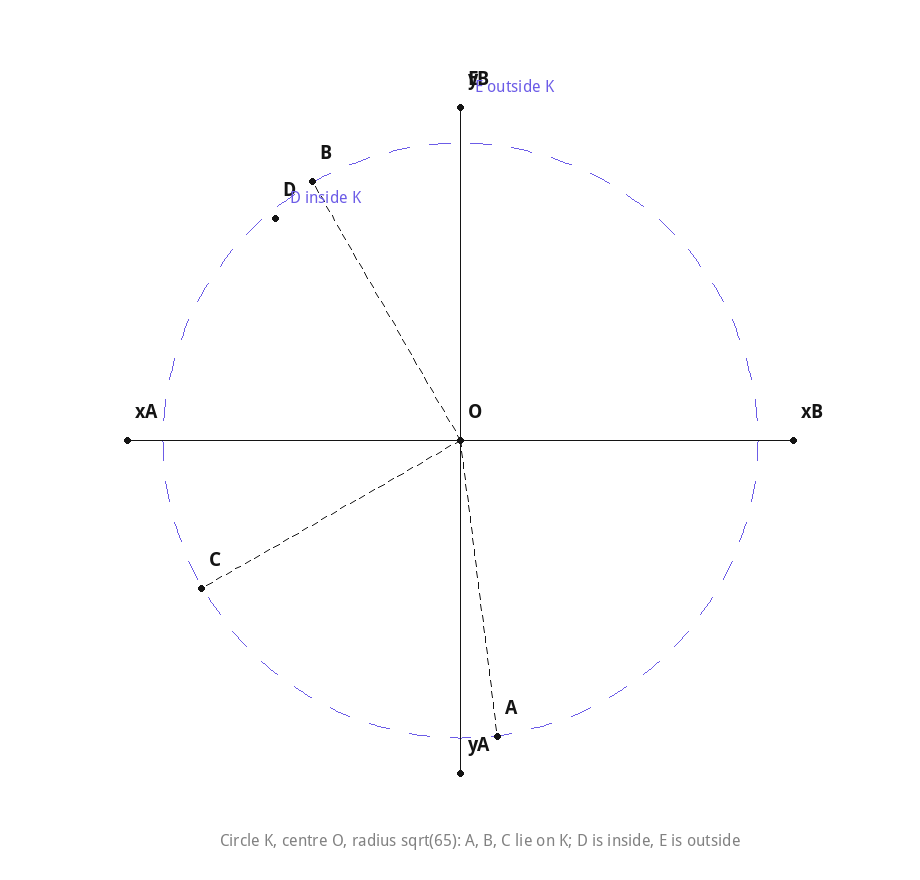
Q12. (i) Given the points A (1, −8), B (−4, 7) and C (−7, −4), show that they lie on a circle K whose centre is the origin O (0, 0). What is the radius of circle K? — Answer:
Answer:
OA = √(1² + (−8)²) = √(1 + 64) = √65
OB = √((−4)² + 7²) = √(16 + 49) = √65
OC = √((−7)² + (−4)²) = √(49 + 16) = √65
Since OA = OB = OC = √65, all three points are equidistant from the origin, so A, B and C lie on a circle K centred at O (0, 0) with radius √65 units.
Q12. (ii) Given the points D (−5, 6) and E (0, 9), check whether D and E lie within the circle, on the circle, or outside the circle K — Answer:
Answer:
OD = √((−5)² + 6²) = √(25 + 36) = √61 ≈ 7.81
OE = √(0² + 9²) = √81 = 9
Comparing with the radius √65 ≈ 8.06: since √61 < √65, D lies inside circle K. Since 9 > √65, E lies outside circle K.
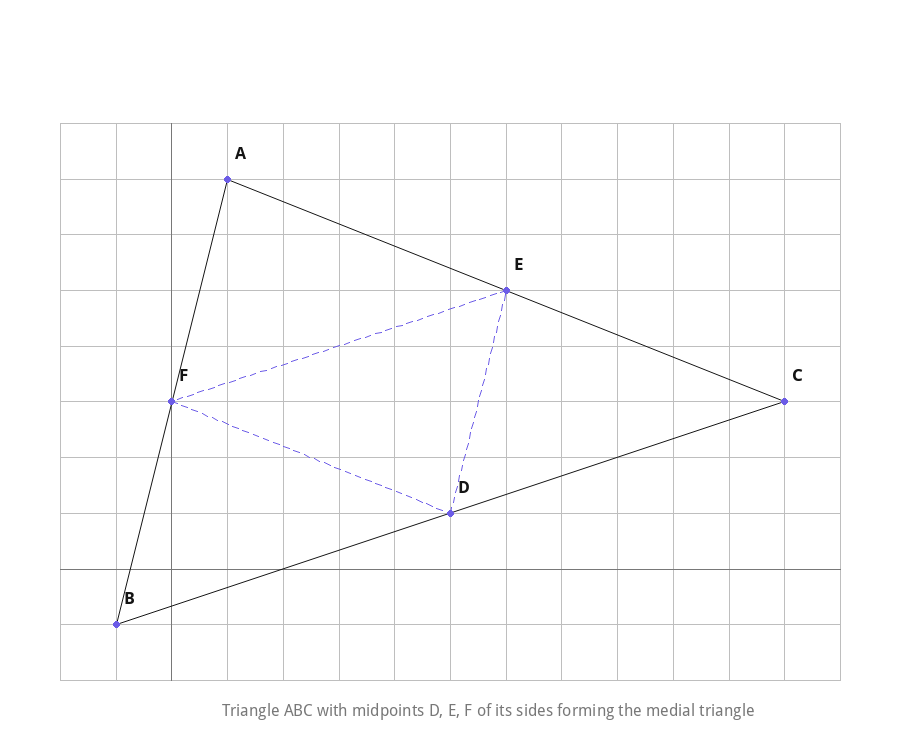
Q13. The midpoints of the sides of triangle ABC are the points D, E and F. Given that the coordinates of D, E and F are (5, 1), (6, 5) and (0, 3) respectively, find the coordinates of A, B and C — Answer: Let A (x₁, y₁), B (x₂, y₂), C (x₃, y₃). D is the midpoint of BC, E…
Answer: Let A (x₁, y₁), B (x₂, y₂), C (x₃, y₃). D is the midpoint of BC, E is the midpoint of CA, and F is the midpoint of AB.
From D (5, 1): x₂ + x₃ = 10 …(1), y₂ + y₃ = 2 …(2)
From E (6, 5): x₃ + x₁ = 12 …(3), y₃ + y₁ = 10 …(4)
From F (0, 3): x₁ + x₂ = 0 …(5), y₁ + y₂ = 6 …(6)
Solving for x: From (5), x₂ = −x₁. Substituting into (1): −x₁ + x₃ = 10 ⟹ x₃ = 10 + x₁ …(7). Substituting (7) into (3): (10 + x₁) + x₁ = 12 ⟹ 2x₁ = 2 ⟹ x₁ = 1. Then x₂ = −1 and x₃ = 11.
Solving for y: From (6), y₂ = 6 − y₁. Substituting into (2): (6 − y₁) + y₃ = 2 ⟹ y₃ = y₁ − 4 …(8). Substituting (8) into (4): (y₁ − 4) + y₁ = 10 ⟹ 2y₁ = 14 ⟹ y₁ = 7. Then y₂ = −1 and y₃ = 3.
Therefore, A = (1, 7), B = (−1, −1) and C = (11, 3).
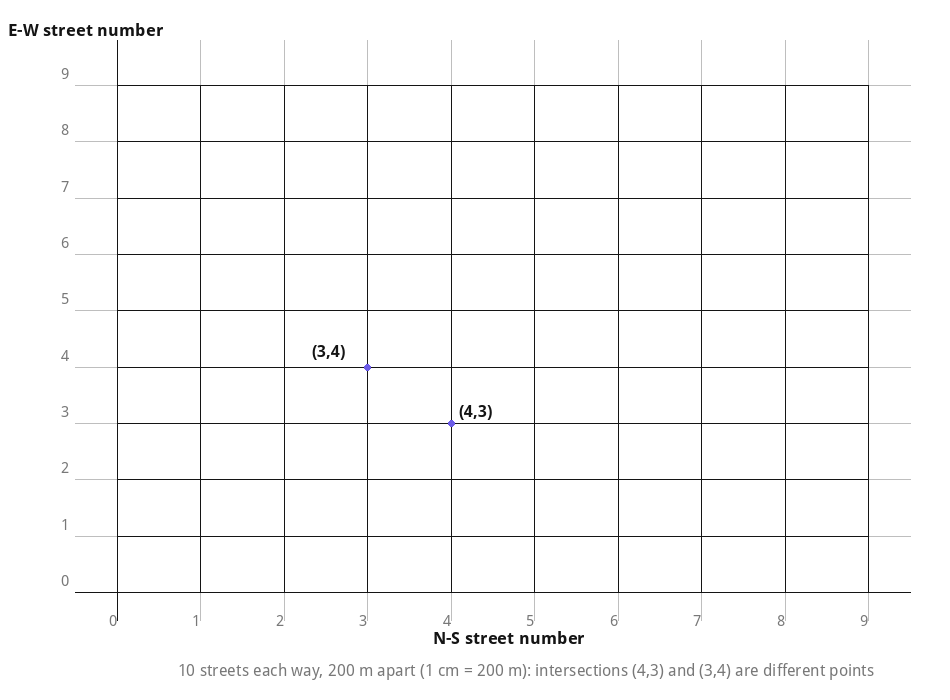
★ Q14. A city has two main roads which cross each other at the centre of the city, running North-South (N-S) and East-West (E-W). All other streets run parallel to these two roads and are 200 m apart, with 10 streets in each direction.
Answer:
(i) Using 1 cm = 200 m, draw a model of the city in your notebook, representing the roads/streets by single lines.
Since each pair of adjacent streets is 200 m apart and the scale is 1 cm = 200 m, each street is drawn 1 cm from the next. With 10 streets running N-S (drawn as 10 vertical parallel lines) and 10 streets running E-W (drawn as 10 horizontal parallel lines), each spaced 1 cm apart, the resulting model is a 9 cm × 9 cm square grid.
(ii) Each street intersection is named (N-S street number, E-W street number) — for example, where the 2nd N-S street meets the 5th E-W street is intersection (2, 5). Using this convention, find: (a) how many street intersections can be referred to as (4, 3); (b) how many can be referred to as (3, 4).
A given N-S street and a given E-W street can cross at exactly one point (two straight, non-parallel lines meet at a single point). So:
(a) Only one intersection can be called (4, 3) — the crossing of the 4th N-S street and the 3rd E-W street.
(b) Only one intersection can be called (3, 4) — the crossing of the 3rd N-S street and the 4th E-W street.
Note that (4, 3) and (3, 4) are two different intersections, since the coordinate order matters — exactly the same reasoning that makes an ordered pair (x, y) different from (y, x) unless x = y.
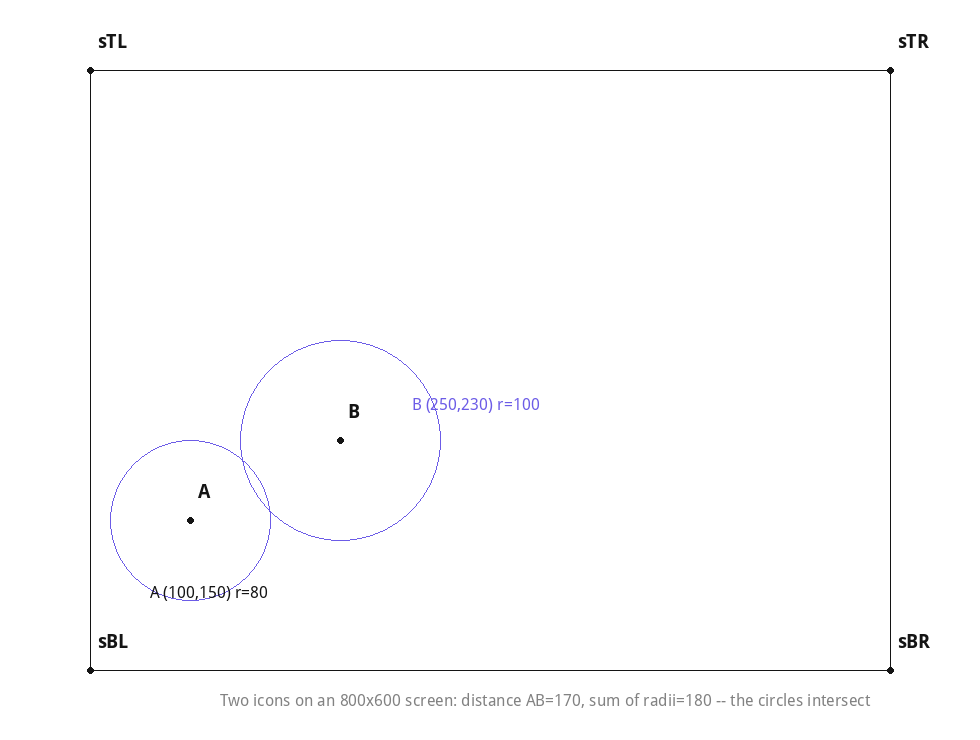
★ Q15. A computer graphics program displays images on a rectangular screen whose coordinate system has the origin at the bottom-left corner. The screen is 800 pixels wide and 600 pixels high. A circular icon of radius 80 pixels is centred at A (100, 150). Another circular icon of radius 100 pixels is centred at B (250, 230). Determine:
Answer:
(i) Whether any part of either circle lies outside the screen.
For circle A (centre (100, 150), radius 80): its extremes are x = 100 − 80 = 20 to x = 100 + 80 = 180, and y = 150 − 80 = 70 to y = 150 + 80 = 230. All these values lie within 0–800 (width) and 0–600 (height), so circle A is entirely on the screen.
For circle B (centre (250, 230), radius 100): its extremes are x = 150 to x = 350, and y = 130 to y = 330 — again entirely within the screen. So no part of either circle lies outside the screen.
(ii) Whether the two circles intersect each other.
Distance between centres AB = √[(250 − 100)² + (230 − 150)²] = √(150² + 80²) = √(22500 + 6400) = √28900 = 170 pixels.
Sum of radii = 80 + 100 = 180 pixels. Difference of radii = 100 − 80 = 20 pixels.
Since the distance between centres (170) is less than the sum of the radii (180) and more than the difference of the radii (20), the two circles intersect each other at two points.
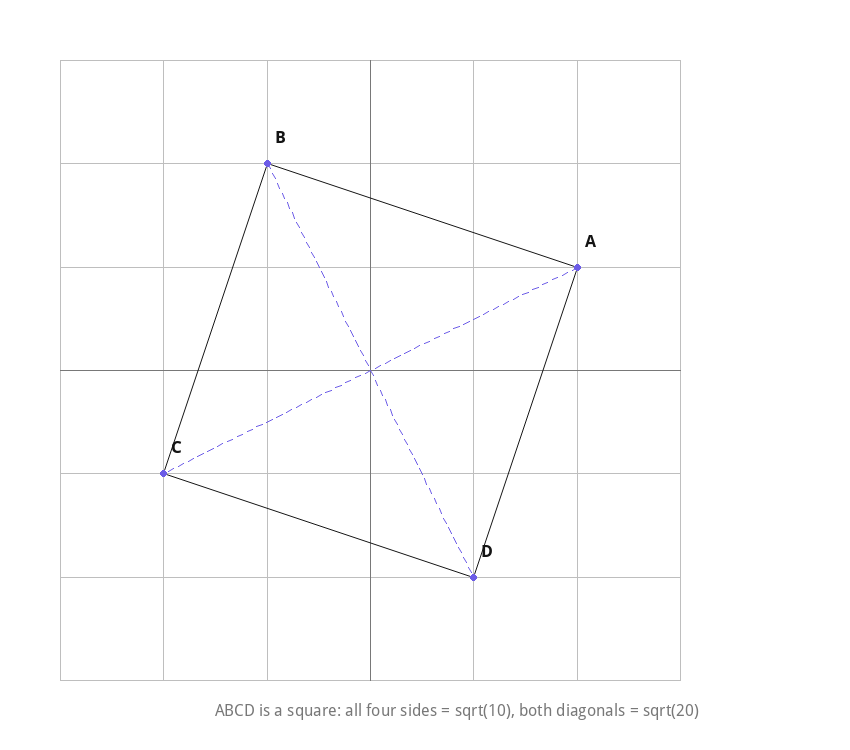
Q16. Plot the points A (2, 1), B (−1, 2), C (−2, −1) and D (1, −2) in the coordinate plane. Is ABCD a square? Can you explain why? What is the area of this square? — Answer: Finding the lengths of all four sides using the distance formula:
Answer: Finding the lengths of all four sides using the distance formula:
AB = √[(−1−2)² + (2−1)²] = √(9+1) = √10
BC = √[(−2−(−1))² + (−1−2)²] = √(1+9) = √10
CD = √[(1−(−2))² + (−2−(−1))²] = √(9+1) = √10
DA = √[(2−1)² + (1−(−2))²] = √(1+9) = √10
All four sides are equal (√10 units each). Now checking the diagonals:
AC = √[(−2−2)² + (−1−1)²] = √(16+4) = √20
BD = √[(1−(−1))² + (−2−2)²] = √(4+16) = √20
Both diagonals are equal too (√20 units each). Since all four sides are equal and both diagonals are equal, ABCD is a square.
Area of square ABCD = (side)² = (√10)² = 10 square units.
Practice more: Extra Questions for Class 9 Mathematics Chapter 1
Quick revision: Revision Notes for Class 9 Mathematics Chapter 1
- Chapter 2: Introduction to Linear Polynomials – Free PDF Download
- Chapter 3: The World of Numbers – Free PDF Download
- Chapter 4: Exploring Algebraic Identities – Free PDF Download
- Chapter 5: I'm Up and Down, and Round and Round – Free PDF Download
- Chapter 6: Measuring Space: Perimeter and Area – Free PDF Download
- Chapter 7: The Mathematics of Maybe: Introduction to Probability – Free PDF Download
- Chapter 8: Predicting What Comes Next?: Exploring Sequences and Progressions – Free PDF Download
Frequently Asked Questions
What are the coordinate axes and how do they define a point position?
The coordinate axes are two perpendicular number lines — the horizontal x-axis and vertical y-axis — meeting at the origin (0,0); any point in the plane is uniquely located by its distances from these two axes, written as an ordered pair (x, y).
What is the difference between the four quadrants formed by the coordinate axes?
The two axes divide the plane into four quadrants, distinguished by the sign of x and y: Quadrant I (+,+), Quadrant II (-,+), Quadrant III (-,-), and Quadrant IV (+,-), moving counter-clockwise starting from the top-right.
Chapter Quiz — Test Your Understanding
Class 9 Mathematics Chapter 1: Orienting Yourself: The Use of Coordinates – Notes and Extra Questions
Along with these NCERT Solutions, students can also use the Class 9 Mathematics Chapter 1 Extra Questions and Class 9 Mathematics Chapter 1 Revision Notes for quick revision and extra practice.
Recommended: Buy the Printed NCERT Class 9 Maths Book
Contains Amazon affiliate links.
If you’d like a printed copy alongside the PDF, here’s a verified option:
4.0 out of 5 stars (1,313 ratings) · Rs. 106
Price and availability may change on Amazon. As an Amazon Associate, ncertbooks.org earns from qualifying purchases.



Pingback: Class 9 Maths Chapter 1 Coordinates Extra Questions (2026-27)
Pingback: Class 9 Maths Chapter 4 Algebraic Identities Extra Questions (2026-27)