
Class 10 Science Chapter 12, Magnetic Effects of Electric Current, has a single consolidated end-of-chapter exercise (18 questions) in the current 2023-rationalised, 2026-27 session syllabus. Below are original, concept-based solutions to all 18. These Class 10 Science Chapter 12 solutions are also useful as quick revision notes before exams.
Why This Chapter Matters for Boards
This chapter blends conceptual reasoning (field lines, right-hand and Fleming’s rules) with applied numericals (force on a conductor) and diagram-based questions (electric motor, electric generator). It is a favourite source of assertion-reason and diagram-labelling questions in CBSE board papers.
Exercise Solutions
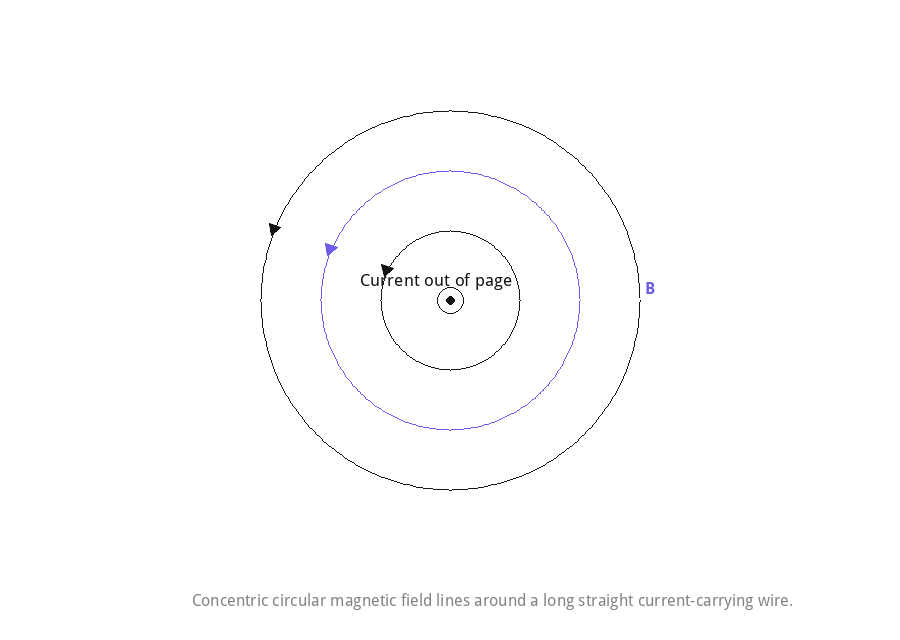
- Q1. Which describes the magnetic field near a long straight current-carrying wire? (a) perpendicular straight lines (b) parallel straight lines (c) radial lines (d) concentric circles

Concentric circular magnetic field lines around a long straight current-carrying wire.
Solution: (d). The right-hand thumb rule gives concentric circular field lines around the wire, weakening with distance.
- Q2. Electromagnetic induction is: (a) charging a body (b) field from current in a coil (c) induced current from relative motion between magnet and coil (d) rotating a motor’s coil
Solution: (c). Induction is specifically current produced by a changing linked magnetic flux, as from relative motion between magnet and coil. - Q3. Device used to produce electric current: (a) Generator (b) Galvanometer (c) Ammeter (d) Motor
Solution: (a). A generator converts mechanical energy to electrical energy via electromagnetic induction; the others measure/use current rather than generate it. - Q4. Essential difference between AC and DC generator: (a) magnet type (b) DC gives higher voltage (c) AC gives higher voltage (d) AC uses slip rings, DC uses commutator
Solution: (d). Both work by the same induction principle; the structural difference is slip rings (AC, current reverses naturally) vs. split-ring commutator (DC, current kept unidirectional). - Q5. At a short circuit, current: (a) reduces (b) unchanged (c) increases heavily (d) varies continuously
Solution: (c). Live and neutral touching directly removes normal resistance, so current surges (V=IR), causing overheating/fire risk. - Q6. True/False: (a) motor converts mechanical to electrical energy (b) generator works on electromagnetic induction (c) field at centre of a long circular coil is parallel straight lines (d) green-insulated wire is usually live
Solution: (a) False (motor does the reverse: electrical to mechanical). (b) True. (c) True (a long circular coil = solenoid; field inside is parallel/uniform). (d) False (green is the earth wire; live is red/black). - Q7. List three sources of magnetic fields.
Solution: (i) A permanent magnet. (ii) A straight wire or loop carrying current. (iii) A current-carrying solenoid/electromagnet. - Q8. How does a solenoid behave like a magnet? Can its poles be found using a bar magnet?
Solution: Inside a solenoid, fields from each turn add up into a strong, uniform, parallel field along the axis, giving it a distinct N and S end, just like a bar magnet. Yes: bring a bar magnet’s known N pole near one end — if it’s repelled, that end is N (like poles repel); if attracted, that end is S. - Q9. When is the force on a current-carrying conductor in a field largest?
Solution: When the conductor is perpendicular (90°) to the field, since F=BIL sinθ is maximum at sin90°=1. Force is zero when parallel (θ=0°). - Q10. Sitting with your back to a wall, an electron beam moves from back wall to front wall and deflects to your right under a magnetic field. Find the field direction.
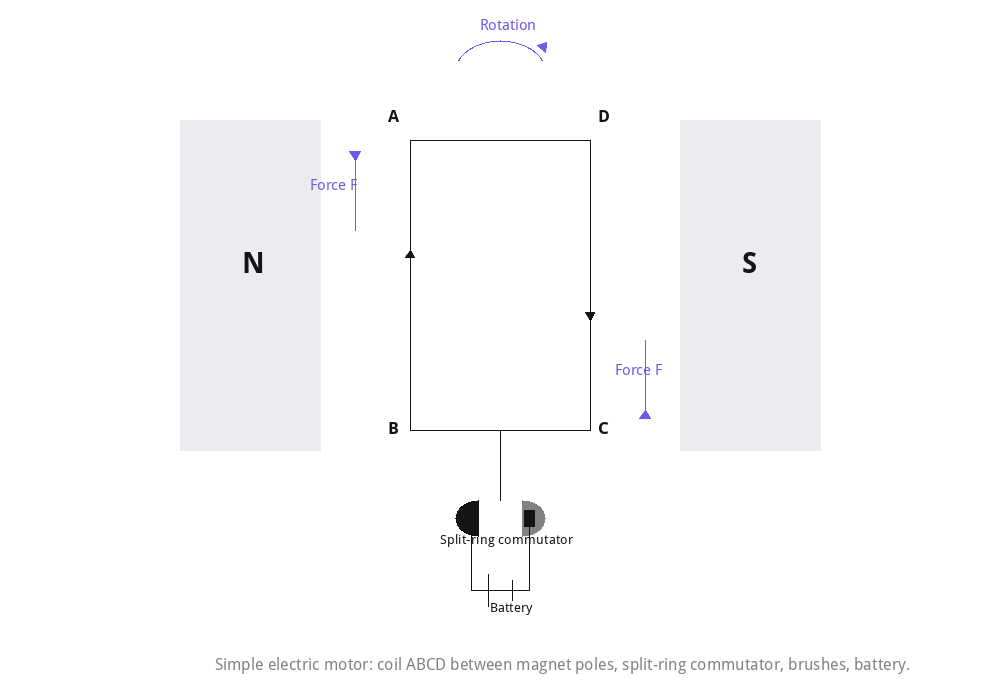
Solution: Electron motion is back-to-front (away from you); conventional current (opposite, for negative charge) is front-to-back (towards you). Applying Fleming’s Left-Hand Rule with middle finger (current) towards you and thumb (force) to your right, the forefinger (field) points vertically downward. - Q11. Draw and explain an electric motor’s principle, working, and the split ring’s function.

Simple electric motor: coil ABCD between magnet poles, split-ring commutator, brushes, battery.
Solution: Principle: a current-carrying coil in a magnetic field experiences a torque because its two arms carry current in opposite directions and feel oppositely-directed forces (Fleming’s Left-Hand Rule). Working: coil ABCD between magnet poles N-S, ends joined to a split-ring commutator touching fixed brushes connected to a battery; current makes AB and CD feel opposite forces, rotating the coil; every half turn the split ring reverses the current so the torque keeps acting the same rotational way, giving continuous rotation. Split ring’s function: reverses current direction in the coil every half rotation, keeping rotation continuous instead of oscillating. (A labelled diagram of the coil, magnet, split ring, brushes and battery should accompany this answer.)
- Q12. Name devices using electric motors.
Solution: Electric fans, water pumps, mixer-grinders, washing machines, refrigerator compressors, electric vehicles. - Q13. A coil is connected to a galvanometer. What happens if a bar magnet is (a) pushed in (b) withdrawn (c) held stationary inside?
Solution: (a) Increasing flux induces a momentary current — galvanometer deflects one way. (b) Decreasing flux induces current in the opposite direction — deflects the other way. (c) No change in flux ⇒ no induced current, no deflection. - Q14. Coils A and B are close; current in A is changed. Is current induced in B? Why?
Solution: Yes. Changing current in A changes its magnetic field, which changes the flux linked with nearby coil B; by electromagnetic induction this changing flux induces a current in B, even with no direct electrical connection. - Q15. State the rule for direction of: (a) field around a straight current-carrying conductor (b) force on a conductor perpendicular to a field (c) induced current from a rotating coil.
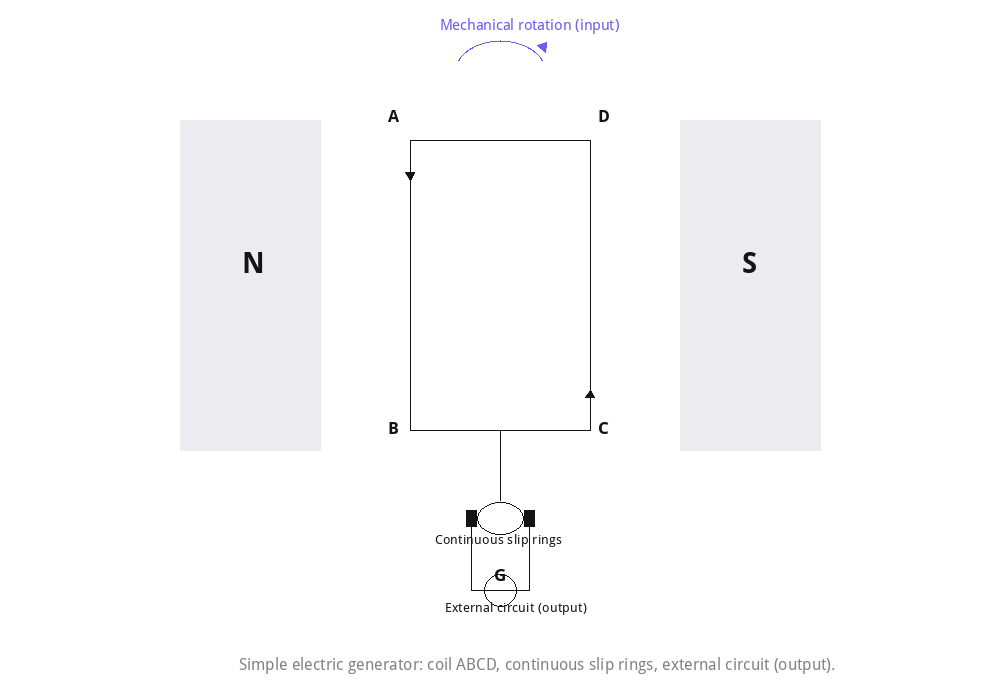
Solution: (a) Right-hand thumb rule: thumb along current, curled fingers give field direction. (b) Fleming’s Left-Hand Rule: forefinger=field, middle finger=current, thumb=force. (c) Fleming’s Right-Hand Rule: thumb=motion, forefinger=field, middle finger=induced current. - Q16. Explain an electric generator’s principle, working (labelled diagram), and function of brushes.
Simple electric generator: coil ABCD, continuous slip rings, external circuit (output).
Solution: Principle: electromagnetic induction — rotating a coil in a magnetic field continuously changes flux, inducing a current. Working: coil ABCD on an axle between magnet poles, ends joined to slip rings (AC) or a split-ring commutator (DC), with brushes touching these rings connecting to the external circuit; as the axle turns, Fleming’s Right-Hand Rule gives the induced current direction in each arm, which reverses every half turn — slip rings let this reversal show up as alternating output (AC), while a commutator swaps brush contact at the same moment to keep external current one-directional (pulsating DC). Brushes’ function: stay in sliding contact with the rotating rings/commutator to carry the induced current out to the external circuit.
- Q17. When does a short circuit occur?
Solution: When the live and neutral wires touch directly (worn/damaged insulation, or overloading), removing normal circuit resistance and causing a sudden sharp current surge and heating. - Q18. What is the function of an earth wire, and why must metallic appliances be earthed?
Solution: The green-insulated earth wire connects an appliance’s metal casing to the ground, keeping it at zero potential. If a fault makes the live wire touch the casing, the leakage current flows safely to ground through this low-resistance path instead of through a person touching the appliance, preventing electric shock. Hence earthing all high-power metallic appliances is a mandatory safety practice.
- NCERT Solutions – Chapter 12
- Extra Questions (HOTS) – Chapter 12
- Revision Notes – Chapter 12
- Class 10 Science Book (Catalog Page)
CBSE Exam Weightage
This chapter falls under Unit IV: Effects of Current in the CBSE Class 10 Science board exam syllabus. This unit typically carries around 13 marks (16.25%) of the 80-mark theory paper, based on CBSE’s published unit-wise weightage (Question Paper Design). CBSE sets weightage at the unit level rather than chapter-by-chapter, so the exact share from this specific chapter can vary a little between years and sample papers.
Class 10 Science Chapter 12 – Notes and Extra Questions
Along with these NCERT Solutions, students can also use the Class 10 Science Chapter 12 Extra Questions and Class 10 Science Chapter 12 Revision Notes for quick revision and extra practice.
- Chapter 1: Chemical Reactions and Equations – Free PDF Download
- Chapter 2: Acids, Bases and Salts – Free PDF Download
- Chapter 3: Metals and Non-metals – Free PDF Download
- Chapter 4: Carbon and its Compounds – Free PDF Download
- Chapter 5: NCERT Solutions for Class 10 Science: Periodic Classification of Elements (Supplementary — Not in Current CBSE Syllabus) – Free PDF Download
- Chapter 6: Life Processes – Free PDF Download
- Chapter 7: Control and Coordination – Free PDF Download
- Chapter 8: How do Organisms Reproduce? (2026-27) – Free PDF Download
- Chapter 9: Heredity – Free PDF Download
- Chapter 10: Light - Reflection and Refraction – Free PDF Download
- Chapter 11: The Human Eye and the Colourful World (2026-27) – Free PDF Download
- Chapter 12: Electricity (2026-27) – Free PDF Download
FAQ
Q: Is this content updated for the 2026-27 NCERT edition?
A: Yes. This is Chapter 12 in the current rationalised numbering (it was Chapter 13 before Periodic Classification of Elements was removed from the syllabus in 2023), with one consolidated 18-question exercise, verified against two independent current sources.
Q: What are the two key hand rules in this chapter?
A: Fleming’s Left-Hand Rule (force/motor direction: Field-Current-Motion via forefinger-middle-thumb) and Fleming’s Right-Hand Rule (induced current/generator direction: Motion-Field-Current via thumb-forefinger-middle).


