
Chapter 6 of Class 11 Physics, System of Particles and Rotational Motion, moves beyond treating objects as single points and shows how real, extended bodies behave – through the centre of mass, torque, angular momentum, moment of inertia, and the dynamics of rotation about a fixed axis. It is one of the most calculation-heavy, high-weightage chapters in the CBSE Class 11 syllabus and lays the base for later chapters on gravitation and oscillations, as well as for JEE and NEET mechanics. Below are original, step-by-step solutions to all 17 in-chapter exercise questions (6.1-6.17) of the 2026-27 rationalised NCERT edition.
Last Updated: September 23, 2026
NCERT Solutions for Class 11 Physics Chapter 6: System of Particles and Rotational Motion
Q6. 1: Centre of Mass of Symmetric Bodies — Give the location of the centre of mass of (i) a sphere, (ii) a cylinder, (iii) a ring,…
Give the location of the centre of mass of (i) a sphere, (ii) a cylinder, (iii) a ring, and (iv) a cube, each of uniform mass density. Does the centre of mass of a body necessarily lie inside the body?
For a body with uniform mass density, mass is distributed symmetrically about its geometric centre, so the centre of mass coincides with the geometric centre in every case listed: the centre of the sphere, the midpoint of the cylinder’s axis, the centre of the ring, and the centre of the cube. However, the centre of mass need not lie within the material of the body – for a ring (or a hollow sphere), the geometric centre falls in empty space at the middle of the ring, not on the ring material itself. Centre of mass = geometric centre in each case; no, the centre of mass does not necessarily lie inside the material of the body (e.g., a ring).
Q6. 2: Centre of Mass of the HCl Molecule — In the HCl molecule, the separation between the nuclei of the two atoms is about 1.27 Å…
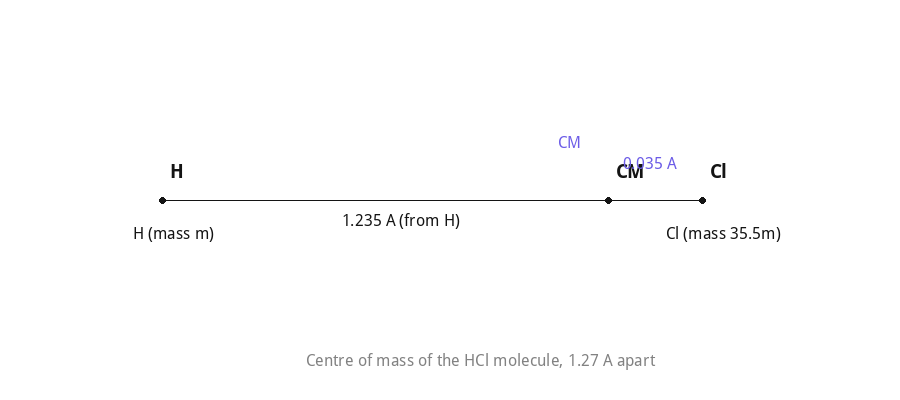
In the HCl molecule, the separation between the nuclei of the two atoms is about 1.27 Å (1 Å = 10-10 m). Find the approximate location of the centre of mass of the molecule, given that a chlorine atom is about 35.5 times as massive as a hydrogen atom and nearly all the mass of an atom is concentrated in its nucleus.
Take the origin at the hydrogen nucleus, with the chlorine nucleus at x = 1.27 Å. Let the mass of hydrogen be m, so the mass of chlorine is 35.5m. Using xcm = (m×0 + 35.5m×1.27)/(m + 35.5m) = (35.5 × 1.27)/36.5 = 45.085/36.5 = 1.235 Å from the hydrogen atom. This is only 1.27 − 1.235 = 0.035 Å away from the chlorine atom, since chlorine is far more massive and pulls the centre of mass close to itself. The centre of mass lies about 1.235 Å from the hydrogen atom, i.e., roughly 0.035 Å from the chlorine atom, along the line joining the nuclei.
Q6. 3: CM Speed of a Child Running on a Trolley — A child sits stationary at one end of a long trolley moving uniformly with a speed V on…
A child sits stationary at one end of a long trolley moving uniformly with a speed V on a smooth horizontal floor. If the child gets up and runs about on the trolley in any manner, what is the speed of the centre of mass of the (trolley + child) system?
The floor is smooth (frictionless) and the child’s motion on the trolley involves only internal forces between the child and the trolley; no external horizontal force acts on the (trolley + child) system. Since the centre of mass of a system moves according to the net external force alone (internal forces cannot change it), its velocity remains unchanged regardless of how the child moves about. The speed of the centre of mass remains V, unchanged, in the same direction as before.
Q6. 4: Area of a Triangle Using the Vector Cross Product — Show that the area of the triangle contained between the vectors a and b is one-half of…
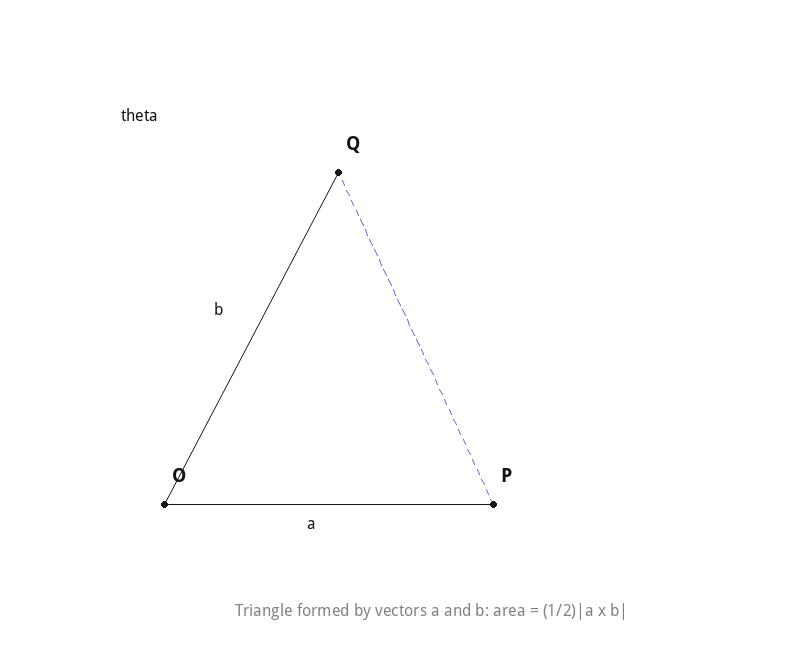
Show that the area of the triangle contained between the vectors a and b is one-half of the magnitude of a × b.
Let a and b be two vectors drawn from a common point O, with an angle θ between them, forming a triangle with the line joining their tips. The magnitude of the cross product is |a × b| = |a||b|sinθ. Geometrically, |b|sinθ is the perpendicular height of the triangle when |a| is taken as the base, so |a||b|sinθ is exactly twice the area of the triangle (base × height), which is the same as the area of the parallelogram formed by a and b. Therefore Area of triangle = (1/2)|a||b|sinθ. Area of the triangle = (1/2)|a × b|, as required.
Q6. 5: Scalar Triple Product and Parallelepiped Volume — Show that a.(b × c) is equal in magnitude to the volume of the parallelepiped formed on…
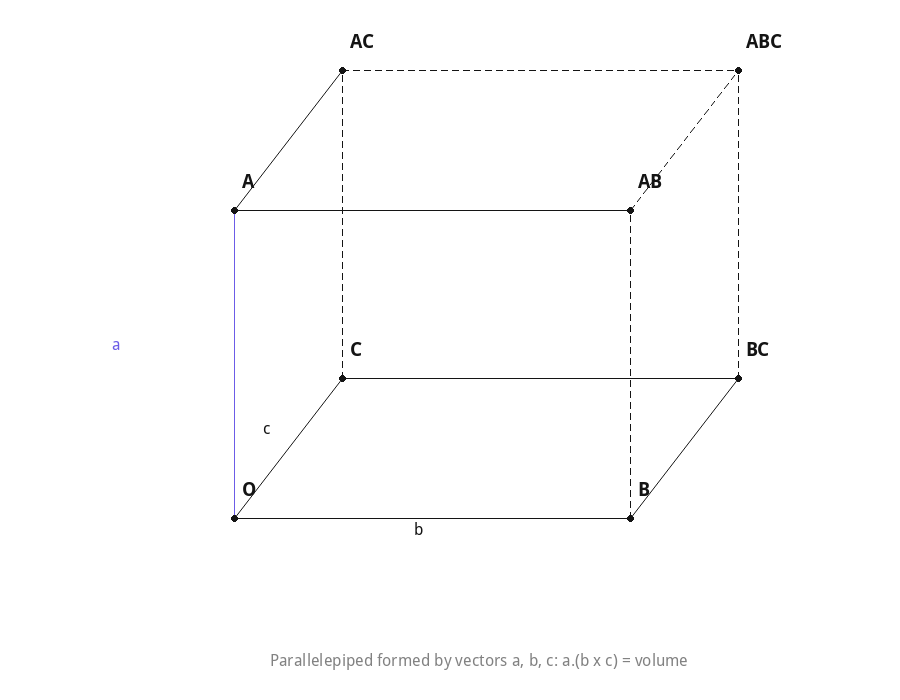
Show that a.(b × c) is equal in magnitude to the volume of the parallelepiped formed on the three vectors a, b and c.
Consider a parallelepiped with three edges from a common vertex represented by a, b and c. The vector b × c has a magnitude |b||c|sin90° equal to the area of the base parallelogram formed by b and c, and its direction is normal to that base. The dot product a.(b × c) then equals |a| times the component of a along this normal, i.e., |a|cosθ × (area of base), where |a|cosθ is exactly the perpendicular height of the parallelepiped above the base. Height × base area is precisely the volume of the parallelepiped. a.(b × c) = volume of the parallelepiped formed by a, b and c.
Q6. 6: Components of Angular Momentum of a Particle — Find the components along the x, y, z axes of the angular momentum l of a particle whose…
Find the components along the x, y, z axes of the angular momentum l of a particle whose position vector is r with components x, y, z and momentum is p with components px, py and pz. Show that if the particle moves only in the x-y plane, the angular momentum has only a z-component.
Angular momentum is l = r × p. Expanding the cross product of r = (x, y, z) and p = (px, py, pz) gives: lx = y·pz − z·py; ly = z·px − x·pz; lz = x·py − y·px. If the particle is confined to the x-y plane, then z = 0 and pz = 0 at all times. Substituting these into the expressions above makes lx = 0 and ly = 0, while lz = x·py − y·px remains, in general, non-zero. lx = ypz − zpy, ly = zpx − xpz, lz = xpy − ypx; for motion confined to the x-y plane, only lz survives, confirming the angular momentum is purely along the z-axis.
Q6. 7: Angular Momentum of Two Particles Moving in Opposite Directions — Two particles, each of mass m and speed v, travel in opposite directions along parallel…
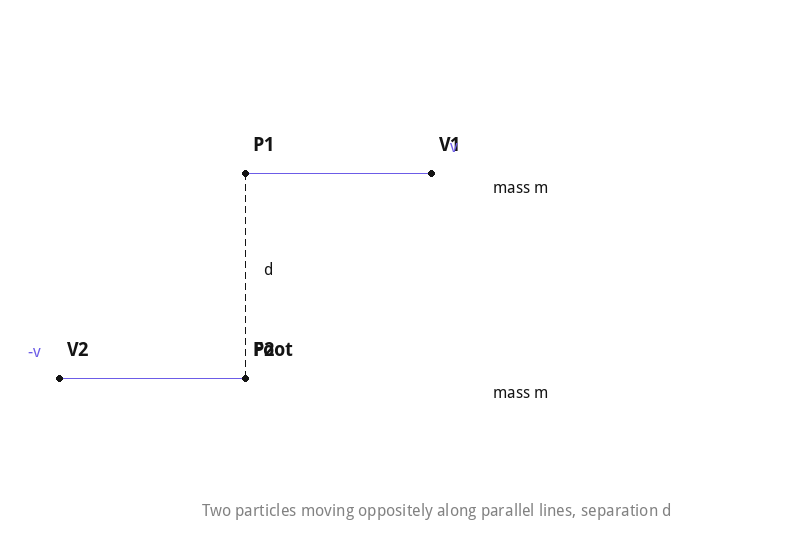
Two particles, each of mass m and speed v, travel in opposite directions along parallel lines separated by a distance d. Show that the vector angular momentum of the two-particle system is the same whatever be the point about which the angular momentum is taken.
Let the two particles be at position vectors r1 and r2 at some instant, relative to an arbitrary origin O, moving with velocities v and −v respectively (equal speed, opposite directions). The total angular momentum about O is L = r1 × (mv) + r2 × (−mv) = m(r1 − r2) × v. The vector (r1 − r2) simply points from one particle to the other and does not depend on where O is chosen, so L is independent of the origin. Its magnitude is m × v × (perpendicular distance between the two parallel lines) = mvd, because only the component of (r1 − r2) perpendicular to v (which is exactly d) contributes to the cross product. L = mvd for every choice of reference point, confirming the angular momentum of the two-particle system is independent of the point about which it is calculated.
Q6. 8: Centre of Gravity of a Suspended Non-Uniform Bar — A non-uniform bar of weight W is suspended at rest by two strings of negligible weight…
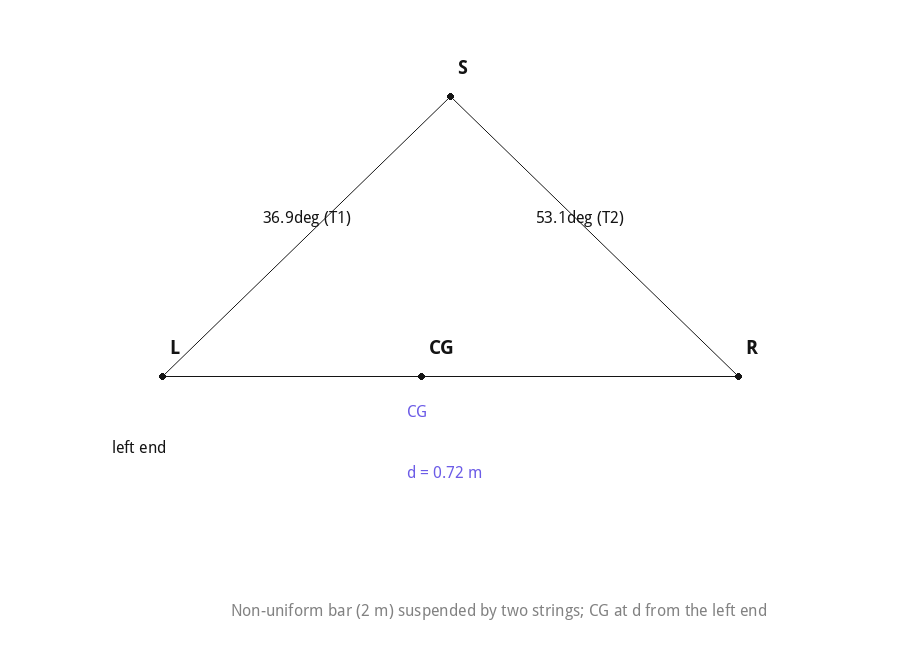
A non-uniform bar of weight W is suspended at rest by two strings of negligible weight tied to its two ends, going up to a common support. The strings make angles of 36.9° and 53.1° with the vertical, and the bar is 2 m long. Calculate the distance d of the centre of gravity of the bar from its left end.
Using sin36.9° = 0.6, cos36.9° = 0.8, sin53.1° = 0.8, cos53.1° = 0.6. For horizontal equilibrium, the horizontal components of the two tensions must cancel: T1sin36.9° = T2sin53.1°, giving T1(0.6) = T2(0.8), so T1 = (4/3)T2. For vertical equilibrium: T1cos36.9° + T2cos53.1° = W. Substituting T1: (4/3)T2(0.8) + T2(0.6) = W, i.e., (1.0667 + 0.6)T2 = W, so T2 = 0.6W. Taking torques about the left end (where T1 acts, contributing zero torque there): T2cos53.1° × 2 = W × d, so d = (2 × 0.6W × 0.6)/W = 0.72 m. The centre of gravity of the bar lies 0.72 m from its left end.
Q6. 9: Normal Reaction Forces on a Car's Wheels — A car weighs 1800 kg. The distance between its front and back axles is 1.8 m. Its centre…
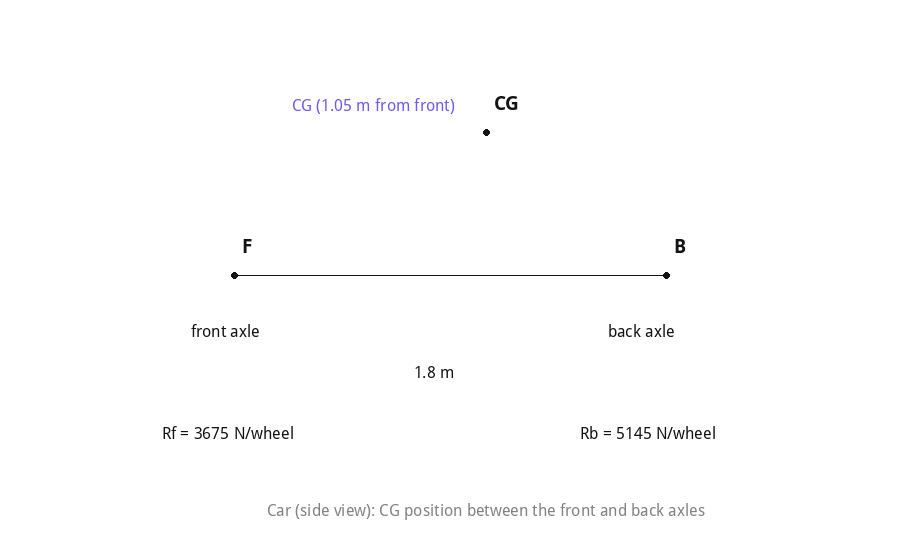
A car weighs 1800 kg. The distance between its front and back axles is 1.8 m. Its centre of gravity is 1.05 m behind the front axle. Determine the force exerted by the level ground on each front wheel and each back wheel. (Take g = 9.8 m/s²)
Total weight = mg = 1800 × 9.8 = 17640 N. Let Rf and Rb be the total normal reactions on the front and back axles. Vertical equilibrium gives Rf + Rb = 17640 N. Taking torques about the front axle: Rb × 1.8 = mg × 1.05, so Rb = 17640 × 1.05/1.8 = 10290 N. Then Rf = 17640 − 10290 = 7350 N. Since each axle has two wheels sharing the load equally: force on each front wheel = 7350/2 = 3675 N, and force on each back wheel = 10290/2 = 5145 N. Each front wheel bears 3675 N, and each back wheel bears 5145 N.
Q6. 10: Comparing Angular Speeds of a Hollow Cylinder and a Solid Sphere — Torques of equal magnitude are applied to a hollow cylinder and a solid sphere, both…
Torques of equal magnitude are applied to a hollow cylinder and a solid sphere, both having the same mass and radius. The cylinder is free to rotate about its standard axis of symmetry, and the sphere about an axis through its centre. Which of the two will acquire a greater angular speed after a given time?
Let mass = m and radius = r for both. Moment of inertia of the hollow cylinder about its axis, I1 = mr². Moment of inertia of the solid sphere about a diameter, I2 = (2/5)mr², which is smaller than I1. Since τ = Iα, for the same torque τ, angular acceleration α = τ/I is larger for the body with smaller I. Comparing: αsphere/αcylinder = I1/I2 = mr²/((2/5)mr²) = 5/2, so the sphere’s angular acceleration is 2.5 times greater. Using ω = ω0 + αt starting from rest, a larger α over the same time t means a larger final ω. The solid sphere acquires the greater angular speed, because its smaller moment of inertia (2/5 mr² versus mr²) gives it a larger angular acceleration for the same applied torque.
Q6. 11: Kinetic Energy and Angular Momentum of a Rotating Cylinder — A solid cylinder of mass 20 kg rotates about its axis with angular speed 100 rad s-1.…
A solid cylinder of mass 20 kg rotates about its axis with angular speed 100 rad s-1. The radius of the cylinder is 0.25 m. What is the kinetic energy associated with the rotation of the cylinder? What is the magnitude of angular momentum of the cylinder about its axis?
Moment of inertia of a solid cylinder about its axis: I = (1/2)MR² = (1/2)(20)(0.25)² = (1/2)(20)(0.0625) = 0.625 kg·m². Rotational kinetic energy: K = (1/2)Iω² = (1/2)(0.625)(100)² = (1/2)(0.625)(10000) = 3125 J. Angular momentum: L = Iω = 0.625 × 100 = 62.5 kg·m²/s. Rotational kinetic energy = 3125 J, and angular momentum = 62.5 kg·m²s-1.
Q6. 12: Conservation of Angular Momentum – Child on a Turntable — (a) A child stands at the centre of a turntable with arms outstretched, rotating…
(a) A child stands at the centre of a turntable with arms outstretched, rotating (frictionlessly) at 40 rev/min. If the child folds the arms and reduces the moment of inertia to 2/5 of its initial value, what is the new angular speed? (b) Show that the new kinetic energy of rotation is more than the initial kinetic energy, and explain the increase.
(a) With no external torque, angular momentum is conserved: I1ω1 = I2ω2. Here ω1 = 40 rev/min and I2 = (2/5)I1, so ω2 = I1ω1/I2 = I1(40)/((2/5)I1) = 40 × (5/2) = 100 rev/min. (b) Kinetic energies: Ei = (1/2)I1ω1² and Ef = (1/2)I2ω2². Taking the ratio: Ef/Ei = (I2ω2²)/(I1ω1²) = (2/5) × (100/40)² = (2/5) × 6.25 = 2.5. Since Ef = 2.5Ei, kinetic energy has increased even though angular momentum stayed constant; the extra energy comes from the muscular (internal) work the child does in pulling the arms inward against the centripetal requirement. (a) New angular speed = 100 rev/min. (b) The new kinetic energy is 2.5 times the initial value; the increase comes from internal work done by the child’s muscles, not from any external torque.
Q6. 13: Angular and Linear Acceleration of a Pulled Cylinder — A rope of negligible mass is wound round a hollow cylinder of mass 3 kg and radius 40…
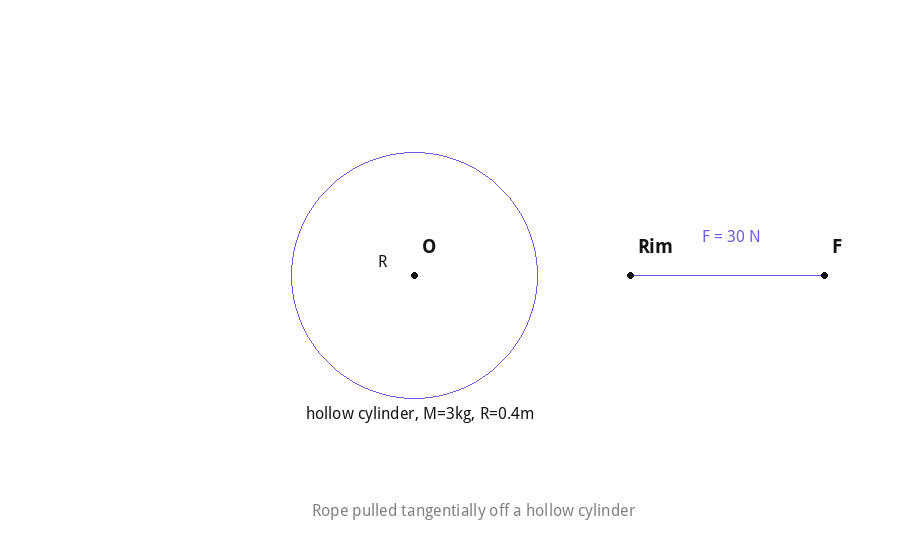
A rope of negligible mass is wound round a hollow cylinder of mass 3 kg and radius 40 cm. What is the angular acceleration of the cylinder if the rope is pulled with a force of 30 N? What is the linear acceleration of the rope, assuming no slipping?
Moment of inertia of the hollow cylinder about its axis: I = MR² = 3 × (0.4)² = 3 × 0.16 = 0.48 kg·m². Torque due to the applied force: τ = F × R = 30 × 0.4 = 12 N·m. Angular acceleration: α = τ/I = 12/0.48 = 25 rad s-2. Linear acceleration of the rope (equal to the tangential acceleration at the rim, since there’s no slipping): a = αR = 25 × 0.4 = 10 m s-2. Angular acceleration = 25 rad s-2, and linear acceleration of the rope = 10 m s-2.
Q6. 14: Power Required to Maintain a Rotor's Angular Speed — To maintain a rotor at a uniform angular speed of 200 rad s-1, an engine needs to…
To maintain a rotor at a uniform angular speed of 200 rad s-1, an engine needs to transmit a torque of 180 N m. What is the power required by the engine, assuming it is 100% efficient?
Power delivered by a torque acting on a body rotating with angular speed ω is given by P = τω. Substituting the given values: P = 180 × 200 = 36000 W. Converting to kilowatts: 36000 W = 36 kW. The engine must supply a power of 36000 W, i.e., 36 kW.
Q6. 15: Centre of Mass of a Disc With a Hole Cut Out — From a uniform disc of radius R, a circular hole of radius R/2 is cut out. The centre of…
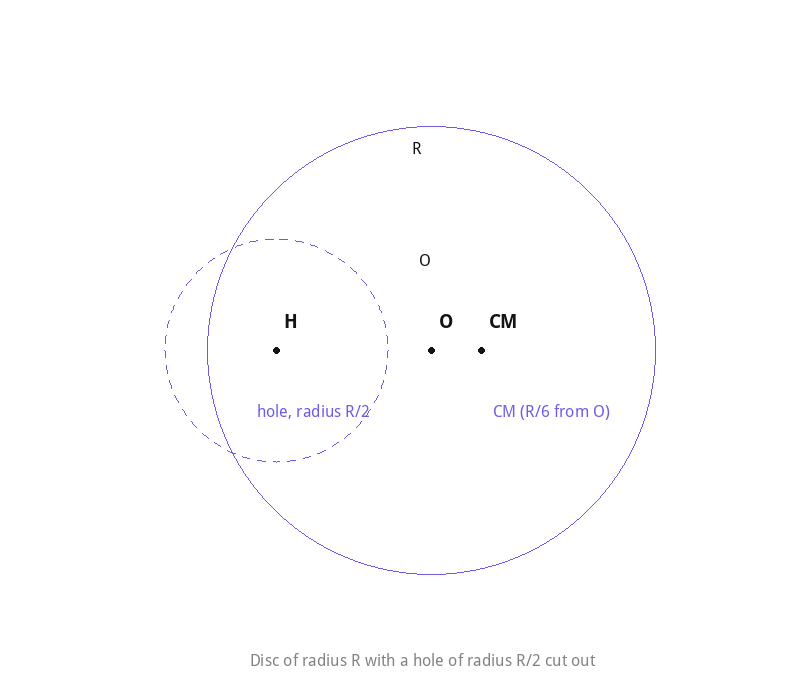
From a uniform disc of radius R, a circular hole of radius R/2 is cut out. The centre of the hole is at R/2 from the centre of the original disc. Locate the centre of mass of the resulting flat body.
Let the mass per unit area of the disc be σ, so the mass of the full disc is M = σπR². The removed piece has radius R/2, so its mass is m = σπ(R/2)² = M/4, and its centre lies a distance R/2 from the centre O of the original disc. Treat the remaining (disc-with-hole) body as the full disc of mass M at O, combined with a “negative mass” −M/4 at position R/2 (representing the removed piece). The centre of mass of this combination is xcm = [M(0) − (M/4)(R/2)] / [M − M/4] = [−MR/8] / [3M/4] = −R/6. The negative sign shows the centre of mass shifts by R/6 away from the hole, on the opposite side of the centre O. The centre of mass of the resulting body lies at a distance R/6 from the original centre O, on the side opposite to the hole.
Q6. 16: Mass of a Metre Stick From a Balance Point — A metre stick is balanced on a knife edge at its centre (the 50 cm mark). When two…
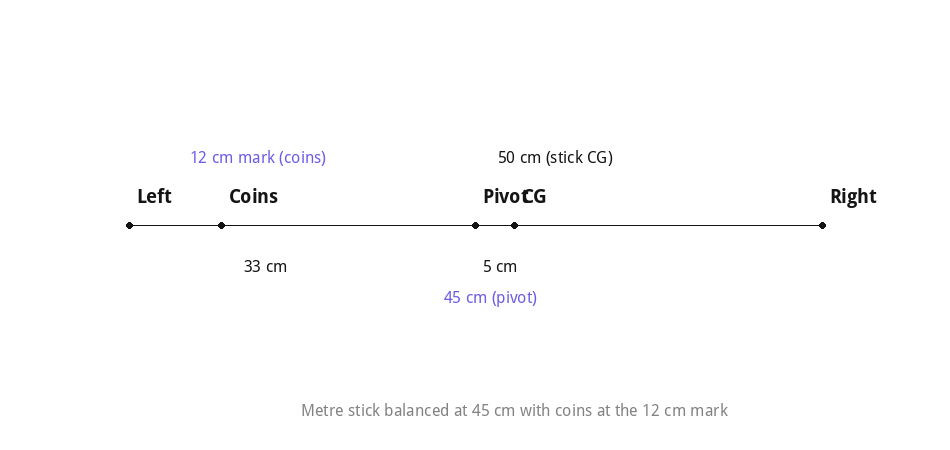
A metre stick is balanced on a knife edge at its centre (the 50 cm mark). When two coins, each of mass 5 g, are placed one on top of the other at the 12.0 cm mark, the stick balances at the 45.0 cm mark. What is the mass of the metre stick?
Since the stick alone balances at the 50 cm mark, its own centre of gravity is located there. With the coins added, the new pivot (balance point) is at 45 cm. Taking torques about this new pivot: the coins (total mass 10 g) sit at 12 cm, a distance of (45 − 12) = 33 cm from the pivot, on one side; the stick’s weight acts at its centre of gravity (50 cm), a distance of (50 − 45) = 5 cm from the pivot, on the other side. For rotational equilibrium: 10 g × 33 cm = m × 5 cm (using g for grams here as mass units, since g cancels from both sides), so m = 330/5 = 66 g. The mass of the metre stick is 66 g.
Q6. 17: Angular Velocity of a Rotating Oxygen Molecule — The oxygen molecule has a mass of 5.30 × 10⁻²⁶ kg and a moment of inertia of 1.94 ×…
The oxygen molecule has a mass of 5.30 × 10⁻²⁶ kg and a moment of inertia of 1.94 × 10-46 kg m² about an axis through its centre, perpendicular to the line joining the two atoms. The mean speed of the molecule in a gas is 500 m/s, and its rotational kinetic energy is two-thirds of its translational kinetic energy. Find the average angular velocity of the molecule.
Translational kinetic energy of the molecule: Etrans = (1/2)mv². Given Erot = (2/3)Etrans, and Erot = (1/2)Iω², equating gives (1/2)Iω² = (2/3)(1/2)mv², so ω² = (2mv²)/(3I). Substituting m = 5.30 × 10⁻²⁶ kg, v = 500 m/s, and I = 1.94 × 10-46 kg m²: mv² = 5.30 × 10-26 × 2.5 × 105 = 1.325 × 10⁻²⁰. So ω² = (2 × 1.325 × 10-20)/(3 × 1.94 × 10-46) = (2.65 × 10⁻²⁰)/(5.82 × 10-46) ≈ 4.553 × 1025. Taking the square root: ω ≈ 6.75 × 10¹² rad s-1. The average angular velocity of the oxygen molecule is approximately 6.75 × 10¹² rad s-1.
Class 11 Physics Chapter 6 – Notes and Extra Questions
Along with these NCERT Solutions, students can also use the Class 11 Physics Chapter 6 Extra Questions and Class 11 Physics Chapter 6 Revision Notes for quick revision and extra practice.
- Chapter 1: Units and Measurements (2026-27)
- Chapter 2: Motion in a Straight Line – Free PDF Download
- Chapter 3: Motion in a Plane – Free PDF Download
- Chapter 4: Laws of Motion – Free PDF Download
- Chapter 5: Work, Energy and Power – Free PDF Download
- Chapter 7: Gravitation – Free PDF Download
- Chapter 8: Mechanical Properties of Solids – Free PDF Download
- Chapter 9: Mechanical Properties of Fluids – Free PDF Download
- Chapter 10: Thermal Properties of Matter – Free PDF Download
- Chapter 11: Thermodynamics – Free PDF Download
- Chapter 12: Kinetic Theory – Free PDF Download
- Chapter 13: Oscillations – Free PDF Download
- Chapter 14: Waves – Free PDF Download
Frequently Asked Questions
What exactly is the centre of mass of a system, and why is it useful?
The centre of mass is the single point at which the entire mass of a system can be imagined to be concentrated for the purpose of describing its overall translational motion. Its great usefulness is that the centre of mass moves exactly as if all the mass of the system were located there and all external forces acted at that point – regardless of how complicated the internal motion or internal forces within the system are. This lets us apply simple particle mechanics (like Newton’s laws) to complex, extended, or multi-part systems.
How are torque and angular momentum related?
Torque (τ) is the rotational analogue of force and is defined as τ = r × F, where r is the position vector from the axis/point to where the force acts. Angular momentum (L) is the rotational analogue of linear momentum, and the net external torque acting on a system equals the rate of change of its angular momentum: τ = dL/dt, just as force equals the rate of change of linear momentum in translational motion. This is why, when the net external torque on a system is zero, its angular momentum remains constant – the principle of conservation of angular momentum.
Why does the moment of inertia of a body depend on the axis of rotation, and not just on its mass?
Moment of inertia, I = ∑miri², measures how a body’s mass is distributed relative to a specific axis of rotation, so it depends on the shape of the body, the position and orientation of the axis, and how far the mass elements lie from that axis – not on mass alone. This is why the same rigid body has a different moment of inertia about different axes: mass concentrated farther from the axis contributes more to I (since it enters as r²), which is why, for example, a ring has a larger moment of inertia than a disc of the same mass and radius about a perpendicular axis through the centre.
What is the connection between rolling motion and conservation of angular momentum?
Rolling motion is a combination of translation of the centre of mass and rotation about an axis through the centre of mass, with the “no-slipping” condition requiring the velocity of the contact point to be zero relative to the surface. While the detailed derivations of rolling dynamics fall outside the current rationalised syllabus for this chapter, the underlying principle used throughout the chapter’s exercises – conservation of angular momentum when no external torque acts (as in the turntable problem, Q6.12) – is the same principle that governs how spinning and rolling bodies speed up or slow down when their mass distribution or motion changes.
Recommended: Buy the Printed NCERT Class 11 Physics Book Set
Contains Amazon affiliate links.
If you’d like a printed copy alongside the PDF, here’s a verified option:
Rs. 280
Price and availability may change on Amazon. As an Amazon Associate, ncertbooks.org earns from qualifying purchases.



Pingback: Class 11 Physics Chapter 8 Mechanical Properties of Solids Extra Questions (2026-27)
Pingback: Class 11 Physics Chapter 14 Waves Revision Notes (2026-27)
Pingback: Class 11 Physics Chapter 8 Mechanical Properties of Solids Revision Notes (2026-27)