
Chapter 10 of the Class 8 NCERT Curiosity textbook is titled “Light: Mirrors and Lenses”. It covers the laws of reflection, how plane, concave and convex mirrors form images differently, how convex and concave lenses converge or diverge light, and everyday applications like magnifying glasses, vehicle mirrors and refraction.
Last Updated: September 23, 2026
This chapter has in-text questions plus a 12-question “Keep the Curiosity Alive” exercise section. Original, independently verified solutions to all of them are below.
In-Text Questions
Q1. Can we make mirrors that give enlarged or diminished images?
Solution: Yes. Concave mirrors can form either enlarged or diminished images depending on how far the object is from the mirror. Convex mirrors always form diminished (smaller) images, regardless of object distance.
Q2. Vehicle side-view mirrors carry the warning “Objects in mirror are closer than they appear”. Why?
Solution: These mirrors are convex. Convex mirrors make objects look smaller and farther away than they really are, which can cause a driver to misjudge distance — the warning exists to prevent that misjudgement.
Q3. Why do some reading glasses have a curved profile?
Solution: These are convex lenses (thicker at the centre than the edges), which converge light rays and help focus close-up images properly on the retina — correcting for age-related difficulty focusing on nearby objects (presbyopia).
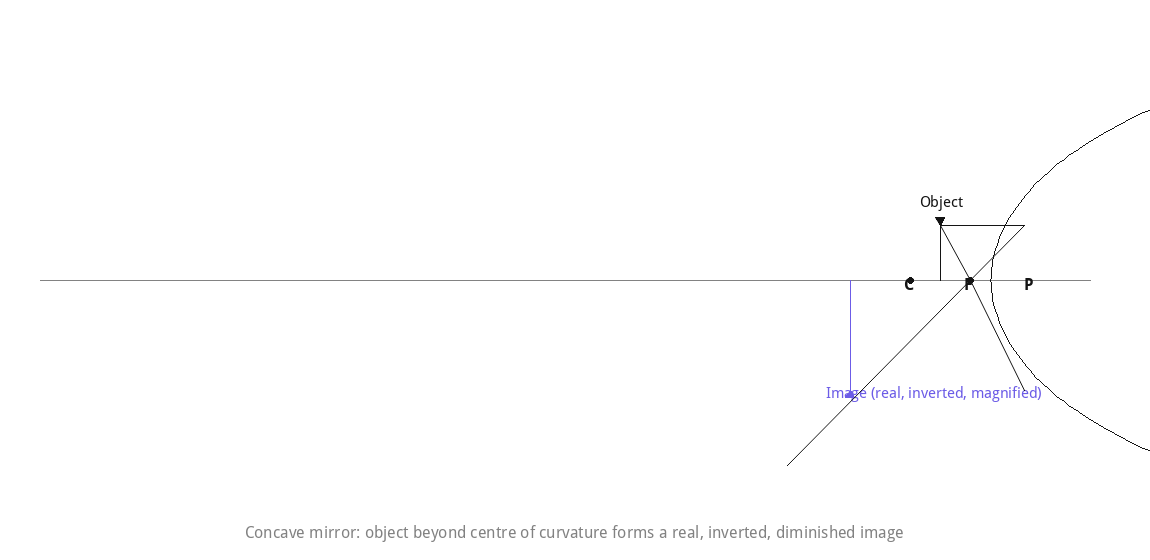
Ray diagram: a concave mirror converging reflected rays to form a real, inverted image.
Q4. How can we tell concave and convex mirrors apart?
Solution: A concave mirror curves inward, converges parallel light rays to a focal point, and can form both real and virtual images depending on object distance. A convex mirror curves outward, diverges parallel light rays, and always forms a virtual, diminished image.
Q5. Do laws govern how plane, concave and convex mirrors form images?
Solution: Yes — the laws of reflection: the angle of incidence equals the angle of reflection, and the incident ray, reflected ray and the normal all lie in the same plane.
Q6. Do the laws of reflection apply to spherical (curved) mirrors too?
Solution: Yes. At any point on a curved mirror, the same rule holds relative to the normal at that point: angle of incidence = angle of reflection.
Q7. What changes appear in an object’s image when viewed through a lens?
Solution: The image’s size, orientation and type (real or virtual) can all change. A concave lens always produces a diminished, virtual, upright (erect) image, regardless of object distance.
Q8. Do lenses converge or diverge a light beam?
Solution: Both types exist: a convex lens converges (focuses) light; a concave lens diverges (spreads out) light.
Q9. Since a convex lens converges light, can it burn paper?
Solution: Yes. A convex lens (like a magnifying glass) focuses sunlight to a small, intensely hot spot, which can ignite flammable material such as paper.
Q10. Where are lenses used?
Solution: Eyeglasses, cameras, microscopes, telescopes, projectors, magnifying glasses, and peepholes/spyholes in doors, among other instruments.
Keep the Curiosity Alive — Full Exercise Solutions
Q1. A light ray hits a mirror, with the incident ray making 40° with the normal. What angle does the reflected ray make with the mirror surface (not the normal)?
Solution: Angle of reflection = angle of incidence = 40° (measured from the normal). Angle with the mirror surface = 90° − 40° = 50°.
Q2. For three situations — (i) ray along the normal to a flat mirror, (ii) ray along the normal to a tilted mirror, (iii) ray at 20° from the normal on a tilted mirror — find the angle of reflection in each case.
Solution: (i) Angle of incidence = 0°, so angle of reflection = 0° — the ray reflects straight back along its own path. (ii) Same reasoning applies even though the mirror is tilted, since the ray still meets the (tilted) surface along its normal: angle of reflection = 0°, ray retraces its path. (iii) Angle of incidence = 20° ⇒ angle of reflection = 20°, on the opposite side of the normal.
Q3. Match a sketch-pen cap’s image in three different mirrors (plane, concave, convex) to the correct mirror type.
Solution: This depends on the specific images printed in the textbook figure; use these identifying rules: the plane mirror image is same-size and upright; the concave mirror image can be enlarged/inverted (or enlarged/upright if very close); the convex mirror image is always smaller and upright.
Q4. Match a sketch-pen cap’s image seen through a convex lens, a concave lens, and flat glass to the correct type.
Solution: This depends on the specific images printed in the textbook figure; use these identifying rules: through flat glass, the image is unchanged in size and upright; through a convex lens, the image can appear magnified/inverted (or magnified/upright if very close); through a concave lens, the image is always smaller and upright.
Q5. When light is incident along the normal to a mirror, which statement is true: (i) angle of incidence is 90° (ii) angle of incidence is 0° (iii) angle of reflection is 90° (iv) no reflection occurs?
Solution: (ii) Angle of incidence is 0°. Light striking exactly along the normal reflects straight back along the same path (angle of reflection is also 0°).
Q6. Identify plane, concave and convex mirrors from the images of a graph sheet they form.
Solution: This is a diagram-matching question that depends on the printed figure; identify by effect: the mirror giving a same-size, undistorted grid is plane; the one magnifying/distorting the grid lines outward from the centre is concave; the one shrinking the grid uniformly is convex.
Q7. A woman walks towards a large convex mirror in a museum. What happens to her image?
Solution: A convex mirror always forms a virtual, erect (upright) image, and this image’s size increases as the object gets closer to the mirror (though it always stays smaller than the real person, only approaching the same size right at the mirror’s surface). So: her erect image keeps increasing in size as she walks towards the mirror. (Note: some answer keys online state the image “keeps decreasing” here, but that describes what happens as she walks away from the mirror, not towards it. Using the standard convex-mirror magnification formula, m = f/(f+u) where u is the object’s distance from the mirror, m clearly increases as u decreases — i.e., the image grows larger as the object approaches. We’ve used the physically correct answer here.)

Ray diagram: a convex lens converging light rays through its focus.
Q8. Hold a magnifying glass over text, note the distance where text looks bigger, then move it away. What do you observe, and what type of lens is it?
Solution: A magnifying glass is a convex lens. Held close to the text, the image appears larger and clearer (upright, magnified, virtual). As you move it further away, the image grows even larger but becomes blurred, and past a certain point (beyond the focal length) the image flips — becoming smaller, inverted, and eventually out of focus.
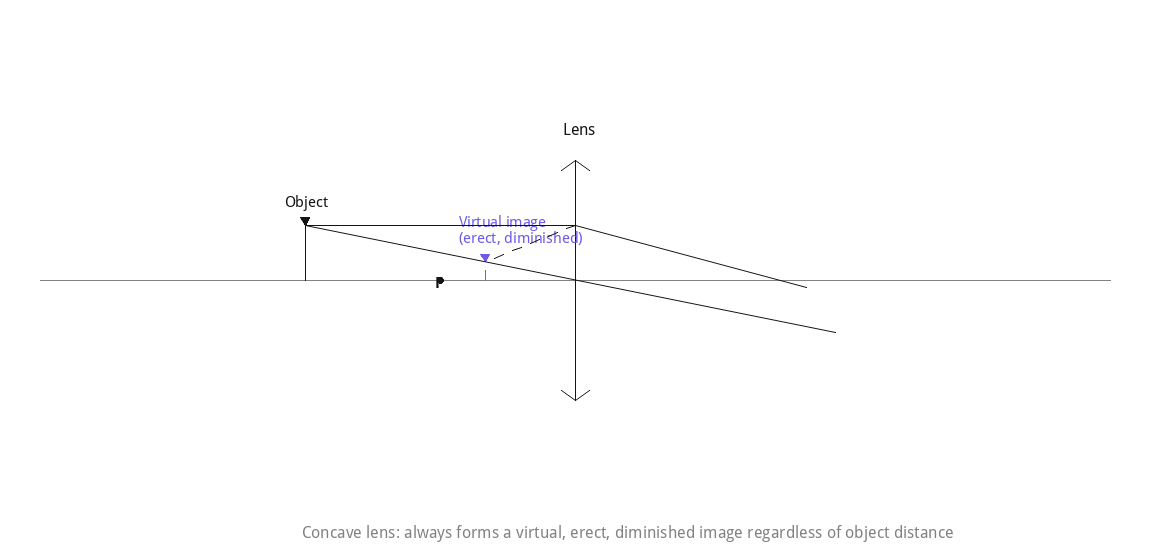
Ray diagram: a concave lens diverging light rays, always forming a virtual, diminished image.
Q9. Match: (i) Concave mirror (ii) Convex mirror (iii) Convex lens (iv) Concave lens, with: (a) reflecting surface curves inward (b) always forms an erect, diminished image (c) an object behind it may appear inverted at some distance (d) an object behind it always appears diminished.
Solution: (i)–(a): a concave mirror’s reflecting surface curves inward. (ii)–(b): a convex mirror always gives an erect, diminished image. (iii)–(c): a convex lens can form an inverted (real) image when the object is beyond its focal length. (iv)–(d): a concave lens always gives a diminished image, regardless of object position.
Q10. Assertion: Convex mirrors are preferred for viewing traffic behind a vehicle. Reason: Convex mirrors provide a significantly larger field of view than plane mirrors.
Solution: Both statements are true, and the Reason correctly explains the Assertion — a convex mirror’s outward curve spreads reflected rays over a wider area, letting the driver see a much larger area behind the vehicle than a same-sized plane mirror would.
Q11. Object O, mirror M, and image I are shown in two figures (a) and (b). Which mirror type does each represent?
Solution: Based on the standard version of this figure: Figure (a) shows a convex mirror (image is virtual, erect and diminished, formed between the mirror and its focus) and Figure (b) shows a concave mirror (image formation and position varies with object distance, and can be real/inverted).
Q12. A pencil is placed behind a glass tumbler; the tumbler is then filled halfway with water. How does the pencil appear, and why?
Solution: The submerged part of the pencil appears bent or displaced at the water surface (and can look slightly shifted or distorted), while the part above water looks normal. This happens due to refraction: light travels at different speeds in water (denser medium) and air (rarer medium), so light rays bend as they cross the water-air boundary. Since our eyes and brain assume light travels in straight lines, this bending makes the submerged part of the pencil appear to be at a different position than it actually is — creating the illusion of a break or bend at the surface.
Why This Chapter Matters
Reflection and refraction are foundational optics topics that reappear in far more mathematical depth in Class 10 Science (mirror and lens formulas, magnification, ray diagrams with sign conventions). Getting the qualitative behaviour right now — especially that convex mirrors/lenses always behave one way while concave ones can behave differently depending on object distance — makes the Class 10 formulas much easier to learn.
See also: Class 8 Science NCERT Book (Curiosity) and the Class 8 Science Formulas/Concepts Handbook.
Related pages: Extra Questions | Revision Notes
Chapter Quiz — Test Your Understanding
Class 8 Science Chapter 10 – Notes and Extra Questions
Along with these NCERT Solutions, students can also use the Class 8 Science Chapter 10 Extra Questions and Class 8 Science Chapter 10 Revision Notes for quick revision and extra practice.
- Chapter 1: Exploring the Investigative World of Science – Free PDF Download
- Chapter 2: The Invisible Living World – Free PDF Download
- Chapter 3: Health: The Ultimate Treasure – Free PDF Download
- Chapter 4: Electricity: Magnetic and Heating Effects – Free PDF Download
- Chapter 5: Exploring Forces – Free PDF Download
- Chapter 6: Pressure, Winds, Storms and Cyclones – Free PDF Download
- Chapter 7: Particulate Nature of Matter – Free PDF Download
- Chapter 8: Nature of Matter - Elements, Compounds and Mixtures - Curiosity
- Chapter 9: The Amazing World of Solutes, Solvents and Solutions - Curiosity
- Chapter 11: Keeping Time with the Skies - Curiosity
- Chapter 12: How Nature Works in Harmony - Curiosity
- Chapter 13: Our Home: Earth, A Unique Life Sustaining Planet - Curiosity
Frequently Asked Questions
Q: Does a convex mirror ever form a real image?
A: No — a convex mirror always forms a virtual, erect, diminished image, no matter where the object is placed.
Q: What’s the difference between how convex and concave lenses behave?
A: A convex lens can form either a magnified virtual image (object close, like a magnifying glass) or a real, often inverted image (object farther away, like in a camera). A concave lens always forms a virtual, erect, diminished image, regardless of object distance.
Recommended: Buy the Printed NCERT Class 8 Science Book
Contains Amazon affiliate links.
If you’d like a printed copy alongside the PDF, here’s a verified option:
4.6 out of 5 stars (3 ratings) · Rs. 130
Price and availability may change on Amazon. As an Amazon Associate, ncertbooks.org earns from qualifying purchases.


