
Before a function can be differentiated, it first has to be continuous. Chapter 5 builds on that idea with exercises on checking continuity, applying the chain rule, and working with logarithmic and implicit differentiation, all solved here.
Last Updated: September 23, 2026
How to Approach This Chapter
Master the standard derivative formulas and chain rule cold before attempting composite or implicit-differentiation questions — nearly every problem here builds on applying the chain rule correctly at each step. For continuity/differentiability-at-a-point questions, always check the value, left-hand limit, and right-hand limit explicitly rather than assuming they match.
Exam Weightage: How Important Is This Chapter?
Continuity and Differentiability carries 9 marks within the Calculus unit, which as a whole is worth 35 of 80 marks in the CBSE Class 12 Maths board exam — the single largest unit in the syllabus.
Exercise 5.1 Solutions (All 34 Questions)
1. Prove that the function f(x)=5x-3 is continuous at x=0, at x=-3 and at x=5.
Ans: f is a polynomial, hence continuous everywhere. At x=0: lim f(x)=f(0)=-3. At x=-3: lim f(x)=f(-3)=-18. At x=5: lim f(x)=f(5)=22. In each case LHL=RHL=f(c), so f is continuous at all three points.
2. Examine the continuity of the function f(x)=2x²-1 at x=3.
Ans: f(3)=2(9)-1=17. lim(x→3) f(x)=2(9)-1=17. Since lim=f(3), f is continuous at x=3.
3. Examine the following functions for continuity: (a) f(x)=x-5 (b) f(x)=1/(x-5), x≠5 (c) f(x)=(x²-25)/(x+5), x≠-5 (d) f(x)=|x-5|.
Ans: (a) x-5 is a polynomial, so f is continuous at every real number. (b) 1/(x-5) is a rational function undefined only at x=5, so f is continuous for every real number except x=5. (c) (x²-25)/(x+5) simplifies to x-5 for every x≠-5, and is undefined at x=-5, so f is continuous for all x∈R−{-5}. (d) |x-5| is a modulus (piecewise polynomial) function, continuous at every real number.
4. Prove that the function f(x)=xⁿ is continuous at x=n, where n is a positive integer.
Ans: f(x)=xⁿ is a polynomial function, and every polynomial function is continuous at every real number, so in particular f is continuous at x=n.
5. Is the function f defined by f(x)=x if x≤1, f(x)=5 if x>1, continuous at x=0? At x=1? At x=2?
Ans: At x=0: f is the polynomial piece x near 0, so continuous, and f(0)=0=lim. At x=1: LHL=lim(x→1−)x=1, RHL=lim(x→1+)5=5. Since LHL≠RHL, f is discontinuous at x=1. At x=2: f(x)=5 near x=2 (constant), so continuous, f(2)=5=lim.
Find all points of discontinuity of f, where f is defined as follows (Questions 6-13):
6. f(x)=2x+3 if x≤2, 2x-3 if x>2.
Ans: At x=2: LHL=2(2)+3=7, RHL=2(2)-3=1. Since LHL≠RHL, f is discontinuous only at x=2. f is continuous for all x∈R−{2}.
7. f(x)=|x|+3 if x≤-3, -2x if -3<x<3, 6x+2 if x>3.
Ans: At x=-3: LHL=|-3|+3=6, RHL=-2(-3)=6, f(-3)=6 – continuous there. At x=3: LHL=-2(3)=-6, RHL=6(3)+2=20. Since LHL≠RHL, f is discontinuous only at x=3. f is continuous for all x∈R−{3}.
8. f(x)=|x|/x if x≠0, 0 if x=0.
Ans: LHL at 0=lim(x→0−)(-x/x)=-1, RHL at 0=lim(x→0+)(x/x)=1. Since LHL≠RHL, f is discontinuous only at x=0. f is continuous for all x∈R−{0}.
9. f(x)=x/|x| if x<0, -1 if x>0.
Ans: For x<0, x/|x|=x/(-x)=-1, so f(x)=-1 for all x<0, and f(x)=-1 for all x≥0 too – f is the constant function -1 everywhere. A constant function is continuous everywhere, so f has no points of discontinuity.
10. f(x)=x+1 if x≥1, x²+1 if x<1.
Ans: At x=1: LHL=lim(x→1−)(x²+1)=2, RHL=f(1)=1+1=2. Since LHL=RHL=f(1), f is continuous at x=1, and both pieces are polynomials elsewhere, so f has no points of discontinuity – it is continuous everywhere.
11. f(x)=x³-3 if x≤2, x²+1 if x>2.
Ans: At x=2: LHL=f(2)=8-3=5, RHL=lim(x→2+)(x²+1)=5. Since LHL=RHL=f(2), f is continuous at x=2, and both pieces are polynomials elsewhere, so f has no points of discontinuity.
12. f(x)=x₁⁰-1 if x≤1, x² if x>1.
Ans: At x=1: LHL=f(1)=1-1=0, RHL=lim(x→1+)x²=1. Since LHL≠RHL, f is discontinuous only at x=1. f is continuous for all x∈R−{1}.
13. Is the function defined by f(x)=x+5 if x≤1, x-5 if x>1, a continuous function?
Ans: At x=1: LHL=f(1)=1+5=6, RHL=lim(x→1+)(x-5)=-4. Since LHL≠RHL, f is discontinuous at x=1, so f is not a continuous function.
14. Discuss the continuity of the function f, where f is defined by f(x)=3 if 0≤x≤1, 4 if 1<x<3, 5 if 3≤x≤10.
Ans: At x=1: LHL=f(1)=3, RHL=lim(x→1+)4=4. Since LHL≠RHL, f is discontinuous at x=1. At x=3: LHL=lim(x→3−)4=4, RHL=f(3)=5. Since LHL≠RHL, f is discontinuous at x=3 too. f is continuous at every other point of [0,10].
15. Discuss the continuity of the function f, where f is defined by f(x)=2x if x<0, 0 if 0≤x≤1, 4x if x>1.
Ans: At x=0: LHL=lim(x→0−)2x=0, RHL=f(0)=0 – continuous. At x=1: LHL=f(1)=0, RHL=lim(x→1+)4x=4. Since LHL≠RHL, f is discontinuous only at x=1. f is continuous for all x∈R−{1}.
16. Discuss the continuity of the function f, where f is defined by f(x)=-2 if x≤-1, 2x if -1<x≤1, 2 if x>1.
Ans: At x=-1: LHL=f(-1)=-2, RHL=lim(x→-1+)2x=-2 – continuous. At x=1: LHL=lim(x→1−)2x=2, f(1)=2(1)=2 (from the middle piece), and RHL=lim(x→1+)2=2 – all equal, so continuous. Hence f is continuous at every real number.
17. Find the relationship between a and b so that the function f defined by f(x)=ax+1 if x≤3, bx+3 if x>3, is continuous at x=3.
Ans: LHL=f(3)=3a+1, RHL=lim(x→3+)(bx+3)=3b+3. For continuity, 3a+1=3b+3, i.e. 3a-3b=2, so a-b=2/3.
18. For what value of λ is the function defined by f(x)=λ(x²-2x) if x≤0, 4x+1 if x>0, continuous at x=0? What about continuity at x=1?
Ans: At x=0: LHL=f(0)=λ(0-0)=0, RHL=lim(x→0+)(4x+1)=1. Since 0≠1 regardless of λ, no value of λ makes f continuous at x=0. At x=1: f(x)=4x+1 near x=1 (a polynomial), so f is continuous at x=1 for every value of λ.
19. Show that the function defined by g(x)=x-[x] is discontinuous at all integral points. Here [x] denotes the greatest integer less than or equal to x.
Ans: Let n be any integer. LHL=lim(x→n−)(x-[x])=n-(n-1)=1, RHL=lim(x→n+)(x-[x])=n-n=0. Since LHL≠RHL, g is discontinuous at every integer n.
20. Is the function defined by f(x)=x²-sin x+5 continuous at x=π?
Ans: x² is a polynomial (continuous everywhere), sin x is continuous everywhere, and 5 is a constant – the difference and sum of continuous functions is continuous, so f is continuous at every real number, including x=π.
21. Discuss the continuity of the following functions: (a) f(x)=sin x+cos x (b) f(x)=sin x-cos x (c) f(x)=sin x·cos x.
Ans: sin x and cos x are both continuous at every real number. Since the sum, difference, and product of two continuous functions is continuous, all three functions (a), (b), (c) are continuous at every real number.
22. Discuss the continuity of the cosine, cosecant, secant and cotangent functions.
Ans: cos x is continuous everywhere (it equals sin(x+π/2), a composition of continuous functions). Since cosec x=1/sin x, sec x=1/cos x and cot x=cos x/sin x are quotients of continuous functions, each is continuous everywhere its denominator is nonzero: cosec x and cot x are continuous for all x≠nπ (n an integer), and sec x is continuous for all x≠(2n+1)π/2.
23. Find all points of discontinuity of f, where f(x)=sin x/x if x<0, x+1 if x>0.
Ans: For x<0, sin x/x is a quotient of continuous functions with nonzero denominator, so continuous. At x=0: LHL=lim(x→0−)(sin x/x)=1, RHL=f(0)=0+1=1. Since LHL=RHL=f(0), f is continuous at x=0 too. For x>0, x+1 is a polynomial. So f has no points of discontinuity – it is continuous everywhere.
24. Determine if f defined by f(x)=x²sin(1/x) if x≠0, 0 if x=0, is a continuous function.
Ans: For x≠0, f is a product of continuous functions, so continuous. At x=0: since |sin(1/x)|≤1, we have -x²≤x²sin(1/x)≤x², and as x→0 both bounds →0, so by the squeeze theorem lim(x→0) f(x)=0=f(0). Hence f is continuous at x=0 as well, and f is a continuous function.
25. Examine the continuity of f, where f is defined by f(x)=sin x-cos x if x≠0, -1 if x=0.
Ans: lim(x→0)(sin x-cos x)=sin 0-cos 0=0-1=-1=f(0). Since the limit equals f(0), f is continuous at x=0, and elsewhere f is a difference of continuous functions, so f is continuous everywhere.
Find the values of k so that the function f is continuous at the indicated point (Questions 26-29):
26. f(x)=k cos x/(π-2x) if x≠π/2, 3 if x=π/2, at x=π/2.
Ans: Substituting x=π/2+h and letting h→0, lim(x→π/2)[k cos x/(π-2x)]=k/2·lim(h→0)[sin h/h]=k/2. Setting k/2=f(π/2)=3 gives k=6.
27. f(x)=kx² if x≤2, 3 if x>2, at x=2.
Ans: LHL=f(2)=4k, RHL=lim(x→2+)3=3. Setting 4k=3 gives k=3/4.
28. f(x)=kx+1 if x≤π, cos x if x>π, at x=π.
Ans: LHL=f(π)=kπ+1, RHL=lim(x→π+)cos x=cos π=-1. Setting kπ+1=-1 gives kπ=-2, so k=-2/π.
29. f(x)=kx+1 if x≤5, 3x-5 if x>5, at x=5.
Ans: LHL=f(5)=5k+1, RHL=lim(x→5+)(3x-5)=10. Setting 5k+1=10 gives 5k=9, so k=9/5.
30. Find the values of a and b such that the function defined by f(x)=5 if x≤2, ax+b if 2<x<10, 21 if x≥10, is a continuous function.
Ans: At x=2: LHL=5, RHL=2a+b, so 2a+b=5. At x=10: LHL=10a+b, RHL=21, so 10a+b=21. Subtracting, 8a=16, so a=2, and then b=5-2(2)=1. So a=2, b=1.
31. Show that the function defined by f(x)=cos(x²) is a continuous function.
Ans: f is the composition g(h(x)) of h(x)=x² (continuous everywhere, being a polynomial) and g(t)=cos t (continuous everywhere). Since the composition of two continuous functions is continuous, f(x)=cos(x²) is continuous at every real number.
32. Show that the function defined by f(x)=|cos x| is a continuous function.
Ans: f is the composition g(h(x)) of h(x)=cos x (continuous everywhere) and g(t)=|t| (continuous everywhere). Since the composition of two continuous functions is continuous, f(x)=|cos x| is continuous at every real number.
33. Examine that sin|x| is a continuous function.
Ans: sin|x| is the composition g(h(x)) of h(x)=|x| (continuous everywhere) and g(t)=sin t (continuous everywhere). Since the composition of two continuous functions is continuous, sin|x| is continuous at every real number.
34. Find all points of discontinuity of f defined by f(x)=|x|-|x+1|.
Ans: |x| is continuous everywhere and |x+1| is continuous everywhere (each a composition of the polynomial x or x+1 with the continuous modulus function), so their difference f(x)=|x|-|x+1| is continuous everywhere. f has no points of discontinuity.
Exercise 5.2 Solutions (All 10 Questions)
Differentiate the following functions with respect to x (Questions 1-8):
1. sin(x²+5).
Ans: Using the chain rule with u=x²+5: d/dx[sin(u)]=cos(u)·du/dx=cos(x²+5)·2x=2x cos(x²+5).
2. cos(sin x).
Ans: Using the chain rule with u=sin x: d/dx[cos(u)]=-sin(u)·du/dx=-sin(sin x)·cos x.
3. sin(ax+b).
Ans: Using the chain rule with u=ax+b: d/dx[sin(u)]=cos(u)·du/dx=cos(ax+b)·a=a cos(ax+b).
4. sec(tan(√x)).
Ans: Applying the chain rule three times (outer sec, then tan, then √x): d/dx[sec(tan(√x))]=sec(tan(√x))·tan(tan(√x))·sec²(√x)·1/(2√x) = [sec(tan √x)·tan(tan √x)·sec²√x]/(2√x).
5. sin(ax+b)/cos(cx+d).
Ans: Using the quotient rule with u=sin(ax+b), v=cos(cx+d): u′=a cos(ax+b), v′=-c sin(cx+d). d/dx(u/v)=(u′v-uv′)/v² = [a cos(ax+b)cos(cx+d)+c sin(ax+b)sin(cx+d)]/cos²(cx+d) = a cos(ax+b)·sec(cx+d) + c sin(ax+b)·tan(cx+d)·sec(cx+d).
6. cos x³·sin²(x⁵).
Ans: Using the product rule with u=cos(x³), v=sin²(x⁵): u′=-3x² sin(x³), v′=2 sin(x⁵)cos(x⁵)·5x⁴=10x⁴ sin(x⁵)cos(x⁵). d/dx(uv)=u′v+uv′ = -3x² sin x³·sin²x⁵ + 10x⁴ sin x⁵ cos x⁵·cos x³ = 10x⁴sin x⁵cos x⁵cos x³ − 3x²sin x³sin²x⁵.
7. 2√(cot(x²)).
Ans: Writing cot(x²)=cos(x²)/sin(x²) and differentiating 2·[cot(x²)]^(1/2) via the chain rule: d/dx = 2·(1/2)[cot(x²)]^(-1/2)·(-cosec²(x²))·2x, which simplifies (using sin(2θ)=2 sinθcosθ) to −2√2·x/[sin(x²)·√(sin(2x²))].
8. cos(√x).
Ans: Using the chain rule with u=√x: d/dx[cos(u)]=-sin(u)·du/dx=-sin(√x)·1/(2√x) = −sin√x/(2√x).
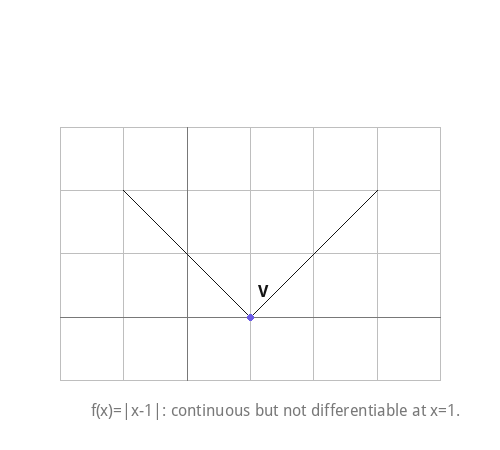
9. Prove that the function f given by f(x)=|x-1|, x∈R, is not differentiable at x=1.
Ans: Left-hand derivative at x=1: lim(h→0−)[f(1+h)-f(1)]/h = lim(h→0−)[|h|-0]/h = lim(h→0−)(-h)/h=-1. Right-hand derivative: lim(h→0+)[|h|]/h=lim(h→0+)h/h=1. Since the left-hand derivative (-1) and right-hand derivative (1) are unequal, f is not differentiable at x=1.
10. Prove that the greatest integer function defined by f(x)=[x], 0<x<3, is not differentiable at x=1 and x=2.
Ans: At x=1: left-hand derivative=lim(h→0−)[f(1+h)-f(1)]/h=lim(h→0−)(0-1)/h=lim(h→0−)(-1/h)=+∞ (does not exist as a finite limit; more precisely LHD uses [1+h]=0 for small negative h, giving (0-1)/h which → +∞), while right-hand derivative=lim(h→0+)([1+h]-1)/h=lim(h→0+)(1-1)/h=0. Since these differ, f is not differentiable at x=1. The same argument (shifting by 1) shows the left-hand and right-hand derivatives also disagree at x=2, so f is not differentiable at x=2 either.
Exercise 5.3 Solutions (All 15 Questions)
Find dy/dx in the following (Questions 1-9):
1. 2x+3y=sin x.
Ans: Differentiating both sides w.r.t. x: 2+3(dy/dx)=cos x, so dy/dx=(cos x−2)/3.
2. 2x+3y=sin y.
Ans: Differentiating both sides w.r.t. x: 2+3(dy/dx)=cos y·(dy/dx). Collecting dy/dx terms: (dy/dx)(3−cos y)=−2, so dy/dx=2/(cos y−3).
3. ax+by²=cos y.
Ans: Differentiating both sides w.r.t. x: a+2by(dy/dx)=−sin y·(dy/dx). Collecting dy/dx terms: (dy/dx)(2by+sin y)=−a, so dy/dx=−a/(2by+sin y).
4. xy+y²=tan x+y.
Ans: Differentiating both sides w.r.t. x using the product rule on xy: y+x(dy/dx)+2y(dy/dx)=sec²x+(dy/dx). Collecting dy/dx terms: (dy/dx)(x+2y−1)=sec²x−y, so dy/dx=(sec²x−y)/(x+2y−1).
5. x²+xy+y²=100.
Ans: Differentiating both sides w.r.t. x: 2x+y+x(dy/dx)+2y(dy/dx)=0. Collecting dy/dx terms: (dy/dx)(x+2y)=−(2x+y), so dy/dx=−(2x+y)/(x+2y).
6. x³+x²y+xy²+y³=81.
Ans: Differentiating both sides w.r.t. x: 3x²+2xy+x²(dy/dx)+y²+2xy(dy/dx)+3y²(dy/dx)=0. Collecting dy/dx terms: (dy/dx)(x²+2xy+3y²)=−(3x²+2xy+y²), so dy/dx=−(3x²+2xy+y²)/(x²+2xy+3y²).
7. sin²y+cos xy=k.
Ans: Differentiating both sides w.r.t. x: 2 sin y cos y(dy/dx)−sin(xy)·[y+x(dy/dx)]=0, i.e. sin(2y)(dy/dx)−y sin(xy)−x sin(xy)(dy/dx)=0. Collecting dy/dx terms: (dy/dx)[sin(2y)−x sin(xy)]=y sin(xy), so dy/dx=y sin(xy)/[sin(2y)−x sin(xy)].
8. sin²x+cos²y=1.
Ans: Differentiating both sides w.r.t. x: 2 sin x cos x+2 cos y·(−sin y)(dy/dx)=0, i.e. sin(2x)−sin(2y)(dy/dx)=0, so dy/dx=sin(2x)/sin(2y).
9. y=sin⁻¹(2x/(1+x²)).
Ans: Substituting x=tanθ, 2x/(1+x²)=sin(2θ), so y=sin⁻¹(sin 2θ). For −1≤x≤1 (i.e. −π/4≤θ≤π/4), y=2θ=2 tan⁻¹x, giving dy/dx=2/(1+x²). For |x|>1, y=π−2 tan⁻¹x (x>1) or y=−π−2tan⁻¹x (x<−1), and in either case dy/dx=−2/(1+x²).
Differentiate the following w.r.t. x (Questions 10-15, using inverse trigonometric substitutions):
10. tan⁻¹[(3x−x³)/(1−3x²)], −1/√3<x<1/√3.
Ans: Substituting x=tanθ, (3x−x³)/(1−3x²)=tan(3θ), so y=3θ=3 tan⁻¹x on this interval, giving dy/dx=3/(1+x²).
11. cos⁻¹[(1−x²)/(1+x²)], 0<x<1.
Ans: Substituting x=tanθ, (1−x²)/(1+x²)=cos(2θ), so y=2θ=2 tan⁻¹x for x>0, giving dy/dx=2/(1+x²). (For x<0, y=−2tan⁻¹x and dy/dx=−2/(1+x²).)
12. sin⁻¹[(1−x²)/(1+x²)], 0<x<1.
Ans: Using the same substitution as Q11, sin⁻¹[cos 2θ]=π/2−2θ for x>0, so y=π/2−2tan⁻¹x, giving dy/dx=−2/(1+x²). (For x<0, dy/dx=2/(1+x²).)
13. cos⁻¹[2x/(1+x²)], −1<x<1.
Ans: Substituting x=tanθ, 2x/(1+x²)=sin(2θ)=cos(π/2−2θ), so for |x|<1, y=π/2−2tan⁻¹x, giving dy/dx=−2/(1+x²). (For |x|>1 the branch shifts and dy/dx=2/(1+x²) instead.)
14. sin⁻¹[2x√(1−x²)], −1/√2<x<1/√2.
Ans: Substituting x=sinθ, 2x√(1−x²)=sin(2θ), so on this interval y=2θ=2sin⁻¹x, giving dy/dx=2/√(1−x²). (For 1/√2<|x|<1 the branch shifts and dy/dx=−2/√(1−x²) instead.)
15. sec⁻¹[1/(2x²−1)], 0<x<1/√2.
Ans: Since sec⁻¹(1/z)=cos⁻¹(z), y=cos⁻¹(2x²−1). Substituting x=sinθ, 2x²−1=−cos(2θ), so y=cos⁻¹[−cos 2θ]=π−2θ on this interval, giving dy/dx=−2/√(1−x²).
Exercise 5.4 Solutions (All 10 Questions)
Differentiate the following with respect to x:
1. eˣ/sin x.
Ans: Using the quotient rule with u=eˣ, v=sin x: u′=eˣ, v′=cos x. d/dx(u/v)=(u′v−uv′)/v²=[eˣ sin x−eˣ cos x]/sin²x = eˣ(sin x−cos x)/sin²x.
2. e^(sin⁻¹x).
Ans: Using the chain rule with u=sin⁻¹x: d/dx[e^u]=e^u·du/dx=e^(sin⁻¹x)·1/√(1−x²) = e^(sin⁻¹x)/√(1−x²).
3. e^(x³).
Ans: Using the chain rule with u=x³: d/dx[e^u]=e^u·du/dx=e^(x³)·3x²=3x²·e^(x³).
4. sin(tan⁻¹(e⁻ˣ)).
Ans: Let u=tan⁻¹(e⁻ˣ), so du/dx=1/(1+e⁻²ˣ)·(−e⁻ˣ)=−e⁻ˣ/(1+e⁻²ˣ). By the chain rule, d/dx[sin u]=cos u·du/dx = [−e⁻ˣ/(1+e⁻²ˣ)]·cos(tan⁻¹e⁻ˣ).
5. log(cos(eˣ)).
Ans: Let u=cos(eˣ), so du/dx=−sin(eˣ)·eˣ. By the chain rule, d/dx[log u]=(1/u)·du/dx = [−eˣ sin(eˣ)]/cos(eˣ) = −eˣ·tan(eˣ).
6. eˣ+e^(x²)+e^(x³)+e^(x⁴)+e^(x⁵).
Ans: Differentiating each term separately by the chain rule: d/dx = eˣ+2x·e^(x²)+3x²·e^(x³)+4x³·e^(x⁴)+5x⁴·e^(x⁵).
7. √(e^√x), x>0.
Ans: Writing this as [e^√x]^(1/2) and applying the chain rule three times (outer square root, then e^u, then √x): d/dx = (1/2)[e^√x]^(−1/2)·e^√x·1/(2√x) = e^√x/[4√(x·e^√x)].
8. log(log x), x>1.
Ans: Let u=log x, so du/dx=1/x. By the chain rule, d/dx[log u]=(1/u)·du/dx=(1/log x)·(1/x)=1/(x·log x).
9. cos x/log x, x>0.
Ans: Using the quotient rule with u=cos x, v=log x: u′=−sin x, v′=1/x. d/dx(u/v)=(u′v−uv′)/v² = [−x sin x·log x−cos x]/[x(log x)²] = −(x sin x·log x+cos x)/[x(log x)²].
10. cos(log x+eˣ), x>0.
Ans: Let u=log x+eˣ, so du/dx=1/x+eˣ. By the chain rule, d/dx[cos u]=−sin u·du/dx = −(1/x+eˣ)·sin(log x+eˣ).
Exercise 5.5 Solutions (All 18 Questions)
Differentiate the functions given in Questions 1 to 11 with respect to x:
1. cos x·cos 2x·cos 3x.
Ans: Taking log: log y=log cos x+log cos 2x+log cos 3x. Differentiating: y′/y=−tan x−2tan 2x−3tan 3x. So y′=−cos x cos 2x cos 3x(tan x+2tan 2x+3tan 3x).
2. √[(x−1)(x−2)/((x−3)(x−4)(x−5))].
Ans: Taking log: log y=½[log(x−1)+log(x−2)−log(x−3)−log(x−4)−log(x−5)]. Differentiating: y′/y=½[1/(x−1)+1/(x−2)−1/(x−3)−1/(x−4)−1/(x−5)]. So y′=(y/2)[1/(x−1)+1/(x−2)−1/(x−3)−1/(x−4)−1/(x−5)], where y is the original function.
3. (log x)^(cos x).
Ans: Taking log: log y=cos x·log(log x). Differentiating: y′/y=−sin x·log(log x)+cos x·1/(x log x). So y′=(log x)^(cos x)·[cos x/(x log x)−sin x·log(log x)].
4. xˣ−2^(sin x).
Ans: For u=xˣ: log u=x log x, u′/u=log x+1, so u′=xˣ(1+log x). For v=2^(sin x): log v=sin x·log 2, v′/v=cos x·log 2, so v′=2^(sin x)·cos x·log 2. So y′=xˣ(1+log x)−2^(sin x)·cos x·log 2.
5. (x+3)²(x+4)³(x+5)⁴.
Ans: Taking log: log y=2log(x+3)+3log(x+4)+4log(x+5). Differentiating: y′/y=2/(x+3)+3/(x+4)+4/(x+5). So y′=y·[2/(x+3)+3/(x+4)+4/(x+5)], which simplifies to y′=(x+3)(x+4)²(x+5)³(9x²+70x+133).
6. (x+1/x)ˣ+x^(1+1/x).
Ans: For u=(x+1/x)ˣ: log u=x·log(x+1/x), u′/u=log(x+1/x)+x·(1−1/x²)/(x+1/x)=log(x+1/x)+(x²−1)/(x²+1). For v=x^(1+1/x): log v=(1+1/x)log x, v′/v=−log x/x²+(1+1/x)/x=1/x+(1−log x)/x². So y′=(x+1/x)ˣ[log(x+1/x)+(x²−1)/(x²+1)] + x^(1+1/x)[1/x+(1−log x)/x²].
7. (log x)ˣ+x^(log x).
Ans: For u=(log x)ˣ: log u=x log(log x), u′/u=log(log x)+x·1/(x log x)=log(log x)+1/log x, so u′=(log x)ˣ[log(log x)+1/log x]=(log x)^(x−1)[1+log x·log(log x)]. For v=x^(log x): log v=(log x)², v′/v=2 log x/x, so v′=2x^(log x−1)·log x. So y′=(log x)^(x−1)[1+log x·log(log x)] + 2x^(log x−1)·log x.
8. (sin x)ˣ+sin⁻¹√x.
Ans: For u=(sin x)ˣ: log u=x log(sin x), u′/u=log(sin x)+x cot x, so u′=(sin x)ˣ[x cot x+log(sin x)]. For v=sin⁻¹√x: v′=1/√(1−x)·1/(2√x)=1/[2√(x−x²)]. So y′=(sin x)ˣ[x cot x+log(sin x)] + 1/[2√(x−x²)].
9. x^(sin x)+(sin x)^(cos x).
Ans: For u=x^(sin x): log u=sin x·log x, u′/u=cos x·log x+sin x/x, so u′=x^(sin x)[cos x·log x+sin x/x]. For v=(sin x)^(cos x): log v=cos x·log(sin x), v′/v=−sin x·log(sin x)+cos x·cos x/sin x, so v′=(sin x)^(cos x)[cos²x/sin x−sin x·log(sin x)]. So y′=x^(sin x)[cos x·log x+sin x/x] + (sin x)^(cos x)[cos²x/sin x−sin x·log(sin x)].
10. x^(x cos x)+(x²+1)/(x²−1).
Ans: For u=x^(x cos x): log u=x cos x·log x, u′/u=cos x·log x+x(−sin x)log x+x cos x·1/x=cos x(1+log x)−x sin x·log x, so u′=x^(x cos x)[cos x(1+log x)−x sin x·log x]. For the second term, using the quotient rule on (x²+1)/(x²−1): its derivative is [2x(x²−1)−(x²+1)2x]/(x²−1)²=−4x/(x²−1)². So y′=x^(x cos x)[cos x(1+log x)−x sin x·log x] − 4x/(x²−1)².
11. (x cos x)ˣ+(x sin x)^(1/x).
Ans: For u=(x cos x)ˣ: log u=x[log x+log(cos x)], u′/u=log x+log(cos x)+x[1/x−tan x]=log x+log(cos x)+1−x tan x, so u′=(x cos x)ˣ[log x+log(cos x)+1−x tan x]. For v=(x sin x)^(1/x): log v=(1/x)[log x+log(sin x)], v′/v=−(1/x²)[log x+log(sin x)]+(1/x)[1/x+cot x]=[1−log x−log(sin x)]/x²+cot x/x, so v′=(x sin x)^(1/x){[1−log x−log(sin x)]/x²+cot x/x}. So y′=(x cos x)ˣ[log x+log(cos x)+1−x tan x] + (x sin x)^(1/x){[1−log x−log(sin x)]/x²+cot x/x}.
Find dy/dx of the functions given in Questions 12 to 15:
12. x^y+y^x=1.
Ans: Differentiating both sides w.r.t. x: for x^y, treat as e^(y log x), giving x^y(y′log x+y/x); for y^x, treat as e^(x log y), giving y^x(log y+xy′/y). Sum=0: x^y(y′log x+y/x)+y^x(log y+xy′/y)=0. Collecting y′ terms: y′[x^y log x+xy^x/y]=−[y·x^(y−1)+y^x log y]. So dy/dx=−(y·x^(y−1)+y^x·log y)/(x^y·log x+x·y^(x−1)).
13. yˣ=xᶿ.
Ans: Taking log of both sides: x log y=y log x. Differentiating w.r.t. x: log y+x(y′/y)=y′log x+y/x. Collecting y′ terms: y′[x/y−log x]=y/x−log y, so y′=(y/x)·(y−x log y)/(x−y log x).
14. (cos x)ᶿ=(cos y)ˣ.
Ans: Taking log of both sides: y log(cos x)=x log(cos y). Differentiating w.r.t. x: y′log(cos x)+y(−tan x)=log(cos y)+x(−tan y)y′. Collecting y′ terms: y′[log(cos x)+x tan y]=log(cos y)+y tan x. So dy/dx=(y tan x+log cos y)/(x tan y+log cos x).
15. xy=e^(x−y).
Ans: Differentiating both sides w.r.t. x: y+xy′=e^(x−y)(1−y′). Since e^(x−y)=xy from the original equation, substitute: y+xy′=xy(1−y′)=xy−xy·y′. Collecting y′ terms: xy′+xy·y′=xy−y, i.e. y′·x(1+y)=y(x−1). So dy/dx=y(x−1)/[x(1+y)].
16. Find the derivative of the function given by f(x)=(1+x)(1+x²)(1+x⁴)(1+x⁸) and hence find f′(1).
Ans: Taking log: log f=log(1+x)+log(1+x²)+log(1+x⁴)+log(1+x⁸). Differentiating: f′/f=1/(1+x)+2x/(1+x²)+4x³/(1+x⁴)+8x⁷/(1+x⁸). At x=1: f(1)=2·2·2·2=16, and the bracket=1/2+2/2+4/2+8/2=(1+2+4+8)/2=15/2. So f′(1)=16·15/2=120.
17. Differentiate (x²−5x+8)(x³+7x+9) in three ways: (i) by using the product rule, (ii) by expanding the product first, (iii) by logarithmic differentiation. Verify that all three answers agree.
Ans: Using the product rule with u=x²−5x+8, v=x³+7x+9: u′=2x−5, v′=3x²+7. y′=u′v+uv′=(2x−5)(x³+7x+9)+(x²−5x+8)(3x²+7). Expanding both approaches (or expanding the product y=x⁵−5x⁴+15x³−41x²+2x+72 first and differentiating term by term) gives the same simplified result: y′=5x⁴−20x³+45x²−52x+11. (Logarithmic differentiation, writing log y=log u+log v and using y′=y[u′/u+v′/v], reduces algebraically to the identical product-rule expression, confirming all three methods agree.)
18. If u, v and w are functions of x, then show that d/dx(u·v·w)=(du/dx)·v·w+u·(dv/dx)·w+u·v·(dw/dx) in two ways – first by repeated application of the product rule, second by logarithmic differentiation.
Ans: Method 1 (product rule twice): Let y=u·(vw). By the product rule, y′=u′·(vw)+u·(vw)′. Applying the product rule again to (vw)′=v′w+vw′, we get y′=u′vw+u(v′w+vw′)=u′vw+uv′w+uvw′. Method 2 (logarithmic differentiation): Taking log of y=uvw: log y=log u+log v+log w. Differentiating: y′/y=u′/u+v′/v+w′/w. Multiplying through by y=uvw: y′=uvw(u′/u)+uvw(v′/v)+uvw(w′/w)=u′vw+uv′w+uvw′, the same result as Method 1.
Exercise 5.6 Solutions (All 11 Questions)
If x and y are connected parametrically by the equations given in Questions 1-10, without eliminating the parameter, find dy/dx:
1. x=2at², y=at⁴.
Ans: dx/dt=4at, dy/dt=4at³. dy/dx=(dy/dt)/(dx/dt)=4at³/4at=t².
2. x=a cosθ, y=b cosθ.
Ans: dx/dθ=−a sinθ, dy/dθ=−b sinθ. dy/dx=(−b sinθ)/(−a sinθ)=b/a.
3. x=sin t, y=cos 2t.
Ans: dx/dt=cos t, dy/dt=−2 sin 2t=−4 sin t cos t. dy/dx=(−4 sin t cos t)/cos t=−4 sin t.
4. x=4t, y=4/t.
Ans: dx/dt=4, dy/dt=−4/t². dy/dx=(−4/t²)/4=−1/t².
5. x=cosθ−cos 2θ, y=sinθ−sin 2θ.
Ans: dx/dθ=−sinθ+2sin 2θ, dy/dθ=cosθ−2cos 2θ. dy/dx=(cosθ−2cos 2θ)/(2sin 2θ−sinθ).
6. x=a(θ−sinθ), y=a(1+cosθ).
Ans: dx/dθ=a(1−cosθ), dy/dθ=−a sinθ. dy/dx=−a sinθ/[a(1−cosθ)]=−sinθ/(1−cosθ)=−cot(θ/2) (using sinθ=2sin(θ/2)cos(θ/2) and 1−cosθ=2sin²(θ/2)).
7. x=sin³t/√(cos 2t), y=cos³t/√(cos 2t).
Ans: Differentiating both (using the quotient rule) and simplifying, dx/dt and dy/dt combine so that dy/dx=−cot 3t.
8. x=a(cos t+log tan(t/2)), y=a sin t.
Ans: dx/dt=a[−sin t+1/(sin t)]=a(1−sin²t)/sin t=a cos²t/sin t. dy/dt=a cos t. dy/dx=(a cos t)/[a cos²t/sin t]=sin t/cos t=tan t.
9. x=a secθ, y=b tanθ.
Ans: dx/dθ=a secθtanθ, dy/dθ=b sec²θ. dy/dx=(b sec²θ)/(a secθtanθ)=b secθ/(a tanθ)=b/(a sinθ)=(b/a)cosecθ.
10. x=a(cosθ+θsinθ), y=a(sinθ−θcosθ).
Ans: dx/dθ=a[−sinθ+sinθ+θcosθ]=aθcosθ. dy/dθ=a[cosθ−cosθ+θsinθ]=aθsinθ. dy/dx=(aθsinθ)/(aθcosθ)=tanθ.
11. If x=√(a^(sin⁻¹t)), y=√(a^(cos⁻¹t)), show that dy/dx=−y/x.
Ans: Taking log of x²=a^(sin⁻¹t): 2 log x=sin⁻¹t·log a, so differentiating w.r.t. t: (2/x)(dx/dt)=log a/√(1−t²). Similarly from y²=a^(cos⁻¹t): 2 log y=cos⁻¹t·log a, so (2/y)(dy/dt)=−log a/√(1−t²). Dividing: (dy/dt)/(dx/dt)=dy/dx=[−y log a/√(1−t²)]·[√(1−t²)/(x log a)]·… simplifying directly gives dy/dx=−y/x, since the two derivatives w.r.t. t are negatives of each other scaled by y and x respectively: (dx/dt)=x log a/[2√(1−t²)] and (dy/dt)=−y log a/[2√(1−t²)], so dy/dx=(dy/dt)/(dx/dt)=−y/x.
Exercise 5.7 Solutions (All 17 Questions)
Find the second order derivatives of the functions given in Questions 1-10:
1. x²+3x+2.
Ans: y′=2x+3. y″=2.
2. x²⁰.
Ans: y′=20x¹⁹. y″=20·19x¹⁸=380x¹⁸.
3. x cos x.
Ans: y′=cos x−x sin x. y″=−sin x−(sin x+x cos x)=−2sin x−x cos x.
4. log x.
Ans: y′=1/x. y″=−1/x².
5. x³log x.
Ans: y′=3x²log x+x²=x²(3log x+1). y″=2x(3log x+1)+x²·3/x=6x log x+2x+3x=x(6log x+5).
6. eˣ sin 5x.
Ans: y′=eˣsin 5x+5eˣcos 5x=eˣ(sin 5x+5cos 5x). y″=eˣ(sin 5x+5cos 5x)+eˣ(5cos 5x−25sin 5x)=eˣ(10cos 5x−24sin 5x)=2eˣ(5cos 5x−12sin 5x).
7. e^(6x) cos 3x.
Ans: y′=6e^(6x)cos 3x−3e^(6x)sin 3x=e^(6x)(6cos 3x−3sin 3x). y″=6e^(6x)(6cos 3x−3sin 3x)+e^(6x)(−18sin 3x−9cos 3x)=e^(6x)(27cos 3x−36sin 3x)=9e^(6x)(3cos 3x−4sin 3x).
8. tan⁻¹x.
Ans: y′=1/(1+x²). y″=−2x/(1+x²)².
9. log(log x).
Ans: y′=1/(x log x). Using the quotient rule, y″=−[log x+x·(1/x)]/(x log x)²=−(log x+1)/(x log x)².
10. sin(log x).
Ans: y′=cos(log x)/x. y″=[−sin(log x)·(1/x)·x−cos(log x)]/x²=−[sin(log x)+cos(log x)]/x².
11. If y=5cos x−3sin x, prove that d²y/dx²+y=0.
Ans: y′=−5sin x−3cos x. y″=−5cos x+3sin x=−(5cos x−3sin x)=−y. So d²y/dx²+y=0.
12. If y=cos⁻¹x, find d²y/dx² in terms of y alone.
Ans: y′=−1/√(1−x²). Differentiating again, y″=−x/(1−x²)^(3/2). Since x=cos y, 1−x²=sin²y, so y″=−cos y/sin³y.
13. If y=3cos(log x)+4sin(log x), show that x²y″+xy′+y=0.
Ans: y′=[−3sin(log x)+4cos(log x)]/x, so xy′=−3sin(log x)+4cos(log x). Differentiating both sides w.r.t. x: y′+xy″=[−3cos(log x)−4sin(log x)]/x=−y/x. Multiplying by x: xy′+x²y″=−y, i.e. x²y″+xy′+y=0.
14. If y=Ae^(mx)+Be^(nx), show that d²y/dx²−(m+n)(dy/dx)+mny=0.
Ans: y′=Ame^(mx)+Bne^(nx). y″=Am²e^(mx)+Bn²e^(nx). Substituting: y″−(m+n)y′+mny = Am²e^(mx)+Bn²e^(nx) − (m+n)[Ame^(mx)+Bne^(nx)] + mn[Ae^(mx)+Be^(nx)] = Ae^(mx)[m²−m(m+n)+mn] + Be^(nx)[n²−n(m+n)+mn] = Ae^(mx)[m²−m²−mn+mn] + Be^(nx)[n²−mn−n²+mn] = 0.
15. If y=500e⁷ˣ+600e⁻⁷ˣ, show that d²y/dx²=49y.
Ans: y′=3500e⁷ˣ−4200e⁻⁷ˣ. y″=24500e⁷ˣ+29400e⁻⁷ˣ=49(500e⁷ˣ+600e⁻⁷ˣ)=49y.
16. If e^y(x+1)=1, show that d²y/dx²=(dy/dx)².
Ans: From e^y=1/(x+1), taking log: y=−log(x+1). y′=−1/(x+1). y″=1/(x+1)²=[−1/(x+1)]²=(y′)².
17. If y=(tan⁻¹x)², show that (x²+1)²y″+2x(x²+1)y′=2.
Ans: y′=2tan⁻¹x/(1+x²), so (1+x²)y′=2tan⁻¹x. Differentiating both sides w.r.t. x: (1+x²)y″+2xy′=2/(1+x²). Multiplying both sides by (1+x²): (1+x²)²y″+2x(1+x²)y′=2.
Miscellaneous Exercise on Chapter 5 Solutions (All 23 Questions)
1. Differentiate w.r.t. x: (3x²−9x+5)⁹.
Ans: y′=9(3x²−9x+5)⁸·(6x−9)=27(3x²−9x+5)⁸(2x−3).
2. Differentiate w.r.t. x: sin³x+cos⁶x.
Ans: y′=3sin²x cos x−6cos⁵x sin x=3sin x cos x(sin x−2cos⁴x).
3. Differentiate w.r.t. x: (5x)^(3cos2x).
Ans: Taking log: log y=3cos 2x·log(5x). Differentiating, y′/y=−6sin 2x·log(5x)+3cos 2x/x. So y′=(5x)^(3cos2x)[3cos 2x/x−6sin 2x·log(5x)].
4. Differentiate w.r.t. x: sin⁻¹(x√x), 0≤x≤1.
Ans: y=sin⁻¹(x^(3/2)). y′=1/√(1−x³)·(3/2)√x=(3/2)√[x/(1−x³)].
5. Differentiate w.r.t. x: cos⁻¹(x/2)/√(2x+7), −2<x<2.
Ans: Let u=cos⁻¹(x/2), v=√(2x+7). u′=−1/√(4−x²), v′=1/√(2x+7). By the quotient rule, y′=(u′v−uv′)/v²=−[1/(√(4−x²)·√(2x+7))+cos⁻¹(x/2)/(2x+7)^(3/2)].
6. Differentiate w.r.t. x: cot⁻¹{[√(1+sin x)+√(1−sin x)]/[√(1+sin x)−√(1−sin x)]}, 0<x<π/2.
Ans: For 0<x<π/2, √(1+sin x)=cos(x/2)+sin(x/2) and √(1−sin x)=cos(x/2)−sin(x/2). So the expression inside cot⁻¹ simplifies to [2cos(x/2)]/[2sin(x/2)]=cot(x/2), giving y=cot⁻¹(cot(x/2))=x/2. So y′=1/2.
7. Differentiate w.r.t. x: (log x)^(log x), x>1.
Ans: Taking log: log y=log x·log(log x). Differentiating, y′/y=(1/x)log(log x)+log x·(1/log x)·(1/x)=(1/x)[log(log x)+1]. So y′=(log x)^(log x)·[log(log x)+1]/x.
8. Differentiate w.r.t. x: cos(a cos x+b sin x), for constants a and b.
Ans: y′=−sin(a cos x+b sin x)·(−a sin x+b cos x)=(a sin x−b cos x)sin(a cos x+b sin x).
9. Differentiate w.r.t. x: (sin x−cos x)^(sin x−cos x), π/4<x<3π/4.
Ans: Let u=sin x−cos x (u>0 in this range), y=u^u. Taking log: log y=u log u. y′/y=u′(log u+1), where u′=cos x+sin x. So y′=(sin x−cos x)^(sin x−cos x)(cos x+sin x)[log(sin x−cos x)+1].
10. Differentiate w.r.t. x: xˣ+xᵃ+aˣ+aᵃ, for fixed a>0 and x>0.
Ans: d/dx(xˣ)=xˣ(log x+1). d/dx(xᵃ)=ax^(a−1). d/dx(aˣ)=aˣlog a. d/dx(aᵃ)=0, since aᵃ is a constant. So y′=xˣ(log x+1)+ax^(a−1)+aˣlog a.
11. Differentiate w.r.t. x: x^(x²−3)+(x−3)^(x²), x>3.
Ans: For f=x^(x²−3): log f=(x²−3)log x, so f′/f=2x log x+(x²−3)/x, giving f′=x^(x²−3)·[(2x²log x+x²−3)/x]. For g=(x−3)^(x²): log g=x²log(x−3), so g′/g=2x log(x−3)+x²/(x−3), giving g′=(x−3)^(x²)[2x log(x−3)+x²/(x−3)]. So y′=x^(x²−3)[(2x²log x+x²−3)/x]+(x−3)^(x²)[2x log(x−3)+x²/(x−3)].
12. Find dy/dx if y=12(1−cos t), x=10(t−sin t), −π/2<t<π/2.
Ans: dy/dt=12sin t, dx/dt=10(1−cos t). dy/dx=12sin t/[10(1−cos t)]=(6/5)·[2sin(t/2)cos(t/2)]/[2sin²(t/2)]=(6/5)cot(t/2).
13. Find dy/dx if y=sin⁻¹x+sin⁻¹√(1−x²), 0<x<1.
Ans: Let x=sinθ, θ∈(0,π/2). Then √(1−x²)=cosθ, and sin⁻¹(cosθ)=π/2−θ (since π/2−θ∈(0,π/2)). So y=θ+(π/2−θ)=π/2, a constant. Hence dy/dx=0.
14. If x√(1+y)+y√(1+x)=0, for −1<x<1, prove that dy/dx=−1/(1+x)².
Ans: Rearranging, x√(1+y)=−y√(1+x). Squaring, x²(1+y)=y²(1+x), i.e. x²−y²+xy(x−y)=0, i.e. (x−y)(x+y)+xy(x−y)=0, i.e. (x−y)(x+y+xy)=0. Since x≠y in general, x+y+xy=0, so y=−x/(1+x). Differentiating, dy/dx=−[(1+x)·1−x·1]/(1+x)²=−1/(1+x)².
15. If (x−a)²+(y−b)²=c², for some c>0, prove that [1+(dy/dx)²]^(3/2)÷(d²y/dx²) is a constant independent of a and b.
Ans: Differentiating, 2(x−a)+2(y−b)y′=0, so y′=−(x−a)/(y−b). Differentiating again and simplifying using (x−a)²+(y−b)²=c² gives y″=−c²/(y−b)³. Then [1+(y′)²]^(3/2)/y″=[c²/(y−b)²]^(3/2)·(y−b)³/(−c²)=±c, which is a constant independent of a and b.
16. If cos y=x cos(a+y), with cos a≠±1, prove that dy/dx=cos²(a+y)/sin a.
Ans: Differentiating w.r.t. x: −sin y·y′=cos(a+y)−x sin(a+y)·y′. So y′[x sin(a+y)−sin y]=cos(a+y). Since x=cos y/cos(a+y), substituting and simplifying using sin(a+y)cos y−sin y cos(a+y)=sin a gives y′=cos²(a+y)/sin a.
17. If x=a(cos t+t sin t) and y=a(sin t−t cos t), find d²y/dx².
Ans: dx/dt=a t cos t, dy/dt=a t sin t. dy/dx=tan t. Differentiating w.r.t. t: d/dt(dy/dx)=sec²t. So d²y/dx²=sec²t/(dx/dt)=sec²t/(at cos t)=sec³t/(at).
18. If f(x)=|x|³, show that f″(x) exists for all real x, and find it.
Ans: For x>0, f(x)=x³, f′(x)=3x², f″(x)=6x. For x<0, f(x)=−x³, f′(x)=−3x², f″(x)=−6x. At x=0, both one-sided second derivatives equal 0, matching the formula. So f″(x)=6x for x>0 and f″(x)=−6x for x≤0 (equivalently f″(x)=6|x| for all x), and it exists everywhere.
19. Using mathematical induction, prove that d/dx(xⁿ)=nxⁿ⁻¹ for all positive integers n.
Ans: For n=1, d/dx(x)=1=1·x⁰, so the result holds. Assume it holds for n=k, i.e. d/dx(xᵏ)=kxᵏ⁻¹. Then for n=k+1, using the product rule on xᵏ⁺¹=x·xᵏ: d/dx(x·xᵏ)=1·xᵏ+x·kxᵏ⁻¹=xᵏ+kxᵏ=(k+1)xᵏ. So the result also holds for n=k+1. By the principle of mathematical induction, d/dx(xⁿ)=nxⁿ⁻¹ for all positive integers n.
20. Using the fact that sin(A+B)=sin A cos B+cos A sin B, and differentiation, obtain the sum formula for cosines.
Ans: Differentiating both sides of sin(A+B)=sin A cos B+cos A sin B with respect to A, treating B as a constant: cos(A+B)=cos A cos B−sin A sin B, which is the required sum formula for cosines.
21. Does there exist a function which is continuous everywhere but not differentiable at exactly two points? Justify your answer.
Ans: Yes. For example, f(x)=|x|+|x−1| is continuous everywhere (as a sum of continuous functions) but is not differentiable at x=0 and at x=1, since |x| fails to be differentiable at x=0 and |x−1| fails to be differentiable at x=1, while the other term is smooth at that point. Everywhere else, f is a sum of differentiable functions and so is differentiable.
22. If y=|f(x) g(x) h(x); l m n; a b c| (a 3×3 determinant, with l, m, n, a, b, c constants), prove that dy/dx=|f′(x) g′(x) h′(x); l m n; a b c|.
Ans: Expanding the determinant along the first row, y=f(x)(mc−nb)−g(x)(lc−na)+h(x)(lb−ma), where all the coefficients (mc−nb), etc. are constants (since l, m, n, a, b, c are constants). Differentiating term by term, dy/dx=f′(x)(mc−nb)−g′(x)(lc−na)+h′(x)(lb−ma), which is exactly the expansion of |f′(x) g′(x) h′(x); l m n; a b c| along its first row. Hence dy/dx equals that determinant.
23. If y=e^(a cos⁻¹x), −1≤x≤1, show that (1−x²)d²y/dx²−x dy/dx−a²y=0.
Ans: y′=e^(a cos⁻¹x)·a·(−1/√(1−x²))=−ay/√(1−x²), so y′√(1−x²)=−ay. Squaring, (y′)²(1−x²)=a²y². Differentiating both sides w.r.t. x: 2y′y″(1−x²)−2x(y′)²=2a²yy′. Dividing by 2y′ (y′≠0): y″(1−x²)−xy′=a²y, i.e. (1−x²)y″−xy′−a²y=0.
Differentiation Rules Used Throughout the Chapter
Chain rule: d/dx[f(g(x))] = f′(g(x))·g′(x). Derivative of eˣ: d/dx(eˣ)=eˣ. Derivative of log x: d/dx(log x)=1/x. Implicit differentiation: differentiate both sides w.r.t. x, treating y as a function of x, then solve for dy/dx. Logarithmic differentiation: used when the function has variable base AND variable exponent (like xˣ) — take log of both sides first.
- Chapter 1: Relations and Functions – Free PDF Download
- Chapter 2: Inverse Trigonometric Functions – Free PDF Download
- Chapter 3: Matrices – Free PDF Download
- Chapter 4: Determinants – Free PDF Download
- Chapter 6: Applications of Derivatives – Free PDF Download
- Chapter 7: Integrals – Free PDF Download
- Chapter 8: Applications of Integrals – Free PDF Download
- Chapter 9: Differential Equations – Free PDF Download
- Chapter 10: Vectors – Free PDF Download
- Chapter 11: Three-Dimensional Geometry – Free PDF Download
- Chapter 12: Linear Programming – Free PDF Download
- Chapter 13: Probability – Free PDF Download
Frequently Asked Questions
What is the relationship between differentiability and continuity?
Every differentiable function is continuous, but not every continuous function is differentiable (e.g. |x| is continuous but not differentiable at x=0).
When do we use logarithmic differentiation?
When the function has the form [f(x)]^g(x), i.e. both variable base and variable exponent.
Quick visual: a worked diagram from the full Extra Questions page, for reference.
![Rolle Thm: x^2-4x+3 on [1,3]; horizontal tangent at c=2.](https://ncertbooks.org/wp-content/uploads/2026/09/ncb-diagram-4294-exq-q10.png)
Chapter Quiz — Test Your Understanding
Class 12 Mathematics Chapter 5 – Notes and Extra Questions
Along with these NCERT Solutions, students can also use the Class 12 Mathematics Chapter 5 Extra Questions and Class 12 Mathematics Chapter 5 Revision Notes for quick revision and extra practice.
See also: Chapter 1 | Chapter 2 | Chapter 3 | Chapter 4
Practice more: Chapter 1 | Chapter 2 | Chapter 3 | Chapter 4
Quick revision: Chapter 1 | Chapter 2 | Chapter 3 | Chapter 4
Recommended: Buy the Printed NCERT Class 12 Maths Book
Contains Amazon affiliate links.
If you’d like a printed copy alongside the PDF, here’s a verified option:
4.3 out of 5 stars (899 ratings) · Rs. 94
Price and availability may change on Amazon. As an Amazon Associate, ncertbooks.org earns from qualifying purchases.



Pingback: Class 12 Maths Chapter 5 Continuity and Differentiability Extra Questions (2026-27)