
Chapter 6 of the Ganita Manjari Class 9 Maths textbook, “Measuring Space: Perimeter and Area,” begins with a real-world puzzle — why do runners in the outer lanes of a race track start ahead of runners in the inner lanes? — and uses it to build up the idea of perimeter, the constant π, and arc length before moving on to areas of rectangles, parallelograms, triangles (via Heron’s formula), cyclic quadrilaterals (via Brahmagupta’s formula) and circles. Along the way the chapter weaves in the history of π across Mesopotamia, Egypt, Archimedes, Āryabhata, Brahmagupta and Mādhava of Sangamagrāma, and repeatedly shows that area formulas can be discovered by cutting and rearranging shapes, not just memorised. The chapter has three formal Exercise Sets (6.1, 6.2 and 6.3), several “Think and Reflect” activities woven through the narrative sections, and a substantial 27-question End-of-Chapter Exercise. This page provides complete NCERT solutions for Class 9 Maths Chapter 6 Measuring Space: Perimeter and Area, with detailed answers to every Exercise Set question from the Ganita Manjari textbook.
Last Updated: September 23, 2026
6.1 Perimeter of a Shape, the Constant π and the Length of an Arc — Exercise Set 6.1 (Page 130)
Sections 6.1 to 6.5 build the idea of perimeter step by step: from the perimeter of squares, rectangles and triangles, to the discovery that the ratio of a circle’s circumference to its diameter is always the same constant π, to the derivation of the arc-length formula and its use in explaining the staggered start on a 400 m athletics track. Unless stated otherwise, use 22/7 for π, as instructed in the textbook.
Think and Reflect (Page 127): What is the difference in radius between the first and second lanes of a race track? Use this to find the stagger needed by the runner in the second lane. Will an equal stagger be needed between the third and second lanes?
Answer: The extra distance an outer-lane runner covers arises only on the two curved ends of the track, since the straights are identical for every lane. For a circular path, circumference C = 2πr. If Lane 1 has radius r₁ = 36.5 m and each lane is w = 1.22 m wider than the lane inside it, the extra distance run once around a full circle (i.e., both curves combined, 360° in total) in Lane 2 compared with Lane 1 is 2π(r₁ + w) − 2πr₁ = 2πw = 2 × 22/7 × 1.22 ≈ 7.67 m. Because every lane is exactly 1.22 m wider than the one before it, the difference in radius — and hence the stagger — between Lane 3 and Lane 2 is exactly the same 7.67 m as between Lane 2 and Lane 1.
Q1. The perimeter of a circle is 44 cm. What is its radius? — Answer: C = 2πr ⟹ 44 = 2 × 22/7 × r ⟹ r = 44 × 7 ÷ (2 × 22) = 7 cm.
Answer: C = 2πr ⟹ 44 = 2 × 22/7 × r ⟹ r = 44 × 7 ÷ (2 × 22) = 7 cm.
Q2. Calculate, correct to 3 significant figures, the circumference of a circle with: (i) radius 7 cm (ii) radius 10 cm (iii) radius 12 cm — Answer: Using C = 2πr with π = 22/7: (i) r = 7 cm: C = 2 × 22/7 × 7 = 44.0 cm. (ii)…
Answer: Using C = 2πr with π = 22/7:
(i) r = 7 cm: C = 2 × 22/7 × 7 = 44.0 cm.
(ii) r = 10 cm: C = 2 × 22/7 × 10 = 440/7 = 62.857… cm ≈ 62.9 cm (3 s.f.).
(iii) r = 12 cm: C = 2 × 22/7 × 12 = 528/7 = 75.428… cm ≈ 75.4 cm (3 s.f.).
Q3. Calculate the length of the arc of a circle if: (i) the radius is 3.5 cm and the angle at the centre is 60°, and (ii) the radius is 6.3 m and the angle at the centre is 120° — Answer: Arc length l = (θ/360°) × 2πr. (i) r = 3.5 cm, θ = 60°: l = (60/360) × 2…
Answer: Arc length l = (θ/360°) × 2πr.
(i) r = 3.5 cm, θ = 60°: l = (60/360) × 2 × 22/7 × 3.5 = (1/6) × 22 = 11/3 ≈ 3.67 cm.
(ii) r = 6.3 m, θ = 120°: l = (120/360) × 2 × 22/7 × 6.3 = (1/3) × 39.6 = 13.2 m.
Q4. Find the perimeter of a sector (i.e., the curved portion as well as the two straight portions) of a circle of radius 14 cm and sector angle 75° — Answer: Perimeter of a sector = arc length + 2r = (θ/360°) × 2πr + 2r. With r = 14…
Answer: Perimeter of a sector = arc length + 2r = (θ/360°) × 2πr + 2r.
With r = 14 cm, θ = 75°: arc = (75/360) × 2 × 22/7 × 14 = (75/360) × 88 = 55/3 cm.
Perimeter = 55/3 + 28 = (55 + 84)/3 = 139/3 = 46⅓ cm.
Q5. Find the perimeters of the following shapes (taking the arcs to be quarter, half, or three-quarters of a circle, as appropriate) (Fig. 6.14 i to ix) — Answer: In every part, the perimeter is built from the curved arcs given, using arc…
Answer: In every part, the perimeter is built from the curved arcs given, using arc length = (θ/360°) × 2πr, and π = 22/7.
(i) Two semicircles of radius 30 m plus two straight lengths of 80 m each: P = 2πr + 2l = 2 × 22/7 × 30 + 2 × 80 = 1320/7 + 160 = 188 4/7 + 160 = 348 4/7 m.
(ii) Two semicircles of radii 4 cm and 6 cm plus two straight widths of 2 cm each: P = π(r₁ + r₂) + 2w = 22/7 × 10 + 4 = 220/7 + 4 = 35 3/7 cm.
(iii) Four semicircles of radius 5 cm: P = 4πr = 4 × 22/7 × 5 = 440/7 = 62 6/7 cm.
(iv) Three semicircles of radius 6 cm: P = 3πr = 3 × 22/7 × 6 = 396/7 = 56 4/7 cm.
(v) Four quadrants of radius 14 cm plus four semicircles of radius 7 cm: P = 4 × ¼ × 2πr₁ + 4 × ½ × 2πr₂ = 2πr₁ + 4πr₂ = 2 × 22/7 × 14 + 4 × 22/7 × 7 = 88 + 88 = 176 cm.
(vi) One large semicircle of diameter 28 cm (r = 14 cm) plus four small semicircles of diameter 7 cm (r = 3.5 cm): P = πr₁ + 4πr₂ = 22/7 × 14 + 4 × 22/7 × 3.5 = 44 + 44 = 88 cm.
(vii) Three semicircles whose diameters are the sides of a right triangle with legs 6 cm and 8 cm: hypotenuse = √(6² + 8²) = √100 = 10 cm, so the three radii are 3, 4, 5 cm. P = π(r₁+r₂+r₃) = 22/7 × 12 = 264/7 = 37 5/7 cm.
(viii) One large semicircle of diameter 12 cm (r = 6 cm) plus three small semicircles of diameter 4 cm (r = 2 cm): P = πr₁ + 3πr₂ = 22/7 × 6 + 3 × 22/7 × 2 = 132/7 + 132/7 = 264/7 = 37 5/7 cm.
(ix) One large semicircle of radius 10 cm plus two small semicircles of radius 5 cm: P = πr₁ + 2πr₂ = 22/7 × 10 + 2 × 22/7 × 5 = 220/7 + 220/7 = 440/7 = 62 6/7 cm.
Q6. If the diameter of a car tyre is 56 cm, then: (i) How far does the car need to travel for the tyre to complete one revolution? (ii) How many revolutions does the tyre make if the car travels 10 km? — Answer: (i) One revolution covers a distance equal to the circumference: C = πd = 22/7…
Answer: (i) One revolution covers a distance equal to the circumference: C = πd = 22/7 × 56 = 176 cm = 1.76 m.
(ii) 10 km = 10,000 m. Number of revolutions = 10,000 ÷ 1.76 ≈ 5681.8, i.e., the tyre makes approximately 5,682 revolutions.
Q7. Find the total perimeter of all the petals in each of the given flowers — Answer: (i) All four petals are made of four semicircles of diameter 14 cm (r = 7 cm):…
Answer:
(i) All four petals are made of four semicircles of diameter 14 cm (r = 7 cm): total perimeter = 4πr = 4 × 22/7 × 7 = 88 cm.
(ii) All six petals are made of six arcs of congruent circles of radius 42 cm, each subtending 120° at the centre: total perimeter = 6 × (120/360) × 2πr = 6 × ⅓ × 2 × 22/7 × 42 = 528 cm.
Q8. The ratio of the perimeters of two circles is 5 : 4. What is the ratio of their radii? — Answer: Since C = 2πr, C is directly proportional to r for a fixed π. So C₁ : C₂ =…
Answer: Since C = 2πr, C is directly proportional to r for a fixed π. So C₁ : C₂ = 2πr₁ : 2πr₂ = r₁ : r₂. Given C₁ : C₂ = 5 : 4, the ratio of radii r₁ : r₂ = 5 : 4.
6.2 Area of a Rectangle, Parallelogram and Triangle — Exercise Set 6.2 (Page 138)
Sections 6.6 to 6.8 build up area formulas from first principles: the area of a rectangle (ab), a parallelogram (base × height, obtained by cutting and sliding a triangular piece), and a triangle (½ × base × height). Section 6.8 then proves that a median divides a triangle into two equal-area triangles — the key tool behind most of the proof-based questions below — and introduces Heron’s formula, Area = √[s(s − a)(s − b)(s − c)] where s is the semi-perimeter, followed by Brahmagupta’s formula for a cyclic quadrilateral, Area = √[(s − a)(s − b)(s − c)(s − d)], which is shown to be a generalisation of Heron’s formula (a triangle is the special case where one side shrinks to zero).
Think and Reflect (Page 131): The area of a rectangle can be found when we know the lengths of its sides. Is the same true for a parallelogram? Can we find the area of a parallelogram when we know only the lengths of its sides? Why or why not?
Answer: No — unlike a rectangle, knowing only the side lengths of a parallelogram is not enough to determine its area, because a parallelogram is not “rigid.” Imagine four rods of lengths a, a, b, b hinged at the corners. When the hinges are locked at 90°, the shape is a rectangle with height h = a and area = bh. But the same four rods can be tilted into thinner and thinner parallelograms (angle x, then a smaller angle y) while keeping the side lengths a and b fixed; as the shape tilts, its height keeps shrinking (h₁ > h₂ > …), so its area keeps shrinking too, even though the sides never change. Since Area = base × height, and height is not determined by the side lengths alone, the area of a parallelogram cannot be found from its sides alone — we also need the angle (or the height).
Think and Reflect (Page 133): Since △ABD and △ACD have equal area, can we divide △ABD using straight cuts into two or more pieces and rearrange them to exactly cover △ACD?
Answer: Yes. Whenever two polygons have equal area, it is a general fact that one can always be cut, by a finite number of straight cuts, into pieces that can be rearranged to exactly cover the other (this is the Bolyai–Gerwien theorem, though the book only asks students to discover it informally). For △ABD and △ACD in particular: draw DE parallel to AC. Cutting △ABD along DE gives two pieces, △AED and △BED; because DE ∥ AC, △AED can be slid to cover the region △DE′A and △BED can be slid to cover the remaining region △DE′C, so together the two pieces exactly cover △ACD.
Think and Reflect (Page 134): (1) Will it always be possible to cut one of two equal-area polygons P and Q into pieces that rearrange to cover the other? Try a square vs. non-square rectangle, two differently-shaped triangles, and a triangle vs. a square. (2) Consider all rectangles with perimeter 40 units. How many are there? Is there one with the largest area? Is there one with the smallest area?
Answer: Part 1: (a) A 4 × 4 square (area 16) and a 2 × 8 rectangle (area 16) can indeed be cut and rearranged into each other — slice the square into strips and restack them. (b) Any two triangles, however different their shape, can each first be cut into pieces that form the same rectangle (base × half-height), so if both can be turned into that common rectangle, they can be turned into each other. (c) A triangle and a square can likewise be connected through the chain triangle → rectangle → square, using the “squaring a rectangle” construction. In general: any two simple polygons of equal area can be cut into a finite number of pieces and rearranged into each other.
Part 2: Let the sides be x and 20 − x (since 2(x + y) = 40 ⟹ x + y = 20). Area A = x(20 − x).
(i) Since x can be any real number between 0 and 20, there are infinitely many such rectangles.
(ii) The area is largest when x = 10, giving the 10 × 10 square with area 100 sq units — the largest-area rectangle for a given perimeter is always the square.
(iii) There is no smallest-area rectangle: as x → 0 (or x → 20), the rectangle becomes an extremely thin sliver and its area approaches 0 but never actually reaches a minimum, since x must stay strictly greater than 0. This is a nice surprise — the maximum exists and is easy to find (the square), but the “minimum” is really just an infimum of 0 that is never attained.
Q1. Find the area of triangle ADE in Fig. 6.31 (AD = BC = 8 cm is the base, and DC = 10 cm is the height) — Answer: Area of △ADE = ½ × base × height = ½ × 8 × 10 = 40 cm².
Answer: Area of △ADE = ½ × base × height = ½ × 8 × 10 = 40 cm².
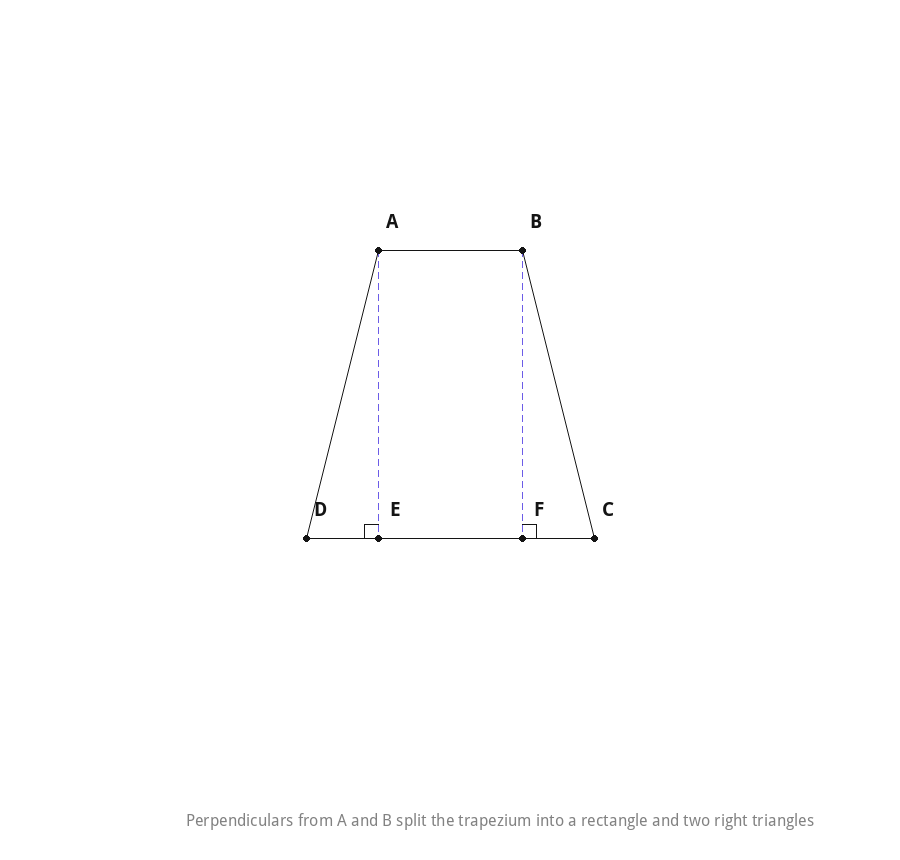
Q2. The parallel sides of a trapezium are 40 cm and 20 cm. If its non-parallel sides are both equal, each being 26 cm, find the area of the trapezium — Answer: Dropping perpendiculars from the ends of the shorter parallel side creates a…
Answer: Dropping perpendiculars from the ends of the shorter parallel side creates a central rectangle (width 20 cm) and two congruent right triangles at the ends, each with base (40 − 20)/2 = 10 cm and hypotenuse 26 cm. By the Baudhāyana–Pythagoras theorem, height h: h² = 26² − 10² = 676 − 100 = 576 ⟹ h = 24 cm.
Area = ½ × (a + b) × h = ½ × (40 + 20) × 24 = 720 cm².
Alternative (special case of Brahmagupta’s formula for an isosceles trapezium): Area = (a + b)√[c² − (b − a)²] where a = half the difference of the parallel sides = 10, b = shorter parallel side = 20, c = non-parallel side = 26: Area = 30√(26² − 10²) = 30√576 = 30 × 24 = 720 cm². Both methods agree.
Q3. Find the area of a triangle, given that its sides are 8 cm and 11 cm long, and its perimeter is 32 cm — Answer: Third side = 32 − (8 + 11) = 13 cm. Semi-perimeter s = 16 cm. By Heron's…
Answer: Third side = 32 − (8 + 11) = 13 cm. Semi-perimeter s = 16 cm. By Heron’s formula, Area = √[s(s−a)(s−b)(s−c)] = √[16 × 8 × 5 × 3] = √1920 = √(64 × 30) = 8√30 ≈ 43.82 cm².
Q4. The sides of a triangular plot are in the ratio 3 : 5 : 7; its perimeter is 300 m. Find its area — Answer: Let the sides be 3x, 5x, 7x. Then 15x = 300 ⟹ x = 20, so the sides are 60 m,…
Answer: Let the sides be 3x, 5x, 7x. Then 15x = 300 ⟹ x = 20, so the sides are 60 m, 100 m, 140 m, and s = 150 m. Area = √[150(150−60)(150−100)(150−140)] = √[150 × 90 × 50 × 10] = √6,750,000 = 1500√3 ≈ 2598.08 m².
Q5. One diagonal of a rhombus is twice as long as the other diagonal. If the rhombus has an area of 128 cm², find the length of the shorter diagonal — Answer: Let the diagonals be d₁ = x and d₂ = 2x. Area = ½d₁d₂ = ½ × x × 2x =…
Answer: Let the diagonals be d₁ = x and d₂ = 2x. Area = ½d₁d₂ = ½ × x × 2x = x² = 128 ⟹ x = √128 = 8√2 ≈ 11.31 cm (the shorter diagonal).
Q6. ABCD is a parallelogram. P and Q are any two points on side AB. What can you say about the ratio area(△PCD) : area(△QCD)? — Answer: Both △PCD and △QCD sit on the same base CD, and since AB ∥ CD, both…
Answer: Both △PCD and △QCD sit on the same base CD, and since AB ∥ CD, both triangles have the same perpendicular height (the distance between the parallel sides). Triangles with the same base and equal height have equal area, so area(△PCD) : area(△QCD) = 1 : 1.
Q7. O is any point on the diagonal PR of a parallelogram PQRS. Prove that the areas of triangles PSO and PQO are equal — Answer: Draw diagonal QS, meeting PR at T. In △PSQ, PT is a median (T is the midpoint…
Answer: Draw diagonal QS, meeting PR at T. In △PSQ, PT is a median (T is the midpoint of QS, since diagonals of a parallelogram bisect each other), so area(△PST) = area(△PQT) …(i) [a median splits a triangle into two equal-area triangles]. Similarly, in △OSQ, OT is a median, so area(△OST) = area(△OQT) …(ii). Subtracting (ii) from (i): area(△PST) − area(△OST) = area(△PQT) − area(△OQT) ⟹ area(△PSO) = area(△PQO), as required.
Q8. If the midpoints of the sides of a 4-gon are joined in order, prove that the area of the parallelogram thus formed is half of the area of the given 4-gon — Answer: Let ABCD be the quadrilateral with P, Q, R, S the midpoints of AB, BC, CD, DA.…
Answer: Let ABCD be the quadrilateral with P, Q, R, S the midpoints of AB, BC, CD, DA. Since P and Q are midpoints of AB and BC, PQ ∥ AC and PQ = ½AC, and the height of △PBQ is half the height of △ABC (measured from AC); hence area(△PBQ) = ¼area(△ABC) …(i). By the same reasoning on the opposite corner, area(△SDR) = ¼area(△ADC) …(ii). Adding (i) and (ii): area(△PBQ) + area(△SDR) = ¼[area(△ABC) + area(△ADC)] = ¼area(ABCD) …(iii). Similarly, from the other two corners: area(△PAS) + area(△QCR) = ¼area(ABCD) …(iv). Adding (iii) and (iv), the four corner triangles together have area = ½area(ABCD). Therefore area(PQRS) = area(ABCD) − ½area(ABCD) = ½area(ABCD), as required.
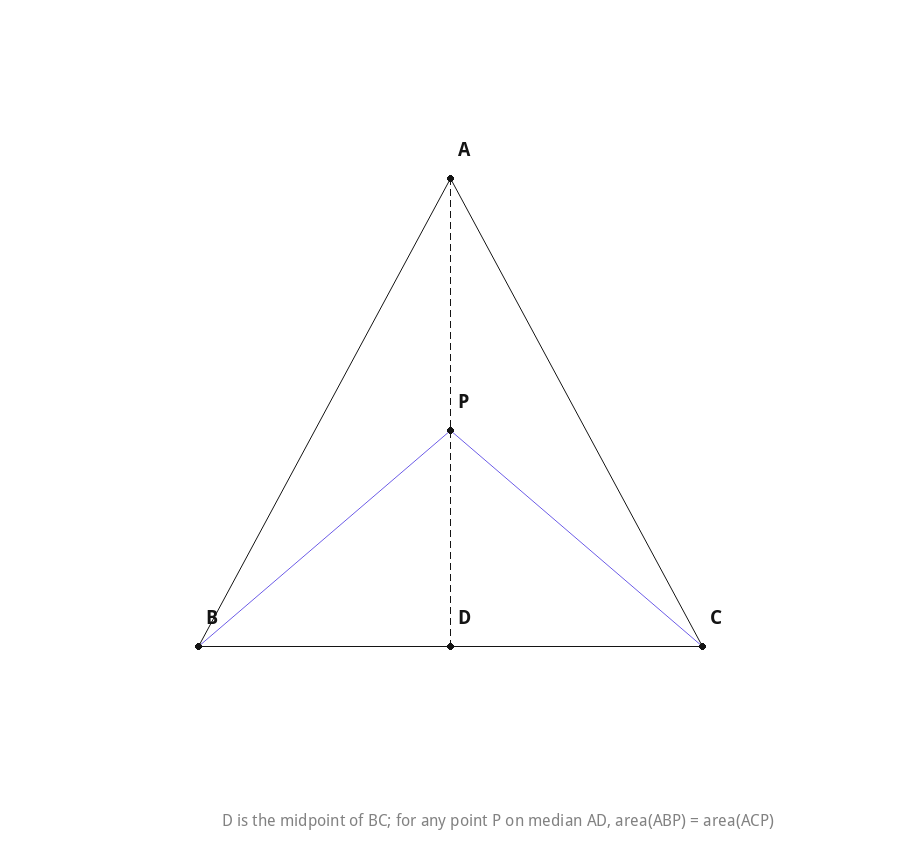
Q9. In △ABC, the midpoint of BC is D (Fig. 6.32). Median AD is drawn. P is any point on AD. Show that area(△ABP) = area(△ACP) — Answer: Since AD is the median of △ABC, area(△ABD) = area(△ACD) …(i). Since PD…
Answer: Since AD is the median of △ABC, area(△ABD) = area(△ACD) …(i). Since PD is the median of △PBC (as BD = DC), area(△PBD) = area(△PCD) …(ii). Subtracting (ii) from (i): area(△ABD) − area(△PBD) = area(△ACD) − area(△PCD) ⟹ area(△ABP) = area(△ACP), as required.
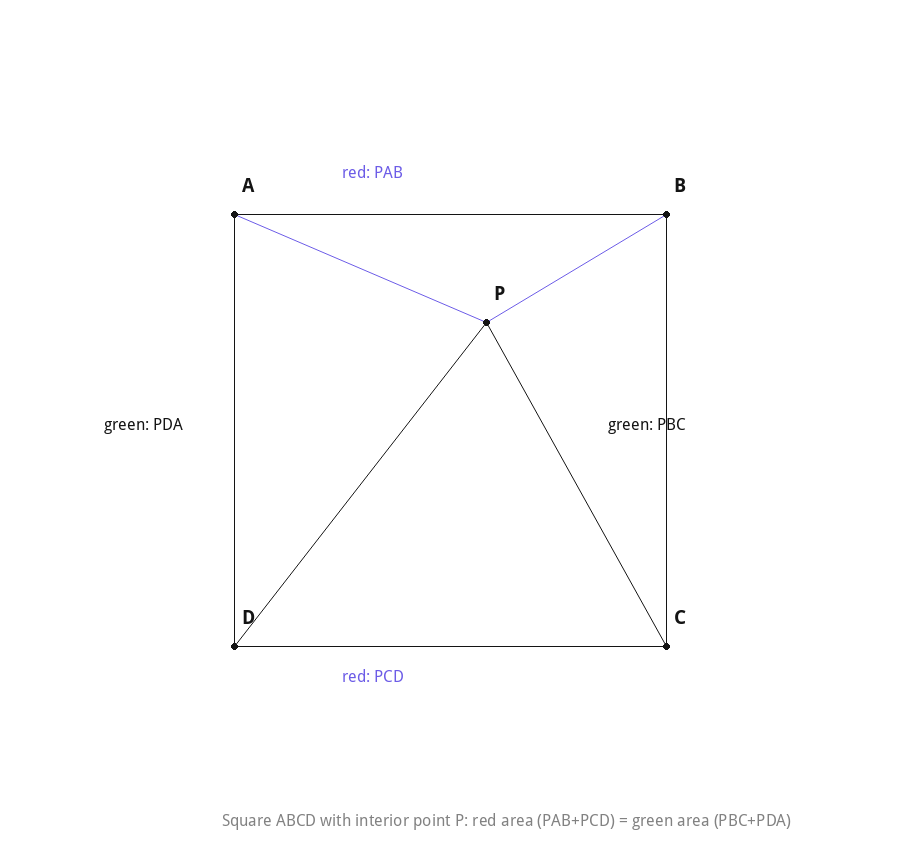
Q10. Given a square ABCD, let P be a point within it. Join PA, PB, PC, PD (Fig. 6.33). What is the ratio of the areas of the red region (△PAB and △PCD) to the green region (△PBC and △PDA)? — Answer: Draw a line through P parallel to BC, dividing the square into two rectangles.…
Answer: Draw a line through P parallel to BC, dividing the square into two rectangles. △PBC and the rectangle containing it share base BC and lie between the same parallels, so area(△PBC) = ½ area(that rectangle); similarly area(△PAD) = ½ area(the other rectangle). Adding these, the total green area = ½ area(square ABCD). By the same argument using a line through P parallel to AB, the total red area also = ½ area(square ABCD). Hence the ratio of red to green area is 1 : 1, regardless of where P is located inside the square.
Q11. In △ABC, D is the midpoint of AB. P is any point on BC, and Q is a point on AB such that CQ ∥ PD. PQ is joined (Fig. 6.34). Prove that Area(△BPQ) = ½ Area(△ABC) — Answer: Join DC. Since CD is the median of △ABC (D is the midpoint of AB),…
Answer: Join DC. Since CD is the median of △ABC (D is the midpoint of AB), area(△BDC) = ½area(△ABC) …(i). Since △DPQ and △DPC lie on the same base DP and between the same parallels DP ∥ CQ, area(△DPC) = area(△DPQ) …(ii). Now area(△BDC) = area(△BPD) + area(△DPC) = area(△BPD) + area(△DPQ) [using (ii)] = area(△BPQ). Combining with (i): area(△BPQ) = ½area(△ABC), as required.
6.3 Squaring a Rectangle and the Area of a Circle — Exercise Set 6.3 (Page 150)
Section 6.9 presents Baudhāyana’s ancient construction for turning any rectangle into a square of equal area (a geometric picture of the identity [(a+b)/2]² − [(a−b)/2]² = ab), and Section 6.10 traces the history of approximating the area of a circle — from the Babylonians and Egyptians through Archimedes’ proof that Area = πr², to Nīlakaṇṭha Somayājī’s visual “slicing” argument — before deriving the sector-area formula πr² × (θ°/360°) and the segment-area idea (sector minus triangle) used throughout Exercise 6.3. Unless stated otherwise, use 22/7 for π.
Think and Reflect (Page 142): What procedure would you use to “square” a given triangle — that is, construct a square with the same area as a given triangle?
Answer: Since we can’t turn a triangle directly into a square, we use a rectangle as a bridge: Triangle → Rectangle → Square.
Step 1 (Triangle to Rectangle): For △ABC with base BC = b and height AD = h, Area = ½bh. Bisect the height at E (so DE = h/2) and construct rectangle BCGF with one side BC = b and the other side DE = h/2. The two small triangles cut off from the triangle exactly fill the two corners left uncovered in the rectangle, so the rectangle’s area = b × h/2 = ½bh, matching the triangle exactly.
Step 2 (Rectangle to Square): Apply Baudhāyana’s rectangle-squaring construction (Section 6.9) to turn this rectangle into a square of the same area, using the identity [(a+b)/2]² − [(a−b)/2]² = ab.
Q1. Find the area of a sector of a circle with radius 7 cm if the angle of the sector is 60° — Answer: Area = (θ/360°) × πr² = (60/360) × 22/7 × 49 = (1/6) × 154 = 77/3 =…
Answer: Area = (θ/360°) × πr² = (60/360) × 22/7 × 49 = (1/6) × 154 = 77/3 = 25⅔ cm².
Q2. Find the area of a quadrant of a circle whose circumference is 44 cm — Answer: 2πr = 44 ⟹ r = 7 cm. Area of quadrant = ¼πr² = ¼ × 22/7 × 49 = 77/2 =…
Answer: 2πr = 44 ⟹ r = 7 cm. Area of quadrant = ¼πr² = ¼ × 22/7 × 49 = 77/2 = 38.5 cm².
Q3. The length of the minute hand of a clock is 7 cm. Find the area swept by the minute hand in 10 minutes — Answer: In 10 minutes the minute hand sweeps θ = (10/60) × 360° = 60°. Area swept =…
Answer: In 10 minutes the minute hand sweeps θ = (10/60) × 360° = 60°. Area swept = (θ/360°) × πr² = (60/360) × 22/7 × 49 = 77/3 = 25⅔ cm².
Q4. A chord of a circle of radius 10 cm subtends 90° at the centre. Find the area of the corresponding: (i) minor sector, and (ii) major sector (that subtends 270°). (Use π = 3.14.) — Answer: (i) Minor sector (θ = 90°): Area = (90/360) × 3.14 × 100 = 78.5 cm². (ii)…
Answer: (i) Minor sector (θ = 90°): Area = (90/360) × 3.14 × 100 = 78.5 cm². (ii) Major sector (θ = 270°): Area = (270/360) × 3.14 × 100 = 235.5 cm² [minor sector = 78.5 cm²].
Q5. A chord of a circle of radius 15 cm subtends an angle of 60° at the centre. Find the areas of the corresponding minor and major segments. (Use π = 3.14, √3 = 1.73.) — Answer: Since the isosceles triangle OAB formed by the chord and two radii has its…
Answer: Since the isosceles triangle OAB formed by the chord and two radii has its vertex angle equal to 60°, its base angles are also 60° each, making it equilateral with side 15 cm.
Area of minor segment = area of sector − area of equilateral triangle = (60/360) × 3.14 × 225 − (√3/4) × 225 = 117.75 − 97.3125 = 20.44 cm² (approx.).
Area of major segment = area of circle − area of minor segment = 3.14 × 225 − 20.44 = 706.5 − 20.44 = 686.06 cm².
Q6. A car has two wipers that do not overlap. Each wiper has a blade of length 28 cm and sweeps through an angle of 120°. Find the total area cleaned at each sweep of the blades — Answer: Area swept by one blade = (120/360) × 22/7 × 28² = ⅓ × 22/7 × 784 =…
Answer: Area swept by one blade = (120/360) × 22/7 × 28² = ⅓ × 22/7 × 784 = 2464/3 = 821⅓ cm². Total area cleaned by both blades (they don’t overlap) = 2 × 821⅓ = 1642⅔ cm².
Q7. A chord of a circle of radius r subtends an angle of 60° at the centre. Show that the area of the corresponding minor segment is πr²(1/6 − √3/4π) — Answer: As in Q5, the triangle OAB is equilateral (vertex angle 60° forces base angles…
Answer: As in Q5, the triangle OAB is equilateral (vertex angle 60° forces base angles of (180° − 60°)/2 = 60° each), with side r. Area of minor segment = area of sector − area of equilateral triangle = (60°/360°)πr² − (√3/4)r² = πr²/6 − √3r²/4 = r²(π/6 − √3/4) = πr²(1/6 − √3/(4π)), as required.
Q8. An equilateral triangle is inscribed in a circle of radius r. Show that the ratio of the area of the triangle to the area of the circle is 3√3/4π ≈ 0.413 — Answer: Let △ABC be equilateral, inscribed in a circle of radius r, centre O. The…
Answer: Let △ABC be equilateral, inscribed in a circle of radius r, centre O. The centroid O divides the median AD in ratio 2 : 1, so AD = (3/2)OA = (3/2)r. Also, for an equilateral triangle of side a, AD = (√3/2)a. Equating: (3/2)r = (√3/2)a ⟹ a = √3r. Area of △ABC = (√3/4)a² = (√3/4)(3r²) = (3√3/4)r². Area of circle = πr². Ratio = (3√3/4)r² ÷ πr² = 3√3/(4π) ≈ (3 × 1.73)/(4 × 3.14) ≈ 5.19/12.56 ≈ 0.413.
Q9. A square is inscribed in a circle of radius r. Show that the ratio of the area of the square to the area of the circle is 2/π ≈ 0.637 — Answer: The diagonal of an inscribed square equals the diameter of the circle: diagonal…
Answer: The diagonal of an inscribed square equals the diameter of the circle: diagonal = 2r. Since diagonal = √2 × side, side a = 2r/√2 = √2r. Area of square = (√2r)² = 2r². Area of circle = πr². Ratio = 2r² ÷ πr² = 2/π ≈ 0.637.
Q10. A regular hexagon is inscribed in a circle of radius r. Show that the ratio of the area of the hexagon to the area of the circle is 3√3/2π ≈ 0.827. Why is this exactly twice the answer to Q8? — Answer: A regular hexagon inscribed in a circle of radius r can be split into 6…
Answer: A regular hexagon inscribed in a circle of radius r can be split into 6 equilateral triangles, each of side r (each central angle is exactly 60°). Area of hexagon = 6 × (√3/4)r² = (3√3/2)r². Area of circle = πr². Ratio = (3√3/2)r² ÷ πr² = 3√3/(2π) ≈ 0.827. This is exactly double the ratio for the inscribed equilateral triangle (Q8) because the equilateral triangle is made of 3 such central triangles meeting at the centre, while the hexagon — inscribed in the very same circle — is made of 6 of them; since both use identical triangles of side r, the hexagon simply covers exactly twice the area the triangle does.
End-of-Chapter Exercises (Page 154)
The chapter closes with a substantial 27-question set that revisits every idea covered — perimeter, arc length, Heron’s formula, the special isosceles-triangle-area shortcut, parallelograms, trapeziums, kites, dissection/rearrangement arguments, and several classical results such as the Lune of Hippocrates. Unless stated otherwise, use 22/7 for π.
Q1. Draw figures corresponding to the identities (a + b)(a − b) = a² − b² and (a + b + c)² = a² + b² + c² + 2ab + 2bc + 2ca, similar to how (a + b)² = a² + 2ab + b² is shown as an area model — Answer: For (a + b)(a − b) = a² − b²: take a square of side a and remove a square…
Answer: For (a + b)(a − b) = a² − b²: take a square of side a and remove a square of side b from one corner, leaving an L-shaped region of area a² − b². Cut this L-shape into two trapezoidal strips and rearrange them into a rectangle of dimensions (a + b) by (a − b); its area is still a² − b², so (a + b)(a − b) = a² − b².
For (a + b + c)² = a² + b² + c² + 2ab + 2bc + 2ca: draw a square of side (a + b + c) and split each side into segments a, b, c, creating a 3 × 3 grid of 9 cells. Three cells on the “diagonal” have areas a², b², c²; the remaining six cells pair up into three pairs of equal rectangles with areas ab, ab, bc, bc, ca, ca. Adding all nine cells gives a² + b² + c² + 2ab + 2bc + 2ca, matching the total area (a + b + c)².
Q2. An isosceles triangle has a perimeter of 40 cm; the equal sides are 15 cm each. Find the area of the triangle — Answer: Base = 40 − 15 − 15 = 10 cm. Semi-perimeter s = 20 cm. Area =…
Answer: Base = 40 − 15 − 15 = 10 cm. Semi-perimeter s = 20 cm. Area = √[s(s−a)(s−b)(s−c)] = √[20 × 5 × 5 × 10] = √5000 = 50√2 ≈ 70.71 cm².
Q3. An isosceles triangle has a base of 10 cm, and its area is 60 cm². What are the lengths of the equal sides? — Answer: Using the shortcut for an isosceles triangle, Area = b√(a² − b²), where a…
Answer: Using the shortcut for an isosceles triangle, Area = b√(a² − b²), where a = equal side and b = half the base. Here b = 5 cm and Area = 60 cm²: 60 = 5√(a² − 25) ⟹ 12 = √(a² − 25) ⟹ 144 = a² − 25 ⟹ a² = 169 ⟹ a = 13 cm.
Q4. The area of a right-angled triangle is 54 sq. cm. One of its legs has a length of 12 cm. Find its perimeter — Answer: Area = ½ × base × height ⟹ 54 = ½ × b × 12 ⟹ b = 9 cm. By the…
Answer: Area = ½ × base × height ⟹ 54 = ½ × b × 12 ⟹ b = 9 cm. By the Baudhāyana–Pythagoras theorem, hypotenuse = √(12² + 9²) = √225 = 15 cm. Perimeter = 12 + 9 + 15 = 36 cm.
Q5. The sides of a triangle are in the ratio 2 : 3 : 4, and its perimeter is 45 cm. Find its area — Answer: Let the sides be 2x, 3x, 4x: 9x = 45 ⟹ x = 5, so the sides are 10 cm, 15 cm,…
Answer: Let the sides be 2x, 3x, 4x: 9x = 45 ⟹ x = 5, so the sides are 10 cm, 15 cm, 20 cm. Semi-perimeter s = 22.5 cm. Area = √[22.5 × 12.5 × 7.5 × 2.5] = √5273.4375 = 18.75√15 ≈ 72.62 cm².
Q6. The sides of a triangle have lengths 7 cm, 24 cm, and 25 cm. Find the area of the triangle in two different ways — Answer: Since 7² + 24² = 49 + 576 = 625 = 25², this is a right triangle with legs 7…
Answer: Since 7² + 24² = 49 + 576 = 625 = 25², this is a right triangle with legs 7 and 24.
Method 1 (base × height): Area = ½ × 24 × 7 = 84 cm².
Method 2 (Heron’s formula): s = (7+24+25)/2 = 28. Area = √[28 × 21 × 4 × 3] = √7056 = 84 cm². Both methods give 84 cm².
Q7. If the wheel of a bicycle has a diameter of 60 cm, find how far a cyclist will have travelled after the wheel has rotated 100 times — Answer: One rotation covers a distance equal to the circumference: C = πd = 22/7 × 60…
Answer: One rotation covers a distance equal to the circumference: C = πd = 22/7 × 60 = 1320/7 ≈ 188.57 cm. Distance for 100 rotations = 100 × 1320/7 = 132000/7 ≈ 18,857.1 cm ≈ 188.57 m.
Q8. Find the area of a quadrant of a circle whose circumference is 66 cm — Answer: 2πr = 66 ⟹ r = 66 × 7/(2 × 22) = 21/2 = 10.5 cm. Area of quadrant = ¼πr²…
Answer: 2πr = 66 ⟹ r = 66 × 7/(2 × 22) = 21/2 = 10.5 cm. Area of quadrant = ¼πr² = ¼ × 22/7 × (21/2)² = 693/8 = 86⅝ cm².
Q9. The wheel of a car has an outer radius of 28 cm. Calculate how far the car travels after one complete turn of the wheel, and how many times the wheel turns during a journey of 1 km — Answer: Distance in one turn = C = 2πr = 2 × 22/7 × 28 = 176 cm. Since 1 km = 100,000…
Answer: Distance in one turn = C = 2πr = 2 × 22/7 × 28 = 176 cm. Since 1 km = 100,000 cm, number of turns = 100,000 ÷ 176 = 568 2/11, i.e., about 568 turns (with a small remainder, since the wheel completes 568 full turns plus a fraction of another).
Q10. Two rectangles have the same area and the same perimeter. Does this mean that they are congruent with each other? — Answer: Yes. For a rectangle with sides l and b, area A = lb and perimeter P = 2(l + b)…
Answer: Yes. For a rectangle with sides l and b, area A = lb and perimeter P = 2(l + b) form a system of two equations. Given fixed A and P, l and b are the two roots of the quadratic t² − (P/2)t + A = 0, which has exactly one unordered pair of solutions. So any two rectangles sharing the same A and the same P must have the same pair of dimensions {l, b} — they are congruent. (Note this is special to rectangles fixing both area and perimeter simultaneously — many different rectangles can share just the perimeter, or just the area, without being congruent; for example a 4 × 4 square and a 2 × 6 rectangle share perimeter 16 but have different areas, 16 and 12.)
Q11. Using the fact that the area of a parallelogram is base × height, and the given figure, show that the area of a trapezium is half the sum of the parallel sides × height, i.e., ½(a + b)h — Answer: In the figure, a trapezium with parallel sides a (top) and b (bottom) and height…
Answer: In the figure, a trapezium with parallel sides a (top) and b (bottom) and height h is split into a parallelogram (base a, height h, since opposite sides of a parallelogram are equal) and a triangle (base b − a, height h, the remaining part of the bottom side). Area of parallelogram = ah. Area of triangle = ½(b − a)h. Total area = ah + ½(b − a)h = ½(2a + b − a)h = ½(a + b)h, as required.
Q12. By dividing a trapezium into two triangles, show that its area is half the sum of the parallel sides multiplied by the height — Answer: Take trapezium ABCD with parallel sides AB = a and DC = b, and height h. Draw…
Answer: Take trapezium ABCD with parallel sides AB = a and DC = b, and height h. Draw diagonal BD, splitting it into △ABD (base AB = a, height h) and △BCD (base DC = b, height h — the perpendicular distance between the parallel lines is still h, no matter how the triangle is oriented). Area(△ABD) = ½ah and Area(△BCD) = ½bh. Total area = ½ah + ½bh = ½(a + b)h, matching the standard formula.
Q13. Show how we can use two identical copies of a trapezium to make a parallelogram, and how this gives the formula for the area of a trapezium — Answer: Take two identical copies of a trapezium with parallel sides a, b and height h.…
Answer: Take two identical copies of a trapezium with parallel sides a, b and height h. Rotate one copy by 180° and place it next to the first so that a side of length a on one copy touches a side of length b on the other. Together the two copies form a parallelogram with base (a + b) and height h, so its area = (a + b)h. Since this parallelogram is made of two identical trapeziums, the area of one trapezium = ½(a + b)h.
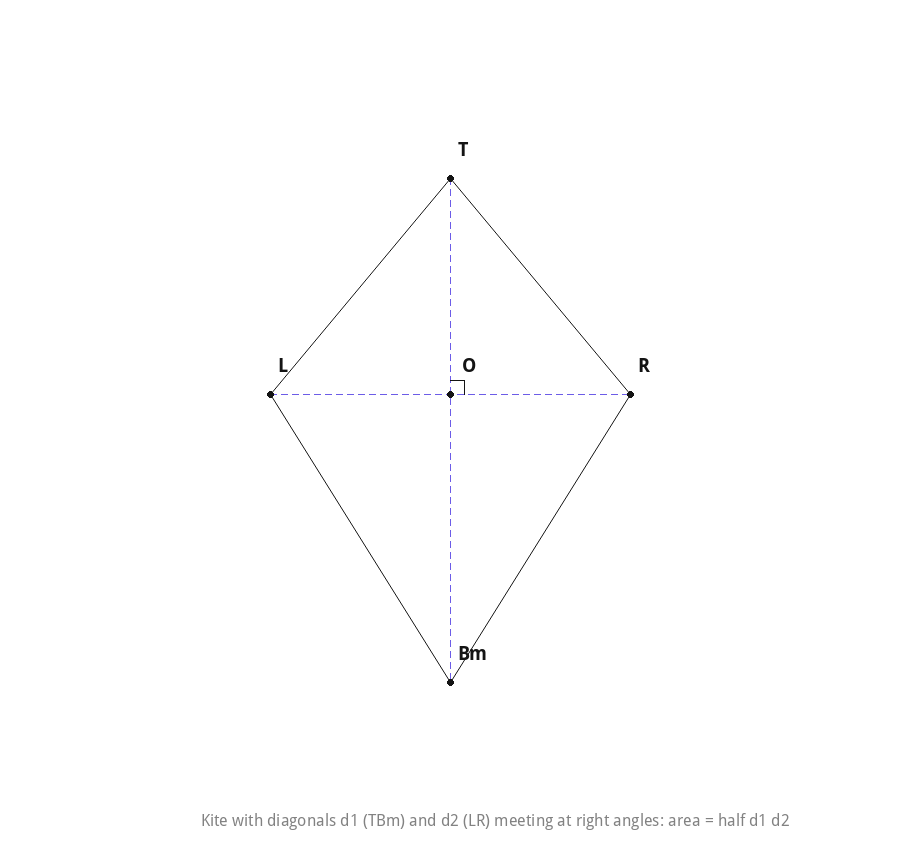
Q14. Show that the area of a kite is half the product of its diagonals: (i) using algebra, and (ii) using geometry — Answer: Let the diagonals be d₁ (= AC) and d₂ (= BD), which intersect at O…
Answer: Let the diagonals be d₁ (= AC) and d₂ (= BD), which intersect at O perpendicularly (a defining property of a kite), with d₁ split into two parts h₁ and h₂ by O.
(i) Algebra: Area = area(△ABD) + area(△CBD) = ½d₂h₁ + ½d₂h₂ = ½d₂(h₁ + h₂) = ½d₂d₁ = ½d₁d₂.
(ii) Geometry: Draw the rectangle that exactly bounds the kite, with sides d₁ and d₂; its area is d₁d₂. The four triangular corners of this rectangle that lie outside the kite are congruent, respectively, to the four triangular pieces of the kite that fill the rest of the rectangle, so the kite occupies exactly half of the rectangle — Area = ½d₁d₂.
Q15. Three problems about fitting congruent shapes together: (i) Rectangle ABCD has sides a, b; rectangle PQRS has sides 2a, 2b. Show PQRS has 4× the area of ABCD, and check whether 4 copies of ABCD fit into PQRS. (ii) △ABC has sides a, b, c; △PQR has sides 2a, 2b, 2c. Show △PQR has 4× the area, and check whether 4 copies of △ABC fit into △PQR. (iii) △ABC has sides a, b, c; △PQR has sides 3a, 3b, 3c. Show △PQR has 9× the area, and check whether 9 copies fit — Answer: Scaling every side of a shape by a factor k scales its area by k². (i)…
Answer: Scaling every side of a shape by a factor k scales its area by k².
(i) Area(ABCD) = ab; Area(PQRS) = 2a × 2b = 4ab = 4 × Area(ABCD). Yes — 4 copies of ABCD tile PQRS perfectly, arranged 2 along the length and 2 along the width.
(ii) By Heron’s formula, scaling all three sides by 2 scales s and each factor (s−a), (s−b), (s−c) by 2 as well, so Area(△PQR) = √[(2s)(2s−2a)(2s−2b)(2s−2c)] = √[16 × s(s−a)(s−b)(s−c)] = 4 × Area(△ABC). Yes — joining the midpoints of △PQR’s sides divides it into 4 congruent triangles, each congruent to △ABC (three “upright” and one “upside-down” in the middle), so 4 copies fit exactly.
(iii) Similarly, scaling all sides by 3 gives Area(△PQR) = √[(3s)(3s−3a)(3s−3b)(3s−3c)] = √[81 × s(s−a)(s−b)(s−c)] = 9 × Area(△ABC). Yes — dividing each side of △PQR into 3 equal parts and drawing lines parallel to the sides creates a triangular grid of 9 small triangles (1 + 3 + 5, in rows), each congruent to △ABC, so 9 copies fit exactly.
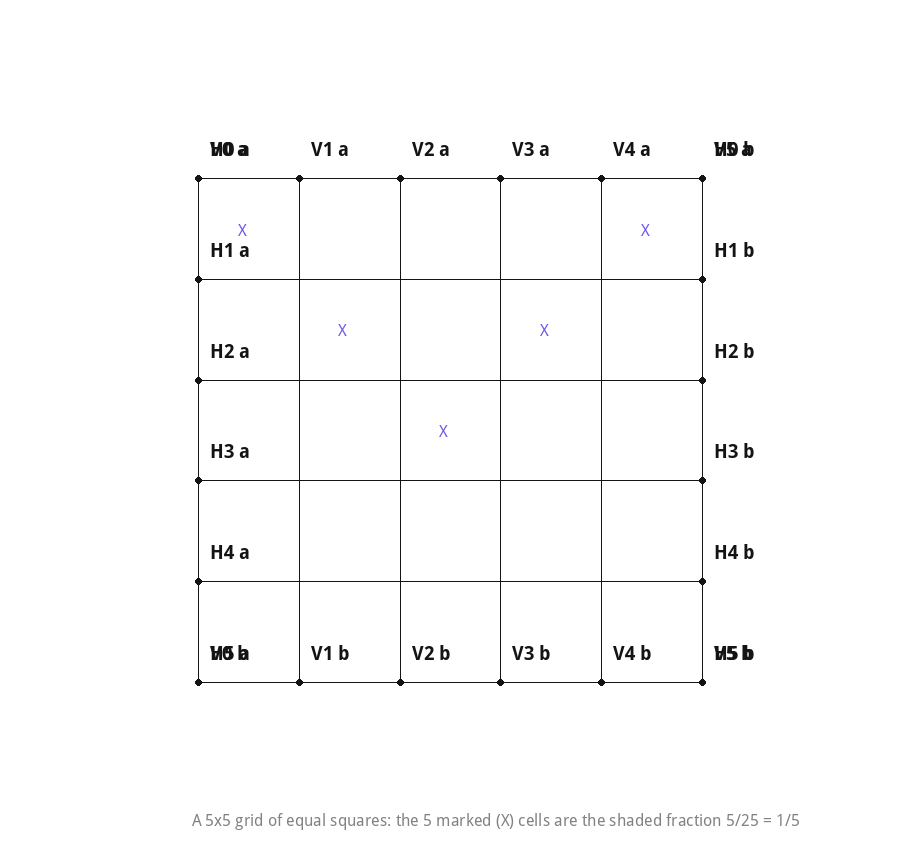
Q16. Find the shaded fraction in Fig. 6.43 (a triangle) and Fig. 6.44 (a square) — Answer: (i) Triangle (Fig. 6.43): Let the whole triangle's area be A. One side is…
Answer: (i) Triangle (Fig. 6.43): Let the whole triangle’s area be A. One side is bisected and the opposite side is trisected by the cevians drawn. Using the fact that a median splits a triangle into two equal-area halves, careful bookkeeping of the resulting small regions gives area a = area b = A/6 and area c = area d = A/3. The shaded region (b + c) = A/6 + A/3 = A/2, so the shaded fraction = 1/2.
(ii) Square (Fig. 6.44): Drawing lines through the vertices of the shaded region, parallel to the sides of the square, divides the whole square into 25 equal small squares, of which the shaded region covers exactly 5. So the shaded fraction = 5/25 = 1/5.
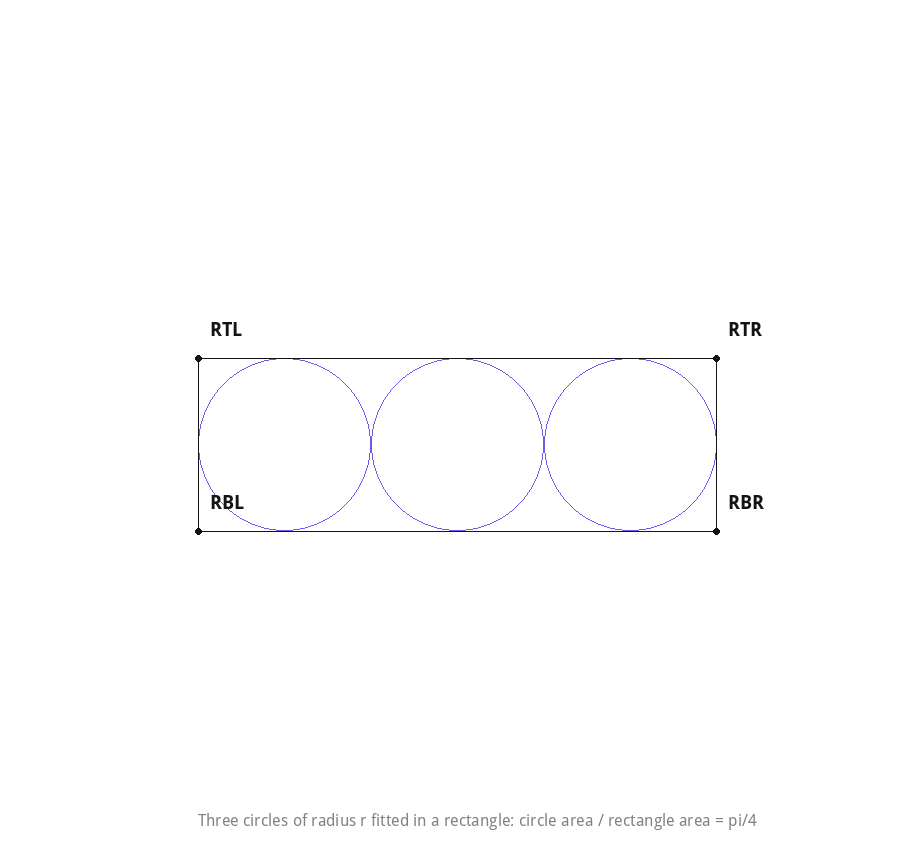
Q17. What fraction of the rectangle is covered by the circles in Fig. 6.45 (3 circles) and Fig. 6.46 (4 circles)? — Answer: Let each circle have radius r, so diameter 2r. Fig. 6.45 (3 circles in a row):…
Answer: Let each circle have radius r, so diameter 2r.
Fig. 6.45 (3 circles in a row): rectangle is 6r long and 2r wide, area = 12r². Total circle area = 3πr². Fraction covered = 3πr²/12r² = π/4.
Fig. 6.46 (4 circles in a row): rectangle is 8r long and 2r wide, area = 16r². Total circle area = 4πr². Fraction covered = 4πr²/16r² = π/4 — the same fraction, regardless of how many circles are lined up.
Q18. Make a conjecture about the fraction of a rectangle covered by circles fitted as in Q17. Test it for 10, 20 and 50 circles, then prove it — Answer: Conjecture: the fraction covered is always π/4, no matter how many circles are…
Answer: Conjecture: the fraction covered is always π/4, no matter how many circles are lined up.
Testing (each circle of radius r, n circles fitted end-to-end so the rectangle is 2nr long and 2r wide, area 4nr²; total circle area nπr²):
n = 10: rectangle area = 40r², circles = 10πr², fraction = 10πr²/40r² = π/4.
n = 20: rectangle area = 80r², circles = 20πr², fraction = 20πr²/80r² = π/4.
n = 50: rectangle area = 200r², circles = 50πr², fraction = 50πr²/200r² = π/4.
Proof: for general n, rectangle area = (2nr)(2r) = 4nr² and total circle area = nπr², so the fraction = nπr²/4nr² = π/4 for every n, since the n cancels out. Each circle simply occupies the same π/4 fraction of its own 2r × 2r “cell,” and the whole rectangle is just n identical cells side by side — so the overall fraction covered is always π/4 ≈ 0.785 (about 78.5%).
Q19. The figure shows nine identical rectangles fitted together to make a large rectangle whose area is 72 cm². Find the perimeter of each small rectangle — Answer: Let each small rectangle have length a and breadth b, with the arrangement…
Answer: Let each small rectangle have length a and breadth b, with the arrangement showing 4a = 5b (matching widths of the two rows/blocks in the figure) — i.e., b = (4/5)a. Total area of 9 small rectangles = 9ab = 72 ⟹ ab = 8. Substituting: a × (4/5)a = 8 ⟹ a² = 10 ⟹ a = √10 cm, and b = (4/5)√10 cm. Perimeter of one small rectangle = 2(a + b) = 2(√10 + 4√10/5) = 2 × (9√10/5) = (18/5)√10 ≈ 11.38 cm.
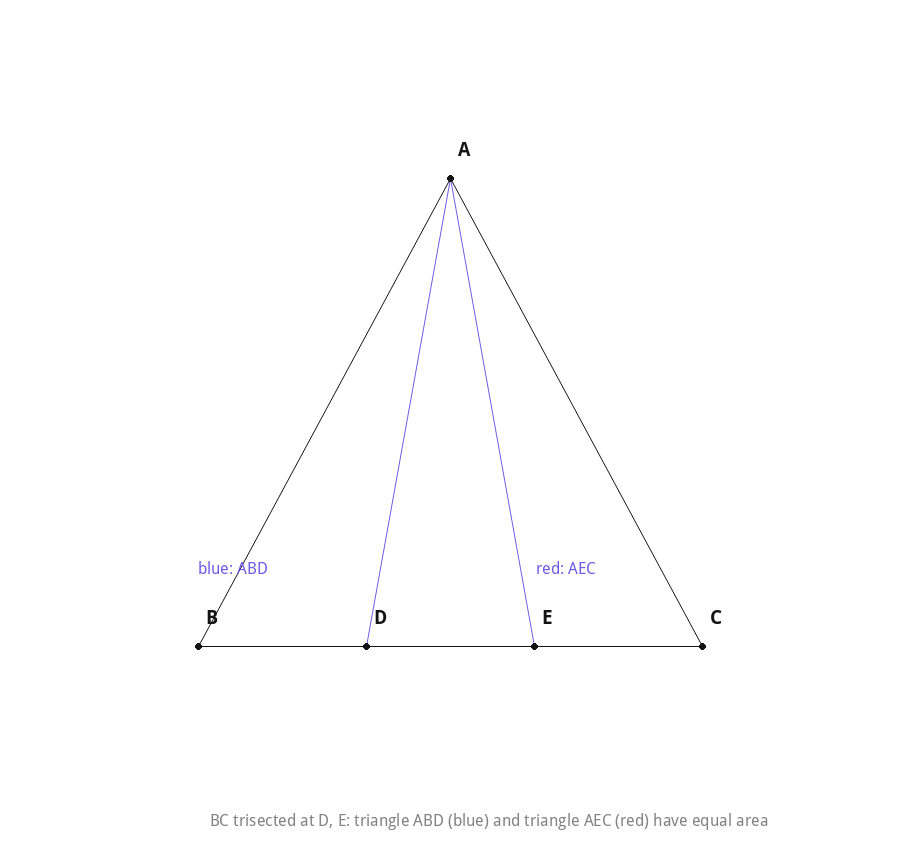
Q20. Lines are drawn from a vertex to the points that trisect the opposite side (Fig. 6.48). Show that the areas of the shaded blue triangle and the shaded red triangle are equal, and find a way of cutting up the blue triangle and rearranging the pieces to cover the red triangle — Answer: Let the base BC be trisected at D and E, with the blue triangle being △ABD and…
Answer: Let the base BC be trisected at D and E, with the blue triangle being △ABD and the red triangle being △AEC. Both triangles share the same apex A, so both have the identical perpendicular height from A to line BC. Their bases, BD and EC, are each exactly ⅓ of BC by construction (trisection), so BD = EC. Since the two triangles have equal bases and equal heights, Area(△ABD) = ½ × BD × h = ½ × EC × h = Area(△AEC), as required.
Rearrangement: cut the blue triangle along the segment joining vertex A to the midpoint of BD. Rotating one of the two resulting pieces by 180° about that midpoint turns the blue triangle into a parallelogram with base ½BD. Because BD = EC, the identical construction on the red triangle produces a congruent parallelogram — so the blue triangle’s two pieces can be rearranged to exactly cover the red triangle.
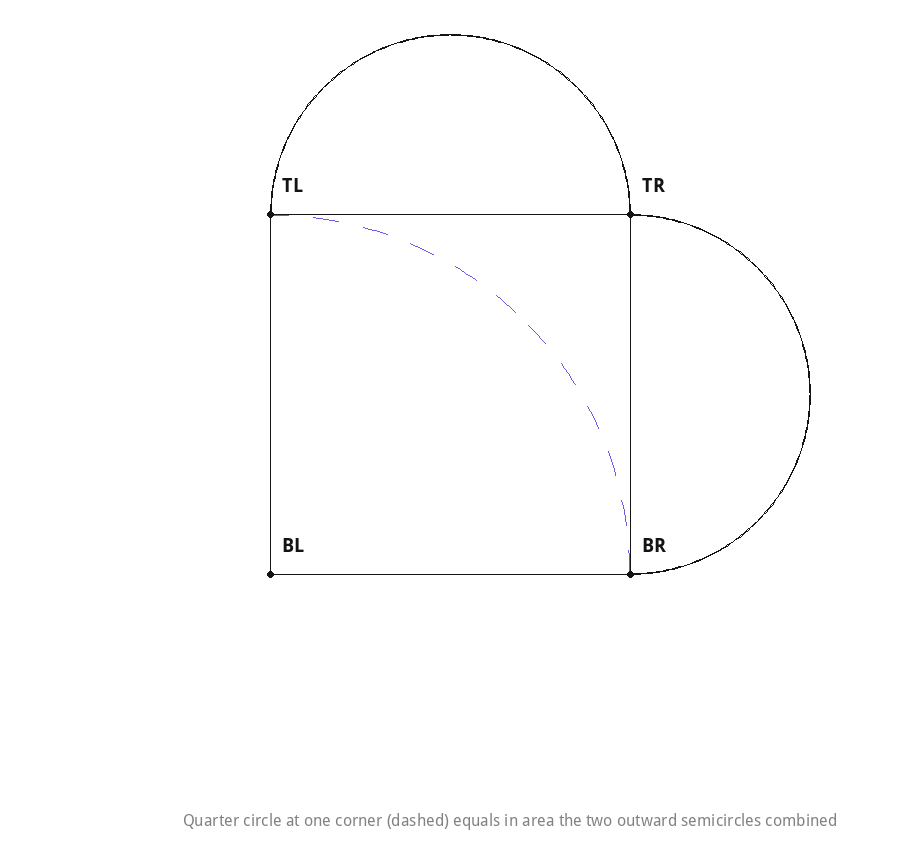
Q21. The figure shows a quarter circle in a square, centred at one vertex and passing through two adjacent vertices, with two semicircles drawn on two adjacent sides as diameters, creating shaded regions A and B. Show that A and B have equal area — Answer: Let the square have side a. The quarter circle (centred at the vertex, radius a)…
Answer: Let the square have side a. The quarter circle (centred at the vertex, radius a) has area ¼πa². Each semicircle (diameter = a side of the square, so radius a/2) has area ½π(a/2)² = πa²/8, and the two semicircles together have area 2 × πa²/8 = πa²/4 — exactly equal to the quarter circle’s area. Let C be the region common to both the quarter circle and the two semicircles (the overlap). Then: Area(quarter circle) = Area(C) + Area(B), where B is the part of the quarter circle outside the semicircles, and Area(semicircle 1) + Area(semicircle 2) = Area(C) + Area(A), where A is the part of the semicircles outside the quarter circle. Since the quarter circle and the combined semicircles have the same total area (πa²/4), Area(C) + Area(B) = Area(C) + Area(A), and cancelling Area(C) from both sides gives Area(A) = Area(B).
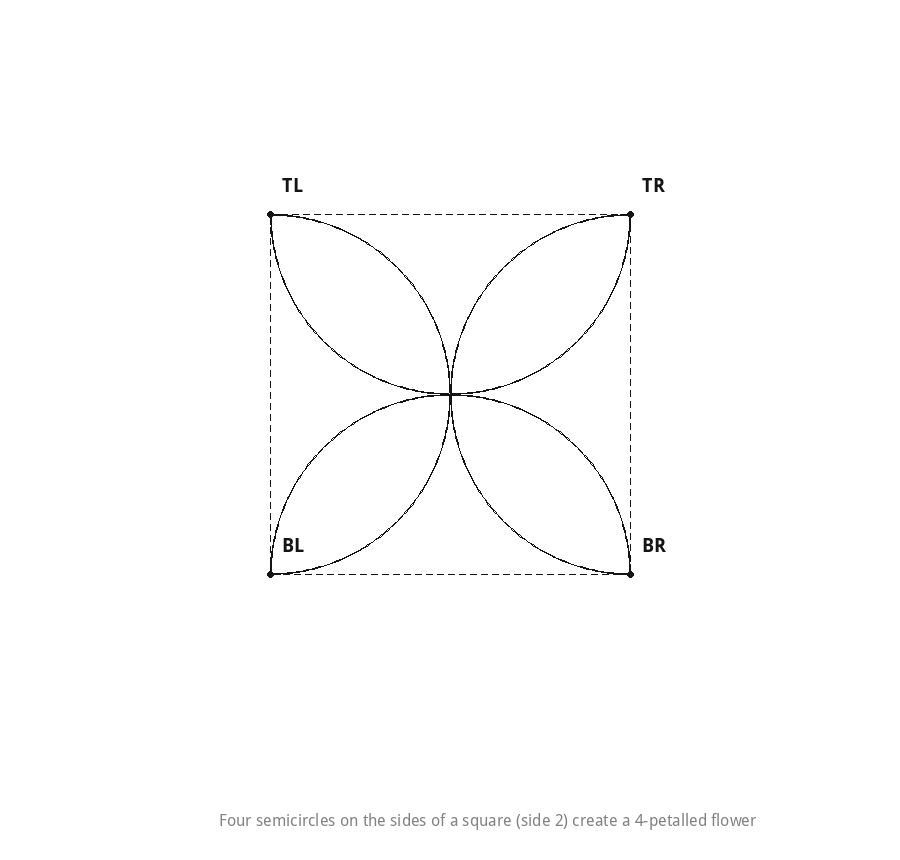
Q22. Four semicircles are drawn within a square of side 2 units, centred at the midpoints of the sides, creating a 4-petalled flower. Find the perimeter and the area of this flower — Answer: Each semicircle has a side of the square as its diameter, so radius = 1 unit.…
Answer: Each semicircle has a side of the square as its diameter, so radius = 1 unit.
Perimeter: each petal’s boundary is made of two quarter-arcs (each of radius 1), so each petal’s boundary length = π/2 + π/2 = π. With 4 petals, total perimeter = 4π ≈ 12.57 units.
Area: each petal is the lens-shaped overlap of two semicircles of radius 1, whose centres are √2 apart (the midpoints of two adjacent sides of a square of side 2). Using the standard “lens” (circle–circle intersection) area formula, each petal has area (π/2 − 1). Total area of 4 petals = 4(π/2 − 1) = 2π − 4 ≈ 2.28 sq units.
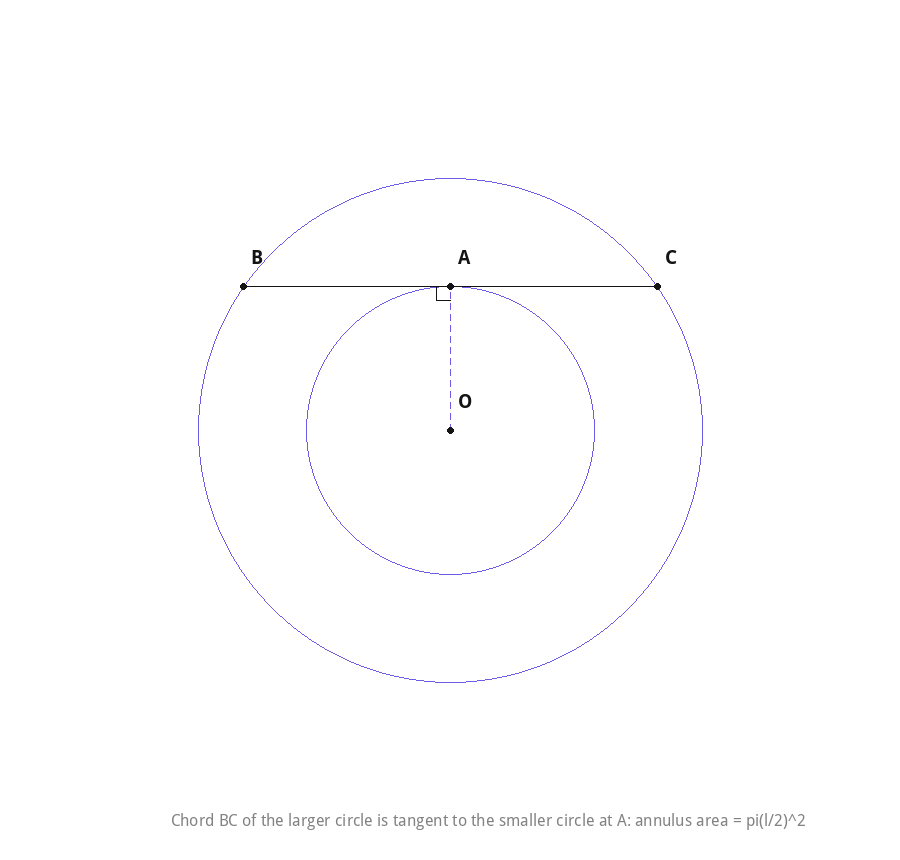
Q23. Two concentric circles have common centre O. A chord BC of the larger circle is tangent to the smaller circle at A, and BC has length l. Show that the area of the region between the two circles (the annulus) is ¼πl² — Answer: Let the radii be R (larger) and r (smaller). Since BC is tangent to the smaller…
Answer: Let the radii be R (larger) and r (smaller). Since BC is tangent to the smaller circle at A, OA ⊥ BC and OA = r. Because the perpendicular from the centre bisects a chord, A is the midpoint of BC, so AB = AC = l/2. In right triangle OAB, by the Baudhāyana–Pythagoras theorem: OB² = OA² + AB² ⟹ R² = r² + (l/2)² ⟹ R² − r² = l²/4. The area of the annulus = πR² − πr² = π(R² − r²) = π × l²/4 = ¼πl², as required.
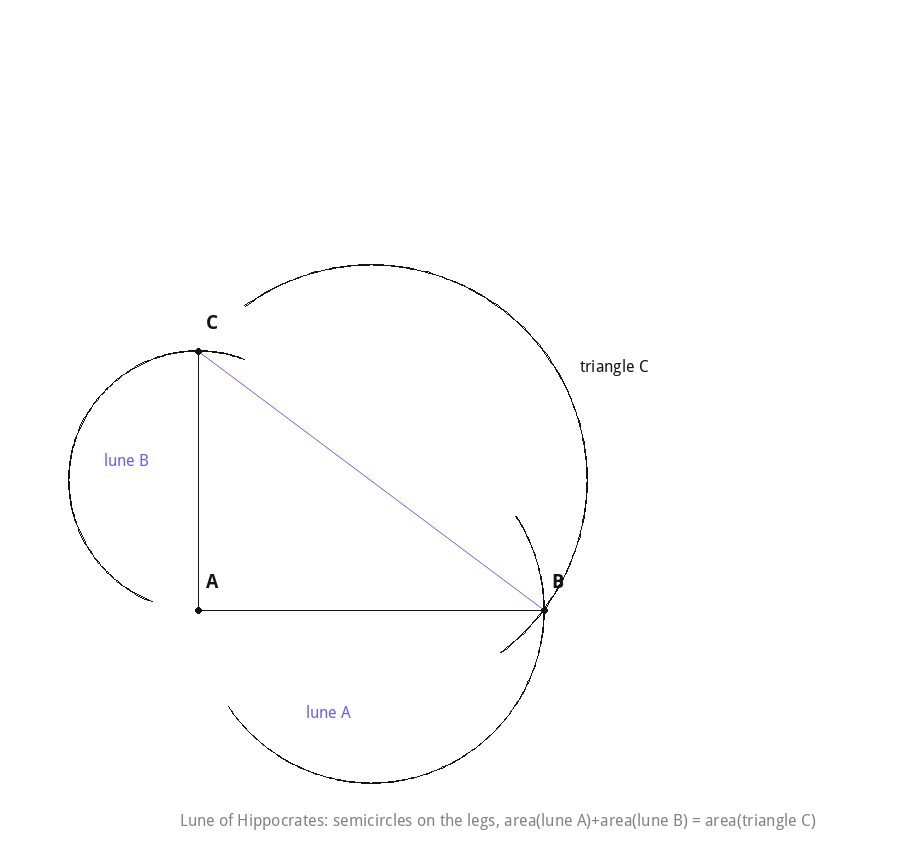
Q24. Semicircles are drawn on all three sides of a right-angled triangle. Show that Area(A) + Area(B) = Area(C), where A and B are the two crescent-shaped "lunes" on the legs and C is the triangle itself — Answer: This is the classical "Lune of Hippocrates" result. Let the right triangle have…
Answer: This is the classical “Lune of Hippocrates” result. Let the right triangle have legs p, q and hypotenuse r, so p² + q² = r² (Baudhāyana–Pythagoras theorem). Multiplying both sides by π/8 (since a semicircle of diameter d has area πd²/8): (semicircle on p) + (semicircle on q) = (semicircle on r). Now the semicircle on the hypotenuse can be split into the triangle C plus two circular segments (the parts cut off outside the triangle but inside that semicircle, using the fact that the right angle lies on a semicircle drawn on the hypotenuse — Thales’ theorem). Each leg’s semicircle similarly splits into its lune (A or B) plus one of those same two segments. Substituting these decompositions into the identity above and cancelling the two shared segments from both sides leaves Lune(A) + Lune(B) = Area(C), as required.
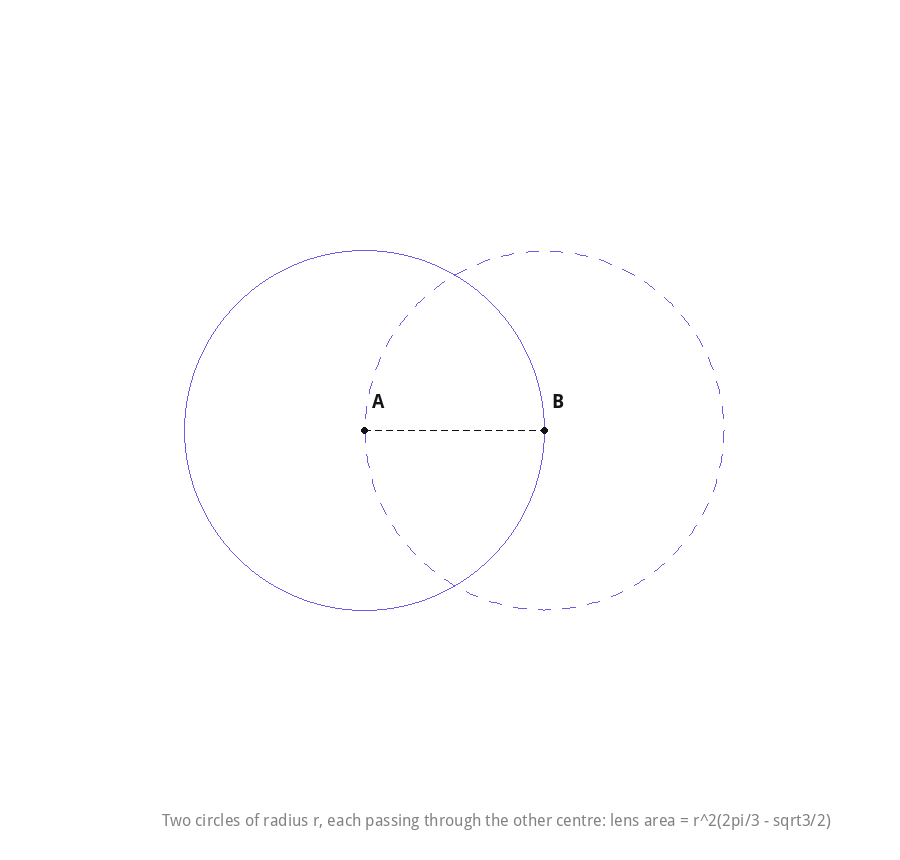
Q25. Two circles of common radius r pass through each other's centres (Fig. 6.53). Find the area of the region enclosed by both circles (the overlapping lens), in terms of r — Answer: Let the circles be centred at A and B (with AB = r, since each passes through…
Answer: Let the circles be centred at A and B (with AB = r, since each passes through the other’s centre), intersecting at C and D. Triangles ABC and ABD are both equilateral (all sides equal r), so ∠CAD = ∠CBD = 2 × 60° = 120°. The lens is made of two identical circular segments — one from each circle — each cut off by chord CD at a central angle of 120°.
Area of a 120° sector (radius r) = πr² × 120/360 = πr²/3. Area of the isosceles triangle with two sides r and included angle 120° = ½r²sin120° = (√3/4)r². So one segment = πr²/3 − (√3/4)r². The lens is made of two such segments: Area = 2[πr²/3 − (√3/4)r²] = r²(2π/3 − √3/2).
Q26. Three triangles A, B, C are formed within a rectangle by cevians drawn from a common point. Show that the area of the rectangle is 2(A + C)(B + C)/C — Answer: This result depends on exactly how the cevians are drawn in the textbook's…
Answer: This result depends on exactly how the cevians are drawn in the textbook’s figure (Fig. 6.54), which fixes which corner regions are labelled A, B and C. The general method used to prove such identities in this chapter is: set up coordinates for the rectangle’s vertices and the point from which the cevians are drawn; express each of A, B and C algebraically as ½ × base × height in terms of the rectangle’s width, height and the position of the common point; then substitute these expressions into 2(A + C)(B + C)/C and simplify — the position-dependent terms cancel out, leaving exactly width × height, i.e., the full area of the rectangle. Students should map the exact points labelled A, B, C in their own textbook figure onto variables and carry out this substitution, following the same “express each region, then simplify” strategy used in Q21, Q24 and Q27.
Q27. The figure shows two shaded regions formed by a quarter circle, a semicircle, and a triangle. Show that the areas of the two shaded regions are equal — Answer: This question belongs to the same family as Q21 and Q24 (constructions built on…
Answer: This question belongs to the same family as Q21 and Q24 (constructions built on the Lune of Hippocrates idea). The general strategy: identify the quarter circle, the semicircle and the triangle in the figure, and use the fact that the semicircle’s diameter is the triangle’s hypotenuse (so, by Thales’ theorem, the triangle is right-angled) to express all three areas in terms of the same base lengths, exactly as in Q24. Once the quarter circle’s area is shown to equal the sum of the semicircle’s and the triangle’s respective “extra” pieces (via the Baudhāyana–Pythagoras relation between the sides), subtracting the region common to both shaded areas from both sides of that equality forces the two shaded regions to be equal — the same “matching areas, then cancel the shared overlap” argument used throughout Q21–Q25.
Practice more: Extra Questions for Class 9 Mathematics Chapter 6
Quick revision: Revision Notes for Class 9 Mathematics Chapter 6
- Chapter 1: Orienting Yourself: The Use of Coordinates – Free PDF Download
- Chapter 2: Introduction to Linear Polynomials – Free PDF Download
- Chapter 3: The World of Numbers – Free PDF Download
- Chapter 4: Exploring Algebraic Identities – Free PDF Download
- Chapter 5: I'm Up and Down, and Round and Round – Free PDF Download
- Chapter 7: The Mathematics of Maybe: Introduction to Probability – Free PDF Download
- Chapter 8: Predicting What Comes Next?: Exploring Sequences and Progressions – Free PDF Download
Frequently Asked Questions
What is the difference between area and perimeter?
Perimeter is the total length of the boundary enclosing a shape (measured in linear units like cm or m); area is the amount of surface enclosed within that boundary (measured in square units like cm^2 or m^2) — two shapes can have the same perimeter but very different areas, or vice versa.
Which formulas from earlier classes are reused most in this chapter?
The area and perimeter formulas for rectangles, squares, triangles, parallelograms, and circles from earlier grades form the foundation here, since this chapter mainly applies them to composite/combined figures and real-life measurement problems.
Chapter Quiz — Test Your Understanding
Class 9 Mathematics Chapter 6: Measuring Space: Perimeter and Area – Notes and Extra Questions
Along with these NCERT Solutions, students can also use the Class 9 Mathematics Chapter 6 Extra Questions and Class 9 Mathematics Chapter 6 Revision Notes for quick revision and extra practice.
Recommended: Buy the Printed NCERT Class 9 Maths Book
Contains Amazon affiliate links.
If you’d like a printed copy alongside the PDF, here’s a verified option:
4.0 out of 5 stars (1,313 ratings) · Rs. 106
Price and availability may change on Amazon. As an Amazon Associate, ncertbooks.org earns from qualifying purchases.


