
Chapter 8 of Class 12 Maths is Applications of Integrals. It uses definite integrals to compute the area under curves, between curves, and bounded by circles/parabolas/ellipses.
Last Updated: September 23, 2026
Area Under a Curve
The area bounded by y=f(x), the x-axis, and the lines x=a, x=b is Area=∫ab|f(x)|dx (the modulus ensures a positive area even if the curve dips below the axis).
Area Between Two Curves
If f(x)≥g(x) on [a,b], the area between the curves is ∫ab[f(x)−g(x)]dx. Intersection points of the curves are found by solving f(x)=g(x) to determine the limits.
Area of Standard Curves
Circle x²+y²=a²: full area=πa², computed via 4∫0a√(a²−x²)dx for the first quadrant, multiplied by 4. Parabola y²=4ax and ellipse x²/a²+y²/b²=1 areas are computed similarly using integration with symmetry.
Sketching Regions
Before integrating, sketch the curves to correctly identify which function is on top/bottom (or left/right, for integration with respect to y) and determine the correct limits of integration.
Integration with Respect to y
When a region is more naturally described in terms of y (e.g. x=g(y)), the area formula becomes ∫cdx dy=∫cdg(y)dy.
Exercise 8.1 Solutions (All 4 Questions)
1. Find the area of the region bounded by the ellipse x²/16 + y²/9 = 1.
Ans: For the ellipse x²/a² + y²/b² = 1, the area enclosed is πab. Here a = 4, b = 3, so the area is π(4)(3) = 12π sq. units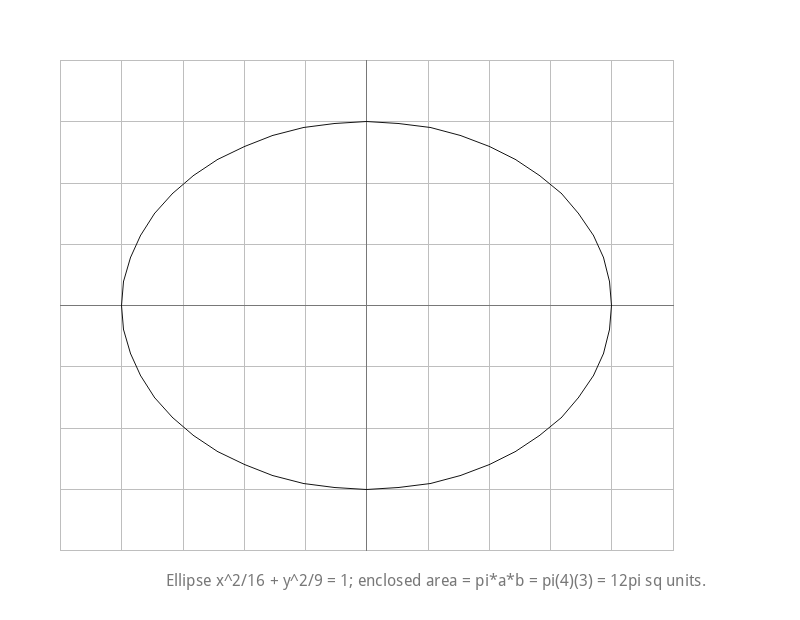
2. Find the area of the region bounded by the ellipse x²/4 + y²/9 = 1.
Ans: Here a = 2, b = 3, so the area is π(2)(3) = 6π sq. units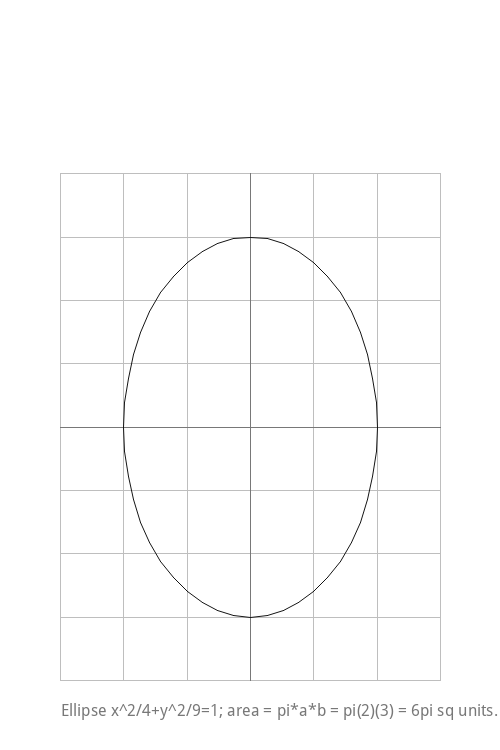
3. Choose the correct answer: Area lying in the first quadrant and bounded by the circle x² + y² = 4 and the lines x = 0 and x = 2 is
(A) π
(B) π/2
(C) π/3
(D) π/4
Ans: This region is exactly the quarter of the circle of radius 2 lying in the first quadrant. Its area is (1/4)π(2)² = π. The answer is (A)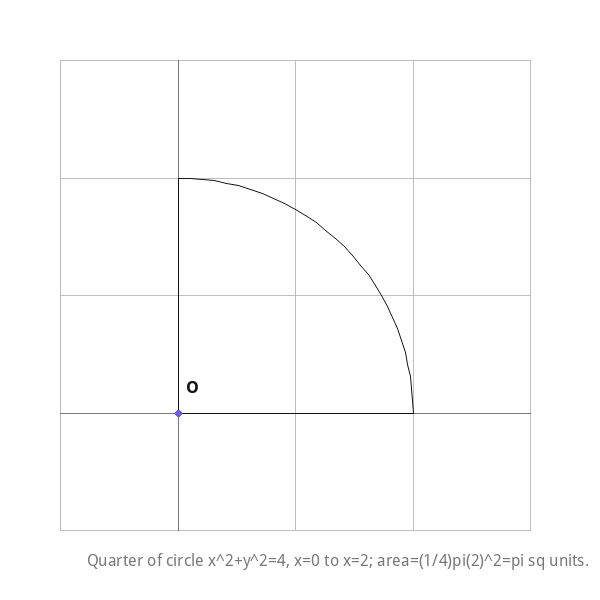
4. Choose the correct answer: Area of the region bounded by the curve y² = 4x, y-axis and the line y = 3 is
(A) 2
(B) 9/4
(C) 9/3
(D) 9/2
Ans: Integrating with respect to y, x = y²/4. The area is ∫03 (y²/4) dy = [y³/12]03 = 27/12 = 9/4. The answer is (B)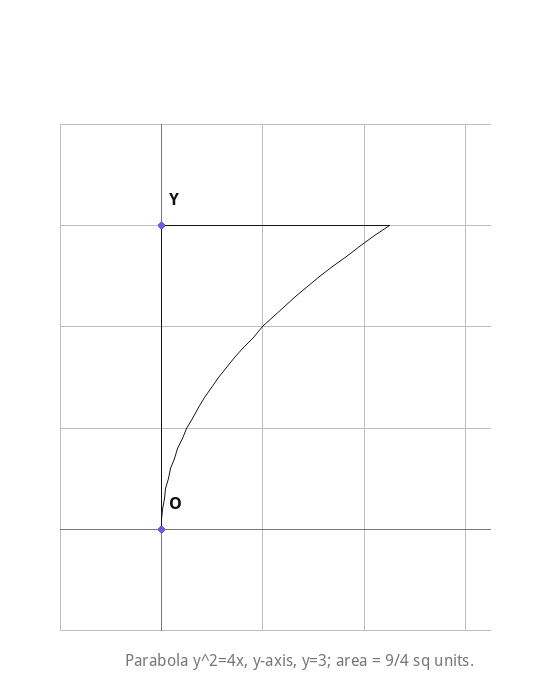
Miscellaneous Exercise Solutions (All 5 Questions)
1. Find the area under the given curves and given lines:
(i) y = x², x = 1, x = 2 and x-axis
Ans: Area = ∫12 x² dx = [x³/3]12 = (8-1)/3 = 7/3 sq. units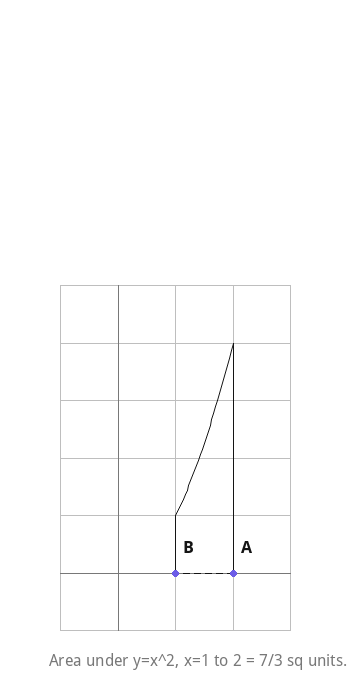
(ii) y = x⁴, x = 1, x = 5 and x-axis
Ans: Area = ∫15 x⁴ dx = [x⁵/5]15 = (3125-1)/5 = 3124/5 = 624.8 sq. units
2. Sketch the graph of y = |x + 3| and evaluate ∫-60 |x + 3| dx.
Ans: Splitting at x = -3, where |x+3| changes sign: ∫-6-3 -(x+3) dx + ∫-30 (x+3) dx = 4.5 + 4.5 = 9 sq. units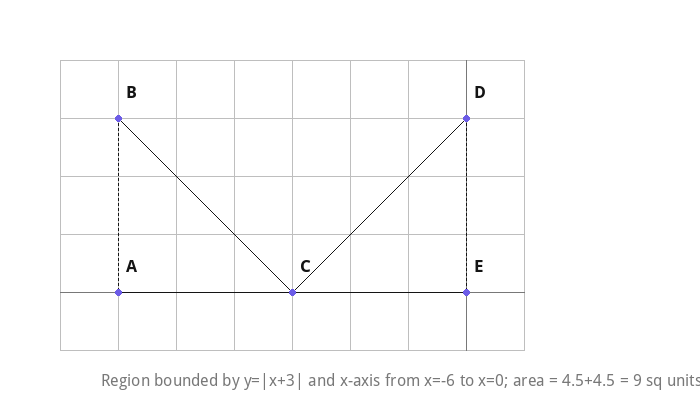
3. Find the area bounded by the curve y = sin x between x = 0 and x = 2π.
Ans: Since sin x is positive on [0,π] and negative on [π,2π], the total area is ∫0π sin x dx + |∫π2π sin x dx| = 2 + 2 = 4 sq. units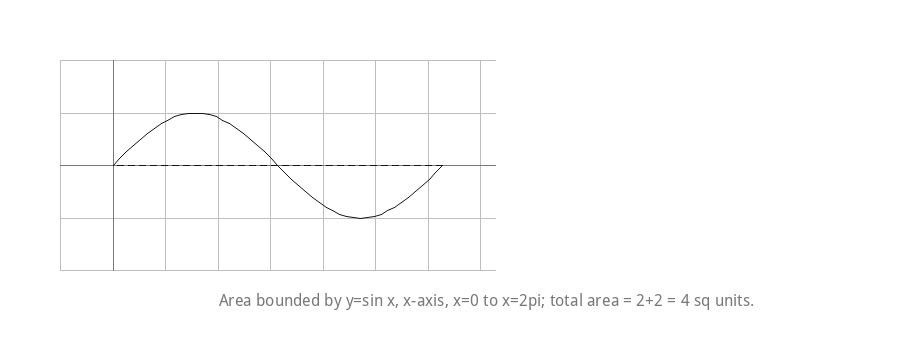
4. Choose the correct answer: Area bounded by the curve y = x³, the x-axis and the ordinates x = -2 and x = 1 is
(A) -9
(B) -15/4
(C) 15/4
(D) 17/4
Ans: Since y = x³ is negative on [-2,0] and positive on [0,1], the area is |∫-20 x³ dx| + ∫01 x³ dx = 4 + 1/4 = 17/4. The answer is (D)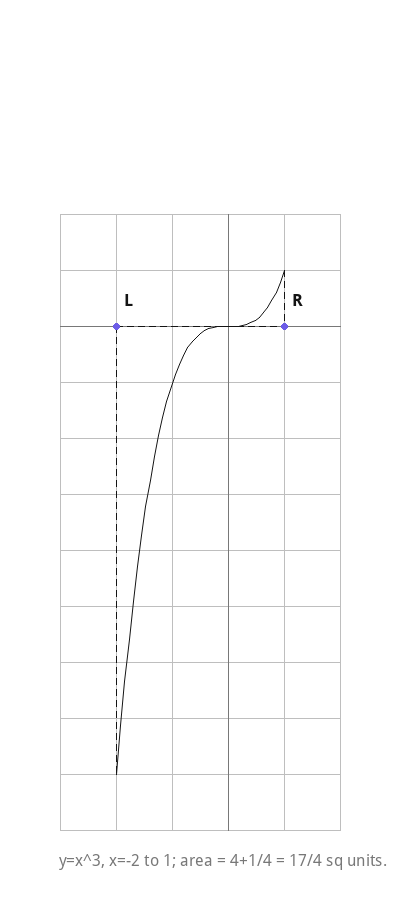
5. Choose the correct answer: The area bounded by the curve y = x|x|, x-axis and the ordinates x = -1 and x = 1 is given by
(A) 0
(B) 1/3
(C) 2/3
(D) 4/3
Ans: Since y = x|x| equals x² in magnitude on both sides of the origin, the total area is ∫-10 x² dx + ∫01 x² dx = 1/3 + 1/3 = 2/3. The answer is (C)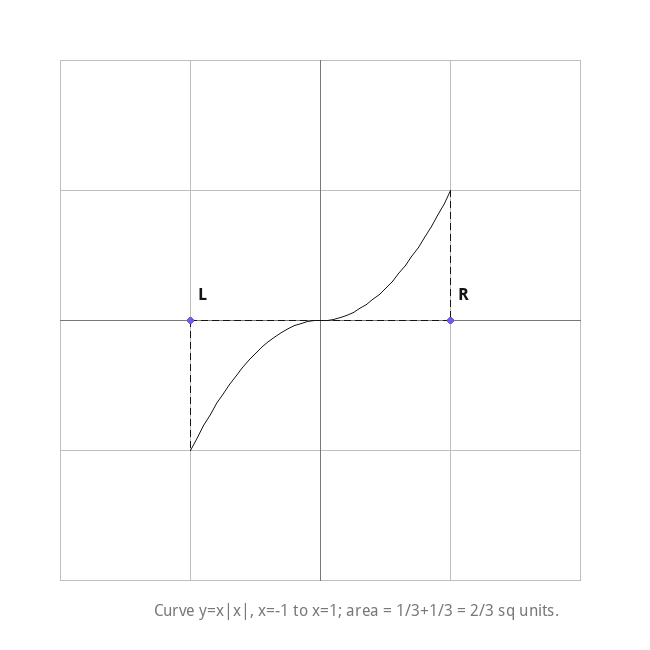
- Chapter 1: Relations and Functions – Free PDF Download
- Chapter 2: Inverse Trigonometric Functions – Free PDF Download
- Chapter 3: Matrices – Free PDF Download
- Chapter 4: Determinants – Free PDF Download
- Chapter 5: Continuity and Differentiability – Free PDF Download
- Chapter 6: Applications of Derivatives – Free PDF Download
- Chapter 7: Integrals – Free PDF Download
- Chapter 9: Differential Equations – Free PDF Download
- Chapter 10: Vectors – Free PDF Download
- Chapter 11: Three-Dimensional Geometry – Free PDF Download
- Chapter 12: Linear Programming – Free PDF Download
- Chapter 13: Probability – Free PDF Download
Frequently Asked Questions
Why is the modulus used in the area formula?
To ensure area is always positive, since integrals below the x-axis are negative but represent real (positive) area.
How do you find the area between two curves?
Find intersection points as limits, then integrate (upper curve − lower curve).
What is the area enclosed by a full circle of radius a?
πa².
Chapter Quiz — Test Your Understanding
Class 12 Mathematics Chapter 8 – Notes and Extra Questions
Along with these NCERT Solutions, students can also use the Class 12 Mathematics Chapter 8 Extra Questions and Class 12 Mathematics Chapter 8 Revision Notes for quick revision and extra practice.
See also: Chapter 1 | Chapter 2 | Chapter 3 | Chapter 4 | Chapter 5 | Chapter 6 | Chapter 7
Practice more: Chapter 1 | Chapter 2 | Chapter 3 | Chapter 4 | Chapter 5 | Chapter 6 | Chapter 7
Quick revision: Chapter 1 | Chapter 2 | Chapter 3 | Chapter 4 | Chapter 5 | Chapter 6 | Chapter 7
Recommended: Buy the Printed NCERT Class 12 Maths Book
Contains Amazon affiliate links.
If you’d like a printed copy alongside the PDF, here’s a verified option:
4.3 out of 5 stars (899 ratings) · Rs. 94
Price and availability may change on Amazon. As an Amazon Associate, ncertbooks.org earns from qualifying purchases.



Pingback: Class 12 Maths Chapter 8 Applications of Integrals Extra Questions (2026-27)