
Sets is the very first chapter of Class 11 Maths, and it quietly sits underneath almost everything you will study for the rest of the year — relations and functions, sequences, probability, and even coordinate geometry all use set notation and set language. In CBSE board exams, Sets usually contributes 1-2 direct questions, but the real reason to master it is that a shaky understanding of unions, intersections, and complements will slow you down in later chapters. Below are complete, step-by-step solutions to every exercise in the 2026-27 rationalised NCERT textbook (Exercises 1.1 to 1.6 and the Miscellaneous Exercise).
Last Updated: September 23, 2026
Exercise 1.1
Q1. Which of the following are sets? Justify your answer — A collection qualifies as a set only if it is well-defined — meaning any object can be…
A collection qualifies as a set only if it is well-defined — meaning any object can be clearly decided as belonging to it or not, without personal opinion.
- Months of a year beginning with letter J — a set (January, June, July are fixed and well-defined).
- Ten most talented writers of India — not a set (“talented” is subjective).
- Eleven best cricket batsmen of the world — not a set (“best” is a matter of opinion).
- All boys in your class — a set (clearly decidable membership).
- All natural numbers less than 100 — a set (well-defined).
- Novels written by Munshi Prem Chand — a set (a fixed, verifiable list).
- All even integers — a set.
- Questions in this chapter — a set.
- Most dangerous animals in the world — not a set (“dangerous” is subjective).
Q2. Let A = {1, 2, 3, 4, 5, 6}. Insert ∈ or ∉.
- 5 ∈ A
- 8 ∉ A
- 0 ∉ A
- 4 ∈ A
- 2 ∈ A
- 10 ∉ A
Q3. Write in roster form.
- {x : x is an integer, -3 ≤ x < 7} = {-3, -2, -1, 0, 1, 2, 3, 4, 5, 6}
- {x : x is a natural number less than 6} = {1, 2, 3, 4, 5}
- {x : x is a two-digit natural number, sum of digits = 8} = {17, 26, 35, 44, 53, 62, 71, 80}
- {x : x is a prime number that divides 60} = {2, 3, 5}
- Letters of the word TRIGONOMETRY = {T, R, I, G, O, N, M, E, Y}
- Letters of the word BETTER = {B, E, T, R}
Q4. Write in set-builder form.
- {3, 6, 9, 12} = {x : x = 3n, n ∈ N, 1 ≤ n ≤ 4}
- {2, 4, 8, 16, 32} = {x : x = 2n, n ∈ N, 1 ≤ n ≤ 5}
- {5, 25, 125, 625} = {x : x = 5n, n ∈ N, 1 ≤ n ≤ 4}
- {2, 4, 6, 8, 10, 12, 14} = {x : x is an even natural number, x ≤ 14}
- {1, 4, 9, …, 100} = {x : x = n2, n ∈ N, 1 ≤ n ≤ 10}
Q5. List all elements.
- A = {x : x is an odd natural number} → A = {1, 3, 5, 7, 9, …} — an infinite set
- B = {x : x is an integer, -1/2 < x < 9/2} → B = {0, 1, 2, 3, 4}
- C = {x : x is an integer, x2 ≤ 4} → C = {-2, -1, 0, 1, 2}
- D = letters of the word “LOYAL” → D = {L, O, Y, A}
- E = months of the year not having 31 days → E = {February, April, June, September, November}
- F = consonants in the English alphabet that come before k → F = {b, c, d, f, g, h, j}
Q6. Match roster form with set-builder form.
- {1, 2, 3, 6} ↔ {x : x is a natural number and a divisor of 6}
- {2, 3} ↔ {x : x is a prime number and a divisor of 6}
- {M, A, T, H, E, I, C, S} ↔ {x : x is a letter of the word MATHEMATICS}
- {1, 3, 5, 7, 9} ↔ {x : x is an odd natural number less than 10}
Exercise 1.2
Q1. Which of the following are examples of the null set?
- {x : x is an odd natural number divisible by 2} — null set.
- {x : x is an even prime number} — not null; equals {2}.
- {x : x is a natural number, x < 5 and x > 7} — null set.
- {y : y is a point common to two parallel lines} — null set.
Q2. Which of the following sets are finite or infinite?
- Set of months of a year — finite (12 elements).
- {1, 2, 3, …} — infinite.
- {1, 2, 3, …, 99, 100} — finite.
- Positive integers greater than 100 — infinite.
- Prime numbers less than 99 — finite.
Q3. State whether finite or infinite.
- Lines parallel to the x-axis — infinite.
- Letters in the English alphabet — finite (26 letters).
- Multiples of 5 — infinite.
- Animals living on the earth — finite.
- Circles passing through the origin — infinite.
Q4. State whether A = B.
- A = {a, b, c, d}, B = {d, c, b, a} → A = B.
- A = {4, 8, 12, 16}, B = {8, 4, 16, 18} → A ≠ B.
- A = {2, 4, 6, 8, 10}, B = {x : multiple of 2, x≤10} → A = B.
- A = {x : multiple of 10}, B = {10, 15, 20, 25, …} → A ≠ B.
Q5. Are the pairs of sets equal? Give reasons.
- A = {2, 3}, B = {x : x2+5x+6=0} → B={-2,-3}. Not equal.
- A = letters of “FOLLOW” = {F,O,L,W}, B = letters of “WOLF” = {W,O,L,F}. Equal.
Q6. Select equal sets — A={2,4,8,12}, B={1,2,3,4}, C={4,8,12,14}, D={3,1,4,2}, E={-1,1}, F={0,a}, G={1,-1},…
A={2,4,8,12}, B={1,2,3,4}, C={4,8,12,14}, D={3,1,4,2}, E={-1,1}, F={0,a}, G={1,-1}, H={0,1}.
B = D = {1,2,3,4}; E = G = {-1,1}.
Exercise 1.3
Q1. Fill in ⊂ or ⊄.
- {2,3,4} ⊂ {1,2,3,4,5}
- {a,b,c} ⊄ {b,c,d}
- {x: student of your school} ⊂ {x: student of your city}
- {x: circle in a plane} ⊄ {x: circle radius 1 unit}
- {x: triangle in a plane} ⊄ {x: rectangle in the plane}
- {x: equilateral triangle} ⊂ {x: triangle}
- {x: even natural number} ⊂ {x: integer}
Q2. True or false?
- {a,b} ⊄ {b,c,a} — False.
- {a,e} ⊂ vowels — True.
- {1,2,3} ⊂ {1,3,5} — False.
- {a} ⊂ {a,b,c} — True.
- {a} ∈ {a,b,c} — False.
- {even nat < 6} ⊂ {nat dividing 36} — True.
Q3. A = {1, 2, {3, 4}, 5}. Which statements are incorrect and why? — The key trap: {3,4} is itself a single element of A, not individual numbers.
The key trap: {3,4} is itself a single element of A, not individual numbers.
- {3,4} ⊂ A — Incorrect (should be ∈).
- {3,4} ∈ A — Correct.
- {{3,4}} ⊂ A — Correct.
- 1 ∈ A — Correct.
- 1 ⊂ A — Incorrect (should be ∈).
- {1,2,5} ⊂ A — Correct.
- {1,2,5} ∈ A — Incorrect.
- {1,2,3} ⊂ A — Incorrect (3 alone is not an element).
- φ ∈ A — Incorrect.
- φ ⊂ A — Correct (empty set is a subset of every set).
- {φ} ⊂ A — Incorrect.
Q4. Write down all the subsets.
- {a} → φ, {a}
- {a,b} → φ, {a}, {b}, {a,b}
- {1,2,3} → φ, {1},{2},{3},{1,2},{1,3},{2,3},{1,2,3}
- φ → φ (only one subset — itself)
Q5. How many elements has P(A), if A = φ? — 20 = 1 element (namely φ itself).
20 = 1 element (namely φ itself).
Q6. Write as intervals.
- {x∈R: -4<x≤6} = (-4,6]
- {x∈R: -12<x<-10} = (-12,-10)
- {x∈R: 0≤x<7} = [0,7)
- {x∈R: 3≤x≤4} = [3,4]
Q7. Write intervals in set-builder form.
- (-3,0) = {x∈R: -3<x<0}
- [6,12] = {x∈R: 6≤x≤12}
- (6,12] = {x∈R: 6<x≤12}
- [-23,5) = {x∈R: -23≤x<5}
Q8. Propose a universal set.
- Right triangles → all triangles in a plane.
- Isosceles triangles → all triangles in a plane.
Q9. A={1,3,5}, B={2,4,6}, C={0,2,4,6,8}. Which can be a universal set for all three? — {0,1,2,…,10} — suitable (contains all elements of A, B, C).
{0,1,2,…,10} — suitable (contains all elements of A, B, C).
Exercise 1.4
Q1. Find the union of each pair of sets.
- X={1,3,5},Y={1,2,3} → X∪Y={1,2,3,5}
- A={a,e,i,o,u},B={a,b,c} → A∪B={a,b,c,e,i,o,u}
- A={3,6,9},B={1,2,3,4,5} → A∪B={1,2,3,4,5,6,9}
- A={2,3,4,5,6},B={7,8,9} → A∪B={2,3,4,5,6,7,8,9}
- A={1,2,3},B=φ → A∪B={1,2,3}
Q2. A={a,b}, B={a,b,c}. Is A ⊂ B? What is A∪B? — A ⊂ B; A∪B = {a,b,c}.
A ⊂ B; A∪B = {a,b,c}.
Q3. If A ⊂ B, what is A∪B? — A∪B = B.
A∪B = B.
Q4. A={1,2,3,4}, B={3,4,5,6}, C={5,6,7,8}, D={7,8,9,10}; find
- A∪B={1,2,3,4,5,6}
- A∪C={1,2,3,4,5,6,7,8}
- B∪C={3,4,5,6,7,8}
- B∪D={3,4,5,6,7,8,9,10}
- A∪B∪C={1..8}
- A∪B∪D={1..10}
- B∪C∪D={3..10}
Q5. Find the intersection of each pair.
- X={1,3,5},Y={1,2,3} → X∩Y={1,3}
- A={a,e,i,o,u},B={a,b,c} → A∩B={a}
- A={3,6,9,12},B={5,10} → A∩B=φ
- Natural numbers ∩ negative naturals = φ
- A={2,3,4},B=φ → A∩B=φ
Q6. A={3,5,7,9,11}, B={7,9,11,13}, C={11,13,15}, D={15,17}; find
- A∩B={7,9,11}
- B∩C={11,13}
- A∩C∩D=φ
- A∩C={11}
- B∩D=φ
- A∩(B∪C)={7,9,11}
- A∩D=φ
- A∩(B∪D)={7,9,11}
- (A∩B)∩(B∪C)={7,9,11}
- (A∪D)∩(B∪C)={7,9,11}
Q7. A=naturals, B=even, C=odd, D=primes; find
- A∩B=B
- A∩C=C
- A∩D=D
- B∩C=φ
- B∩D={2}
- C∩D=D-{2} (all odd primes)
Q8. Which pairs of sets are disjoint?
- {1,2,3,4} and {4,5,6} — not disjoint (4 common).
- {a,e,i,o,u} and {c,d,e,f} — not disjoint (e common).
- Even integers and odd integers — disjoint.
Q9. A={3,6,9,12,15,18,21}, B={4,8,12,16,20}, C={2,4,6,8,10,12,14,16}, D={5,10,15,20}; find
- A-B={3,6,9,15,18,21}
- A-C={3,9,15,18,21}
- A-D={3,6,9,12,18,21}
- B-A={4,8,16,20}
- C-A={2,4,8,10,14,16}
- D-A={5,10,20}
- B-C={20}
- B-D={4,8,12,16}
- C-B={2,6,10,14}
- D-B={5,10,15}
- C-D={2,4,6,8,12,14,16}
- D-C={5,15,20}
Q10. X={a,b,c,d}, Y={f,b,d,g}; find
- X-Y={a,c}
- Y-X={f,g}
- X∩Y={b,d}
Q11. R = reals, Q = rationals. What is R – Q? — R-Q = irrational numbers (e.g. √2, π, e).
R-Q = irrational numbers (e.g. √2, π, e).
Q12. State true or false.
- {2,3,4,5} and {3,6} disjoint — False.
- {a,e,i,o,u} and {a,b,c,d} disjoint — False.
- {2,6,10,14} and {3,7,11,15} disjoint — True.
- {2,6,10} and {3,7,11} disjoint — True.
Exercise 1.5
Q1. U={1..9}, A={1,2,3,4}, B={2,4,6,8}, C={3,4,5,6}. Find complements.
- A′={5,6,7,8,9}
- B′={1,3,5,7,9}
- C′={1,2,7,8,9}
- (A′)′=A
- (B-C)′: B-C={2,8} → {1,3,4,5,6,7,9}
- (A∪C)′: A∪C={1..6} → {7,8,9}
Q2. U={1..10}, A={3,6,9}, B={1,2,3,4,5,6}, C={2,4,6,8,10}, D={5,10}. Find complements.
- A′={1,2,4,5,7,8,10}
- B′={7,8,9,10}
- C′={1,3,5,7,9}
- D′={1,2,3,4,6,7,8,9}
Q3. U=N. Find A′ for each.
- odd → even naturals
- even → odd naturals
- multiples of 3 → naturals not divisible by 3
- primes → composites and 1
- divisible by 3 and 5 → naturals not divisible by both
- perfect squares → not perfect squares
- perfect cubes → not perfect cubes
- {x+5=8}={3} → N-{3}
- {2x+5=9}={2} → N-{2}
- {x≥7} → {x<7}
- {2x+1>10} → {2x+1≤10}
Q4. Verify De Morgan's laws for A={2,4,6,8}, B={6,8,10,12}, U={2,4,…,20} — (i) A∪B={2,4,6,8,10,12}, (A∪B)′={14,16,18,20}. A′={10,12,14,16,18,20},…
(i) A∪B={2,4,6,8,10,12}, (A∪B)′={14,16,18,20}. A′={10,12,14,16,18,20}, B′={2,4,14,16,18,20}, A′∩B′={14,16,18,20}. Matches, verifying (A∪B)′=A′∩B′.
(ii) A∩B={6,8}, (A∩B)′={2,4,10,12,14,16,18,20}. A′∪B′={2,4,10,12,14,16,18,20}. Matches, verifying (A∩B)′=A′∪B′.
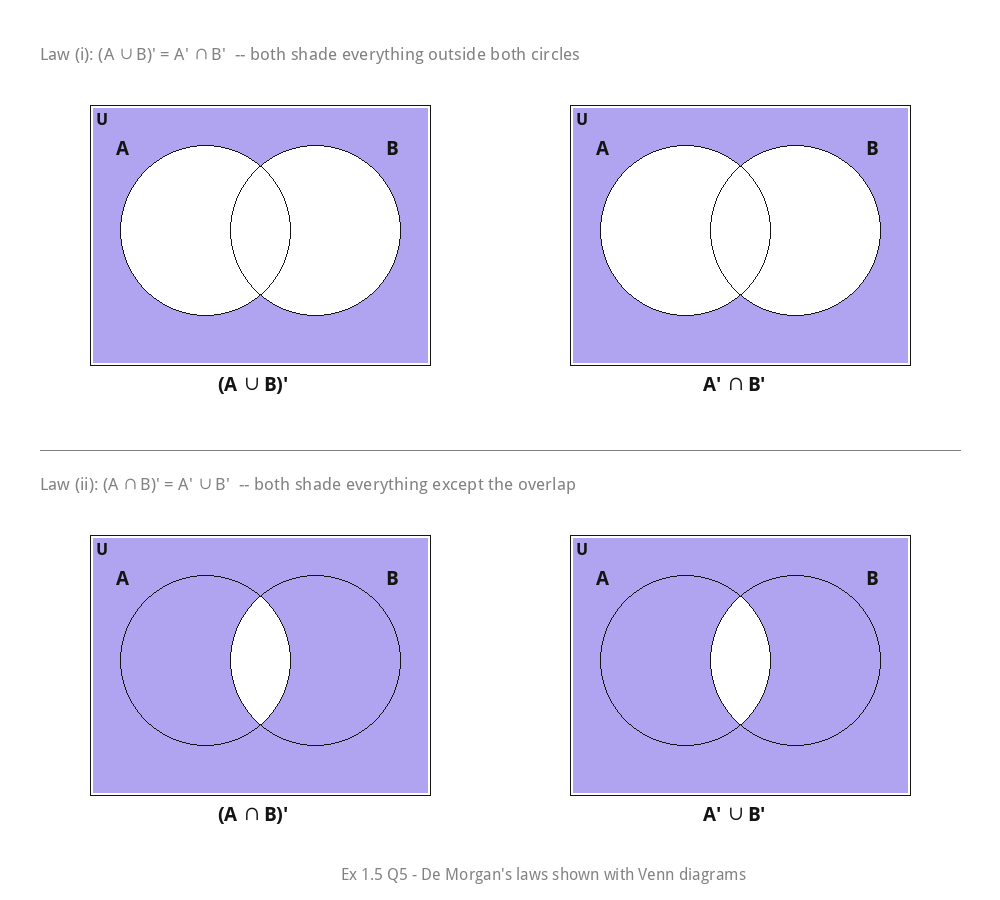
Q5. Draw appropriate Venn diagrams — (A∪B)′ and A′∩B′ shade the same region (outside both circles); (A∩B)′ and…
(A∪B)′ and A′∩B′ shade the same region (outside both circles); (A∩B)′ and A′∪B′ shade the same region (everything except the overlap).
Q6. U=triangles, A=triangles with an angle ≠60°. What is A′? — A′ = equilateral triangles.
A′ = equilateral triangles.
Q7. Fill in the blanks.
- A∪A′=U
- φ′∩A=A
- A∩A′=φ
- U′∩A=φ
Exercise 1.6
Q1. n(X)=17, n(Y)=23, n(X∪Y)=38. Find n(X∩Y) — 38=17+23-n(X∩Y) ⇒ n(X∩Y)=2.
38=17+23-n(X∩Y) ⇒ n(X∩Y)=2.
Q2. n(X∪Y)=18, n(X)=8, n(Y)=15. Find n(X∩Y) — 18=8+15-n(X∩Y) ⇒ n(X∩Y)=5.
18=8+15-n(X∩Y) ⇒ n(X∩Y)=5.
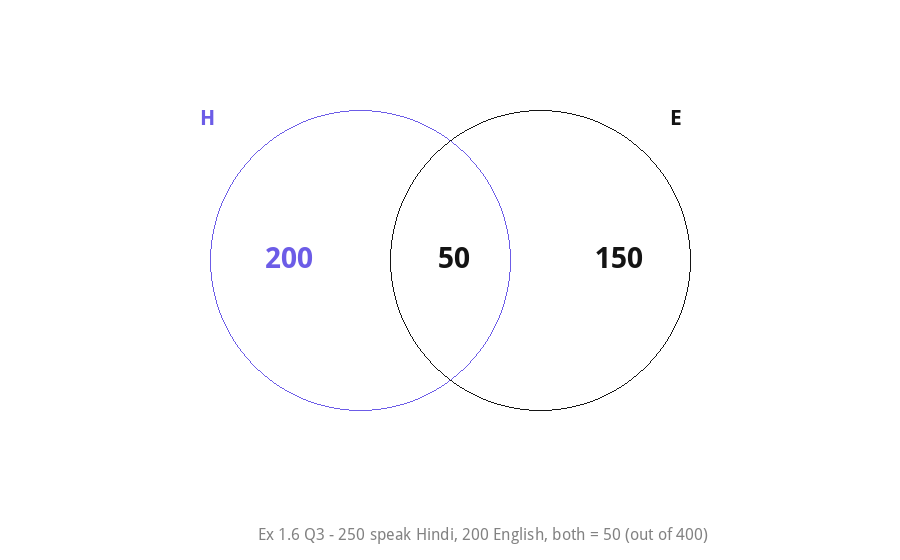
Q3. 400 people: 250 speak Hindi, 200 speak English. How many speak both? — n(H∩E)=250+200-400=50 people.
n(H∩E)=250+200-400=50 people.
Q4. S has 21, T has 32, S∩T has 11. Find n(S∪T) — 21+32-11=42.
21+32-11=42.
Q5. X has 40, X∪Y has 60, X∩Y has 10. Find n(Y) — 60=40+n(Y)-10 ⇒ n(Y)=30.
60=40+n(Y)-10 ⇒ n(Y)=30.
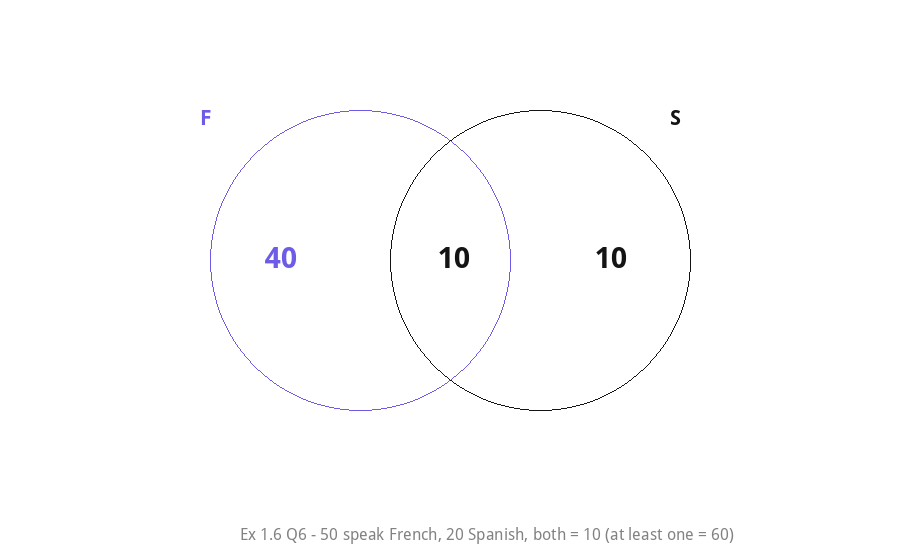
Q6. 50 speak French, 20 Spanish, 10 both. How many speak at least one? — 50+20-10=60 people.
50+20-10=60 people.
Miscellaneous Exercise
Q1. A={x∈R: x²-8x+12=0}, B={2,4,6}, C={2,4,6,8,…}, D={6}. Which are subsets of one another? — A={2,6}. D⊂A, D⊂B, D⊂C, A⊂B, A⊂C, B⊂C.
A={2,6}. D⊂A, D⊂B, D⊂C, A⊂B, A⊂C, B⊂C.
Q2. Decide true/false; prove if true, counter-example if false.
- x∈A, A∈B ⇒ x∈B — False (A={1}, B={{1},2}).
- A⊂B, B∈C ⇒ A∈C — False (A={1},B={1,2},C={{1,2},5}).
- A⊂B, B⊂C ⇒ A⊂C — True (transitivity).
- A⊄B, B⊄C ⇒ A⊄C — False (A={1,2},B={2,3},C={1,2,4}).
- x∈A, A⊄B ⇒ x∈B — False (A={1,2},B={2,3},x=1).
- A⊂B, x∉B ⇒ x∉A — True.
Q3. A∪B=A∪C and A∩B=A∩C. Show B=C — Let x∈B. Then x∈A∪C, so x∈A or x∈C. If x∈A, then x∈A∩B=A∩C, so x∈C.…
Let x∈B. Then x∈A∪C, so x∈A or x∈C. If x∈A, then x∈A∩B=A∩C, so x∈C. Either way x∈C, so B⊂C. By symmetry C⊂B. Hence B=C.
Q4. Show equivalence of: (i) A⊂B (ii) A-B=φ (iii) A∪B=B (iv) A∩B=A — (i)⇒(ii): every element of A is in B, so none is outside B. (ii)⇒(iii): every…
(i)⇒(ii): every element of A is in B, so none is outside B. (ii)⇒(iii): every element of A is already in B, so A∪B=B. (iii)⇒(iv): A⊂A∪B=B so A⊂B, hence A∩B=A. (iv)⇒(i): every element of A is, by definition, also in B.
Q5. If A⊂B, show C-B⊂C-A — Let x∈C-B: x∈C, x∉B. Since A⊂B, if x∈A it would be in B — contradiction. So…
Let x∈C-B: x∈C, x∉B. Since A⊂B, if x∈A it would be in B — contradiction. So x∉A. Hence x∈C-A. C-B⊂C-A.
Q6. P(A)=P(B). Show A=B — A∈P(A)=P(B) ⇒ A⊂B. Similarly B⊂A. Hence A=B.
A∈P(A)=P(B) ⇒ A⊂B. Similarly B⊂A. Hence A=B.
Q7. Is P(A)∪P(B)=P(A∪B) for any sets? — No. A={1},B={2}: P(A∪B)={φ,{1},{2},{1,2}}, but P(A)∪P(B)={φ,{1},{2}} — missing…
No. A={1},B={2}: P(A∪B)={φ,{1},{2},{1,2}}, but P(A)∪P(B)={φ,{1},{2}} — missing {1,2}.
Q8. Show A=(A∩B)∪(A-B) and A∪(B-A)=A∪B — Every element of A is either in B (so in A∩B) or not (so in A-B) — exhaustive,…
Every element of A is either in B (so in A∩B) or not (so in A-B) — exhaustive, mutually exclusive. B-A adds exactly the elements of B not already in A, giving A∪B.
Q9. Show (i) A∪(A∩B)=A (ii) A∩(A∪B)=A — (i) A∩B⊂A always, so union adds nothing new. (ii) A⊂A∪B always, so intersection…
(i) A∩B⊂A always, so union adds nothing new. (ii) A⊂A∪B always, so intersection returns A.
Q10. Show A∩B=A∩C need not imply B=C — A={1,2},B={2,3},C={2,4}: A∩B={2}=A∩C, but B≠C.
A={1,2},B={2,3},C={2,4}: A∩B={2}=A∩C, but B≠C.
Q11. A∩X=B∩X=φ and A∪X=B∪X. Show A=B — A=A∩(A∪X)=A∩(B∪X)=(A∩B)∪(A∩X)=(A∩B)∪φ=A∩B. Similarly B=A∩B. Hence…
A=A∩(A∪X)=A∩(B∪X)=(A∩B)∪(A∩X)=(A∩B)∪φ=A∩B. Similarly B=A∩B. Hence A=B.
Q12. Find A,B,C with A∩B, B∩C, A∩C non-empty but A∩B∩C=φ — A={1,2}, B={2,3}, C={1,3}: A∩B={2}, B∩C={3}, A∩C={1}, but A∩B∩C=φ.
A={1,2}, B={2,3}, C={1,3}: A∩B={2}, B∩C={3}, A∩C={1}, but A∩B∩C=φ.
Related NCERT Content for Class 11 Maths Chapter 1
- Extra Questions (HOTS) for Sets
- Revision Notes for Sets
- Class 11 Maths Formulas Handbook
- Class 11 Maths NCERT Book (Download PDF)
Chapter Quiz — Test Your Understanding
Class 11 Mathematics Chapter 1 – Notes and Extra Questions
Along with these NCERT Solutions, students can also use the Class 11 Mathematics Chapter 1 Extra Questions and Class 11 Mathematics Chapter 1 Revision Notes for quick revision and extra practice.
- Chapter 2: Relations and Functions – Free PDF Download
- Chapter 3: Trigonometric Functions – Free PDF Download
- Chapter 4: Complex Numbers and Quadratic Equations – Free PDF Download
- Chapter 5: Linear Inequalities – Free PDF Download
- Chapter 6: Permutations and Combinations – Free PDF Download
- Chapter 7: Binomial Theorem – Free PDF Download
- Chapter 8: Sequences and Series – Free PDF Download
- Chapter 9: Straight Lines – Free PDF Download
- Chapter 10: Conic Sections – Free PDF Download
- Chapter 11: Introduction to Three Dimensional Geometry – Free PDF Download
- Chapter 12: Limits and Derivatives – Free PDF Download
- Chapter 13: Statistics – Free PDF Download
- Chapter 14: Probability – Free PDF Download
Frequently Asked Questions
Q1. How many exercises are there in Class 11 Maths Chapter 1 Sets as per the 2026-27 syllabus? — Six exercises (1.1-1.6) plus a Miscellaneous Exercise — 57 questions total.
Six exercises (1.1-1.6) plus a Miscellaneous Exercise — 57 questions total.
Q2. Has Chapter 1 Sets been reduced in the rationalised NCERT textbook? — Yes — "Power Set" as a separate topic/question in Ex 1.3 was removed, along with some…
Yes — “Power Set” as a separate topic/question in Ex 1.3 was removed, along with some Ex 1.6 word problems and four Miscellaneous questions.
Q3. Is Sets an important chapter for CBSE Class 11 board exams? — Yes — typically short-answer/MCQ weightage, and its notation underpins Relations &…
Yes — typically short-answer/MCQ weightage, and its notation underpins Relations & Functions and Probability later.
Q4. What is the difference between a subset and a proper subset? — A is a subset of B if every element of A is in B; a proper subset additionally requires…
A is a subset of B if every element of A is in B; a proper subset additionally requires A≠B.
Recommended: Buy the Printed NCERT Class 11 Maths Book
Contains Amazon affiliate links.
If you’d like a printed copy alongside the PDF, here’s a verified option:
4.2 out of 5 stars (953 ratings) · Rs. 170
Price and availability may change on Amazon. As an Amazon Associate, ncertbooks.org earns from qualifying purchases.



Pingback: Class 11 Maths Ch 1 Sets HOTS Questions with Solutions