
Chapter 3 of the Class 7 NCERT Curiosity textbook is titled “Electricity: Circuits and their Components”. It covers electric cells and batteries, bulbs and LEDs, switches, circuit diagrams and symbols, and conductors vs. insulators.
Last Updated: September 23, 2026
Below are original, independently checked solutions to the chapter’s in-text questions, exercise, and key activities.
In-Text Questions
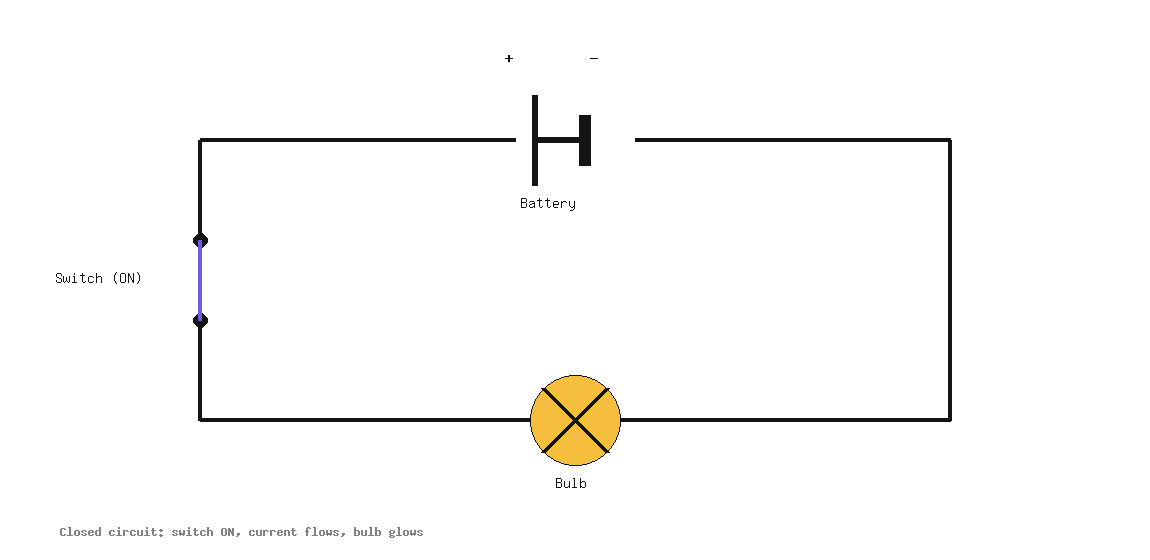
A closed circuit: the switch is ON, so current flows and the bulb glows.
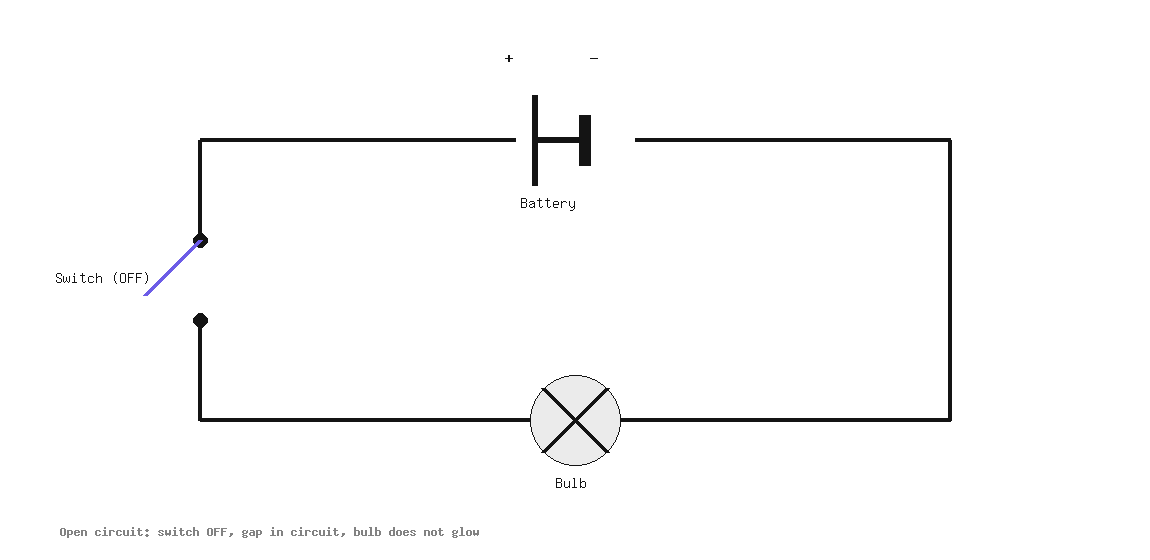
An open circuit: the switch is OFF, creating a gap, so no current flows and the bulb stays off.
Q1. Why does a torch lamp glow only in one position of its switch?
Solution: The lamp glows when the switch is in the ON position because this completes (closes) the circuit, letting current flow through the lamp. In the OFF position, the switch leaves a gap in the circuit (open circuit), so no current can flow and the lamp stays dark.
Q2. In a torch using more than one cell, are the cells placed in a particular order?
Solution: Yes — the cells are placed in series, with the positive terminal of one cell touching the negative terminal of the next. This arrangement adds up the voltage of each cell, giving the lamp enough energy to glow brightly.
Q3. How does a switch turn a torchlight ON or OFF?
Solution: A switch works by opening or closing a small gap in the circuit. In the ON position, the switch’s contacts touch, closing the circuit and allowing current to flow. In the OFF position, the contacts separate, opening the circuit and stopping the current.
Q4. Can a circuit be represented in a simpler way?
Solution: Yes, using standard circuit symbols instead of realistic drawings — for example, a cell/battery is shown as a pair of parallel lines (one long, one short), and a bulb is shown as a circle with an X inside.
Q5. Why is metal wire used for making electric circuits, and could other materials be used instead?
Solution: Metal wires (usually copper) are used because metals are good conductors of electricity, letting current flow through them easily. Materials like rubber or plastic are insulators and don’t allow current to pass, so they cannot be used as the conducting wire itself (though they’re used to coat/insulate the wire).
Q6. Why are electric wires covered with plastic or rubber?
Solution: Plastic and rubber are insulators. Covering wires with them prevents the electric current from escaping the wire, protects people from electric shocks, and stops different wires from accidentally touching each other and causing a short circuit.
Exercise — Let Us Enhance Our Learning
Q1. Choose the incorrect statement: (i) A switch is the source of electric current in a circuit. (ii) A switch helps to complete or break the circuit. (iii) A switch helps us use electricity as needed. (iv) When OFF, there’s an air gap between a switch’s terminals.
Solution: (i) is incorrect. A switch does not generate or supply current — it only opens or closes the path for current that’s supplied by the cell/battery. (Statements ii, iii, and iv correctly describe how a switch works.)
Q2. What kind of material connected between two circuit points would prevent a lamp from glowing?
Solution: Connecting an insulator (such as rubber, plastic, or wood) between the two points would prevent the lamp from glowing, since insulators block the flow of electric current, leaving the circuit effectively open.
Q3. If two lamps are connected end-to-end (in series) and the filament of one breaks, will the other still glow? Justify.
Solution: No, the other lamp will also go out. In a series circuit, current must flow through every component one after another along a single path. If one lamp’s filament breaks, it creates a gap in that single path, interrupting the current for the entire circuit — so neither lamp can glow.
Q4. A student forgot to strip the insulation off the connecting wires while building a circuit. If the lamp and cell both work properly, will the lamp glow?
Solution: No. The insulating covering blocks current from passing between the wire and the component it’s supposed to connect to. Even though the lamp and cell are both functional, current cannot flow through the insulated (uncleared) wire ends, so the circuit remains incomplete and the lamp stays off.
Q5. Suppose a battery’s “+” and “−” symbols are unreadable. How could you identify its two terminals?
Solution: Two simple methods: (1) Connect it to a bulb via a circuit — try both orientations; the bulb lights up (or lights up brighter, for an LED) when connected the correct way. (2) Check the shape — on many standard cells, the flat end is the negative terminal, and the end with the small raised metal cap/bump is the positive terminal.
Q6. You’re given six cells (A–F), some working and some not. Design an activity to identify which are working.
Solution: (i) Items required: a bulb (or LED), connecting wires, and the six cells. (ii) Procedure: connect one cell at a time to the bulb using the wires, forming a simple complete circuit. (iii) Observation: if the bulb glows, that cell is working; if it doesn’t glow (after confirming the bulb and wiring themselves are fine, e.g. by testing with a cell known to work), that cell is not working. Repeat for each of the six cells individually to test them one at a time.
Q7. An LED needs its longer wire (positive terminal) connected to the battery’s positive terminal, and its shorter wire (negative terminal) to the battery’s negative terminal, in order to glow. If these are connected the wrong way round, will the LED glow?
Solution: No — an LED only allows current to flow through it in one direction. If the negative terminal of the LED is connected to the positive terminal of the battery (reversed from the correct arrangement), the LED will not glow. To fix it, the connections must be swapped so that positive meets positive and negative meets negative.
Q8 (Troubleshooting a circuit). A student closes a switch in a circuit, but the lamp doesn’t glow. List possible reasons and how to investigate them.
Solution: Possible reasons: (a) Loose connections — check that all wires are firmly connected to the battery, lamp, and switch. (b) A burnt-out bulb — try replacing the bulb with one known to work. (c) A dead/discharged battery — test the battery separately (e.g. with a different bulb, or a multimeter if available). (d) A faulty switch — temporarily bypass the switch by connecting its two wires directly; if the lamp then glows, the switch itself is the problem.
Activities & Key Data
Activity: Identifying Conductors and Insulators. Testing various everyday objects in a simple circuit (lamp glows = conductor; lamp stays off = insulator) gives:
• Conductors (lamp glows): key (metal), paperclip (metal), copper wire, aluminium foil.
• Insulators (lamp stays off): wooden stick, plastic scale, glass bangle, paper strip, wax candle, rubber eraser, rubber band, glass jar.
This confirms the general rule: metals are good conductors; materials like wood, plastic, glass, paper, wax and rubber are insulators.
Activity: Cells vs. Batteries. A single electric cell is a portable source of electrical energy, with a positive terminal (metal cap) and a negative terminal (flat metal disc). A battery is formed by connecting two or more cells together (typically in series, positive-to-negative), which increases the total energy/voltage available, letting a torch shine longer or brighter.
Activity: Incandescent Lamps vs. LEDs. An incandescent lamp glows via a thin filament that heats up and emits light when current passes through it. An LED (Light Emitting Diode) has no filament, has two terminals (a longer positive lead and a shorter negative lead), and only lights up when connected in the correct direction — unlike an incandescent bulb, which glows regardless of connection direction.
Why This Chapter Matters
Understanding how simple circuits, cells, switches, and conductors/insulators work is the foundation for all later electricity topics (Ohm’s law, series/parallel circuits, electrical safety) taught in Class 8-10 physics.
See also: Class 7 Science NCERT Book (Curiosity) and the Class 7 Science Formulas Handbook.
Related pages: Extra Questions: Class 7 Science Chapter 3 | Revision Notes: Class 7 Science Chapter 3
Chapter Quiz — Test Your Understanding
Class 7 Science Chapter 3 – Notes and Extra Questions
Along with these NCERT Solutions, students can also use the Class 7 Science Chapter 3 Extra Questions and Class 7 Science Chapter 3 Revision Notes for quick revision and extra practice.
- Chapter 1: The Ever-Evolving World of Science - Curiosity
- Chapter 2: Exploring Substances - Acidic, Basic and Neutral - Curiosity
- Chapter 4: The World of Metals and Non-metals - Curiosity
- Chapter 5: Changes Around Us - Physical and Chemical - Curiosity
- Chapter 6: Adolescence - A Stage of Growth and Change - Curiosity
- Chapter 7: Heat Transfer in Nature - Curiosity
- Chapter 8: Measurement of Time and Motion - Curiosity
- Chapter 9: Life Processes in Animals - Curiosity
- Chapter 10: Life Processes in Plants - Curiosity
- Chapter 11: Light: Shadows and Reflections - Curiosity
- Chapter 12: Earth, Moon and the Sun - Curiosity
Frequently Asked Questions
Q: What’s the difference between a cell and a battery?
A: A cell is a single unit that stores/provides electrical energy. A battery is two or more cells connected together (usually in series) to provide more total energy/voltage than a single cell alone.
Q: Why does an LED only work in one direction, unlike a regular bulb?
A: An LED is a type of diode, a component specifically designed to allow current to flow in only one direction; an incandescent bulb’s filament has no such directional restriction, so it glows no matter which way the current flows through it.
Recommended: Buy the Printed NCERT Class 7 Science Book
Contains Amazon affiliate links.
If you’d like a printed copy alongside the PDF, here’s a verified option:
Rs. 130
Price and availability may change on Amazon. As an Amazon Associate, ncertbooks.org earns from qualifying purchases.


